Category: Archive

An archive of published content for media and clients.

  • State Of Decay: Haiti Turns To Free-Market Economics And The UN To Save Itself

    State Of Decay: Haiti Turns To Free-Market Economics And The UN To Save Itself

    By David South

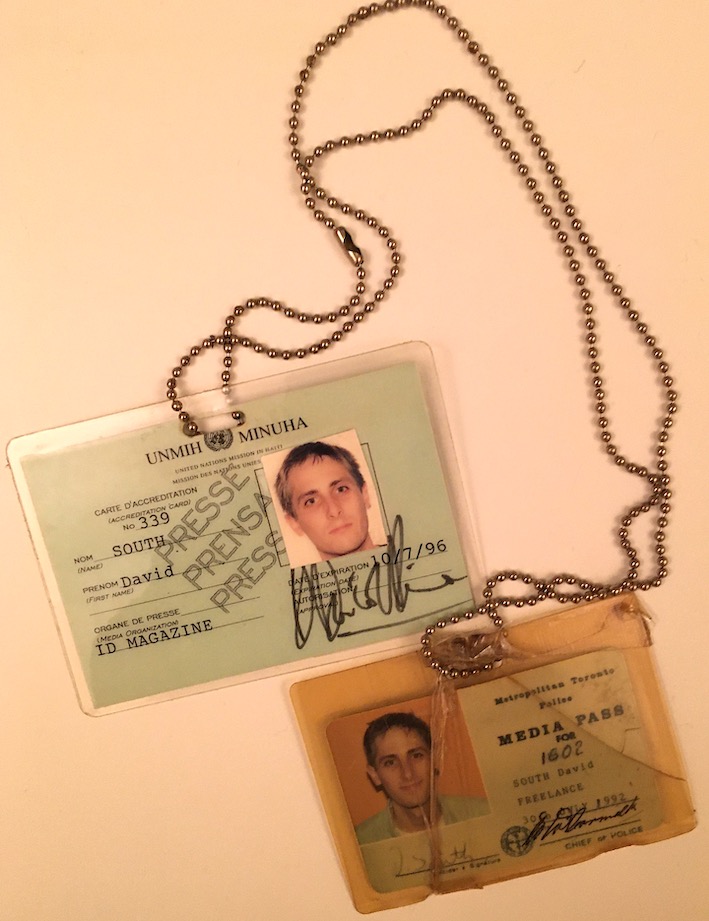
    Id Magazine (Canada), July 11-25, 1996

    Port-au-Prince – Brand-new four-by-four jeeps in various shapes and sizes bounce over the moon-like craters of Port-au-Prince’s roads. The presence of so many expensive vehicles in a country unable to feed all its citizens is hard to take, but it is not one of the worst paradoxes of Haiti.

    The appalling state of the roads – more like occassional stretches of asphalt to break up the monotony of potholes – is an apt symbol of Haiti, a reminder with every jar of the tailbone of the public squalor of the many and the private wealth of the few. The shiny new jeeps are not a sign of recent good times, but reveal who has all the money in this nation of almost seven million: the tiny Haitian elite, thieves, the United Nations and the multitude of non-governmental aid agencies.

    When democratically-elected president Jean-Bertrand Artistide, deposed in a 1991 coup, returned to complete his term in office in 1994, many Haitians hoped that this country would at last begin to shake off centuries of exploitation at the hands of a selfish elite backed by American corporate masters and begin to build a democratic future.

    The United Nations mission in Haiti, which includes 700 Canadian troops, is intended to support the country’s fledgling democracy. But Haiti’s future remains uncertain – as does the role the UN will play in shaping it.

    Despite negotiating a peaceful and democratic transition last February 7 from Aristide – a firebrand former priest and passionate advocate of Haiti’s poor – to successor Rene Garcia Preval, Haiti hasn’t stopped its economic freefall. Economists predict the country won’t match 1991 earning levels until the next century. Political unrest resulting from opposition to the government’s privatization plans could also spell trouble ahead.

    The United Nations presence, due to end June 30, has been extended another five months at the request of the Haitian government. The newly-minted UN Support Mission in Haiti, a military force of 600 UN troops supported by 700 soldiers paid through voluntary contributions, is being assembled. It will replace the current force of 1900.

    Lousy loans

    Meanwhile, the government of Rene Preval is negotiating with the International Monetary Fund (IMF), the World Bank and the United States to get much-needed loans to help balance the budget. Critics say the world’s banks are trying to lock the poorest country in the Western hemisphere further into crippling debt. The Haitian budget is US $750 million, 60 per cent of which the government hopes to raise from loans.

    But there is a condition. Haiti must embark on a structural adjustment programme: widespread firings of the public service, privatization of most of the public sector, loosening of controls over foreign capital, adherance to the ethos of global trading blocks espoused by the North American Free Trade Agreement (NAFTA). Some call this neo-liberalism, others neo-conservatism. Either way, it forces this impoverished country to limit how it can address rebuilding a crumbling infrastructure.

    The government’s hands are tied, though, as the conditions were part of the deal to return Aristide to power.

    A Canadian public relations company, Gervais-Gagnon-Covington Associates, has been paid US $800,000 by the American government to sell the idea of privatization of Haiti’s handful of idle and near-bankrupt state enterprises.

    In order to plunge deep into this Haitian quagmire, I pitch up at the legendary Hotel Oloffson – made famous by novelist Graham Greene in The Comedians – and begin interviewing in the languid atmosphere by the pool.

    “Aristide has put Haitians in a giant trap with the IMF plan,” says Jane Regan, who runs an independent news service based in Port-au-Prince. “The US $1 billion in loans will double the national debt.

    “Haiti used to be self-sufficient in rice – last year they bought US $56 billion in US rice. The roads are worse now than a year ago. Right now the UN mission is of questionable worth and Canadians are getting taken advantage of.  They have been sent to clean up after the Americans. These are the same neo-liberal economic policies that hurt Canadian workers – just imagine what Haitians are feeling!”

    Regan thinks that, so far, the only people to make any money out of this arrangement are businesses and the more than 800 NGOs operating in Haiti. And on that note, the feisty Regan disrobes and plunges into the Hotel’s pool.

    According to Kim Ives, a reporter with the Haitian newspaper Haiti Progres, there are a few cracks in the solidarity between Preval and Aristide: “Aristide is hitting out against privatizations. In a two-hour TV interview, he drew a line between himself and Preval.”

    One of the few visible signs of change in Haiti is the dusty Octobre 15 road leading from the airport past former president Aristide’s palatial home on its way to the wealthy suburb of Petionville. It is bordered on one side by Camp Maple Leaf, and on the other by dilapidated shanty towns and desperate street vendors.

    Cynics point out the road conveniently serves the interests of the elite once again. It offers a direct and more or less pothole-free route from the secluded mansions of Petionville to the airport – a crucial escape route in a politically volatile developing country. In fact, a development of monster homes that would make a Canadian suburbanite blush is going up near the airport to capitalise on this.

    Canadian troops

    Caught between the Haitian government and its people is the United Nations, including Canada’s troops. Canadian troops form the first line of defence – along with Preval’s personal secuity guards – to defend the National Palace. They accompany the president wherever he goes, 24 hours a day.

    Some fear growing resentment among Haitians for government policies will pitch the population against the soldiers.

    At Camp Maple Leaf, the home base of Canada’s military contingent in Haiti, the troops are scrambling to adjust to a new mission sanctioned by the United Nations. As of June 30, they must take a back seat to the troubled Haitian police force as it tries to prove that the intensive training provided by police from around the world has paid off.

    In the first week of July, the Canadian soldiers of the Royal 22nd Regiment – the famous Vandoos  – receive confusing news about a change in their firing orders or Rules of Engagement. ROEs dictate the tone and behaviour of peacekeepers on a UN mission and, as the experience of Somalia demonstrates, they can be the difference between success and disaster.

    As the new mandate starts, the Canadians are first told they will be only able to use deadly force to defend themselves and not Haitians. If a member of the government is assassinated, they must stand by. If a Haitian is clubbed to death before their eyes, they must stand back. It is a qualitative change from their ROEs prior to June 30.

    Ottawa military spokesman Captain Conrad Bellehumour says the change is indicative of an evolving mandate. But a military spokesman in Haiti says the old ROEs are now back in force, and Canadians can intervene to save a Haitian’s life.

    “Maybe somebody’s been listening to Jean-Luc Picard too much,” quips retired Brigadier-General Jim Hanson, in a reference to TV show Star Trek’s prime directive of non-interference in a culture.

    Preval’s police

    A large banner hangs over a Port-au-Prince street: “Police + Population = Securite + Paix”. The UN has placed its greatest emphasis on reforming Haiti’s policing and justice system. The Police Nationale d’Haiti (PNH) was formed, and the RCMP and the American Federal Bureau of Investigation (FBI) were asked to provide training. The idea is to break from the past – when the military used policing as an opportunity to terrorize the population – and establish a police force to serve and protect.

    But the efforts of the Haitians and their international police advisers have had a mixed success. According to Canadian soldiers, the Haitian police need to be coaxed into conducting routine patrols and have not given up patrolling in large numbers in the back of a pick up truck with rifles at the ready. To be fair, seven police officers have been killed since January, in what many believe is an organized campaign of terror orchestrated by sympathizers of the old dictatorship and drug gangs.

    According to Sergeant Serge Martin of the Vandoos, “The PNH use 15 police officers to patrol and don’t talk to anybody.”

    “You don’t depend on police to protect you,” claims Regan. “The Haitian government has no control over them. You don’t know if there is going to be a coup tomorrow.”

    Jean-Yves Urfie, editor of the pro-democracy Libete newspaper in Port-au-Prince, believes the campaign to kill police goes back to the United States. “I am convinced the coup d’etat was financed by the Republican administration. I believe the Republicans want to destroy things here to show (President) Clinton wasted his time bringing Aristide back.

    “The government was forced to incorporate former members of the military into the police force. And it would be terrible if the population develops the impression all cops are bad.”

    “They are 10 years away from a viable police force,” concludes Hanson.

    A stop at the fourth precinct police station shows just how far things still need to go. At the counter is a lone police officer, sharply turned out in his beige shirt and yellow-striped navy pants, courtesy of the Royal Canadian Mounted Police. But this proves to be a veneer of change. Canadian soldiers ask if everything is alright. They then ask to see tonight’s prisoners. The officer sheepishly leads the troops down a narrow corridor to 9 ‘ by 12 ‘ foot cell stuffed with nine prisoners. It is very hot and the stench from an open drain overflowing with sewage is nauseating.

    Outside the Penitencier National in downtown Port-au-Prince, a yellow concrete structure with peeling pain, Haitians lined up to feed the inmates, talk about their frustrations with a justice system that has collapsed. Many complain that only the rich, who can hire lawyers, can enjoy the fruits of democracy. While state-directed beatings and killings have been dramatically reduced, most prisoners rot on remand until they are charged with a crime. Heiner Rosentdahl, the UN representative in Haiti in charge of prison reform, tries to be upbeat. “There have been no changes in conditions in Haiti’s prisons. Treatment of the prisoners is better, though there have been some abuses. We have developed a nation-wide register book of prisoners to help keep track of who is in prison.”

    Another mixed blessing, according to Rosendahl, is the new requirement that all prisoners be fed two meal a day. The food is so poor, prisoners have been getting sick.

    He is frustrated with the pace of penal reform. “The Haitian prison system hasn’t had a budget since October 1995, because of battles within the parliament,” he says. “The Haitian government didn’t ask for a plan to change this situation despite the minister of justice visiting the prison for the first time.”

    According to Rosendahl, it is not the routine killing of thieves by mobs that worries the elite. Nor is it the assassination of police officers, or the untold thousands dying of disease and hunger. The only thing that is beginning to rock their world is a new phenomenon for Haiti: kidnapping and extortion.

    Voodoo economics

    For such a seriously depressed economy, there is an astonishingly large number of lottery booths – or Borlettes – on Haitian streets. They are so plentiful, they join gas stations as the main landmarks of the streets.

    The industrial park which is now home to the remaining American troops stationed in Port-au-Prince, is a good monument to Haiti’s economic problems. Dilapidated and only barely functioning, this facility once supported, directly and indirectly, a large portion of the city’s population. As crummy as the sweatshop jobs were, they provided valuable income for the capital’s poor.

    The Haitian economy under Francois Duvalier and his son, Jean-Claude, before the chaos of the late 1980s and 1990s, was based on assembling manufactured goods for the US market. Haiti was the world’s largest producer of baseballs, and ranked as “top three in the assembly of such diverse products as stuffed toys, dolls and apparel, especially brassieres. All told, the impact of international subcontracting was considerable,” according to author Paul Farmer in his book, The Uses of Haiti.

    Today, Pierre Joseph, a Haitian-American from New York City, has a new job: he screens the ID cards of Haitian workers as they enter the park. He says there were once over 50 factories operating here; now there are 30.

    Evidence of Haiti’s economic collapse is everywhere. On the walls outside the National Palace is scrawled Aba Preval Granhanje – Preval is a liar. Across the wide boulevard in a square are around 75 homeless children. They joke with the Canadian soldiers, especially boyish 2nd Lt. Marc Verret, who looks like a baby in soldiers clothes. The kids beg him for water and money.

    In the market area, the piles of garbage, rotting meat and excrement make a muddy devil’s stew. Homeless children sleep on top of the abandoned crates. One small child is curled up in an American flag, asleep.

    Desecrating dead

    The dead also suffer the indignities of economic ruin. Outside the gates of the Hopital Generale, a man lies dead on a broken trolley in the yard. Others still alive, with limbs missing, are sprawled out on the ground. Chickens and goats roam the grounds. In the back is the main morgue for Port-au-Prince. The odour just 25 feet from the entrance to the morgue is normal for this city strewn with rotting garbage and stewed by a hot sun.

    Inside, an overpowering odour like rotten chicken meat is the product of 450 human cadavers. Like rag dolls laid out in a ghoulish toy store, row upon row of children dead from starvation and disease – Haiti’s infant mortality rate is 127 per 1,000 babies born – are stacked almost to the ceiling. There are also adults. Old women, young men badly mutilated for stealing, are strewn out on the dirty concrete floor and on shelves.

    There is no refrigeration, and according to military doctor Major Tim Cook, “something really nasty is going to come out of there if they don’t do something.”

    Proving peacekeeping

    More is at stake in Haiti than the re-building of a politically and economically devastated nation. For Canada’s armed forces, shaken and little stirred by the Somalia scandal, it is an opportunity to make amends. This time around, the peacekeepers are keeping the needs of the local population foremost in their gun sights. When the Vandoos head out on another one of their 24-hour patrols, the atmosphere is friendly and filled with gentle ribbing with the locals. They have the advantage of being able to speak French, a language understood to varying degrees by most of the population.

    The approach of the individual soldiers varies widely. On a routine patrol, Alpha Company engaged in good-natured kidding around, with splashing the locals the worst offence. But a day out with Charlie Company, led by Sergeant Serge Martin, proved another story. The two privates assigned to accompany a group of journalists were a couple of operators. The day included a visit to a perfume shop, a trip through the wharf area looking for prostitutes and constant propositioning of the local women.

    One Canadian corporal with the Vandoos, Eric Charbonneau, has been trying to make a small difference to the lives of the 400 people living in the community of Cazeau, a shanty town near the international airport. He has started literacy and hygiene lessons and raised money to help the residents build concrete houses to replace the mud dwellings they currently inhabit.

    “I was walking along the fence and started to build a relationship with the kids,” he explains. “Some guy approached me and needed some help. It took three weeks to build a relationship. They are too used to white people giving away things for doing nothing. They were surprised when they had to work for it.”

    At the gates to Camp Maple Leaf is a spray-painted sign. In Creole, French and English beside a Canadian flag, it says “No More Jobs.” While it could look at home back in Canada, it illustrates how important the presence of soldiers, the United Nations and charities are right now to the economy.

    Some observers see the UN presence as part of a slide back into dependency on foreign money, restricting Haiti’s ability to assert itself. But others believe the turn to the international community is Haiti’s last hope of breaking with a past littered with dictatorships and poverty.

    According to Captain Roberto Blizzard – an erudite and wise observer of the situation – the base has been stampeded with desperate Haitians looking for work. Blizzard has tried to find work for as many Haitians as he can, even helping them to form a laundry co-operative he hopes will survive long past the Canadians’ stay.

    “There is a danger of the Haitian people turning into full-time beggars,” he says with sadness.

    Further reading:

    Failed States and Institutional Decay: Understanding Instability and Poverty in the Developing World by Natasha M. Ezrow and Erica Frantz, Bloomsbury Academic, 18 July 2013.

    Towards a taxonomy of failed states in the New World Order: decaying Somalia, Liberia, Rwanda and Haiti by Jean-Germain Gros, Third World Quarterly, Vol. 17 No. 3 September 1996 Section 5 Page 455

    https://davidsouthconsulting.org/2021/10/28/ending-gang-violence-while-cleaning-the-streets-in-haiti/

    https://davidsouthconsulting.org/2021/09/01/haiti-earthquake-prompts-tech-aid/

    https://davidsouthconsulting.org/2021/01/08/haitian-coffee-becoming-a-hit-with-american-connoisseurs/

    https://davidsouthconsulting.org/2021/10/28/milk-co-operatives-help-hungry-haiti/

    https://davidsouthconsulting.org/2022/09/23/opinion-canada-is-allowing-u-s-to-dictate-haitis-renewal-more-news-and-opinion-on-what-the-un-soldiers-call-the-haitian-vacation/

    https://davidsouthconsulting.org/2021/01/26/u-s-elections-update-clinton-is-using-canada-to-keep-control-of-haiti/

    Creative Commons License

    This work is licensed under a
    Creative Commons Attribution-Noncommercial-No Derivative Works 3.0 License.

    ORCID iD: https://orcid.org/0000-0001-5311-1052.

    © David South Consulting 2025

  • Artists Fear Indifference From Megacity

    Artists Fear Indifference From Megacity

    The Annex Gleaner (Toronto, Canada), February 1997

    The Harris government’s proposed megacity is stirring up fear, rumour and speculation in many quarters, and no group is more worried than Toronto’s artists.

    The merger of Toronto into a new megacity will place arts funding in jeopardy. Toronto’s generous contributions to the arts far exceed those of any other municipality in the region, meaning the city’s artists could be devastated if Toronto receives only a sixth of a new mega arts budget.

    Currently, Annex-based artists and arts groups can turn to two levels of municipal funding: the City of Toronto and Metro Toronto.

    Even at the Metro level, Toronto artists receive the bulk of arts funding, and a healthy share of that money goes to individuals and groups based in the Annex.

    Alas, the Annex’s vibrant milieu of resident artists, festivals and respected institutions is small comfort to many arts supporters who fear the indifference of politicians from the satellite cities and the cost-cutting measures of the Tories.

    They worry because the budget of the Toronto Arts Council, which will be eliminated under amalgamation, far exceeds the contributions to the arts made by the surrounding cities. In 1996, Toronto’s arts budget was $4.7 million, compared to $325,905 for the five other Metro municipalities combined.

    Many fear Toronto’s superior cultural activities will simply be overlooked by philistine councillors from Metro’s satellite cities.

    Tarragon Theatre general manager Mallory Gilbert, a former resident of Detroit who witnessed first-hand that city’s decline, worries Toronto could go the same way.

    “Once you get a population that doesn’t work or entertain downtown, they will just want an expressway through the city.”

    As Gilbert sees it, those voters who never patronize the arts in downtown Toronto are going to pressure politicians not to fund them. Gilbert also worries that suburban councillors will demand quotas to ensure arts funding is redirected away from downtown Toronto.

    Anne Bermonte, associate director for the Toronto Arts Council, also fears downtown artists will be lost in the megacity abyss.

    “The political make-up will resemble Metro rather than Toronto – the councillors who realize the arts accrue benefits will be out-voted.”

    Not surprisingly, officials at Metro don’t think downtown will be neglected. John Elvidge, cultural affairs officer at Metro Parks and Culture, doesn’t believe suburban politicians will pull money out of the core of the city. He says this never happened in the past and sees no reason why it would in the future.

    “The 28 councillors from the geographic area understand the core of arts is in the downtown. Look at our almost 40-year-funding history: 90 per cent is based in Toronto organizations. If you are a councillor in Etobicoke, you know people go downtown. (North York councillor) Howard Moscoe is the biggest supporter of the arts.”

    Statistics show the Annex has a strong competitive advantage over other areas when it comes to receiving arts grants. Bermonte estimates the Annex area currently receives close to $400,000 in grants in the course of a year, from both Metro and Toronto. While half of the Metro culture budget goes to the “big four” (the Toronto Symphony, the Art Gallery of Ontario, the National Ballet and the Canadian Opera Company), the Annex receives 10 per cent of the remaining $3 million, estimates Elvidge. Out of the combined Metro and Toronto budgets of $10.7 million, the Annex receives just under five per cent. All for a population of 36,000.

    “There are a lot of artists who live in the Annex area,” says Bermonte. “And the Annex enjoys the economic impact of the presence of those activities. If the Fringe disappeared, there wouldn’t be the animation in the area.”

    Unfortunately for artists, the past five years have seen shrinking arts budgets at all levels of government.

    While TAC has held on to its current funding level since 1994, Bermonte is worried this could change. TAC’s highest funding level was in 1991, when the board received $5.5 million. Metro has seen its budget drop from $7.5 million in 1993 to today’s $6 million. Both budgets are up for review, with Metro’s expected to drop by a further five per cent.

    If the megacity goes through, Bermonte hopes the new municipality will commit to arts funding levels appropriate for a modern, cultured city. She points out that London, England spends $30 million, while Berlin, Germany spends $930 million on culture.

    As Gilbert says, if the arts aren’t funded, the Annex will become less interesting to the many notables living here, such as writers Margaret Atwood, Rick Salutin, Judith Thompson, Stuart Ross and MT Kelly.

    Deputations will take place at City Hall on Feb. 17 to defend the Toronto Arts Council’s 1997 budget.

    Creative Commons License

    This work is licensed under a
    Creative Commons Attribution-Noncommercial-No Derivative Works 3.0 License.

    ORCID iD: https://orcid.org/0000-0001-5311-1052.

    © David South Consulting 2021

  • Will The Megacity Mean Mega-Privatization?

    Will The Megacity Mean Mega-Privatization?

    Annex Gleaner (Toronto, Canada), March 1997

    As the provincial government tries to shoehorn six municipalities into one megacity, opponents of the plan worry that one of the results of amalgamation will be widespread privatization of public services.

    References to contracting out and tendering municipal services in order to achieve savings run through the provincial government’s much-maligned report supporting a megacity, produced by consultants KPMG.

    Many observers feel the new city will have no choice, while others argue privatization won’t be nearly as extensive as some fear. Still others think it is far from a foregone conclusion that a future amalgamated council will push privatization.

    “Who knows if the council will have an interest in privatization?” says a senior bureaucrat at the City of Toronto, who did not want to go on record. “People are running around saying they will privatize everything, but who knows what the political make-up will be of the new council? They are assuming there will always be savings to be had from privatization – that doesn’t automatically follow. The financial pressures on the megacity can’t be avoided by privatization.”

    Among the six current Metro municipalities, it is Etobicoke that has most fully embraced contracting out. The City of Etobicoke’s experiments with contracting out – 60 per cent of public works contracts are performed by private-sector companies – calls into question the estimates of substantial savings being bandied about by the provincial government.

    According to the senior bureaucrat in charge of running that city, acting city manager and commissioner of public works Tom Denes, contracting out isn’t the tax-saving nirvana some believe.

    “I think we are finding in contracting out,” says Denes, “that the higher the skills of the workforce, the less sense it makes to contract out. For example, it would be very expensive to contract out water treatment.”

    Denes says the city’s pride and joy is its privatized garbage collection handled by Waste Management Inc. and BFI. The WMI contract is worth $6 million a year, down from the $7.5 million a year it was costing to publicly run garbage collection. The price is fixed for five years, when it must be negotiated again. While the city made $1.9 million selling its old trucks, councillors set up a $4 million fund so Etobicoke could go back to collecting garbage itself if private companies tried to gouge the city.

    Denes, who has been meeting with counterparts at other cities and the provincial government, believes the new Toronto will be divided up into several districts which private garbage collectors will have to compete for.

    “Based on what I know, if you were to divide the city up into waste contracts, it would be at least four areas,” claims Denes. “No company can handle the whole city. You just can’t find a company that could handle a megacity. It would become a monopoly.”

    Denes thinks the likely suspects for contracting out would be any manual labour work and the TTC. He thinks a megacity would be mistaken to contract out skilled work like surveying, arguing that skilled workers would use their desirability to their advantage and charge high consulting fees.

    “The US cities have all gone through these exercises. They are in fact contracting services back in,” says Denes.

    While the Tories have been slipperier than a scoop of ice cream about their specific privatization plans, one thing is clear: An essential element of the Tory economic vision is a greater role for the private sector in delivering public services. The $100,000 KPMG report plays to this, making it clear contracting out is a key means to saving money in the new megacity. The report claims between $28 million and $43 million per year could be saved from contracting out computer operations and some management; between $38.5 million and $68 million by contracting out fraud investigations; between $29.6 million and $54.5 million by contracting out road and electrical maintenance, snow removal and data collection; between $21 million and $39.4 million by contracting out garbage pick-up and processing.

    The report also offers this proviso: “There is no such thing as automatic, cost-free savings from organizational change. The implementation process must be tightly managed to produce the savings suggested here.”

    Ron Moreau is the administrator for Local 43 of the Metro Toronto Civic Employees Union, which represents over 3,000 public works workers and ambulance drivers at Metro.

    “How will the megacity and municipalities cope with pressure from the public to hold the line on taxes? Where will councils find the difference between spending and revenues?” asks Moreau. “The level of service will suffer. When you contract out, public policy is held hostage by private enterpise.”

    Moreau threatens that labour will play hardball with the new city. Most of the contracts for Moreau’s members run out on Dec. 31 of this year.

    “Assuming the government doesn’t tamper with the labour legislation on our books, the unions can be organized into two large locals, one clerical/technical, the other outside workers. They would have effective bargaining clout.”

    One major player looking for government contracts in a megacity will be Laidlaw Inc. While the company recently sold its garbage collection operations to an American firm, USA Waste, it still has interests in operating school buses and ambulances. Laidlaw is a heavy contributor to the Ontario Progressive Conservative Party, according to records kept by the Commission on Election Financing. Laidlaw has also made an influential new friend: in January, it hired former Metro chief administrative officer Bob Richards as its vice-president.

    Ward 13 city councillor John Adams is definitely in the privatization-if-necessary-but-not-necessarily-privatization camp. “I don’t see everything being contracted out, but more stuff being put out for competitive bids.”

    Adams thinks contracting out could be a good tactic to help modernize garbage collection, for example. He points to the City of Toronto’s deal with WMI to collect garbage at apartment buildings. In that deal, costs were reduced by $2.5 million over a five-year contract, and the crews on trucks were reduced from two to one. Instead of an extra crew member, closed-circuit television cameras were installed on trucks to speed up pick-up. Adams points out the crews are still unionized, but instead of CUPE it is the Teamsters.

    “The way we pick up garbage from households is back-breakingly stupid. I think we need to rethink how we do it, to use machines more than people’s backs.”

    But Adams doesn’t believe a megacity is a money-saver. “There will be a leveling up of wages. How long will two firefighters work side-by-side for different salaries? You can bet the union will negotiate an increase at the first opportunity.”

    Adams thinks a megacity will be more prone to the slick lobbying efforts of companies like Laidlaw because councillors will be dependent on political parties to get elected. “The provincial government will contract out municipal government to Laidlaw,” he says sarcastically.

    More on megacities:

    African Megacity Makeovers Tackle Rising Populations

    Artists Fear Indifference From Megacity

    Cities For All Shows How The World’s Poor Are Building Ties Across The Global South

    Global South’s Rising Megacities Challenge Idea of Urban Living

    Safety At Stake

    Southern Innovator Issue 4

    David South Consulting business card
    In 2010, David South Consulting was relaunched with a new logo and branding for the 21st century. It represented a new phase, as work became global and very high-profile and influential. The foundations have been laid for future growth and expansion.
    Creative Commons License

    This work is licensed under a
    Creative Commons Attribution-Noncommercial-No Derivative Works 3.0 License.

    ORCID iD: https://orcid.org/0000-0001-5311-1052.

    © David South Consulting 2021

  • Take Two Big Doses Of Humanity And Call Me In The Morning

    Take Two Big Doses Of Humanity And Call Me In The Morning

    By David South

    The Toronto Star (Toronto, Canada), January 1, 1993

    “Anybody going into medicine should read a whole bunch of good novels.” Dr. Alvin Newman isn’t kidding. The head of curriculum renewal at the largest English-speaking medical school in the world, the University of Toronto, feels strongly that doctors have been ill-prepared for their profession’s challenges.

    How doctors become doctors is being hotly debated as Ontario’s five medical schools institute a potpourri of curriculum reforms. After a century of taking a back seat to scientific achievement, bedside manners and the art of medicine are in vogue again.

    “Around the world, medical education is undergoing significant changes,” says Newman. “Medical schools must strike a balance between the incredible explosion of scientific knowledge and re-establish the role of the physician as wise counsel and empathic healer.”

    It’s a role that many feel doctors have ignored. An American Medical Association poll, conducted between 1985 and 1988, found that fewer than 50 per cent of respondents said they thought doctors listened well and half believed doctors no longer care as much about patients as they used to.

    In response to these criticisms, current reforms are shifting medical education away from reliance on the turn-of-the-century science-based approach, says Professor Jackie Duffin, a medical historian at Queen’s University who helped organize the new curriculum introduced there in 1991.

    “In the old days doctors could probably make a diagnosis and tell people what was happening to them, but not do very much for them,” says Newman.

    “Yet society had more trust and fondness for physicians than they do now. Much of the condemnation of the medical profession is because we have become the custodians of high-tech medicine.”

    While the Ontario government embarks on the most sweeping reforms to health care since the 1966 introduction of comprehensive health insurance in Ontario and the founding of national medicare in 1968, many doctors feel their profession cannot afford to maintain the status quo.

    The concensus at Ontario’s five medical schools – U of T, Queen’s, University of Western Ontario, University of Ottawa and McMaster University – has gelled around a belief that doctors need to be as comfortable dealing with people as they are with scientific medicine. To this end, revamped curricula supplement basic science and clinical medicine with emphasis on early exposure to patients, communication skills, psychological issues, medical ethics, medical literacy and health promotion.

    These schools hope to produce new doctors to fit into a rapidly-changing health care system – one that many believe will rely far less on large hospitals.

    Instead, many procedures will take place in the home or in the day clinics. Expanding community health care care centres will try to tackle extensive social and health problems. This preventive approach ot medical education was pioneered by Hamilton’s McMaster medical school.

    Since its founding in 1967, McMaster has experimented with teaching methods that steer away from mass lectures to concentrate on the individual student. The evolution of McMaster’s curriculum has placed greater emphasis on communication skills, psychosocial aspects of medicine, community issues, and disease prevention and health promotion.

    How do McMaster students rate against other medical students?

    Last year they scored above the national average on licencing exams. A higher proportion of McMaster students enter research and academic medicine than their counterparts from other schools. One study comparing them to U of T suggested they were more motivated to be life-long learners.

    Dr. Rosana Pellizzari practices the kind of medicine everyone is talking about these days. Working out of renovated church, Pellizzari’s practice at the Davenport/Perth Community Health Centre in west end Toronto serves a working class neighbourhood that has been home to generations of recent immigrants.

    A member of the Medical Reform Group – which has long advocated significant reforms to health care – and trained at McMaster, Pellizzari can be seen to represent the doctor of the future: Sensitive, salaried and working in community health.

    “McMaster’s curriculum attracts people with innovative ideas,” says Pellizzari, who was active in community health education before going to medical school. “It is a very supportive environment.

    “I think the important question is: Who do we choose to be medical students? They should open up medical schools to those who know what it’s like to be a parent, a mother or disabled. Doctors should represent the population they serve. We are still getting mostly white, inexperienced young males as physicians. They aren’t going to practice the way that is necessary.”

    In Ontario, many doctors see the 1986 doctors’ strike as a watershed for public opinion.

    As a result of the negative fallout from the strike and perceived gap between physicians andhe public they serve, a five-year project entitled Educating Future Physicians for Ontario became a major advocate for reform.

    Started in 1988, EFPO has examined fundamental issues in designing and implementing new medical school curricula. These issues include defining societal health care needs and expectations, faculty development and student evaluation. While each medical school has adapted reforms to its particular situation, EFPO hopes to prod further reforms.

    “This is a unique venture in Canada, and could have implications far beyond Ontario if successful,” says Dr. William Seidelman, a key player in EFPO. “It captures the unique sense of the Canadian scene, and will build on the implied contact in the Canadian health system.”

    Pellizzari sees the attitude of medical schools and teaching hospitals towards medical students as a significant factor in creating insensitive doctors. She recalls the high rate of suicide among medical students and the abusive work environment that forces doctors-in-training to work shifts unthinkable for other workers.

    “The way we train doctors is inhumane,” she says. “We don’t expect other workers to put in 30-hour shifts. It creates in new physicians the attitude that they paid their dues and now society owes them.”

    Many critics feel that changing training methods isn’t enough; the whole ethos and selection process must be changed. If doctors are to better serve the population, they must better reflect it.

    “We are getting very close to gender equality and a laudable distribution of ethnic and racial backgrounds,” says Newman. “But students still come from a fairly narrow social spectrum,  very middle class kids. Their exposure to the extremes of society, to poverty, to homelessness and related illnesses have been very limited.”

    Pellizzari found how out-of-date the medical profession was in her first year. One teacher wanted her to work till 10 at night. When told that she needed 24 hours notice for a babysitter, the teacher shot back that motherhood and medicine don’t mix.

    “I was a mother before I was a physician. When I get a call at night from a mother, I understand this. With 30 per cent of visits to doctors having no biological basis – like depression due to unemployment – you can’t do anything unless you have experienced life.

    “If we don’t address this, you can design the best training in the world, but things won’t change.”

    But Newman also feels many factors outside of medical school discourage a more diverse student body.

    “To go through medical school in the United States requires large indebtedness. That’s not true in Canada. You can calculate what a year of medical school costs in terms of a finite number of CDs, a leather jacket and ghetto blaster. So something is dissuading people from pursuing this career, and it isn’t money.”

    While there is a concensus among academics that medical schools haven’t prepared doctors well enough, there is little support for a dramatic change in selection criteria. “I can’t muster a lot of support from colleagues for serious changes,” says Newman.

    Dr. Jock Murray, the former dean of Dalhousie medical school in Halifax, recently told an EFPO meeting he doesn’t see any significant changes ahead.

    “Physicians have a reputation for being conservative and self-serving,” says Murray. “If reform is going to be successful we have to be clear that it is about what is good for the people.”

    Pellizzari believes life experience and empathy with social circumstances just can’t be taught.

    “I grew up in this neighbourhood. I understand their powerlessness, the conditions. Doctors have to see themselves as a member of a team of health professionals, not as the top of the social and medical totem pole.”

    U of T’s experience is a classic example of the hurdles ahead. Newman admits it has come as a shock to students loaded with society’s ingrained expectations.

    “They spend half a day a week in the community seeing things like drug rehab clinics and community health centres. But being out in the community doesn’t make the students feel comfortable. Their image of what they are going to do involves big buildings, chrome and steel, scurrying personnel and banks of computers.”

    This work is licensed under a Creative Commons Attribution 4.0 International License.

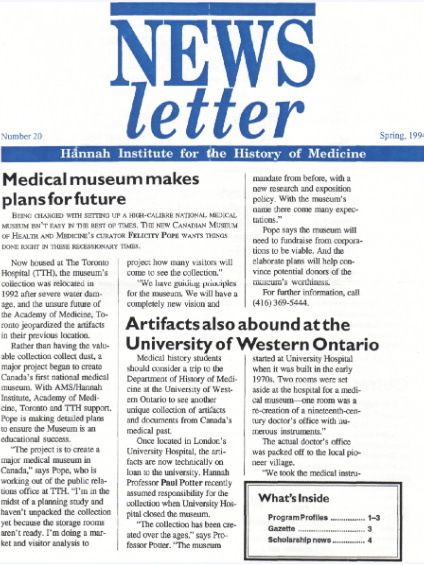
    “… in recent years it has become a pursuit for a growing number of researchers. … Behind much of this growth has been the Hannah Institute for the History of Medicine …” 

    Read more about Canadian innovation in healthcare delivery here: Taking Medicine To The People: Four Innovators In Community Health

    Read more on my work promoting Canadian medical history scholarship here: Hannah Institute For The History Of Medicine | 1992 – 1994

    Read more on my work leading on innovation and modernisation in the UK’s NHS here: CASE STUDY 5: GOSH/ICH Child Health Portal | 2001 – 2003

    ORCID iD: https://orcid.org/0000-0001-5311-1052.

    © David South Consulting 2021