Drones – unpiloted aircraft, formally called Unmanned Aerial Vehicles (UAV) or Unmanned Aircraft Systems (UAS) – have long been used for military purposes. The U.S. military claims to have 7,500 drones – a massive growth from just 50 a decade ago – and has used them for surveillance and combat in conflicts from Afghanistan to Iraq.
Drones can cost anywhere between a few thousand and millions of dollars depending on their size and sophistication. Some weigh as little as half a kilogram, and the largest can reach 18,000 kilograms (19 tons).
It is estimated 40 countries around the world are working on drones in one capacity or another.
Military drones come with ominous-sounding names such as Predator, Fire Scout, Global Hawk and Hunter. But many pioneers and innovators are setting out to prove drones can be a technology of peace and development and not just of fear and war.
In Shanghai, the InCake bakery has used drones to deliver cakes (http://www.youtube.com/watch?v=fXwgwSkujOY). The service was brought to a halt after complaints from citizens, worried the drone would crash into someone.
These may prove to be novelty experiments – or the early days of a revolution. Time will tell.
But serious thinking about drones is taking place in the area of development.
One pioneering company thinks it has a solution for two big problems common to many developing countries: the chaos, congestion and crowding that clog urban areas; and the poor or non-existent infrastructure in rural areas. Both problems make it expensive and time-consuming to move goods around.
A billion people in the world do not have access to all-weather roads, says the World Bank. Some roads are being upgraded in parts of sub-Saharan Africa but many are in worse shape than they were decades ago. Modern infrastructure is expensive to build, and the funds to do it often must be borrowed.
A startup called Matternet thinks it has the solution to getting around this problem in Africa, and in rapidly growing cities of the global South. It believes drones can come to the rescue where infrastructure is poor or non-existent, and save valuable wealth that can be diverted to real improvements in human development, or used to reduce congestion in crowded urban areas.
The Matternet (http://matternet.us/) is billed as “the next paradigm for transportation.” Matternet is offering a system and a concept for deploying drones as a scalable solution to overcome the problem of poor transportation networks in developing countries.
The artist’s vision on Matternet’s website shows drones buzzing their way through an urban high-rise landscape as they go about their business.
The Matternet drone design has two wings with three fans in each wing to allow it to take off and land vertically as well as flying in a straight line. There is a 10 litre space for packages and a rechargeable battery at the bottom of the drone. The drones can fly at 40 kilometres an hour, at an altitude of up to 121 metres and are guided by GPS (Global Positioning System) (http://en.wikipedia.org/wiki/Global_Positioning_System).
The drone moves in and out of a ground-station landing pod, where it is recharged, picks up new packages to deliver, and connects electronically to receive instructions. An entry and exit slot sits on top of the pod while there is a place at ground level for people to pop in packages for delivery.
Each vehicle costs US $1,000 and can last 10 years, the makers claim. Matternet believes the drones could transport 2 kilograms over 10 kilometres for just 24 US cents a trip.
Matternet’s Andreas Raptopoulos (https://www.solveforx.com/moonshots/physical-transport) hopes to push Africa away from simply upgrading its infrastructure along the lines of what is already in existence in developed countries. It is estimated it will take Africa another 50 years to have an infrastructure equal to North America. But why wait so long? Why not, he argues, just use drones or UAVs to knit a transport infrastructure criss-crossing the continent delivering goods and services to people?
Radical drone advocates like Matternet are very ambitious. They believe drones are to infrastructure what mobile phones have been to telecommunications: an advanced, 21st-century technology that enables countries to leapfrog ahead of old-school 20th century infrastructure and connect people up for much less cost and effort.
Imagine a city in the global South 15 years from now: canyons of high-rise buildings stretch from the central business district out to the suburbs where apartment towers replace office buildings. And whooshing through these canyons will be the drones carrying everything from takeaway food to medical supplies to the latest fashion items.
Anywhere in Africa can currently contact Matternet to arrange a trial of the technology (http://matternet.us/get-matternet/). The concept had field trials in the Dominican Republic and Haiti in the Caribbean. A large field test trial is being arranged for Lesotho, where the drones will help with delivering supplies to clinics serving patients with HIV/AIDS. The 47 clinics are spread out over a 138 square kilometre area and will be served by 50 ground stations and 150 drones at a cost of US $900,000. In comparison, building 2 kilometres of a single lane road would cost US $1 million.
Matternet is based in Palo Alto, California and founded by partners Andreas Raptopoulos, Paola Santana, Dimitar Pachlov and Darlene Damm.
It was conceived at the Singularity University (http://singularityu.org/) whose mission is to educate, inspire and empower leaders to apply exponential technologies to address humanity’s grand challenges.
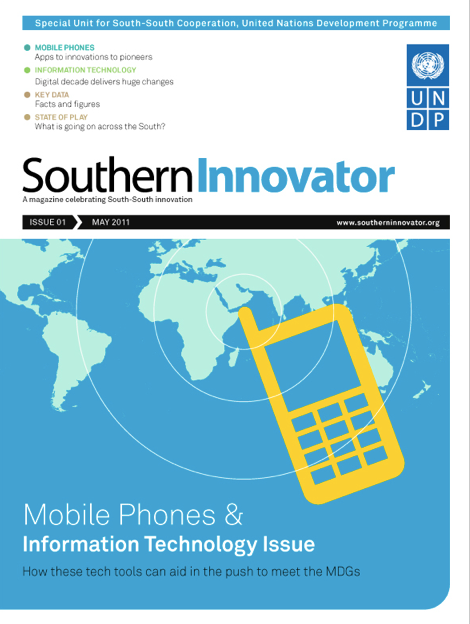
Development Challenges, South-South Solutions was launched as an e-newsletter in 2006 by UNDP’s South-South Cooperation Unit (now the United Nations Office for South-South Cooperation) based in New York, USA. It led on profiling the rise of the global South as an economic powerhouse and was one of the first regular publications to champion the global South’s innovators, entrepreneurs, and pioneers. It tracked the key trends that are now so profoundly reshaping how development is seen and done. This includes the rapid take-up of mobile phones and information technology in the global South (as profiled in the first issue of magazine Southern Innovator), the move to becoming a majority urban world, a growing global innovator culture, and the plethora of solutions being developed in the global South to tackle its problems and improve living conditions and boost human development. The success of the e-newsletter led to the launch of the magazine Southern Innovator.
Where social activists have tried and failed to get Canadian corporations to change their behaviour towards the environment, labour, women and minorities, EthicScan Canada – a for-profit consulting and research firm – steps in.
Toronto-based EthicScan acts as a consultant on ethical issues to both government and private businesses and produces a guide for investors. Its latest project hit the bookstores last fall. The Ethical Shopper’s Guide to Supermarket Products rates products according to companies’ ethical performance. “EthicScan is the only company in Canada doing this,” says senior writer Joan Helsen. “Companies respond to us differently because we are – like them – a business. We have a very good reputation for doing strong research and presenting the facts.”
Non-profit groups have produced similar guides. In the US, perhaps the best known is the American Council on Economic Priorities’ Shopping for a Better World. Here in Canada, both Pollution Probe’s Green Consumer Guide and the Ontario Public Interest Research Group’s The Supermarket Tour offer educational information.
But The Ethical Shopper’s Guide is the first guide in Canada to give a product-by-product breakdown, and to detail the web of corporate ownership. It lists more than 1,200 brand-name products from baby food to soft drinks, with the manufacturer’s “grade” for each ethical category. The guide also profiles 87 companies, with an “honour roll” of 37 corporations.
All of this can be confusing. Oxo gets an F for “women’s issues” and F+ for “environmental management,” but scores A+ on “progressive staff policies” and “environmental performance.” (Apparently. “environmental management” has to do with company structures for dealing with environmental issues while “environmental performance” measures how much it actually pollutes.) What aspect of Oxo’s ethical behaviour do you reward or punish?
EthicScan’s approach fits current advertising trends. Nissan tells us it is just trying to build cars we can live with. Loblaws puts “Green” on everything from plastic garbage bags to tubes of shampoo. But once idea-starved ad copywriters move on to the next gimmick, EthicScan may find that the relationship between ethics and profit isn’t as straightforward as its grading system suggests.
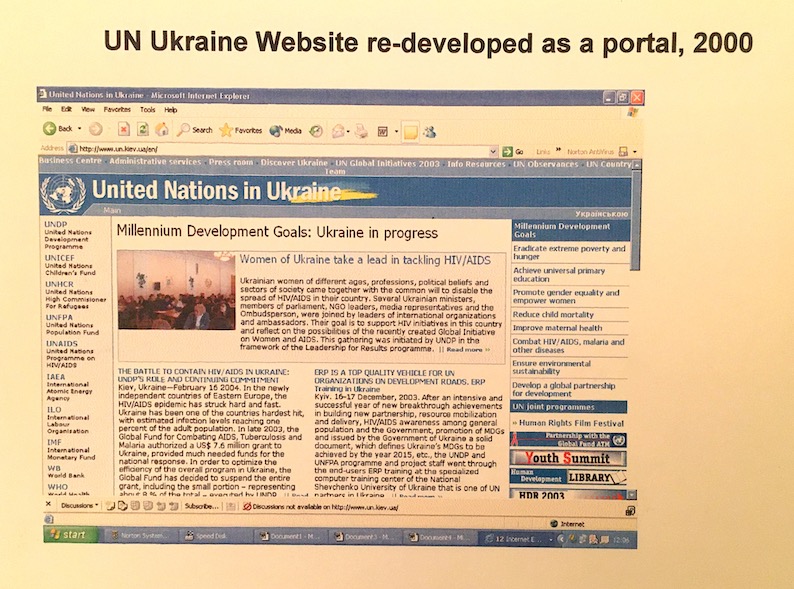
In November/December 2000 I worked in Kyiv/Kiev, Ukraine for the United Nations mission on the strategic re-launch of the mission website as a portal, whilst also advising the UN Resident Coordinator/UNDP Resident Representative Douglas Gardner on communications strategy. It was an extraordinary experience on many levels. It was a time when the Internet was fast evolving and required quick thinking and an ability to innovate; it was also a key moment in Ukraine’s history.
According to Olena Nikolayenko in Youth Movements and Elections in Eastern Europe (Cambridge University Press, 2017), “Gongadze’s murder in September 2000 engendered the Ukraine without Kuchma Movement. The website Maidan (http://maidanua .org) was initially set up by civic activists to provide extensive coverage of the movement’s activities.”
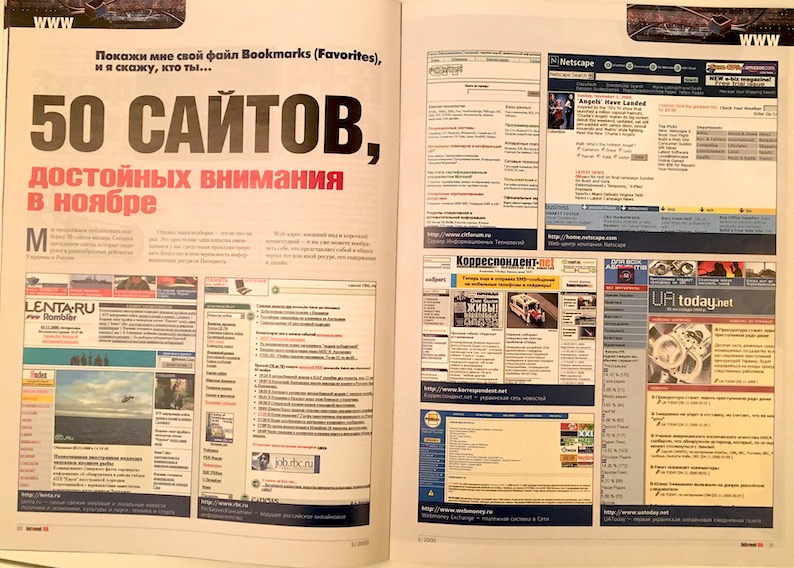
But despite those dangers and clear threats from the government of the time, there was a flourishing and inventive Internet and digital economy. The magazine Internet UA (whose editor I enjoyed meeting) gave a great overview of the scene in Ukraine and its creativity. Just as now, the creation of Internet stars who can exploit the medium (in this case sexy videos: a very large online market today) was driving viewers and subscribers. But there was also a vibrant online news media, blogging, commerce and gaming presence as well.
Internet UA magazine: Sex sells and the sex industry has always had pioneers seeking new ways to get eyeballs for their content. The Internet from its early days has been driven by the search for nude pictures and sex videos. In this cover feature, “Internet + TV: Double Impact”. That content mix has become the foundation of websites such as Pornhub etc.
According to ain.ua, the Ukrainian digital economy today is ” … ‘local’ only just figuratively speaking. Ukrainian startups are initially focused on international markets. Product companies are included into international industry ratings. Outsourcing works with clients from all over the world. Global players enter Ukrainian market, opening R&D offices, acquiring and investing into local companies. There are no boundaries.”
A magazine feature on ‘Natasha’s’ Internet content offering.
It is easy to take digital freedoms for granted now but there was great resistance at the time and, unlike today, many governments were openly hostile to digital technology, online communications and e-commerce.
50 websites to bookmark in 2000.
The UN itself was evolving and embracing the communications and design revolution being driven by digital change. This was the first “dot.com” boom, which had begun in 1997. I had played a key role in pioneering online content for Mongolia (1997-1999) and could bring this experience to Ukraine. In particular, I launched an award-winning web portal for the UN Mongolia mission in 1997 (www.un-mongolia.mn) and also the country’s first web magazine, Ger.
The UN Ukraine brief involved creating content that was accessible to users with low bandwidth, dial-up connections (few had mobile phones in 2000). I had been building new media experience throughout the 1990s, tracking the cable and satellite TV and mobile/Internet revolutions for the Financial Times as a journalist, as well as launching websites for various media clients.
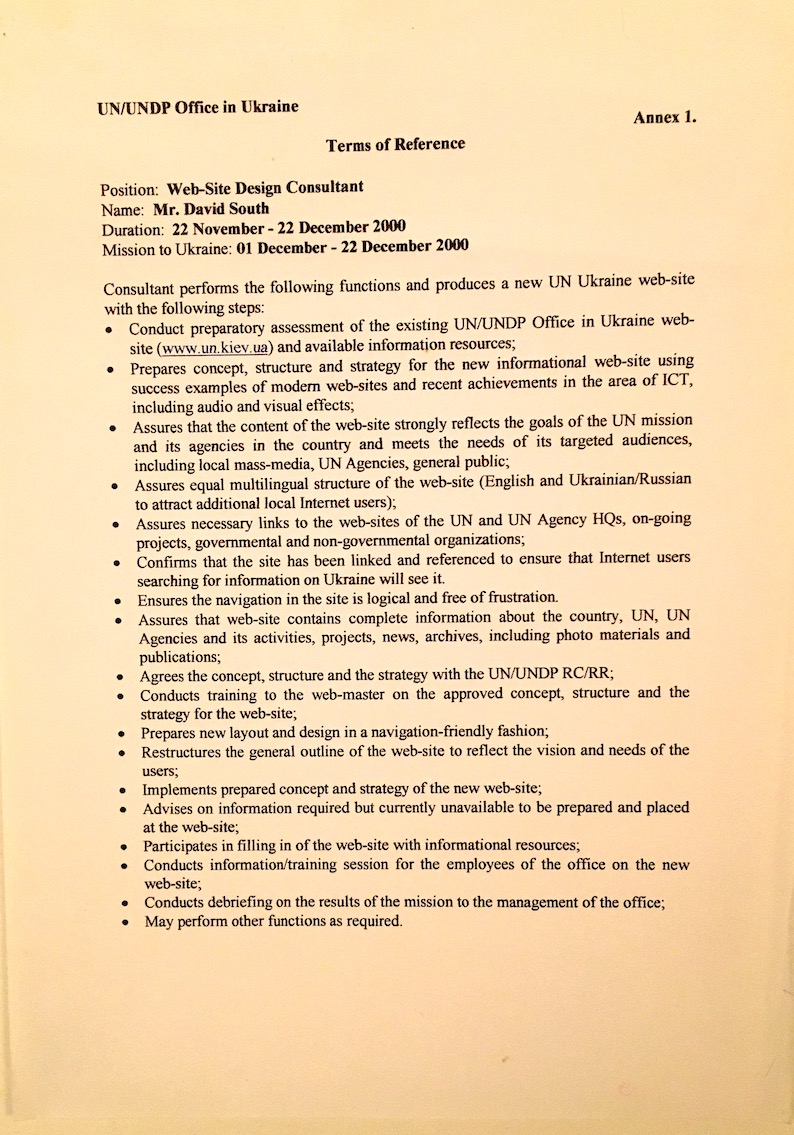
The Terms of Reference for the UN/UNDP Ukraine assignment.The assignment business card.The UN/UNDP Ukraine website before launch as a portal.The first iteration of the new UN Ukraine portal.
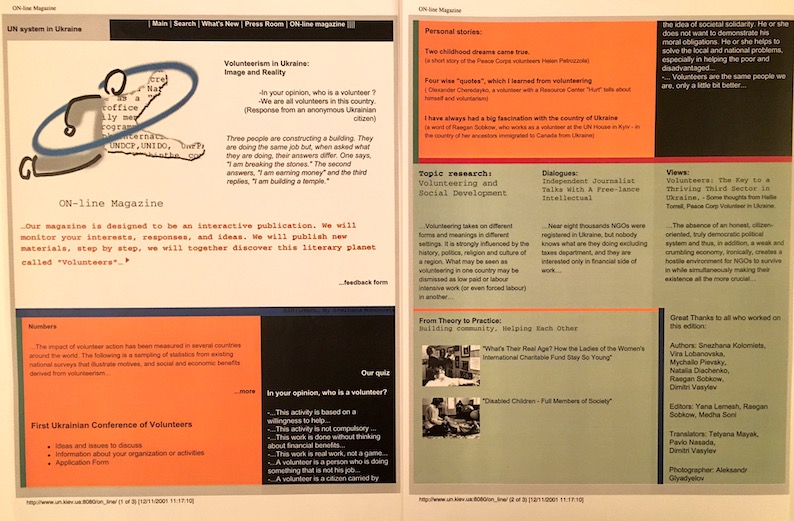
Key content created and launched on the UN Ukraine portal included critical information on the HIV/AIDS crisis in Ukraine, UN Ukraine’s first online magazine to explore perceptions of volunteering and NGOs in the post-communist period, and content preparing for the visit of the UN Secretary-General Kofi Annan, by showing how Ukraine was engaging with global development priorities, for example the eight Millennium Development Goals (MDGs), and bringing together UN agencies and entities into a cohesive web and “One UN” experience.
The first UN Ukraine online magazine.Bringing together UN agencies and entities into a cohesive web and “One UN” experience.
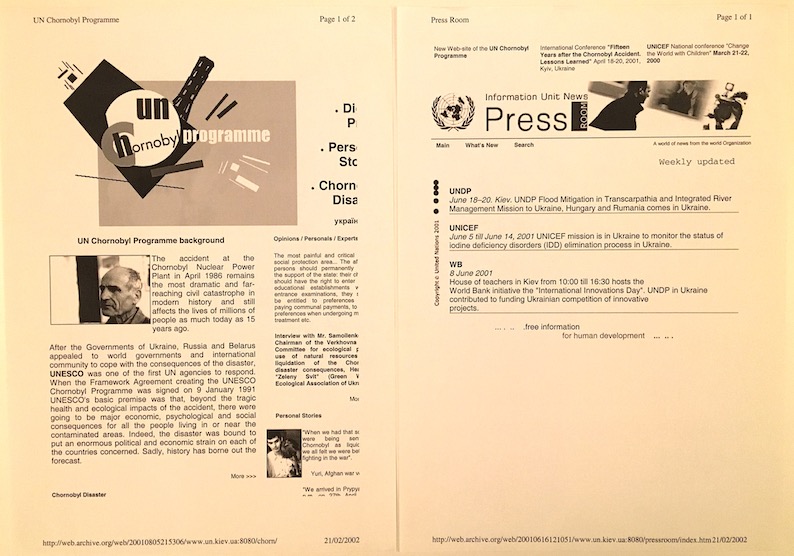
One highlight of this assignment was working with the “UN Chornobyl Programme” to develop its web content. This included visiting Pripyat (https://en.wikipedia.org/wiki/Pripyat),an abandoned city because of the Chernobyl Nuclear Power Plant disaster in 1986. I have visited many abandoned and “secret” cities and towns in the course of working with the United Nations but this particular visit had the added dimension of an environmental and human health disaster hanging over it (and as a former healthcare worker at Canada’s top cancer hospital and research institute, I couldn’t forget the impact of high radiation levels on the body).
UN Chornobyl Programme website in development, 2000.UN agencies in Ukraine. UNDP in Ukraine.
The power of the Internet and the digital economy to engage people, especially the young, despite living in a country with significant political repression of free speech and even physical intimidation and murder, stuck with me. This work also contributed to laying the foundations for Ukraine’s growing freedoms and greater engagement with Europe.
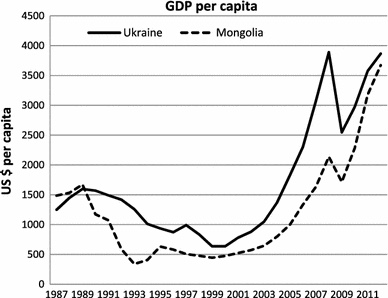
As this chart shows, increasing connectivity had a profound impact on living standards in Ukraine and Mongolia post-2000. The extreme turbulence Mongolia experienced in the 1990s – after the collapse of support mechanisms from the Soviet Union – calmed down as Mongolia integrated with the global economy, especially a booming China.
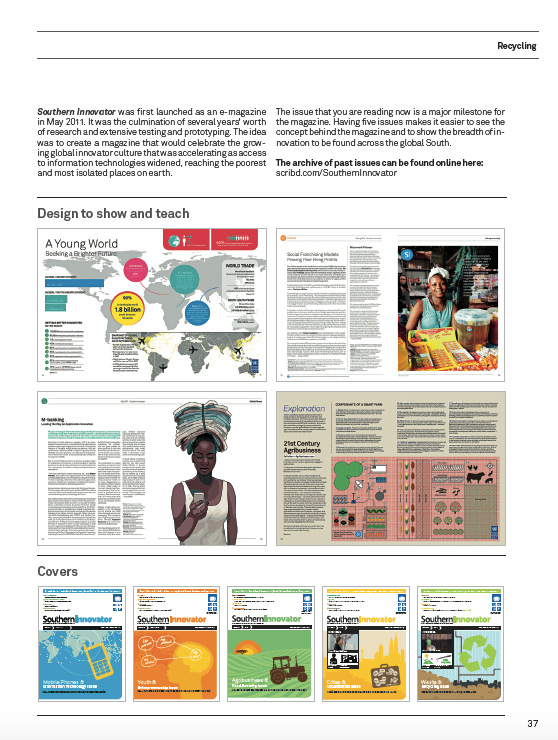
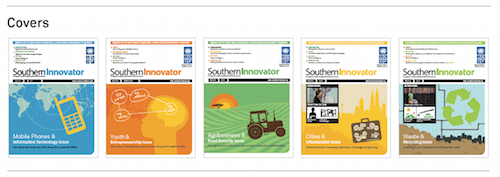
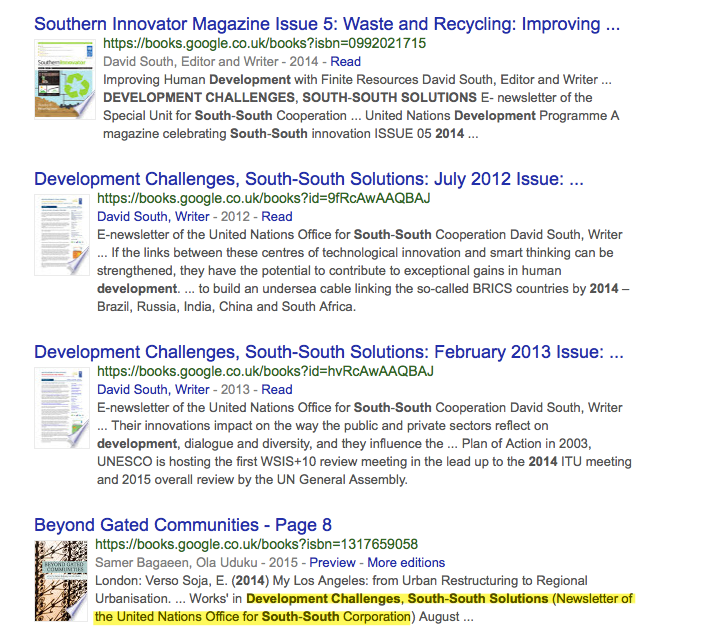
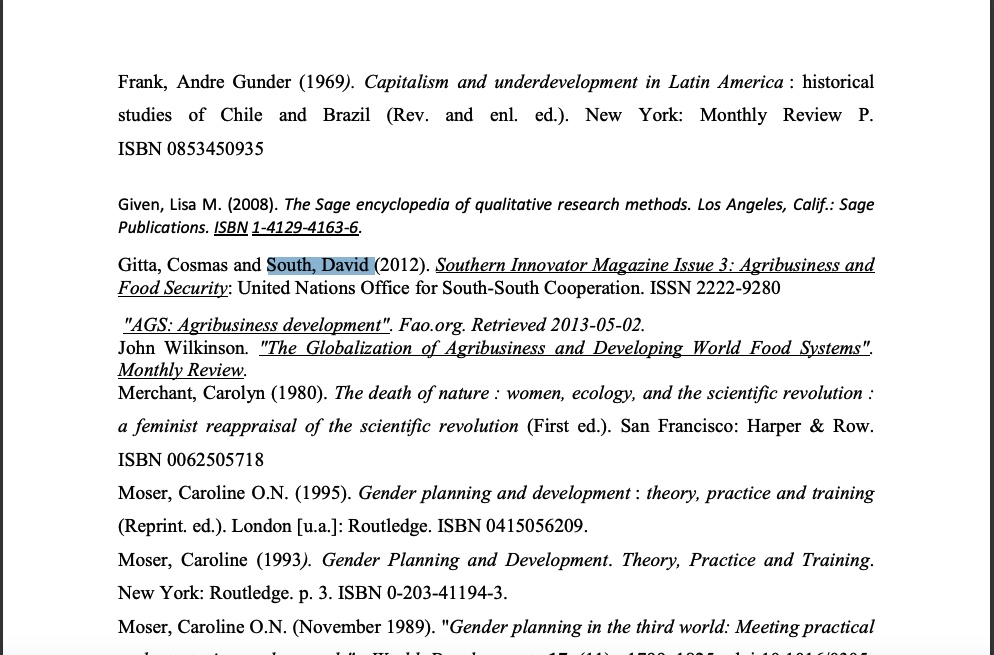
Southern Innovator was initially launched in 2011 with the goal of – hopefully – inspiring others (just as we had been so inspired by the innovators we contacted and met). The magazine seeks to profile stories, trends, ideas, innovations and innovators overlooked by other media. The magazine grew from the monthly e-newsletter Development Challenges, South-South Solutions published by the United Nations Office for South-South Cooperation (UNOSSC) since 2006. A selection of books and papers citing stories from the magazine are featured below to aid researchers, in particular those interested in health and human development and the role of innovators in international development.
The first five issues of Southern Innovator from 2011 to 2014. Called a “Beautiful, inspiring magazine from UNDP on South-South innovation.”
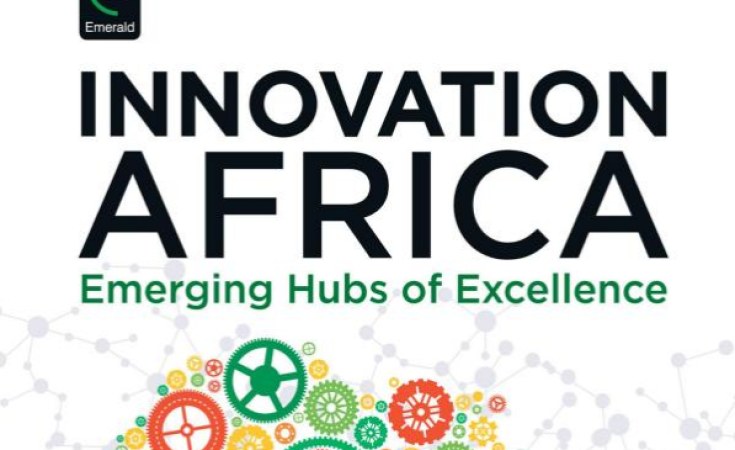
“Innovation is critical to growth and development in Africa. In the context of a continent characterized by fast growing economies as well as an array of socioeconomic challenges, such as high levels of poverty and inequality, innovation in Africa must be understood in an encompassing manner. Africa needs to support the emergence of its own Silicon Valleys, but it must also foster the invention and adoption of cleaner technologies that limit respiratory illnesses, deforestation and combat climate change. This book contains a number of analytical case studies that examine the nature and origins of emerging high-end innovation hubs in Africa. These “hubs” or ecosystems are both understudied and little known inside and outside the continent. With this analysis, the book highlights and draws lessons from some of the most promising and successful innovation cases in Africa today, exploring the key factors driving their successful emergence, growth and future prospects. Relevant for scholars, policymakers, and business leaders, the book provides both inspiration and useful policy advice that can inform strategies and concrete measures to speed up the pace of innovation in Africa today.”
“Research on gated communities is moving away from the hard concept of a ‘gated community’ to the more fluid one of urban gating. The latter allows communities to be viewed through a new lens of soft boundaries, modern communication and networks of influence.
The book, written by an international team of experts, builds on the research of Bagaeen and Uduku’s previous edited publication, Gated Communities (Routledge 2010) and relates recent events to trends in urban research, showing how the discussion has moved from privatised to newly collectivised spaces, which have been the focal point for events such as the Occupy London movement and the Arab Spring.
Communities are now more mobilised and connected than ever, and Beyond Gated Communities shows how neighbourhoods can become part of a global network beyond their own gates. With chapters on Australia, Canada, Europe, South America, Asia, Africa and the Middle East, this is a truly international resource for scholars and students of urban studies interested in this dynamic, growing area of research.”
“The economic, political and social situation in Chile shows a country in transition. Some observers anticipate a broad “reboot” of the nation. While Chile is still seen by many as an example of progress in South America and of developmental potential in the global South, it faces a complex political constellation, particularly in the aftermath of the re-election of Michelle Bachelet. Many wonder how social and institutional innovations can be incepted without interrupting the country’s remarkable success over the past decades.
This book provides an interdisciplinary analysis of Chile’s situation and perspectives. In particular, it addresses the questions:
What is Chile’s real socio-political situation behind the curtains, irrespective of simplifications?
What are the nation’s main opportunities and problems?
What future strategies will be concretely applicable to improve social balance and mitigate ideological divisions?
The result is a provocative examination of a nation in search of identity and its role on the global stage.
Roland Benedikter, Dr., is Research Scholar at the Orfalea Center for Global and International Studies, University of California, Santa Barbara, Senior Research Scholar of the Council on Hemispheric Affairs Washington D.C., Trustee of the Toynbee Prize Foundation Boston and Full Member of the Club of Rome.
Katja Siepmann, MA, is Senior Research Fellow of the Council on Hemispheric Affairs Washington D.C., Member of the German Council on Foreign Relations, and Lecturer at the Faculty of Interdisciplinary Cultural Sciences of the European University Frankfurt/Oder.
The volume features a Foreword by Ned Strong, Executive Director of the David Rockefeller Center for Latin American Studies, Harvard University, and a Preface by Larry Birns, Director of the Council on Hemispheric Affairs, Washington D.C., and Former Senior Public Affairs Officer of the United Nations’ Economic Commission for Latin America (Santiago, Chile).”
“A Sociological Approach to Health Determinants investigates how the social works in determining health and health inequity. Taking a global perspective, the book shines a light on how experiences of health, illness and health care are shaped by a variety of complex social dynamics. Informed primarily by sociology, the book engages with the WHO’s social determinants of health approach and draws on contributions from history, political economy and policy analysis to examine issues such as class, gender, ethnicity and indigeneity, and the impact they have on health. A Sociological Approach to Health Determinants is a comprehensive resource that provides a new perspective on the influence of social structures on health, and how our understanding of the social can ensure improved health outcomes for people all over the globe. Toni Schofield is Associate Professor at the University of Sydney. She specialises in research and teaching in sociology, and public policy and administration.”
New Directions in Children’s and Adolescents’ Information Behavior Research edited by Dania Bilal and Jamshid Beheshti (Emerald Group Publishing: 2014)”This book comprises innovative research on the information behavior of various age groups. It also looks at special populations such as ethnic minorities, indigenous peoples, and users with disabilities. The book presents research and reflections on designing systems that help the new generation cope with a complex knowledge society.
Economy Reports for APEC Economies on demographics, policies & ICT applications for people with Special Needs (Seniors and People with Disabilities), Asia-Pacific Economic Cooperation, APEC Telecommunications and Information Working Group, January 2013
Taming the Tide: Stories from India by Claire Bentley, Vanessa Brombosz, Sofianne Gabrielli, Ga Eun Lee, Vaidehi Nafade, Lindsay Steele and Muhammad Wali, Global Health Case Studies: A Compilation from PPHS 511 Fundamentals of Global Health, McGill Global Health Programs, Case studies – Fall 2015, pages 23 to 32
If you would like to either sponsor an issue of Southern Innovator or place an advertisement in the magazine, then please contact southerninnovator@yahoo.co.uk.






































 David South Consulting
You must be logged in to post a comment.