What happens when rednecks pick up a lesson or two from the world of identity politics? Mostly ridiculed by smug urbanites, or just plain ignored by the general population at large as cultural fads come and go, angry rednecks are standing tall in these conservative times.
Part Mark Twain-like satire, reverence and condescension, a cottage industry promoting the southern American redneck lifestyle is starting to resemble past struggles for cultural pride.
Just think of the gay rights movement in the 70s and 80s, which turned the derogatory word queer into a touchstone of homosexual pride.
In the 90s, dismissing rednecks as a bunch of dumb crackers can not only ensure free dental work in many an American bar, it can also be seen as an affront to white American values. But while some want to stereotype this culture as the heart and soul of white working-class American ideals, it is hard not to be disturbed by this phenomenon. Can God, beer, the American Constitution and guns weave together a stable lifestyle?
Author, radio personality and Redneck Olympics MC Bo Whaley was interviewed in a phone booth across from the bomb site at Atlanta’s Centennial Olympic park. During the interview Bo was kicked out of the phone booth by Atlanta police for talking too long. He picked up the interview from a truckstop near Dublin, Georgia.
id: What is a redneck?
Bo: A redneck to me is a lifestyle, that’s what it is. I relate rednecks to people who work hard, men of the soil. They look for the common things in life. They enjoy the outdoors, enjoy hunting and fishing. They aren’t too interested in status or setting the world on fire. They like to do their own thing. Real close to being what we call a good ole boy. They enjoy life – they work hard and they party hard.
There is nothing put on by them. They are down to earth. I really enjoy them, they are on the level. If you ask them a question they will tell you the truth. They aren’t trying to impress anybody, just trying to be themselves.
Go to the local bar and they are listening to the juke-box, smoking cigarettes and drinking beer. We can make fun of ourselves down here, we enjoy it. We laugh at ourselves. Poke a lot of fun. I’m having fun with people who live on farms, live in small towns. Like to hunt, like to fish. They drink beer. I have lived in the south for 24 years. I try to look at people and write what I see. I also wrote The Field Guide to Southern Women.
id: I heard the Redneck Olympics didn’t go down so well with the city council.
The chamber of commerce was concerned about the image. We attract a lot of industry to the town, they were afraid what was going out was a negative image of the lifestyle that is going on in Dublin.
We didn’t know it was going to catch on like it did. At the opening ceremony we were expecting maybe 250 maybe 350 people – and we had 4,000! The national and international media has got into it.
id: Are rednecks all right-wing?
On the right of the political spectrum, yeah. Happy with Newt Gingrich. I don’t think we take politics as seriously as up north. (Former U.S. president) Jimmy Carter is not very popular with the rural people here in Georgia. Well, I think when he went to Washington his values changed. I can name many, many people including me, who don’t like him. Right now I’m five minutes from the Carter Centre in Atlanta. I’ve never been to it. Not really interested in what Carter is doing.
He is trying to solve all the problems of the world. He looks at himself as more of a missionary than an ex-president. He goes to Haiti, he goes to South Africa, Bosnia. He calls these peace conferences and by-passes the established government in the United States to try to do his own thing. It’s a self-serving thing.
id: What do you think about the militia movement?
I do not agree with them. Right now I’m standing across from Olympic park where they had the bomb go off. People that I talked to have no sympathy for the militia, they say let the established investigators handle it and they don’t have any use for (the militia) at all.
id: Do you think the militias are a symbol of the frustration a lot of rednecks are feeling?
I agree. But they do a lot more talking than they do acting.
id: Why do they distrust the federal government and imagine black helicopters are helping the U.N. to set up a totalitarian state?
I think what they feel is that they know more about handling a situation than the government does and they want to do it on their own. I don’t agree with that. The government’s not perfect here nor in Canada. As long as it is the government I’m going to support it. I was not a Clinton fan but once he was elected he became my president. I have to support him until he gets out. But I don’t support everything he does.
id: Is the redneck style locked in the 70s?
The redneck symbol is more popular than it has ever been. A lot of people in offices in stuffed shirts and ties who would love to get out and live this way but they can’t do it on account of losing their jobs. They like to get in a jeep or ride on a motorcycle and say “whee” and to the heck with it. Everybody in the world needs some quiet time, time to yourself to do what you want to do.
id: Do you think rednecks are in danger of extinction in the age of the Internet?
They are on the increase. They don’t know about high-tech stuff. They haven’t even got into electric typewriter yet – they are still on manual typewriter.
id: Do they have any heroes or heroines?
They are beer people, and if they have any drug they smoke marijuana.
id: I mean heroes.
Many are country music fans, like Garth Brooks and Hank Williams Jr. They are big on country music. Female rednecks admire shows like Designing Women.
Oh lord, they love T-shirts. The T-shirts say “Opry land,” “Dollywood,” “Get your heart in America or get your ass out.” They don’t like plain T-shirts.
id: Can you give an estimate of the number of rednecks in the U.S.?
I travel more in the South Eastern states. In my hometown, in my home county, there are 37,000 people. Most of the people there, I’d say 75 per cent are working people, they either farm or work in factories. Out of those people, I’d say 20 to 25 per cent fall in the category of what I call redneck – they work hard all day and they play hard all night. Nationwide, I have no idea. I can tell you towns that have a lot of rednecks. Chattanooga, Tennessee – lot of rednecks. Columbus, Georgia, it’s a military town. In Montgomery, Alabama they work real hard at being rednecks.
id: Is there a problem with blurring rednecks with more negative elements like the Ku Klux Klan?
No, I really don’t see that. Most of the people I know can’t stand the Klan. They give country people a bad name.
id: Some guy at the Redneck Olympics had a Klan T-shirt on.
I’m not surprised by that. The main thing you are going to see them wearing if they have anything to do with a symbol of patriotism is a Confederate flag saying “God bless America” and “God bless the South.”
id: What about the rebel flag?
They do not want to give it up. There is some legislator in Atlanta who is trying to ban it, and this has to do with trying to appease a faction for their votes. But you get out into rural Georgia, rural Alabama, they want to keep that flag. To be truthful it has a lot to do with the civil rights movement.
id: That it means it’s an affront to the civil rights movement?
Yeah.
id: Are there yuppie rednecks?
I know a neuro-surgeon living in Birmingham, Alabama, I met him through his wife while I was signing books. She came up and said “I’ve got to have one of those Redneck Handbooks,” and I said “Why?” She said, “Because my husband is a neuro-surgeon and he’s from Arkansas and all day long on in his office he’s got his blue buttoned-down shirt, his navy blue suit and his spit shine shoes and driving his Mercedes. When he gets home in the afternoon he puts on his blue jeans, and denim shirt gets the pick-up truck, the dog gets in back and he starts riding in the woods.” He’s a Dr. Jekyll and Mr. Hyde type. I see a lot of that. They kind of let their hair down. It’s a release for them.
id: Do you see the redneck lifestyle as a different kind of leisure lifestyle, a more working-class leisure lifestyle?
I think so, David. They put on ragged jeans, say to the world “I am a redneck.”
What they like to do is go fishing. They will go to the coast and go deep sea fishing. Especially they like to go to stock car races. Big stock car fans. The faster that car goes the better they like it, and the more wrecks they have the better they like it.
“Wang thinks the internet is the way forward for porn distribution.”
Meet Steven Wang. The young Toronto distributor of porn magazines and videos is jerking his arm up and down as he describes what sells adult videos.
“Explicit boxes – dick in the mouth, cum in the face makes it sell,” says Wang as he tells me about packaging the videos he distributes.
Wang doesn’t fit the stereotype of a smut dealer. He is wiry, well-groomed and fits in easily amid Toronto’s army of yuppies. Despite the topic of our conversation, he isn’t shy about being graphic in a public place.
Wang admits his parents aren’t too keen about his success as a smut dealer, but he proudly tells me about his latest project, Cybercafe (located on Toronto’s main goodtime drag, Yonge Street). Banks of computers line the walls of the cafe, and a few customers bang away on keyboards and swivel mouses. Blinders on video terminals are quickly jerked forward by shy internet users as each new customer walks by.
Wang thinks the internet is the way forward for porn distribution.
“It’s heading more to bondage, violence – anything that is weird. Haven’t seen it, want to see it. You can only find penetration on VHS (video), though fisting is allowed.” continues Wang, who prides himself on foreseeing trends. “Now that people have seen these things, they want to go to the next step. Because you can only get these things on the internet, 80 per cent of the people are there for the adult material. Internet is the future, period.”
“Because you can only get these things on the internet, 80 per cent of the people are there for the adult material. Internet is the future, period.”
Wang got into distributing porn videos in 1990, just as the Ontario government began to relax the restrictions on hardcore porn movies, as long as they didn’t contain sex involving violence, coercion, bondage, sado-masochism, degradation, incest, animals, or minors under the age of 18.
Wang says he has made some good money, but it’s time to start looking to the next trend. He says those who consume his products have an insatiable appetite for sex in all its forms.
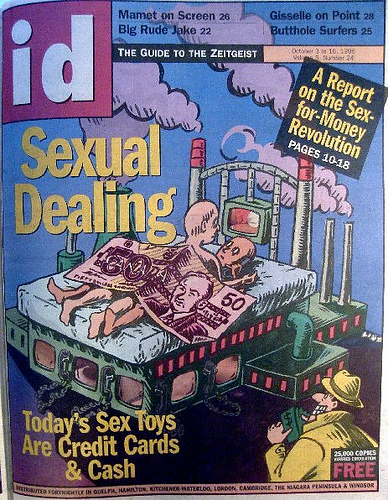
Money-for-sex revolution
The 90s have seen a quiet revolution in the sale of sex. While paying for sex is nothing new, never before has such a plethora of choices been so openly peddled in Ontario’s newspapers and magazines, mostly at a male audience. There are escort services, so-called massage parlours, phone sex, adult videos, sadism and masochism shops and clubs, strip clubs and swingers’ clubs. On the internet, 127 sex news groups compete with over 200 sex services on the World Wide Web, many charging for the privilege to peek at sex photos. And the sex trade comes at a price, with evidence showing lack of regulation means youths continue to be drawn into the business, while users search for bigger and better thrills.
Toronto weekly Now Magazine has been a pioneer in sex advertising. In September, 1989 the magazine’s back pages of classified ads contained around 130 “business personals,” ads placed by the city’s working prostitutes.
In the September 26, 1996 issue of Now, in seven pages of telephone personals and phone sex ads, there were 514 “Adult Classified” ads, a cornucopia of “massage” parlours, prostitutes, and escort agencies offering shemales, “hot Asian” and “Swedish” beauties.
While there isn’t any one source for accurate information on the size of Ontario’s sex industry, it is obvious it has not only grown in visibility, but in size.
“There definitely seems to be more of everything,” says Detective-Constable Austin Ferguson of the Metro Toronto Police’s vice section. “Look at how pornography video stores have blossomed – the spas, whatever you want to call them. Look through the yellow pages for strip bars, escort agencies.
“You got Now, Eye, pink pages, green pages, you can pick up the Toronto Star, The Sun. The phone lines are everywhere you look. I love it, it’s a great business,” says Ferguson sarcastically.
“Even five years ago, there were only a few massage parlours. Now there are 400 to 500 massage parlours in Toronto alone. It has quadrupled since 1990.”
“It’s an underground revolution,” says Sue McGarvie, a sex therapist and Ottawa talk-radio personality. “You go out on the street and see how many prostitutes there are, and how much more open it is, how many more night clubs there are that are gender neutral, that are fetish.”
McGarvie doesn’t think it necessarily means more people are turning to commercial sex.
“We are having as much sex as we ever had, we have as much sexual desire as we ever had,” says McGarvie. “I think the outlets are changing, so that we are going to have to be flexible about that.”
Steven Wang estimates 3,000 out of 5,000 Metro Toronto video stores carry adult videos. Another 1,250 exclusively carry adult videos. A manager at Toronto’s Adult Video Superstore says, “Sales and rentals have gone up in the last three years.” The Adults Only Video chain, founded by Kitchener-Waterloo resident Randy Jorgensen, now spans Canada with 51 stores, 12 in Toronto. And what internet user hasen’t taken a few minutes (or hours) to play voyeur on the many adult web sites or chat lines?
An Adults Only Video survey found, out of 2,000 customers, 56 per cent watch adult videos with a partner. It also claims 20 per cent of renters are women. Many are skeptical about these claims.
Barking through what sounds like a speaker phone, Larry Gayne, president of sex toy mail-order company Lady Calston, says “It’s all men who look at the back of Now. Some claim as much as 50 per cent of adult video watchers are women. I don’t know if I believe that figure.
“Sex is a US $40-billion business in North America alone. In 1992, more sex aids were sold than breakfast cereal.”
The businesses manufacturing sex try to distance themselves from the more visibly seedy porn stores.
“The explosion in triple X video stores is the only seedy end,” continues Gayne. “The sad part is you take away those triple X stores, there is no seedy part to this industry. Not behind the scenes, not in front. It doesn’t exist. There is nobody seedy at our level. Those people don’t exist, they are just normal businesses. There is in fact a downside to the triple X stores.”
Sue McGarvie is an enthusiastic supporter of greater sexual liberation, even if its expression is through the sex industry.
Speaking between clients from her Ottawa office, she says 36 new adult video stores have opened in Ottawa in the past five years.
“Some are small sections of regular video stores,” says McGarvie. “I’m a big believer, I’m still under 30, my generation is one of the first generations that is no longer attending church as a regular part of what we do. Sex is no longer a moral issue. But people are saying ‘wait a minute, because of STDs I’m going to be stuck with my partner for the rest of my life? I better make it the best damn sex we possibly can have.’ Vibrators are outselling any other appliance.
“I’m poised on the industry of the next decade, the next millennium. Sexuality as an expression is the second most powerful drive after food.”
McGarvie doesn’t think that what is in the adult video stores is unhealthy. “Porn as a term is not right, either. Porn is illegal, but the stuff in the video stores is not illegal.”
McGarvie also doubts adult videos are contributing to an atomised world, similar to Aldous Huxley’s Brave New World, where the government controls a population anaesthetized by the buzz of orgasms and drugs.
“I don’t necessarily think it is causing people to be less intimate. The industry needs to stop being in the shadows. Our lives are busy. People are having a hard time connecting with others, but I think that is a separate issue. I think there is a new sexual revolution going on, and if our reality checks catch up with our sex drive, we’ll be okay. We don’t have socially acceptable ways of meeting people that isn’t in a bar when people are drinking.”
Toronto swinger and strip club DJ Ron Michaels thinks the tables are turning on the money-for-sex industry.
“A lot of adult video stores are closing. A lot of strip clubs are on the verge of going under,” says Michaels. “It is like a ghost town in there. I don’t see it is a growing trend. Perhaps it is more front page, more visible. I don’t think it’s any larger than is has been before. I think our society in general is far more sexually liberated than we were 50 years ago. Certainly more than 100 years ago.
“A lot of people thought they could make a fast buck off of it. The market can’t support that number,” according to Michaels.
Child porn
But is this really just good fun? Unfortunately, there is too much evidence showing a direct connection between a robust sex industry, and the sexual exploitation of minors and demand for degrading sex. A booming sex industry just can’t be disconnected from the exploitation of youths and an absorption in degrading, freaky sex, like defecation or bestiality. The industry may not be directly connected to the much-publicized paedophile rings in the news, but the mainstream sex industry is not adverse to exploiting youths and an appetite for sex with minors to sell videos and magazines.
“We have laid charges on people who were initially operating a reputable business,” says Ferguson, “until they found there was a demand for the seedier stuff.”
Sue Miner, the head of Toronto’s Street Outreach Services, says high unemployment rates amongst youth feeds the sex industry with a steady supply of desperate teens.
“It’s indicative of people needing to survive and not having jobs. I’ve heard enough young people saying they needed some money to pay the rent. A lot of young people do it to survive – survival sex.”
“I have yet to come across an escort agency that uses minors,” claims Ferguson, admitting that because he hasn’t, doesn’t mean it isn’t happening. “It’s usually a bit more classier than that. You don’t get your Parkdale hooker types. Pimps don’t run escort agencies.”
A 1984 government study on prostitution, the Badgley Committee on Sexual Offences Against Children and Youth, found one-half of prostitutes had entered the sex trade under the age of 16, 96 per cent had become prostitutes before the age of 18.
The overwhelming majority of prostitutes have run away from home at least once. Street prostitutes leave home at an earlier age than other children, at an average age of 13.7 years, compared to 17.3 years.
The most difficult porn to regulate, as most governments know, is on the internet.
Detective-Constable Ferguson says having photos of bestiality and paedophilia, for a few seconds on a harddrive, is considered by the law to be possession. He also admits because of the ethereal nature of computers, the law is totally unenforceable.
“You would have to get online with that person. Get to know them, chat with them.”
He does warn any internet cafes to stay clear of the stuff. “They are totally nuts to have obscene or child pornography available because somebody would spill the beans pretty quick.”
Escorts
As for prostitution, the police have a harder time controlling escort agencies because they are careful to never make a deal on the phone, says Ferguson.
“They are only going out for dinner and dance, eh?,” chuckles Ferguson. “Somebody sees a business opportunity to run prostitutes. They are harder to crack. It’s a long, long process to take one of these places down because of all the undercover work involved. What you can, can’t do. It’s no easy task.
“They won’t make a deal over the phone. They might say ‘you can have my service for $150/$200 an hour,’ as soon as you say ‘what do you get for that?’…click.”
McGarvie says she wouldn’t be too happy if her husband went to a prostitute to cope with sexual stress if they were too busy to have sex. On the other hand, she thinks the escort industry would decline if there were more healthy outlets for sexual release.
“Business goes up when we get pickets, negative reviews are always positive for the business – automatically sales go up that day,” says Wang smiling.
Toronto feminist and author Susan G. Cole, in her book Power Surge: Sex, Violence and Pornography, and ironically a Now Magazine editor, has called for greater regulation of pornography, arguing the industry really has no claim on freedom of expression. The public, Cole says, can accept a regulatory role for government when it comes to other industries, so why the exception for the smut trade?
This should be extended to the rest of the sex trade, she argues. Body-rub parlours, escort services, street prostitutes, strip clubs and phone sex, should not be allowed to remain in regulatory limbo, only subject to police attention when community groups kick up a storm.
Back at the Cybercafe, Steven Wang is trying to be heard over the Pet Shop Boys’ pounding dance beats.
If anybody wants to protest outside one of Wang’s two Toronto stores, or any other adult stores his videos are distributed in, he would probably make the placards. “Business goes up when we get pickets, negative reviews are always positive for the business – automatically sales go up that day,” says Wang smiling.
Source: statista
Swing Shift: Sexual liberation is back in style
By David South
Id Magazine (Canada), October 3-16, 1996
Deep in the bedrooms (and livingrooms) of the home-owning classes, the sexual liberation movement marches on: swingers’ parties are back. Those libidinous libertines many thought were lost in a 70s disco haze, according to a Toronto swinger, are back in greater numbers than in those polyester days.
In contrast to the many people (mostly men) looking for the anonymous and on-demand buzz of escort agencies, porn videos and sex toys, it seems to me swinging is the most idealistic camp in the army of sexual liberation. There isn’t any sneaking around behind your spouse’s back – in fact, you bring them along for the good times.
Swingers were usually the subject of the porn movies I watched at the base cinema during my army days. They weren’t real people, but some sort of myth from more electric times.
Ron Michaels, 41, is an unabashed proselytizer for swinging. A strip-club DJ and erotic and commerical photographer, he’s also co-owner, along with his wife, of swingers’ club Eros. A confident and articulate spokesperson, he has been swinging since he was 17.
“We believe honesty is the cornerstone of our lifestyle – that makes it work,” he says. “The people engaging in back-alley sex are being dishonest. It’s the same with having an affair – wanting your cake but not being able to share it with the rest of us.
“Swinging is a moral alternative to having affairs.”
The divorce rate among swingers, Michaels maintains, is only five per cent, compared to 51 per cent for the general population. The one wrinkle in this impressive “fact” is Michaels’ other admission that many swingers are on their second “married relationship”.
Interviewing Michaels, I feel like I’m talking to a Rotary Club member or a boy scout leader, not a swinger. The talk is about clubs, memberships ($69 a year per couple), trips. It’s a hobby, sport and lifestyle to many swingers, claims Michaels.
“We have regular weekly functions throughout the year. Some of them are organized by the members. We organize trips and holidays. Weekends in the Caribbean. Like any other social club.”
That can’t be wife/husband swapping he’s talking about, can it?
Michaels’ Toronto Beaches home leaves no doubt as to its occupant’s lifestyle choices: “If you don’t swing, don’t ring,” says a brass plaque nailed to the door.
Michaels is very proud of swinging’s growth in the 90s. His group has grown from 300 member-couples 14 years ago to 1,800 today. Michaels ambitiously estimates that between 100,000 and 200,000 Southern Ontarians are into swinging, between 20 and 25 million across North America.
So, how does swinging in the 90s work?
Michaels says most clubs operate more as matchmaking parties than full-out orgies. Couples get to know each other and make the arrangements to meet away from the club’s party. Michaels is quick to disassociate his club from drop-in style swingers parties.
“Canadians are much more conservative than Americans. In New York they are more hardcore, less selective of their partners. When they get there they are more like, ‘let’s find the first available body and get to it,’ whereas people at social clubs want to get to know you. We are talking about four-way compatability here.”
According to Michaels, the big victory for Canadian swingers took place in 1992. “Our Mississauga club was raided back in ’92 and we took it through the courts for a year. We were acquitted and set a legal precedent, making swingers’ clubs legal.”
To many men, the whole swinging thing seems like the best of both worlds: you keep your wife and get to taste the fruits of other trees at the same time. But Michaels says this male teenage fantasy doesn’t pan out in reality.
“That wears off pretty quickly. Let’s face it, men have a much lower capacity for sex than women do. Men need a longer recovery period and don’t have as many orgasms in a night. Women can just go and go. Guys can’t compete with that. After a while the fantasy wears thin, and it’s the guy that wants to drop out of the lifestyle.”
And what about that oher most-asked-question: what’s it like to see your spouse having the time of their life with your neighbour?
“They don’t get into those kinds of comparisons. How can I describe this? It’s not a competitive thing where you try to outperform each other. Most swingers appreciate each other as being unique and different, rather than this is bigger, this is harder, this is faster, this is better. Each new experience is taken at face value, ‘Hey, it’s a good time’. You move on to the next one or you go back to your regular partner.”
“Cock Tales” too much for Hamilton
By David South
Id Magazine (Canada), October 3-16, 1996
Steeltown is a little less hot now that View, Hamilton’s alternative weekly, has dropped a controversial sex columnist in the face of complaints from distributors. The fracas has raised a thorny issue: to what extent should a newspaper stand behind a controversial writer?
My Messy Bedroom, a weekly column by Montreal journalist Josey Vogels, mixes graphic language and humour in its look at sexuality. The dispute erupted over a column in the August 22 issue entitled Cock Tales 1 (Cock Tales 2 will not run in View).
A surprised and angry Vogels says she only found out her column had been dropped when id called her in September. Vogels believes the problem was with the frank discussion by men of their sexual tastes. “Maybe it was the opening line. ‘Mouth on my cock, finger in my butt, looking me in the eyes,’ then a joke: ‘Would you like fries with that?’”
Vogels maintains View knew what it was getting into when it picked up the syndicated column in June, 1995. “You can’t say you want a column because of its nature, then say you don’t like it.”
Vogels says she co-operated in the past when the magazine asked her to tone down a column. “But there is a line where my integrity is at stake.”
Tucked away among five pages of classified ads, My Messy Bedroom was the only piece of journalism with a sexual theme in View.
Editor Veronica Magee says View received complaints that children were reading the column, and some distributors refused to carry the paper. In a rambling editorial in the September 5 issue, Magee defends the decision to drop the column, saying it was time the paper made some changes.
Magee writes that Vogels’ column taught “sexuality is something clean, not dirty,” but admits some urban weeklies aren’t so urban, and must cater to a more conservative, suburban readership. “Hamilton is a conservative city,” she claims.
In an interview with id, Magee admitted View’s attitude towards the column was “what can we get away with – let’s push the limit.
“Some people argue she should have known better. Although I’m sure people will believe we are making the writer suffer for a decision we made, that is not the intent.”
But the publisher and editor of View offer conflicting explanations of who actually pulled the column. “It was a collective decision,” says Magee.
Sean Rosen, one of View’s two publishers, told id the magazine had been considering dropping the column for some time. But Rosen says the decision was solely Magee’s. “The editor decided it had run its course, trying to be sensational for the sake of being sensational.”
Other stories from the special feature:
“Barely Legal”: Scummy New Generation of Mags Evades Anti-paedophilia Laws by Nate Hendley
Randy for the People: Conservative Ontario City Home to Porn Empire by Nate Hendley
Is Stripping Worth It? by Cynthia Tetley
Those Old Crusaders: Pornography and the Right by Eric Volmers
Feminists for Porn by Nate Hendley
The Sex Trade Down the Ages by Fiona Heath
Update: It is over 20 years since this Special Report was published. It forecast the significant role the Internet was to play in the growth of sex content and the sex industry and vice versa. Here is an interesting overview of the situation in 2020. The Internet is for Porn – It always was, it always will be.
“One of the biggest and most interesting things happening in the consumer web right now is running almost completely under the radar. It has virtually zero Silicon Valley involvement. There are no boastful VCs getting rich. It is utterly absent from tech’s plethora of twitters, fora and media (at least, as they say, “on main”). Indeed, the true extent of its incredible success has gone almost completely unnoticed, even by its many, many, many customers.
John Kenneth Galbraith was photographed by David South at the University of Toronto.
It was with hungry enthusiasm that I rushed to hear the great liberal economist John Kenneth Galbraith speak. It was with enormous disappointment that I found a genius emptied of solutions to the current political battles in today’s Ontario.
For those unfamiliar with Galbraith, think of him as a hybrid of the liberalism of former prime minister Pierre Trudeau and the manner of Jimmy Stewart. Now 88, the former Guelph agricultural economist became a servant of the US government just as president Franklin Roosevelt was beginning to introduce the New Deal – today’s rusting welfare state – as a solution to the cruel hardships imposed on Americans as a result of the Great Depression. Galbraith rode out the Second World War in a senior government position as Roosevelt’s price-control czar. He later advised Democratic presidents John F. Kennedy and Lyndon Johnson, before seeing his influence in American economic thought wane under Ronald Reagan’s Republicans.
Galbraith has long followed the ideas of British economist John Maynard Keynes, who believed goverments should keep money tight in good times, but should spend their way out of bad times to avoid undue hardship. Galbraith also made the plight of the poor one of the pillars of his economic theory, and criticized the unnecessary appetites and demands created by the goliath American advertizing industry. He has supported wage and price controls and once, in the 1930s, even wanted to join the American Communist Party.
Last week, Galbraith breezed into Toronto with his ivy league roadshow. Speaking to a stodgy crowd of liberals (and Liberals, including former prime minister Pierre Trudeau and failed Ontario leadership candidate Gerrard Kennedy) at the University of Toronto, Galbraith was at an institution that comes as close as Canada gets to his current stomping ground, Harvard.
Symbolically, Galbraith couldn’t have visited Ontario at a better time. The Conservative government of Mike Harris is in the middle of an ambitious campaign to reverse everything that Galbraith has stood for: budget deficits to avoid depressions; social programmes to prevent poverty; taxes on the rich to fund those programmes; government policy subservient to public good. Harris oozes contempt out of every pore for the pillars of Galbraith’s thinking. In fact Ontario, once the bedrock of Canadian liberalism, is now joining Alberta in dismantling the welfare state.
A graduate of the University of Guelph when it was still the Ontario Agricultural School, Galbraith took his bitter memories of farming in southern Ontario to the University of California, Berkeley and subsequently to the Roosevelt government.
In his day, Galbraith was amongst a rare species of mainstream economists that earned respect from the once-abundant Marxists who cluttered universities. Not that the Marxists liked his compromises and complicity with the American government, or his assertions that he could save capitalism. But they thought he softened up the system for some body blows to be delivered by the workers’ revolution.
I am a member of a generation that grew up on government largesse, well-funded public schools, family allowance, university grants, and make-work progammes. But we have seen a lot of that eroded over the past eight years, during a period of high unemployment not seen since the Depression. It was time to see if this titan of liberal thought had something new to say.
Galbraith’s talk had two main points: the market economy is the best system going; he supports a guaranted minimum salary to prevent poverty. Other than that, Galbraith’s speech was a rehash of the same ideas he has been mulling over for the past 50-plus years. It could be called Liberalism 101.
His speech was peppered with euphamisms like the “socially concerned.” Perhaps he was pulling his punches so as not to offend the “distinguished” audience. The most exciting moments displayed his dry wit: “In the United States , the war against the poor having now been won,” or “We, the socially concerned, do not seek the euthanasia of the rentier class.”
He struck out against annual balanced budgets because they have been used as an excuse in the US to cut off benefits to the poor. He also slammed the globalization-uber-alles philosophy that sees welfare policies as uncompetitive – a sentiment that doesn’t seem to be in vogue these days with liberals. Last week, Prime Minister Jean Chretien told the South Koreans they need to remove jobs-for-life provisions to join the global marketplace.
His ideas and his approach to communicating those ideas come from a special historical time. A time when governments under pressure from trade unions and the far-left and right political parties decided to make capitalism a little friendlier. But they needed advisers who could speak the language of the elite. Eloquent, confident, pragmatic – advisers who felt comfortable in the courts of the democratic government. They didn’t want hot-headed union guys or hectoring left-wing demagogues.
Galbraith takes credit for civilizing capitalism and ensuring its survival: “It would not have survived had it not been for our successful civilizing efforts. We, the socially concerned, are the custodians of the political tradition and action that saved classical capitalism from itself. We are frequently told to give credit where credit is due. Let us accept it when it is ours.”
Galbriath’s economic theories have always been grounded by morality, preferring to avoid being a servant to flow charts. It is his most insightful side. When many fear to speak in broad terms about current economic problems, where many fear to make connections, Galbraith has pieced the complex puzzle together, much to the frustration of those who believe capitalism should be left unfettered. It is his worthiest legacy.
The Galbraith Interview
You point out it is reforms that have given capitalism a new lease on life. What policies would alleviate the worst aspects of today’s capitalism?
We still have the oldest problem. (That is) to eliminate the cruelties that are inherent in the system. In the United States, and I imagine also in Canada, we still have the terrible problems of the urban poor, of the people who do not make it. I see one of the central tasks of our time is to do two things: to provide a safety net so that in a modern rich society we don’t let people starve, and that we provide the means for escape from urban poverty.
How would you elliminate poverty?
No novelty about that. Two things are absolutely essential. One, that there be a basic safety net. That we accept in a modern society that there has to be a level of income below which people are not allowed to go. I do not join this attack on welfare, this notion the poor should be allowed to starve. Another thing is a strong educational system, which allows people to escape from poverty in the next generation. Those are the two absolute essentials.
Should government just concentrate on ending poverty and abandon universal programmes like public health care?
You can always have a conversation that separates itself from the reality. I think in Canada if some politician or some political group wanted to repeal the health system, they would soon find themselves in considerable disfavour. If they were committed to allowing the poor to starve, they would get a reputation for cruelty that no civilized society would tolerate. And if they started saving money on the schools, as some already have, we would find out how absolutely essential good education is for economic and social well-being. So we have a difference between what is possible in oratory and what is possible in reality … When the axing comes, it is a good deal less popular than it is in the previous rhetoric.
Who do you think, within or outside political movements, represents the socially concerned today?
I don’t speak generally on this. There is in all countries a substantial voting and politically expressive group. In the United States it is the political left, in Britain it is the Labour Party, in France it is the socialists, in Germany the social democrats. They are broadly committed to the welfare state and I think will remain so.
Would you include the Liberal Party in Canada amongst those?
I would include a substantial part of the Liberal Party in the United States. The Liberal Party in Canada, like the Democrats in the United States, have a double orientation, on one hand to the welfare state and on the other hand a more centrist attitude. Both parties have an internal problem to resolve.
Do you think they have lost interest in the welfare state?
To some extent I regret that. We must take some responsibility for human suffering and human well-being.
You don’t see that with the Democrat Party?
I prefer it to the Republicans.
Are some of these policies like welfare reform in the US making it harder for the poor?
I was not in favour of welfare reform.
I grew up in a very poor household but was able to go to the University of Toronto because of various government policies. In fact, they have kept me from destitution. You have written about a culture of contentment that prevents further social reforms. Will it whither?
Those of us who have been associated with the welfare state have made a lot of people comfortable, happy and conservative. We have undermined our own political influence by our success.
Do you think current levels of high unemployment and economic stagnation might erode that contentment?
No, if we suffer another recession there will be a desperate effort to have the government do something about it. The present conservatism is an aspect of good times. We had it in the 1980s under Reagan.
Are we still in good times?
We still have a lot of people who have a problem. We should have sympathy.
Do you see any political parties in Canada who defend the welfare state?
I’ve lived all my life in the the United States and I’ve always avoided coming back to give Canada advice. As I said in my lecture, anybody who does that should have stayed in Canada for his own lifetime. Let Canadians look after their affairs in Canada.
You said the socially concerned don’t seek income equality. I guess that is where you split with socialists?
I accept the inevitable, that people are going to be different in aspirations, ability and luck and probably different in parentage. All of this is going to mean differences in income.









 David South Consulting
You must be logged in to post a comment.