Categories
Archive Blogroll Development Challenges, South-South Solutions Newsletters

China’s Outsourced Airliner Development Model

By David SouthDevelopment Challenges, South-South Solutions

SOUTH-SOUTH CASE STUDY

Many emerging-market countries in the global South have built up substantial foreign currency reserves. Much of this has been a response to past foreign currency crises, particularly the Asian Crisis in the late 1990s (http://en.wikipedia.org/wiki/1997_Asian_financial_crisis).

But what to do with this often vast wealth? How should it be used to improve economies, human development and people’s lives?

China — whose foreign currency reserves reportedly total US $3.7 trillion — is showing one approach, using the wealth to build industrial capability in sectors traditionally associated with more developed countries, such as aircraft manufacturing.

China is seeking to build a commercial airliner able to compete with the sector’s longstanding giants, Boeing and Airbus. To ensure it can do it to the highest global standards, it is outsourcing much of the parts manufacturing to the best around the world, while keeping the overall design and assembly in China.

Comac, or Commercial Aircraft Corporation of China, Ltd. (http://english.comac.cc/products/ca/pi/), is located outside Shanghai, China’s rapidly growing global business hub. The modern Comac factory is working on building China’s first commercial airliner, the C919. It is also making a smaller jet, the ARJ21.

Comac calls the outsourcing method an “airframer supplier” model. Suppliers provide the components, and Comac designs and assembles the plane.

Countries making the parts include the United States, France, Ireland, the United Kingdom, Austria, Switzerland and Japan.

Comac’s dream is to graduate to the top tier of global aircraft manufacturers alongside Boeing and Airbus, which together account for 70 per cent of the global commercial airliner market (Fortune).

At present, this is just an aspiration, with a detailed life-sized plastic model of the C919 – right down to the intricacies of the cockpit instrument panels — all there is to show for the project.

Founded in 2008, Comac ambitiously aims to be making and selling commercial airliners within a decade. State-owned Comac is an amalgamation of various aviation companies, as previous efforts to make a commercial airliner in China had failed. China has invested US $3 billion in the venture.

The name, C919, breaks down as C for China, 9 because it sounds similar to the Chinese word for forever, and 19 because it will carry 190 passengers.

The idea is to target the city-to-city aircraft market which is dominated by Boeing’s 737 and  Airbus’s A320.

China saw huge aviation growth in the first decade of the 21st century, and is expecting that trend to continue. The country is on track to surpass the United States for airline-passenger traffic by 2032 and is already the world’s second largest market (Fortune).

To feed this fast-growing market, China will need an estimated 5,580 new planes by 2032, costing US $780 billion in today’s prices (Boeing).

China has decided, rather than committing this vast investment to purchasing all the aircraft from overseas manufacturers, to instead use this wealth to build a competitive aircraft manufacturing industry to rival the big leaders. This would create jobs in the country and create a multiplier effect as airline industry investment helps the domestic economy.

China already has years of experience manufacturing aircraft parts for foreign companies. Comac makes the tail section of Boeing’s 737, as well as manufacturing cargo door frames for the Airbus’ A320.

More importantly, since 2009 China has assembled A320s for Airbus under license in Tianjin — 130 of them to date (http://www.airbus.com/company/worldwide-presence/airbus-in-china/).

The C919 is similar in some ways to the Airbus A320. They have similar dimensions and are made from similar materials. Comac has hired over 100 foreign experts to help with the project, to ensure quality control meets global standards.

By trying to compete with the world’s best, China is entering a very competitive and complex marketplace. The complexity of modern aircraft (an average of 4 million parts in a typical commercial airliner) means there is no room for mistakes or cutting corners. And this is where China has to change its reputation. The country has experienced several high-profile manufacturing failures due to corner-cutting and corruption. These have included tainted milk products, poorly constructed buildings that collapsed, and high-speed train crashes.

The C919 is an opportunity to show high standards and high quality can be the norm in Chinese manufacturing.

In the 1970s, China designed and built the Y-10 (http://en.wikipedia.org/wiki/Shanghai_Y-10) in Shanghai, modeled on Boeing’s 707. But it was a failed programme, shut down after the plane flew once.

Those behind the new plane acknowledge that this is a learning experience for China: “Comac must learn how to walk first before running,” Comac chairman Jin Zhuanglong told Fortune magazine.

“I’ve always maintained the point that we won’t be a big challenge for Airbus or Boeing in the short term,” said Jin, who used to work in China’s satellite and spacecraft industry.  “But in terms of some single product, we might be competitive.”

There’s no doubt that China needs planes. China will have constructed 80 new airports between 2011 and 2015 (China Daily). It has already received 1,000 Airbus planes for domestic carriers, quickly bringing fleets to international standards.

State-owned airlines, including China Air, China Southern and China Eastern, dominate 80 per cent of flights. All stand to be a ready market for the C919, which will sell for around US $75 million – US $10 million less than the next generation Boeing 737 and the Airbus A320 (Fortune).

Ireland-based budget airline Ryanair is considering being the first Western airline to purchase the C919.

Ryanair CEO Michael O’Leary is confident people will fly on a Chinese-made plane: “Ninety-nine percent of my passengers don’t know what kind of aircraft they are getting on,” O’Leary told Fortune. “You trust the Chinese to make computers and medical devices, and the question is, Would you get on a Chinese aircraft? Of course!”

Brazil has shown it is possible. The Embraer (embraer.com) aircraft company, based in São José dos Campos, is now a US $6 billion a year success story that has won the public’s trust.

Comac’s C919 project is a risk, but the rewards could be enormous.

Published: May 2014

https://davidsouthconsulting.org/2021/12/20/better-by-design-in-china/

https://davidsouthconsulting.org/2022/10/20/china-consumer-market-asian-perspective-helps/

https://davidsouthconsulting.org/2020/04/25/china-looking-to-lead-on-robot-innovation/

https://davidsouthconsulting.org/2020/04/25/china-pushing-frontiers-of-medical-research/

https://davidsouthconsulting.org/2020/12/10/china-sets-sights-on-dominating-global-smartphone-market/

https://davidsouthconsulting.org/2022/10/04/chinas-booming-wine-market-can-boost-south/

https://davidsouthconsulting.org/2021/01/25/creating-green-fashion-in-china/

https://davidsouthconsulting.org/2021/01/26/designed-in-china-to-rival-made-in-china/

https://davidsouthconsulting.org/2021/07/19/global-south-trade-boosted-with-increasing-china-africa-trade-in-2013/

https://davidsouthconsulting.org/2021/02/12/rammed-earth-houses-china-shows-how-to-improve-and-respect-traditional-homes/

https://davidsouthconsulting.org/2022/11/01/southern-innovator-magazine-2010-2014/

https://davidsouthconsulting.org/2022/10/26/tackling-chinas-air-pollution-crisis-an-innovative-solution/

https://davidsouthconsulting.org/2020/04/17/virtual-supermarket-shopping-takes-off-in-china/

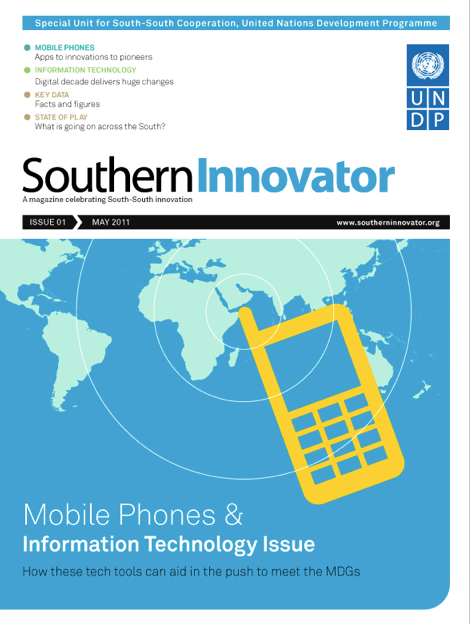
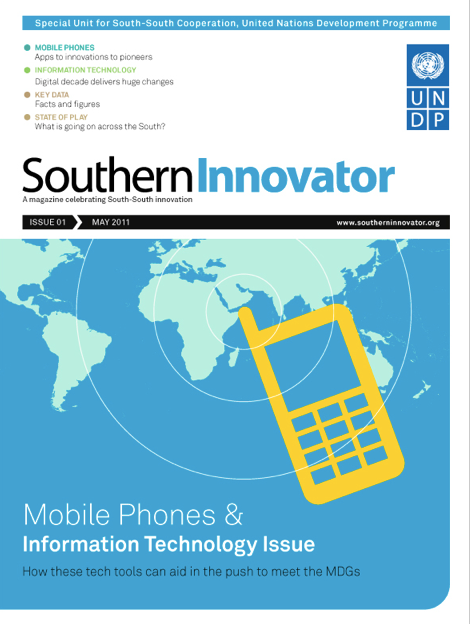
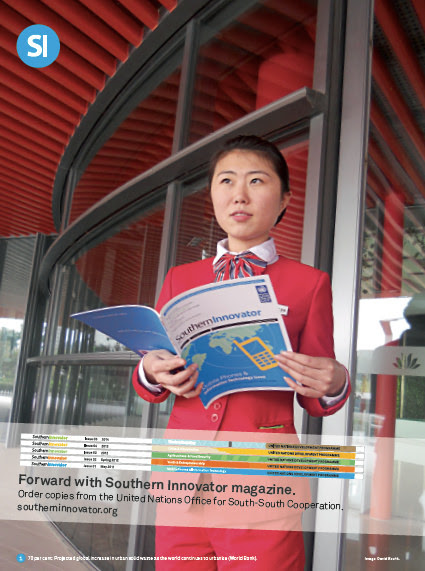
Development Challenges, South-South Solutions was launched as an e-newsletter in 2006 by UNDP’s South-South Cooperation Unit (now the United Nations Office for South-South Cooperation) based in New York, USA. It led on profiling the rise of the global South as an economic powerhouse and was one of the first regular publications to champion the global South’s innovators, entrepreneurs, and pioneers. It tracked the key trends that are now so profoundly reshaping how development is seen and done. This includes the rapid take-up of mobile phones and information technology in the global South (as profiled in the first issue of magazine Southern Innovator), the move to becoming a majority urban world, a growing global innovator culture, and the plethora of solutions being developed in the global South to tackle its problems and improve living conditions and boost human development. The success of the e-newsletter led to the launch of the magazine Southern Innovator.  

Follow @SouthSouth1

Google Books: https://books.google.co.uk/books?id=NhQ9BQAAQBAJ&dq=development+challenges+may+2014&source=gbs_navlinks_s

Slideshare: http://www.slideshare.net/DavidSouth1/may-2014-development-challenges

Southern Innovator Issue 1: https://books.google.co.uk/books?id=Q1O54YSE2BgC&dq=southern+innovator&source=gbs_navlinks_s

Southern Innovator Issue 2: https://books.google.co.uk/books?id=Ty0N969dcssC&dq=southern+innovator&source=gbs_navlinks_s

Southern Innovator Issue 3: https://books.google.co.uk/books?id=AQNt4YmhZagC&dq=southern+innovator&source=gbs_navlinks_s

Southern Innovator Issue 4: https://books.google.co.uk/books?id=9T_n2tA7l4EC&dq=southern+innovator&source=gbs_navlinks_s

Southern Innovator Issue 5: https://books.google.co.uk/books?id=6ILdAgAAQBAJ&dq=southern+innovator&source=gbs_navlinks_s

Creative Commons License
This work is licensed under a
Creative Commons Attribution-Noncommercial-No Derivative Works 3.0 License.

ORCID iD: https://orcid.org/0000-0001-5311-1052.

© David South Consulting 2023
Categories
Archive Blogroll Development Challenges, South-South Solutions Newsletters Southern Innovator magazine

Innovation from the Global South

By David SouthDevelopment Challenges, South-South Solutions

SOUTH-SOUTH CASE STUDY

 A major study has documented a rising tide of scientific innovation coming from Asia’s fast-developing countries, especially India and China. Conducted over 18 months by UK-based think tank Demos, it challenges the conventional wisdom that scientific ideas come from the top universities and research laboratories of large companies based in Europe or the US. It found ideas emerging in unexpected places, flowing around the world conveyed by a mobile diaspora of knowledge workers from the South.

China has seen its spending on research and development jump by 20 percent each year since 1999. India is now producing 260,000 engineers a year and its number of engineering colleges is due to double to 1,000 by 2010. Research and development in India has grown by threefold over the past decade. There is now a global flow of research and development money to the new knowledge centres of Shanghai, Beijing, Hyderabad and Bangalore.

The study found the greater political and economic emphasis being placed on science and technology was paying dividends. These emerging science powers are now investing heavily in research to become world leaders in information technology, biotechnology and nanotechnology within the next ten to fifteen years. This is also producing a flood of scientific papers from China and India to the world’s prestigious scientific journals.

For India, its knowledge-based industries by the end of this year will be a US $57 billion export industry, accounting for 4 million jobs and 7 percent of Indian GDP. Interestingly, the study also found a new wave of change is underway. Where once it was mostly low-wage manufacturing and call centre jobs that were going to China and India, a new wave of research and development jobs is now moving there. Drawn in by technology clusters in Shanghai and Bangalore, “Microsoft began to realize we can’t find all the talented people in the US. Nowhere in this universe has a higher concentration of IQ power (than India),” said Harry Shun, head of Microsoft’s research in Asia.

Published: April 2007

Resources

  • The Atlas of Ideas is an 18-month study of science and innovation in China, India and South Korea, with a special focus on new opportunities for collaboration with Europe. It is a comprehensive account of the rising tide of Asian innovation. It pinpoints where Asian innovation is coming from and explains where it’s headed. Special reports on China, India and Korea, introducing innovation policy and trends in these countries can be downloaded for free here.
  • Entrepreneurship Development Institute of India
  • Innovation China: A website linking all stories on the fast-breaking world of Chinese innovation.

https://davidsouthconsulting.org/2022/10/05/african-innovation-eco-system-taking-shape/

https://davidsouthconsulting.org/2021/07/18/case-study-7-unossc-undp-2007-2016/

https://davidsouthconsulting.org/2020/04/25/china-looking-to-lead-on-robot-innovation/

https://davidsouthconsulting.org/2021/01/05/development-challenges-south-south-solutions-newsletter/

https://davidsouthconsulting.org/2022/10/24/flurry-of-anti-poverty-innovations/

https://davidsouthconsulting.org/2021/03/24/frugal-innovation-trend-meets-global-souths-innovation-culture/

https://davidsouthconsulting.org/2022/11/16/housing-innovation-in-souths-urban-areas/

https://davidsouthconsulting.org/2017/10/18/innovation-agenda-and-timeline-2007-2015/

https://davidsouthconsulting.org/2022/11/11/innovation-cairos-green-technology-pioneers/

https://davidsouthconsulting.org/2020/12/14/innovation-in-growing-cities-to-prevent-social-exclusion/

https://davidsouthconsulting.org/2022/04/28/innovation-in-the-slums-can-bring-peace-and-prosperity/

https://davidsouthconsulting.org/2021/03/04/innovation-villages-tackling-mdgs/

https://davidsouthconsulting.org/2021/10/22/innovations-in-green-economy-top-three-agenda/

https://davidsouthconsulting.org/2016/04/14/southern-innovator-and-the-growing-global-innovation-culture-14-april-2016/

https://davidsouthconsulting.org/2022/11/01/southern-innovator-magazine-2010-2014/

Development Challenges, South-South Solutions was launched as an e-newsletter in 2006 by UNDP’s South-South Cooperation Unit (now the United Nations Office for South-South Cooperation) based in New York, USA. It led on profiling the rise of the global South as an economic powerhouse and was one of the first regular publications to champion the global South’s innovators, entrepreneurs, and pioneers. It tracked the key trends that are now so profoundly reshaping how development is seen and done. This includes the rapid take-up of mobile phones and information technology in the global South (as profiled in the first issue of magazine Southern Innovator), the move to becoming a majority urban world, a growing global innovator culture, and the plethora of solutions being developed in the global South to tackle its problems and improve living conditions and boost human development. The success of the e-newsletter led to the launch of the magazine Southern Innovator.

Creative Commons License
This work is licensed under a
Creative Commons Attribution-Noncommercial-No Derivative Works 3.0 License.

ORCID iD: https://orcid.org/0000-0001-5311-1052.

© David South Consulting 2023

Categories
Archive Blogroll Development Challenges, South-South Solutions Newsletters Southern Innovator magazine

Dynamic Growth in African ICT is Unlocking Secrets of SME Treasure Trove

By David SouthDevelopment Challenges, South-South Solutions

SOUTH-SOUTH CASE STUDY

A newly released survey of 14 African countries in 2006 has documented the impact of Information and Communication Technology (ICT) on private sector development and how it is contributing to developing a vibrant Small Medium Enterprise (SME) sector in Africa. It discovered how dynamic the SME sector is, how it has rapidly adopted mobile phone technology (96 percent have it), and how if used properly in concert with this new technology, extraordinary economic growth is possible.

The survey – Towards An African e-Index: SME e-Access and Usage in 14 African Countries – covered only businesses employing fewer than 50 people and took in the vast informal sector in the countries. It investigated if they had access to ICTs, how they are using them and if it was making them more productive. SMEs were especially interesting because they do not waste money (most people are just trying to survive) and they only use what is really useful to them to increase income. In the informal sector this has become the mobile phone.

The countries surveyed included Botswana, Cameroon, Ethiopia, Ghana, Kenya, Mozambique, Namibia, Nigeria, Rwanda, South Africa, Tanzania, Uganda, Zambia and Zimbabwe. With most of the continent’s poor working in the SME sector, little was actually known about the impact of ICT and its link to profitability and labour productivity. And surveying only formal businesses would be telling half the story since about two-thirds of non-resource driven GDP generation is derived from SMEs, and a large share of that from informal ones.

“This is a sector that has no access to formal finance,” said Dr. Christopher Stork, a senior researcher at the Witwatersrand University in South Africa. “The mobile phones present an opportunity to tap into this market and offer finance, banking services, cash transfers – we see this already in Kenya – without the risks of other services. These informal businesses can build up a history, learn how to better control their businesses, and receive loans. Where the financial system is dysfunctional or overpriced, airtime credits can be the new cash form.”

Africa has a high proportion of entrepreneurs because people have next to no social supports to fall back on and need to do business to survive. Most fall into the informal sector where they can avoid paying tax, pay low wages, and keep overheads down. According to Stork, if governments are serious about dealing with poverty, then the best approach is to acknowledge this sector, and rather than crush it, draw it in to become more sophisticated and efficient. He sees the mobile phones as key to this strategy.

“Innovative technology can help these entrepreneurs to acquire the tools they need to do business better. There is a lack of skills in all areas, a lack of accounting skills, a lack of basic financial management. This is where ICT can overcome this. SMEs can get a monthly statement with all their business transactions, making it easier to manage things. This would be a great way to distribute micro-finance. Savings clubs could store cash on the phones.”

The e-Index also noted the trend for mobile phone providers to consolidate and offer common regional services. This could fuel an explosion in cross-border trade as it becomes cheaper and easier to communicate via mobile phone for business. The e-Index also found the ever-growing importance of internet cafes remains. They continue to evolve into multi-purpose business centres offering a wide range of services, from post to word processing. At present they still remain the main means of accessing the internet. And with broadband still minimal and very expensive, it falls on mobile phones to offer internet access, though this will remain mainly in the continent’s capitals.

The survey’s sponsor, Research ICT Africa! (RIA!) network, seeks to build an African knowledge base in support of ICT policy and regulatory design. The network emerged out of a growing need for hard data and analysis to help the continent join the information age. Throughout 2007 it is conducting household surveys on e-access and e-usage and will present the findings in 2008.

You can download for free the entire report Towards An African e-Index: SME e-Access and Usage in 14 African Countries here: Click

Published: February 2007

https://davidsouthconsulting.org/2022/11/21/africa/

https://davidsouthconsulting.org/2022/10/26/africa-to-get-own-internet-domain/

https://davidsouthconsulting.org/2022/11/11/african-botanicals-to-be-used-to-boost-fight-against-parasites/

https://davidsouthconsulting.org/2022/11/11/african-breakthroughs-to-make-life-better/

https://davidsouthconsulting.org/2022/11/19/african-culture-as-big-business/

https://davidsouthconsulting.org/2022/11/17/african-ingenuity-attracting-interest/

https://davidsouthconsulting.org/2022/11/15/african-innovators-celebrated-in-prize/

https://davidsouthconsulting.org/2022/10/21/african-media-changing-to-reach-growing-middle-class/

https://davidsouthconsulting.org/2022/11/02/african-online-supermarket-set-to-boost-trade/

https://davidsouthconsulting.org/2022/10/26/african-trade-hub-in-china-brings-mutual-profits-2/

https://davidsouthconsulting.org/2022/10/26/africas-consumer-market-in-spotlight-for-2011/

https://davidsouthconsulting.org/2022/10/20/africas-tourism-sector-can-learn-from-asian-experience/

https://davidsouthconsulting.org/2022/10/24/made-in-africa-fashion-brand-pioneers-aim-for-global-success/

https://davidsouthconsulting.org/2022/10/25/many-positive-trends-for-africa-in-2010/

https://davidsouthconsulting.org/2022/10/21/a-new-african-beer-helps-smallholder-farmers/

https://davidsouthconsulting.org/2022/11/01/new-journal-celebrates-vibrancy-of-modern-africa/

https://davidsouthconsulting.org/2022/10/26/shopping-and-flying-in-africas-boom-towns/

Development Challenges, South-South Solutions was launched as an e-newsletter in 2006 by UNDP’s South-South Cooperation Unit (now the United Nations Office for South-South Cooperation) based in New York, USA. It led on profiling the rise of the global South as an economic powerhouse and was one of the first regular publications to champion the global South’s innovators, entrepreneurs, and pioneers. It tracked the key trends that are now so profoundly reshaping how development is seen and done. This includes the rapid take-up of mobile phones and information technology in the global South (as profiled in the first issue of magazine Southern Innovator), the move to becoming a majority urban world, a growing global innovator culture, and the plethora of solutions being developed in the global South to tackle its problems and improve living conditions and boost human development. The success of the e-newsletter led to the launch of the magazine Southern Innovator.

https://davidsouthconsulting.org/2022/11/01/southern-innovator-magazine-2010-2014/

Creative Commons License

This work is licensed under a
Creative Commons Attribution-Noncommercial-No Derivative Works 3.0 License.

ORCID iD: https://orcid.org/0000-0001-5311-1052.

© David South Consulting 2023

Categories
Archive data Development Challenges, South-South Solutions Newsletters Southern Innovator magazine

Computing in Africa is Set to Get a Big Boost

By David SouthDevelopment Challenges, South-South Solutions

SOUTH-SOUTH CASE STUDY

The image of Africa as a technological laggard is set to be seriously challenged as a number of developments converge in 2007. Alongside the booming African mobile phone market – itself now getting global attention for innovation – the African computer scene will soon have both the software and hardware that acknowledge the continent’s unique needs while being affordable. Further challenging stereotypes, the continent’s burgeoning and dynamic open source software movement is the subject of a new film by a Danish filmmaker, and the African-made Ubuntu, Linux-based operating system now has a new user manual to help it attract new adherents.

African technological innovation rarely makes headlines in the West. But a Danish filmmaker is changing these perceptions with his film showing the dynamism and enthusiasm behind the open source software movement in Africa. The yet-untitled film, directed by David Madie, is from Eighty Days Productions and is due for release in the spring of 2007. It follows a young computer entrepreneur, Wire Lunghabo James, from Uganda’s Linux Solutions in Africa, who has been instrumental in building the Web’s presence in the country and in East Africa.

“This film will show the characters fighting for what they believe in. This happens to be Open Source, which I think is an important agenda,” director Madie told Tactical Technology Collective ( www.tacticaltech.org), a website “demystifying technology for non-profits.”

Unlike off-the-shelf software, open source software has many advantages. It is free, and no licence fee is required, so as many copies as necessary can be made. It is fully customisable, so local languages and cultural conditions can be taken into consideration. It is a universal language (the most popular is Linux) and thus it is easier to understand how a specific application works. For developing countries, it has the advantage of empowering local programmers and dymistifying computer programming, removing it from the domain of private companies and large government agencies. In 2005 the New Partnership for African Development (NEPAD) urged African countries to embrace open source software to encourage the growth of indigenous software development.

“I think he (James) is also a role model in the sense that he combines doing a business, with doing social work. To him these things are not opposites: these are things that can perfectly work well together. You can do business in a social manner,” Madie said.

The Ubuntu software programme is a complete, free operating system that emphasizes community, support, and ease of use while refusing to compromise on speed, power, and flexibility. Ubuntu is an ancient African word meaning humanity to others, and its software version is described as Linux for human beings – designed for everyone from computer novices to experts. Ubuntu is the most in-demand Linux system in Africa, and the official guide is aimed at NGOs, home users or small businesses.

One Laptop Per Child Project (OLPC)

In another development, the One Laptop Per Child project (OLPC) has announced the release for general sale of its durable bright green and yellow laptops ready loaded with Linux-based operating systems. Customers in wealthy countries will have to buy two laptops, with the second going to a developing country. Five million will be delivered to the developing world over the summer of 2007. The eventual aim is to sell the machine to developing countries for US $100, but the current cost of the machine is about US $150. The OLPC laptop’s software has been designed to work specifically in an educational context. It has built-in wireless networking and video conferencing so that groups of children can work together. The OLPC project is working with the search engine Google, who will act as “the glue to bind all these kids together”. Google will also help the children publish their work on the internet.

The One Laptop Per Child project (http://wiki.laptop.org/go/Home) has struck its first deal with Rwanda’s president Paul Kagame to provide every school pupil with a laptop computer within the next five years. The laptops and all the support costs will be covered by OLPC.

Published: January 2007

Resources 

https://davidsouthconsulting.org/2022/02/09/african-health-data-revolution/

https://davidsouthconsulting.org/2021/02/20/african-supercomputers-to-power-next-phase-of-development/

https://davidsouthconsulting.org/2022/10/06/african-technology-tackles-health-needs/

https://davidsouthconsulting.org/2020/12/04/big-data-can-transform-the-global-souths-growing-cities/

https://davidsouthconsulting.org/2020/12/04/data-surge-across-global-south-promises-to-re-shape-the-internet/

https://davidsouthconsulting.org/2022/10/20/the-e-reader-battle-reaches-india/

https://davidsouthconsulting.org/2021/02/18/what-is-the-un-doing-with-your-data/

Development Challenges, South-South Solutions was launched as an e-newsletter in 2006 by UNDP’s South-South Cooperation Unit (now the United Nations Office for South-South Cooperation) based in New York, USA. It led on profiling the rise of the global South as an economic powerhouse and was one of the first regular publications to champion the global South’s innovators, entrepreneurs, and pioneers. It tracked the key trends that are now so profoundly reshaping how development is seen and done. This includes the rapid take-up of mobile phones and information technology in the global South (as profiled in the first issue of magazine Southern Innovator), the move to becoming a majority urban world, a growing global innovator culture, and the plethora of solutions being developed in the global South to tackle its problems and improve living conditions and boost human development. The success of the e-newsletter led to the launch of the magazine Southern Innovator. 

https://davidsouthconsulting.org/2021/03/05/southern-innovator-issue-1/

Creative Commons License

This work is licensed under a
Creative Commons Attribution-Noncommercial-No Derivative Works 3.0 License.

ORCID iD: https://orcid.org/0000-0001-5311-1052.

© David South Consulting 2023