Category: Development Challenges, South-South Solutions Newsletters
The Development Challenges, South-South Solutions e-newsletter was published by the United Nations Office for South-South Cooperation (UNOSSC) from 2006 to 2014.
Many initiatives seek to bring inexpensive access to the internet to rural and remote regions around the world. One of the most successful ways to rapidly expand access is to offer wireless internet so that anyone can use a laptop computer, a PC or a mobile phone to quickly access the Net. Access to wireless internet is being rolled out in cities around the world with so-called ‘hot spots’, but the thornier issue of improving access in rural or remote regions could get better, thanks to a Venezuelan team.
The rapid expansion of mobile phones has done much to reduce the digital divide in Africa, for example, where the number has grown from just 15 million in 2000 to more than 160 million by the end of 2006, according to the International Telecommunications Union. This rapid growth has paid off: Morocco, Senegal, Ghana, Gabon and Cote d’Ivoire are in the top ten gainers of the Digital Opportunity Index, 2004-2006 (http://www.itu.int). The proliferation of Wi-Fi-enabled mobile phones combined with the spread of inexpensive wireless access has the potential to close the digital divide between rural and urban areas.
The issue of inequality in access to the internet has stark consequences for global economic development. Already, according to the World Information Society Report 2007, “Europe has achieved the largest overall gain in digital opportunity over the last two years, followed by the Americas… Asia and Africa have witnessed smaller gains in digital opportunity. The implications for the digital divide are clear: digital opportunity is becoming more sharply divided by region, not less.”
As the Digital Divide campaign learned, it is more important to keep in mind “Internet kiosks or rental of cell phones and other devices hold great promise for the poor. But shared use is a complement to a strategy that involves giving each person their own wireless device. Eventually, the price of such devices will be low enough so that everyone can have their own device.”
A Venezuelan team led by Ermanno Pietrosemoli, president of the Latin American networking association Escuela Latinoamericana de Redes, has broken the world record for unamplified broadcasting of a Wi-Fi (wireless internet) signal. The signal was broadcast in June from two mountains 282 kilometres apart in the Venezuelan Andes. Importantly, they did this using equipment costing only just over US $360, while producing a signal strong enough to send video messages. The former record was 220 kilometres set in 2005.
The consequence of this achievement for entrepreneurs is important: It means inexpensive wireless signals can now reach further into remote and rural regions for a small investment.
“We we’re able to transmit voice and video with both,” said Professor Pietrosemoli. “280 kilometres is pushing the envelope, but the same technique can be used at distances of some 150 kilometres by people with some basic training provided there is uninterrupted line of sight between the end points. This usually means shooting from hills or using them as repeater points. For distances up to 80 kilometres, towers can be used to provide connectivity even in flat land”
Pietrosemoli is willing to train people in the techniques he has developed for transmitting wireless over large distances (https://wireless.ictp.it or www.eslareed.org.ve).
The advantages of this approach include cost and simplicity. The more commercial WiMax technology costs more and is usually installed by large companies. Pietrosemoli’s technique is for people who lack those technical and financial advantages.
“I have been installing wireless networks for some 20 years,” he continued, “and reckon that wireless is the only viable alternative to ameliorate the digital divide in developing countries. For rural areas, the challenge is to use as little repeater sites as possible, as each repeater adds costs, delay and powering issues.”
Pietrosemoli said the only other obstacle to setting these networks up is the availability of unlicensed radio frequency spectrum in the 2,4 and 5 Ghz bands. The International Telecommunications Union has recommended that countries make these free for the use of data networks, but some countries are still blocking this.
The Wireless Geographic Logging Engine: This is a website with maps tracking the presence of Wi-Fi access around the globe. So far it maps over 10 million separate Wi-Fi networks. Entrepreneurs only have to log into the website to start searching for wireless networks near them.
Southern Innovator Issue 1: Mobile Phones & Information Technology.
To tackle diseases in the developing world, the most important first step is diagnosis. Without effective diagnosis, it is difficult to go to the next steps of either treatment or cure. While much attention is given to the high costs involved in treating and curing ailments, screening for diagnosis is also expensive, especially if it involves lots of people. Anything that can reduce the cost of diagnosis will free up resources to expand the number of people who can be checked, and help eradicate contagious diseases.
One innovation is an inexpensive microscope that could allow diagnosing diseases such as malaria to be done on a much larger scale. Called the Foldscope (foldscope.com), it is made from paper, comes in a variety of bright colors and resembles the cardboard, three-dimensional cut-and-keep models regularly found in children’s books and magazines.
Foldscope’s designs are developed on a computer and then printed. Foldscopes are made from thick paper, glue, a switch, a battery and a light-emitting diode (LED) (http://en.wikipedia.org/wiki/Light-emitting_diode).
Inspired by the ancient Japanese paper-folding craft of Origami (http://en.wikipedia.org/wiki/Origami), Foldscope’s makers at the Prakash Lab at Stanford University (http://www.stanford.edu/~manup/) are trying to create “scientific tools that can scale up to match problems in global health and science education”, according to their website.
Once assembled, a user places a standard glass microscope slide in the Foldscope, turns on the LED light and uses their thumbs to guide the lens to view the slide.
Each Foldscope can magnify up to 2000 times with a sub-micron resolution of 800 nm. The battery can last up to 50 hours on a single button-cell battery and requires no further external power. Its makers claim it can survive being stepped on or dropped from a three-storey building. It can perform a wide variety of microscopy techniques.
Its makers hope to manufacture billions of Foldscopes a year by exploiting the cheapness of the material and the simplicity of construction.
A beta test called “Ten Thousand Microscopes” will enlist 10,000 people to test the Foldscope in the field. Participants will contribute to helping write a field manual for the Foldscope prior to mass manufacturing. The Foldscope costs just US $0.50 to make for the basic model and US $1 for a higher-magnification version.
Field tests are taking place in the United States, Uganda and India.
Foldscope is designed to be used where more sophisticated lab analysis is not possible or affordable. It can also be an educational tool to give students experience in hands-on microscopy, or build awareness in the general population of how infectious diseases are spread by unseen lifeforms.
Foldscope’s makers hope their creation will help diagnose common but devastating diseases including Plasmodium falciparum (malaria), Trypanosome cruzi (Chagas disease), Giradia lamblia (giardiasis), Leishmania donovani (leishmaniasis), Dirofilaria immitis (filariasis), Human Sickle Cell (sickle-cell anaemia), E. Coli and Bacillus and Pine strobilus.
The quantity of people that need to be checked for diseases is vast and means, in countries where incomes and resources are low, it just isn’t possible to undertake diagnostic services using conventional methods.
“There is definitely a huge gap between where we are and where we want to be,” Stanford School of Medicine Assistant Professor for Bioengineering Manu Prakash explained on the university’s website.
“When you do get it (malaria), there is this simple-minded thing ‘forget diagnostics, let’s just get that tablet’ – and that’s what happens in most of the world. But the problem is there is many different strains, there are many different medications, you could potentially make the problem even worse by not realizing that you have malaria. And at the same time, the people who get a severe case – they are not detected at all.
“What is that one thing that you could almost distribute for free that starts to match the specificity of what detection requires? For malaria, the standard is to be able to image, and sit on a microscope and essentially go through slides.
“What we found as a challenge, if you truly want to scale, you should be really testing more than a billion people every year: that’s a billion tests a year. Any platform that you can imagine needs to scale to those numbers to make an impact.
“One of these things that have been shown over and over again – if you can put (in place) an infrastructure to fight malaria that is scalable and sustainable, then you get retraction of malaria in different regions.”
2) WHO: Ten Facts on Malaria: About 3.4 billion people – half of the world’s population – are at risk of malaria. In 2012, there were about 207 million malaria cases (with an uncertainty range of 135 million to 287 million) and an estimated 627,000 malaria deaths (with an uncertainty range of 473,000 to 789,000). Website: http://www.who.int/features/factfiles/malaria/en/
4) Microscope adapter app for smartphones: iPhone, Android, Blackberry or any Smartphone, with an attachment and an app, can be turned into a microscope. Website: http://internetmedicine.com/iphone-microscope/
5) Stanford University: Stanford University, located between San Francisco and San Jose in the heart of California’s Silicon Valley, is one of the world’s leading teaching and research universities. Website: stanford.edu
6) MaRS: Located in Toronto, Canada, MaRS is where science, technology and social entrepreneurs get the help they need. Where all kinds of people meet to spark new ideas. And where a global reputation for innovation is being earned, one success story at a time. Website: marsdd.com
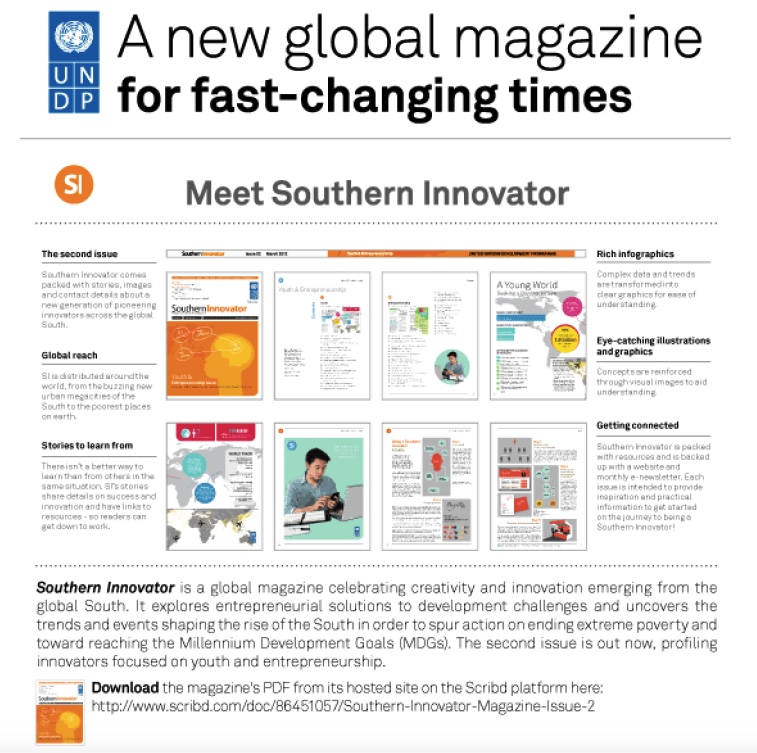
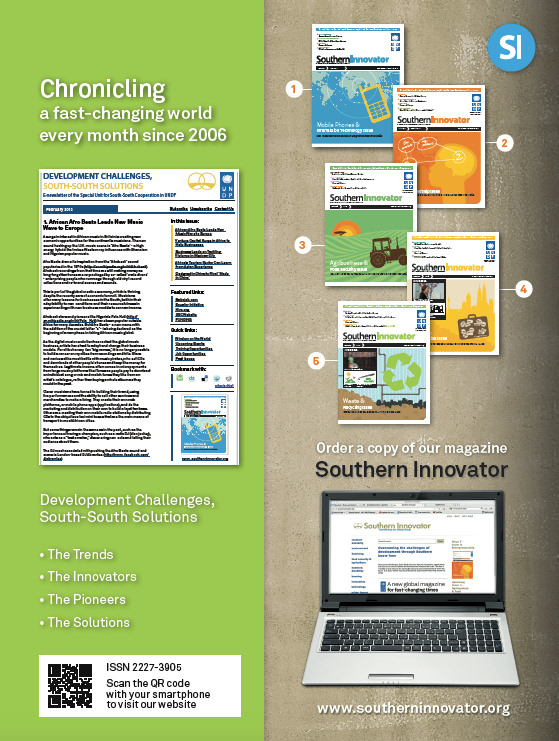
Development Challenges, South-South Solutions was launched as an e-newsletter in 2006 by UNDP’s South-South Cooperation Unit (now the United Nations Office for South-South Cooperation) based in New York, USA. It led on profiling the rise of the global South as an economic powerhouse and was one of the first regular publications to champion the global South’s innovators, entrepreneurs, and pioneers. It tracked the key trends that are now so profoundly reshaping how development is seen and done. This includes the rapid take-up of mobile phones and information technology in the global South (as profiled in the first issue of magazine Southern Innovator), the move to becoming a majority urban world, a growing global innovator culture, and the plethora of solutions being developed in the global South to tackle its problems and improve living conditions and boost human development. The success of the e-newsletter led to the launch of the magazine Southern Innovator.
The Caribbean country of Haiti has had to deal with the twin challenges of recovering from a devastating earthquake in 2010 while also pulling itself out of the economic and social chaos that has resulted in its status as the poorest place in the Western hemisphere.
Violence has also led to a number of UN peacekeeping missions in Haiti over the years, and there is now a substantial international presence in the country to aid in stabilization and economic recovery (http://www.un.org/en/peacekeeping/missions/minustah/).
Haiti has a lot of potential when it comes to agriculture, but this would require substantial changes in the way land and agriculture are managed.
Haiti is ranked 77 out of 79 countries in the 2012 Global Hunger Index. Access to sufficient quantities of nutritious food remains an issue for millions of Haitians. An estimated 3.8 million Haitians, or 38 per cent of the population, is food insecure (WFP 2012). Despite its fertile potential, Haiti is dependent on food aid and imports to meet its food security needs.
Fifty per cent of the country’s food requirements are imported, and food prices have been rising since the end of 2010, the year of Haiti’s devastating earthquake. This increase has led to an overall loss of purchasing power for the majority of Haitians. Low agricultural productivity and urban encroachment on arable land provide additional challenges for Haiti’s rural populations. Eighty per cent of farms fail to produce enough to feed their households (http://www.foodsecurityportal.org/haiti/resources).
But some are trying to create a new market for Haiti’s agricultural products to help boost farmers and farming as an occupation and an industry.
It’s hard to imagine now, but Haiti was once the world’s largest producer of coffee in the 18th century when it was a French colony. Today Haiti produces less than 1 per cent of the world’s coffee.
The targeting of niche coffee drinkers in the United States has introduced a new market to the special taste of the Haitian brew. While the market at present is small, some are hoping, with the right measures, it could be grown significantly, boosting both the country’s revenue from agricultural exports and incomes for coffee farmers.
Several US-based companies are carving out a market for Haitian coffee and boosting awareness about the country’s unique coffee beans. La Colombe Coffee Roasters (http://lacolombe.com/), based in the city of Philadelphia, has already been able to export four shipping containers of Haitian coffee to the United States since 2010. The company supplies high-end chefs such as Eric Ripert and Daniel Boulud.
In Florida, Kafe Pa Nou (kafepanou.com) – “our coffee” in Haitian Creole – is owned by Haitian-American Jean René Faustin and sells online coffee from Haitian suppliers Rebo and Cafe Selecto.
So far, Haitian coffee has not been able to gain wider distribution through mass buyers such as Starbucks because it has not been possible to supply the quantities required to fulfill such a contract.
Haiti would need to boost its current average coffee yield of 250 kilograms per hectare to double or triple that yield to gain large-scale contracts.
“Haiti was for a brief moment in time the biggest producer of coffee for export in the world,” Gilbert Gonzales, Vice President of coffee exporter Rebo (http://rebo.ht/The%20Technics.htm), told Medium for Haiti (https://medium.com/medium-for-haiti). But “right now, most people would say it’s impossible” for Haiti’s coffee sector to return to international prominence.
“We’re not saying that it’s possible in the next two years, maybe not even in the next 12 years,” he said. “But it is possible.”
The coffee cherries used to make the popular beverage are processed in one of two ways: a dry process and a wet process. In Haiti, the dry process is more commonly used to form a hard cocoon on the outside of the coffee cherries to help preserve them for a year or more.
This enables farmers to preserve the coffee cherries so they can keep a portion of the crop back as a safety reserve.
The wet processed beans are first immersed in water and then the pulp is washed away before the beans are dried (http://coffee.wikia.com/wiki/Wet_process). The superior flavor this creates has attracted fans in the United States, especially in the trendy neighbourhoods of Brooklyn, New York and San Francisco, California. By bucking the traditional Haitian dry processing method for the beans, it is possible to earn three times the market price by selling wet-processed beans.
Haiti’s history of coffee growing goes back to the 1700s. At the time, the country grew half the world’s coffee. This helped to make the French colony highly profitable.
This long heritage has left the country with a unique asset: original Arabica typica coffee trees first imported by Europeans to Haiti. These coffee trees are considered to be heirloom because they are so old and untainted by modern breeding methods. According to Douglas Weiner in Medium for Haiti, “when you drink coffee from Haiti, it’s like drinking coffee from 200 years ago.”
Weiner is part of a family business, Geo Weiner (http://selectohaiti.com/home/), which has been selling Haitian coffee for four generations and is one of the few surviving coffee exporters in the country.
The country has an estimated 200,000 coffee farmers. Because their methods have not changed much, they are effectively organic (https://en.wikipedia.org/wiki/Organic_food). Most farmers can not afford chemical fertilizers and pesticides.
The coffee farms are located in mountain areas with a rich biodiversity of plants and trees. This stands in stark contrast with much of the rest of the country, where deforestation has left the country with just 2 per cent of virgin forest left. Coffee-producing areas are lush and green because coffee is one of the few cash crops that makes enough money to keep it worthwhile to preserve the trees and foliage. In other parts of the country, many are making money from turning trees into charcoal for cooking fuel, the most common fuel for most of the country’s population.
Haiti’s coffee growers have had a hard time coping with the rise and fall of world coffee prices. The world market price for coffee dropped in the early 2000s as the markets were flooded with coffee from Brazil and Vietnam. In response, farmers then cut down the coffee trees and replaced them with subsistence crops such as corn and beans.
With the amount of coffee grown in Haiti dropping quickly, the number of exporters in the country plummeted from 20 companies to two companies today, Geo Weiner and Rebo.
Jobert Angrand, Executive Coordinator of the National Institute of Coffee (http://www.icefda.org/), believes coffee production declined in Haiti because of a wide range of problems, from diseases and pests to aging trees, too-small plots and inefficient production methods. Per-hectare coffee yields are as low as one-tenth of production in Latin America.
The Vice President of coffee exporter Rebo says these problems are holding things back. “I don’t think today we’re looking into going mainstream,” said Gilbert Gonzales. “We can’t. There is not enough volume for that.”
Because production will be small, Gonzales believes Haiti would be wise to target the higher end of the marketplace with American grocery stores such as Trader Joe’s and Whole Foods: “It’s looking into the higher-end gourmet shops, things like that,” he said, “so that we could really share with the rest of that world the quality available from Haiti.”
Significant purchases of Haitian coffee have been made by various overseas companies, which does give hope that this plan could work. Irish coffee company Java Republic bought 97 tonnes of Haitian coffee from the Rebo exporter in 2010.
2) International Coffee Organization: The International Coffee Organization (ICO) is the main intergovernmental organization for coffee, bringing together exporting and importing governments to tackle the challenges facing the world coffee sector through international cooperation. Its member governments represent 97 per cent of world coffee production and over 80 per cent of world consumption. Website: http://www.ico.org/
4) Puro Fairtrade Coffee: Puro is a leading brand of Fairtrade and Fair Trade Organic coffee that works in partnership with the World Land Trust to purchase and protect areas of precious rainforest in South America. Website: http://www.purocoffee.com/
Development Challenges, South-South Solutions was launched as an e-newsletter in 2006 by UNDP’s South-South Cooperation Unit (now the United Nations Office for South-South Cooperation) based in New York, USA. It led on profiling the rise of the global South as an economic powerhouse and was one of the first regular publications to champion the global South’s innovators, entrepreneurs, and pioneers. It tracked the key trends that are now so profoundly reshaping how development is seen and done. This includes the rapid take-up of mobile phones and information technology in the global South (as profiled in the first issue of magazine Southern Innovator), the move to becoming a majority urban world, a growing global innovator culture, and the plethora of solutions being developed in the global South to tackle its problems and improve living conditions and boost human development. The success of the e-newsletter led to the launch of the magazine Southern Innovator.
Fashion is a significant global business: some estimates place the world’s clothing industry at US $900 billion a year. Clothing – like food – is something everyone requires, so fashion can be an accessible way for small-scale entrepreneurs and craftspeople to earn income and eventually tap into larger marketplaces. Through clever use of the internet and online shopping, small-scale fashion designers and clothing makers can access global markets and earn income from around the world. Initiatives like ShopAfrica53 (http://www.shopafrica53.com/) are helping people to get online and establish small web shops.
The Democratic Republic of Congo is the size of western Europe. A bitter, decade-long civil war that officially ended in the rest of the country in 2003, and that has claimed several million lives through fighting and disease, still burns on in the eastern border provinces of Ituri, North Kivu and South Kivu. As a result, Congo is now home to the world’s largest UN peacekeeping mission.
In the face of this civil strife, a group of very fashionable gentlemen bring colour and style to the country while also pioneering a way to make money and improve standards of dress in the country. Members of “La sape,” or La Societe des Ambianceurs et Personnes Elegantes (http://fr.wikipedia.org/wiki/Société_des_ambianceurs_et_des_personnes_élégantes) — the society of tastemakers and elegant people — wear designer fashions either bought in Europe, or handmade in Congo.
They are inspired by Paris’s society world of parties, social events and fashion as they see it in magazines. It is a hybrid style: French colonialism (the Congo is a former French colony) mixed with individual interpretations of the in ‘look’.
All in the last place in the world you would expect to find such cutting-edge fashion: a place where slums and warfare are the everyday norm.
The gentlement of La Sape are featured in the new book Gentlemen of Bacongo (http://www.trolleybooks.com/bookSingle.php?bookId=118) by photographer Daniele Tamagni. He chronicles in loving detail this bright fashion phenomenon. The cover of the book features a man in an elegantly tailored lipstick pink suit and pink bowler hat – testament to the eye-catching styles on display.
But rather than a local fancy, the look refined by these gentlemen has become the inspiration for designers in Europe, like Britain’s Paul Smith (http://www.paulsmith.co.uk/).
“A Congolese sapeur is a happy man even if he does not eat, because wearing proper clothes feeds the soul and gives pleasure to the body,” Tamagni said.
They also are the living embodiment of a distinctive modern African style.
Their suits are either designer or handmade copies. The sapeurs have strict rules to go with their style: never wear more than three colours together for example.
Tamagni says there is more to the phenomenon than just appearances. Sapeur Salvador Hassan “thinks that a real sapeur needs to be cultivated and speak fluently, but also have a solid moral ethic: that means beyond the appearance and vanity of smart, expensive clothing there is the moral nobility of the individual.”
Says Hassan, “The label is not important, what is important is to be able to dress depending on the taste of the individual.”
For a sapeur, the saints are Pierre Cardin, Roberto Cavalli, Dior, Fendi, Gaultier, Gucci, Issey Miyake, Prada, Yves Saint Laurent, Versace and Yohji Yamamoto.
Unlike the followers of some other fashion styles, they do not worship violence and gang warfare.
Some find the clothes in shops in Brazzaville and Kinshasa but most try to get them from Paris.
So how do they afford these clothes that sometimes cost in the thousands when most are unemployed? They have turned their passion for fashion into a business too. They rent the clothes out for around US $25 a day to earn income. They also save their money to travel back and forth to Europe selecting the best clothes, which they then carry back to Congo and sell for a good profit.
In another development, African fashion magazines are also playing their role in shifting perceptions.
“Honestly, upwardly mobile African readers are crying out for this magazine,” Helen Jennings, editor of Arise, told the New York Times. Arise is a Nigerian style monthly started by Nigerian media mogul Nduka Obaigbena, who also publishes Nigeria’s leading newspaper, This Day.
“Because the local magazines aren’t as high-end or progressive, and no other international titles speak directly to an African readership, Arise has really caused a stir,” said Jennings.
Jennings calls the magazine’s mix of content “afropolitan”: blending pan-African and global content.
The magazine’s debut issue features the models Alek Wek, Naomi Campbell and Liya Kebede. Stories run the gamut from electronic music to football academies, and the rise of Nollywood, Nigeria’s home-grown film industry.
It features African designers and is distributed in seven countries to 60,000 readers.
Along with new magazines, more and more African designers are now getting attention on Africa’s – and the world’s – catwalks. They include Lisete Silvandira Bento Pires Pote, who started as a designer in 1998 and has been featured in many fashion shows in Angola and around the world. Her clothes are now worn by singers and actors.
From Botswana, Koketso Chiepe has been so successful, she opened a fashion shop in London this past summer. Chrystalix is a Cameroonian fashion designer who uses raw materials found in the Equatorial forests of her country. Another Cameroonian design label is Kreyann and sells from its boutique in Douala clothing made from rich materials like silk.
A list of fashion weeks across the global South (http://en.wikipedia.org/wiki/Fashion_week) offers many opportunities to witness this creative surge across the continent.
Published: December 2009
Resources
The online service CafePress is a specially designed one-stop shop that lets entrepreneurs upload their designs, and then sell them via their online payment and worldwide shipping service. Website:http://www.cafepress.com/cp/info/sell/
Once inspired to get into the global fashion business, check out this business website for all the latest news, jobs and events. Website: http://us.fashionmag.com/news/index.php
Development Challenges, South-South Solutions was launched as an e-newsletter in 2006 by UNDP’s South-South Cooperation Unit (now the United Nations Office for South-South Cooperation) based in New York, USA. It led on profiling the rise of the global South as an economic powerhouse and was one of the first regular publications to champion the global South’s innovators, entrepreneurs, and pioneers. It tracked the key trends that are now so profoundly reshaping how development is seen and done. This includes the rapid take-up of mobile phones and information technology in the global South (as profiled in the first issue of magazine Southern Innovator), the move to becoming a majority urban world, a growing global innovator culture, and the plethora of solutions being developed in the global South to tackle its problems and improve living conditions and boost human development. The success of the e-newsletter led to the launch of the magazine Southern Innovator.





 David South Consulting
You must be logged in to post a comment.