Category: Development Challenges, South-South Solutions Newsletters
The Development Challenges, South-South Solutions e-newsletter was published by the United Nations Office for South-South Cooperation (UNOSSC) from 2006 to 2014.
As economies grow in Africa, more and more people are conducting their financial transactions electronically. This can be either through mobile phones and digital devices, or through the hole-in-the-wall of the automatic teller machine, or ATM.
These short cuts mean many people no longer have to endure long line-ups at banks to conduct day-to-day financial transactions. This convenience is revolutionizing banking for many millions of people, but there is a risk: fraud and theft. Both are rising, and are costing customers and banks, both in cash and in damage to the reputation of electronic banking.
Criminal gangs and lone individuals alike are behind this crime. Most notorious are the “carding” and “skimming” gangs, who plant devices on ATMs to read plastic bank cards and steal victims’ money. Mobile devices can also be “hacked” by sophisticated criminal gangs and the data stolen and used to plunder bank accounts. Lone thieves also take people hostage and force them to use their card to withdraw money. A crime victim is usually forced to give over his or her Personal Identification Number (PIN), which the thief then uses to withdraw cash from the ATM.
But just as thieves have become cleverer about the new opportunities created by digital financial transactions, enterprising start-ups are developing innovations to improve financial security.
One Kenyan start-up is hoping to be a pioneer in innovative financial safety software for mobile devices and ATMs. Usalama Innovative Systems, LTD. (http://usalama.biz/), co-owned by graduate student and lead programmer Denis Karema (deniskarema.com), has already been singled out for a CIO magazine’s CIO100 Award in Enterprise Innovation in 2011 (http://www.cio.com/cio-awards/cio100).
Karema has been working in information technology since 2008 and has a background in computer science. He has built his experience while working on various information technology projects in East Africa.
The ambitious company says it wants to be “the leading provider of innovative solutions to financial entities in Africa by 2015.” Usalama has developed various systems pending patents and copyrights and has built up experience in deploying enterprise information technology.
Usalama is seeking additional funding from investors for multiple innovations to protect customer financial transactions. One of them is an ATM solution, which the company claims can reduce theft by over 90 per cent. Speaking with the Business Daily Africa website, Karema explained the anti-fraud application, dubbed Safety Pin.
“When someone approaches you or when you are involved in a carjacking, or one of those unfortunate incidences, you give them your card or PIN as they ask for it, but when they get to the machine it does not treat them the same way as it does you,” Karema said.
The thief is presented with what looks like the victim’s bank account but actually only has 10 per cent of their cash on display. The thief will then withdraw this cash and think they have cleaned out the victim’s bank account.
It is a clever solution which doesn’t entirely block the thief from receiving money from the ATM, but just gives them a small portion of the amount in the account. The idea is to fulfil the psychological need of the thief to get some cash in the robbery attempt, so they will then release the hostage and go away.
“We are working on reducing the amounts that can be lost by up to 90 per cent, so it means if I have 100,000 shillings in my account, only 10,000 shillings can be lost through fraud,” Karema said.
The amount that is stolen can be covered by bank insurance policies so that the customer does not suffer a serious financial loss.
“(The) good thing about this application, first of all, is this hasn’t been done before,” Karema said. “People have come close to creating ATM anti-fraud measures, like asking you to put your PIN in reverse. But they don’t seem to work. For each of them, you are ending up having your money stolen and then following up with the fraudster. So our application prevents the money from being stolen in the first place. So our preventative measure is better than a curative one when money is involved. And also the application is applicable globally.
“We intend to have this implemented in each and every commercial bank, not only in Africa, but the rest of the world.
“A bank can recoup investment in our application within the first year [by avoiding the loss of clients and funds from fraud]. Aside from that, the bank is also able to receive complete and detailed reports each and every time a fraud occurs and so it makes it easier for the bank to monitor trends and also to know which of their outlets are having more and more fraud-related cases.”
Other innovations Usalama has been developing include Usalama Pin, which helps commercial banks monitor fraud in real time; Usalama Spy, which gives more detailed fraud reports and analyzes the information; Home Bank, a way to offer 24/7 banking to customers so they can deposit the money directly into savings accounts without delay; and Usalama Mobile, a mobile banking and money service solution.
Usalama believes the suite of solutions will help banks to retain current customers and make their financial transactions safer, attracting so-called “high net worth” clients. Usalama believes this will help banks in Africa grow their number of customers and cash reserves.
“We are always thinking about innovation because we feel that innovation is the key thing to developing sustainable enterprises,” Karema believes.
Published: March 2013
Resources
1) Sinapis: Sinapis’ mission is to empower aspiring entrepreneurs in the developing world with innovative, scalable business ideas by providing them with a rigorous business education, world-class consulting and mentoring services and access to seed capital. Website:http://www.sinapisgroup.org/entrepreneurs.php
Nigeria has an unfortunate global reputation as the home of 419 scams (http://en..wikipedia.org/wiki/Advance-fee_fraud). A typical 419 scam involves sending emails to people around the world in order to extort money from them. Online scams may show an unexpected technical sophistication for a country associated with poverty, but are a sign that some of Nigeria’s plentiful talents are being turned to illegal activities rather than building legitimate businesses.
Many argue that Nigeria is missing its potential to become an African legal software powerhouse. The Institute of Software Practitioners of Nigeria said the country’s annual consumption of software reached US $900 million in 2006, making it possibly Africa’s biggest market.
“Nigeria stands a good chance of dominating both the local and West African diaspora in a thriving global software market,” it argues.
Production of computer software is a major income earner for countries like the United States and India.
Many argue that Nigeria has enormous potential, if it can address some common problems: an absence of software quality assurance, poor investment in software development, poor product standards and a lack of proper documentation. In short: if Nigeria’s software industry takes on board global best practice, then it is sitting on a goldmine of legitimate business opportunities.
Chris Uwaje, president of the Institute of Software Practitioners of Nigeria (ISPON), told Business Day that the country’s software technology, if well retooled and strategically positioned for global competitiveness, could earn about US $10 billion annually from foreign software exchange.
He argued that developing the software industry would have many benefits for the population as a whole.
“Software has … become and will remain one of the fastest growing industries with power to enrich, and sustain national economies,” Uwaje said.
Some estimates put the world software industry and associated markets at US $1,300 billion, with 90 percent of the world’s software exports coming from the United States and Europe. Outside the U.S., U.K., Germany and Japan, the new and emerging countries within the software industry are India and China, and to a lesser extent Singapore and Malaysia.
According to market researcher DataMonitor, the worldwide software industry grew by 6.5 percent between 2007 and 2008.
DataMonitor forecasts that in 2013, the global software market alone will have a value of US $ 457 billion, an increase of 50.5 percent since 2008 (Datamonitor’s Software: Global Industry Guide).
Africa has a high proportion of entrepreneurs because people have next to no social supports to fall back on and need to do business to survive. Nigeria’s large youth population – 43.2 percent of the total – could be the driver of this new economy if used right.
Nigeria mostly imports software solutions despite having an extensive capacity in software development. If developed well, software could surpass oil as a revenue generator for the country.
According to A Profile of Nigeria’s Software Industry by H. Abimbola Soriyan and Richard Heeks, “A typical software company (in Nigeria) had between 11 and 50 customers (the average was 36 though a few firms involved with package installation had several thousand). There was a strong concentration among these customers. Almost all were private sector … There was a surprising lack of government/public sector organizations as customers (reflected above in the limited number of firms found in Abuja).”
Jimson Olufuye, president of the Information Technology Association of Nigeria (ITAN), believes that more needs to be done to support the software developers. And while on paper there is strong support for this sector in information technology policy, “In addition, we need to establish more IT parks with appropriate policies on infrastructure, human resources, incentives and business plan.”
Wahab Sarumi, chief executive officer of Wadof Software Consulting, explains the problem: “Indigenous software developers are an endangered species, abandoned by the government, neglected by its own people and bullied by the poachers from India, to whom Nigerian businesses rush to buy software applications to solve local business problems.”
Already, Nigerian software firms are offering existing off-the-shelf software that they custom package with local services. This recognizes software made in advanced countries isn’t entirely right for developing countries: and this is where business opportunities await for software developers.
But the key to success, at the end of the day, is to be the best solution on offer for the right price. James Agada, managing director of ExpertEdge Limited, believes people buy the best software for the task and don’t care where it comes from.
“If you want to sell software, the buyer does not buy the software alone, he buys the software, buys capacity to support the software, buys your capacity to improve on the software, he buys what he assumes is your mastery of the domain the software … the software must be able to compete favourably with its competitors.”
2) Rogue Economics: A website accompanying the book by Loretta Napoleoni on the illegal economic activities unleashed after the fall of communism. Website: http://www.lorettanapoleoni.com/
4) Changing Dynamics of Global Computer Software and Services Industry: Implications for Developing Countries: A report from UNCTAD on how computer software can become the most internationally dispersed high-tech industry. Website:http://www.unctad.org/templates/webflyer.asp?docid=1913&intitemid=2529&lang=1
5) A Profile of Nigeria’s Software Industry by H. Abimbola Soriyan and Richard Heeks, Paper No 21, 2004, Development Informatics: Working Paper Series. Website: http://tinyurl.com/yh25dpa
6) Institute of Software Practitioners of Nigeria: A great contact point for finding legitimate software developers in Nigeria. Website: http://www.ispon.org/
Development Challenges, South-South Solutions was launched as an e-newsletter in 2006 by UNDP’s South-South Cooperation Unit (now the United Nations Office for South-South Cooperation) based in New York, USA. It led on profiling the rise of the global South as an economic powerhouse and was one of the first regular publications to champion the global South’s innovators, entrepreneurs, and pioneers. It tracked the key trends that are now so profoundly reshaping how development is seen and done. This includes the rapid take-up of mobile phones and information technology in the global South (as profiled in the first issue of magazine Southern Innovator), the move to becoming a majority urban world, a growing global innovator culture, and the plethora of solutions being developed in the global South to tackle its problems and improve living conditions and boost human development. The success of the e-newsletter led to the launch of the magazine Southern Innovator.
Drones – unpiloted aircraft, formally called Unmanned Aerial Vehicles (UAV) or Unmanned Aircraft Systems (UAS) – have long been used for military purposes. The U.S. military claims to have 7,500 drones – a massive growth from just 50 a decade ago – and has used them for surveillance and combat in conflicts from Afghanistan to Iraq.
Drones can cost anywhere between a few thousand and millions of dollars depending on their size and sophistication. Some weigh as little as half a kilogram, and the largest can reach 18,000 kilograms (19 tons).
It is estimated 40 countries around the world are working on drones in one capacity or another.
Military drones come with ominous-sounding names such as Predator, Fire Scout, Global Hawk and Hunter. But many pioneers and innovators are setting out to prove drones can be a technology of peace and development and not just of fear and war.
In Shanghai, the InCake bakery has used drones to deliver cakes (http://www.youtube.com/watch?v=fXwgwSkujOY). The service was brought to a halt after complaints from citizens, worried the drone would crash into someone.
These may prove to be novelty experiments – or the early days of a revolution. Time will tell.
But serious thinking about drones is taking place in the area of development.
One pioneering company thinks it has a solution for two big problems common to many developing countries: the chaos, congestion and crowding that clog urban areas; and the poor or non-existent infrastructure in rural areas. Both problems make it expensive and time-consuming to move goods around.
A billion people in the world do not have access to all-weather roads, says the World Bank. Some roads are being upgraded in parts of sub-Saharan Africa but many are in worse shape than they were decades ago. Modern infrastructure is expensive to build, and the funds to do it often must be borrowed.
A startup called Matternet thinks it has the solution to getting around this problem in Africa, and in rapidly growing cities of the global South. It believes drones can come to the rescue where infrastructure is poor or non-existent, and save valuable wealth that can be diverted to real improvements in human development, or used to reduce congestion in crowded urban areas.
The Matternet (http://matternet.us/) is billed as “the next paradigm for transportation.” Matternet is offering a system and a concept for deploying drones as a scalable solution to overcome the problem of poor transportation networks in developing countries.
The artist’s vision on Matternet’s website shows drones buzzing their way through an urban high-rise landscape as they go about their business.
The Matternet drone design has two wings with three fans in each wing to allow it to take off and land vertically as well as flying in a straight line. There is a 10 litre space for packages and a rechargeable battery at the bottom of the drone. The drones can fly at 40 kilometres an hour, at an altitude of up to 121 metres and are guided by GPS (Global Positioning System) (http://en.wikipedia.org/wiki/Global_Positioning_System).
The drone moves in and out of a ground-station landing pod, where it is recharged, picks up new packages to deliver, and connects electronically to receive instructions. An entry and exit slot sits on top of the pod while there is a place at ground level for people to pop in packages for delivery.
Each vehicle costs US $1,000 and can last 10 years, the makers claim. Matternet believes the drones could transport 2 kilograms over 10 kilometres for just 24 US cents a trip.
Matternet’s Andreas Raptopoulos (https://www.solveforx.com/moonshots/physical-transport) hopes to push Africa away from simply upgrading its infrastructure along the lines of what is already in existence in developed countries. It is estimated it will take Africa another 50 years to have an infrastructure equal to North America. But why wait so long? Why not, he argues, just use drones or UAVs to knit a transport infrastructure criss-crossing the continent delivering goods and services to people?
Radical drone advocates like Matternet are very ambitious. They believe drones are to infrastructure what mobile phones have been to telecommunications: an advanced, 21st-century technology that enables countries to leapfrog ahead of old-school 20th century infrastructure and connect people up for much less cost and effort.
Imagine a city in the global South 15 years from now: canyons of high-rise buildings stretch from the central business district out to the suburbs where apartment towers replace office buildings. And whooshing through these canyons will be the drones carrying everything from takeaway food to medical supplies to the latest fashion items.
Anywhere in Africa can currently contact Matternet to arrange a trial of the technology (http://matternet.us/get-matternet/). The concept had field trials in the Dominican Republic and Haiti in the Caribbean. A large field test trial is being arranged for Lesotho, where the drones will help with delivering supplies to clinics serving patients with HIV/AIDS. The 47 clinics are spread out over a 138 square kilometre area and will be served by 50 ground stations and 150 drones at a cost of US $900,000. In comparison, building 2 kilometres of a single lane road would cost US $1 million.
Matternet is based in Palo Alto, California and founded by partners Andreas Raptopoulos, Paola Santana, Dimitar Pachlov and Darlene Damm.
It was conceived at the Singularity University (http://singularityu.org/) whose mission is to educate, inspire and empower leaders to apply exponential technologies to address humanity’s grand challenges.
Development Challenges, South-South Solutions was launched as an e-newsletter in 2006 by UNDP’s South-South Cooperation Unit (now the United Nations Office for South-South Cooperation) based in New York, USA. It led on profiling the rise of the global South as an economic powerhouse and was one of the first regular publications to champion the global South’s innovators, entrepreneurs, and pioneers. It tracked the key trends that are now so profoundly reshaping how development is seen and done. This includes the rapid take-up of mobile phones and information technology in the global South (as profiled in the first issue of magazine Southern Innovator), the move to becoming a majority urban world, a growing global innovator culture, and the plethora of solutions being developed in the global South to tackle its problems and improve living conditions and boost human development. The success of the e-newsletter led to the launch of the magazine Southern Innovator.
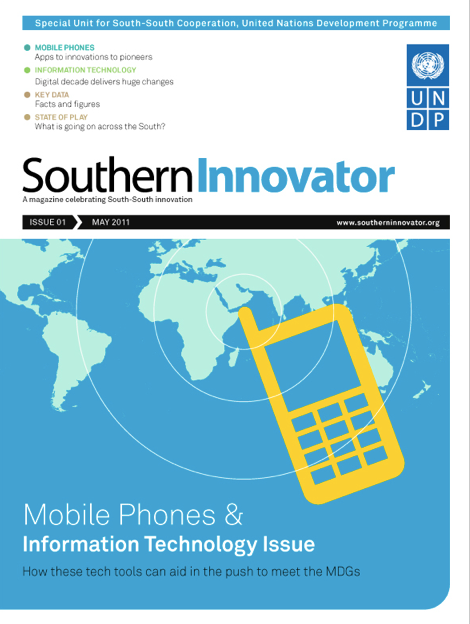
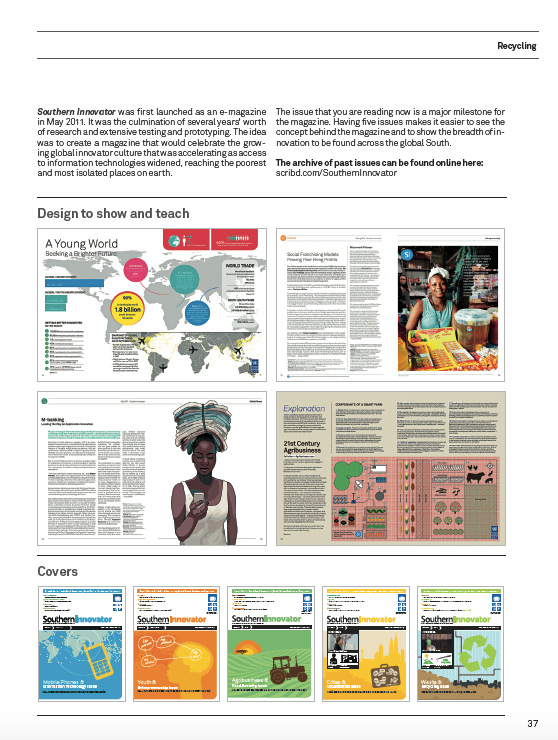
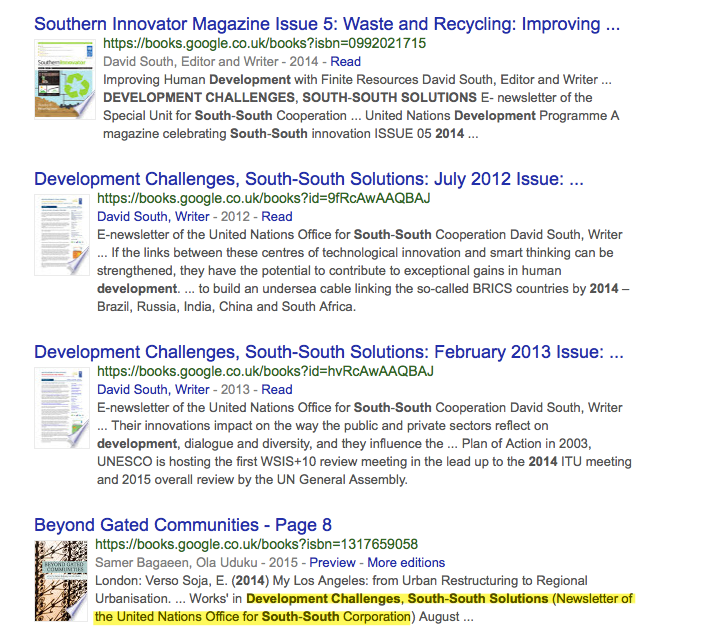
Southern Innovator was initially launched in 2011 with the goal of – hopefully – inspiring others (just as we had been so inspired by the innovators we contacted and met). The magazine seeks to profile stories, trends, ideas, innovations and innovators overlooked by other media. The magazine grew from the monthly e-newsletter Development Challenges, South-South Solutions published by the United Nations Office for South-South Cooperation (UNOSSC) since 2006. A selection of books and papers citing stories from the magazine are featured below to aid researchers, in particular those interested in health and human development and the role of innovators in international development.
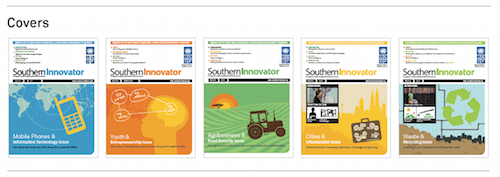
The first five issues of Southern Innovator from 2011 to 2014. Called a “Beautiful, inspiring magazine from UNDP on South-South innovation.”
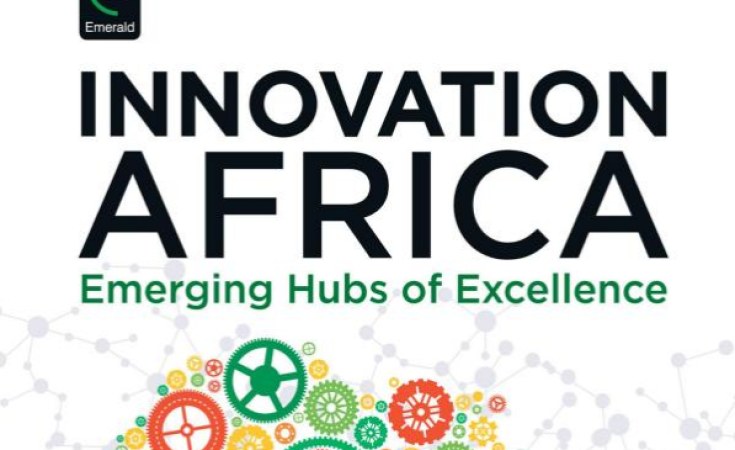
“Innovation is critical to growth and development in Africa. In the context of a continent characterized by fast growing economies as well as an array of socioeconomic challenges, such as high levels of poverty and inequality, innovation in Africa must be understood in an encompassing manner. Africa needs to support the emergence of its own Silicon Valleys, but it must also foster the invention and adoption of cleaner technologies that limit respiratory illnesses, deforestation and combat climate change. This book contains a number of analytical case studies that examine the nature and origins of emerging high-end innovation hubs in Africa. These “hubs” or ecosystems are both understudied and little known inside and outside the continent. With this analysis, the book highlights and draws lessons from some of the most promising and successful innovation cases in Africa today, exploring the key factors driving their successful emergence, growth and future prospects. Relevant for scholars, policymakers, and business leaders, the book provides both inspiration and useful policy advice that can inform strategies and concrete measures to speed up the pace of innovation in Africa today.”
“Research on gated communities is moving away from the hard concept of a ‘gated community’ to the more fluid one of urban gating. The latter allows communities to be viewed through a new lens of soft boundaries, modern communication and networks of influence.
The book, written by an international team of experts, builds on the research of Bagaeen and Uduku’s previous edited publication, Gated Communities (Routledge 2010) and relates recent events to trends in urban research, showing how the discussion has moved from privatised to newly collectivised spaces, which have been the focal point for events such as the Occupy London movement and the Arab Spring.
Communities are now more mobilised and connected than ever, and Beyond Gated Communities shows how neighbourhoods can become part of a global network beyond their own gates. With chapters on Australia, Canada, Europe, South America, Asia, Africa and the Middle East, this is a truly international resource for scholars and students of urban studies interested in this dynamic, growing area of research.”
“The economic, political and social situation in Chile shows a country in transition. Some observers anticipate a broad “reboot” of the nation. While Chile is still seen by many as an example of progress in South America and of developmental potential in the global South, it faces a complex political constellation, particularly in the aftermath of the re-election of Michelle Bachelet. Many wonder how social and institutional innovations can be incepted without interrupting the country’s remarkable success over the past decades.
This book provides an interdisciplinary analysis of Chile’s situation and perspectives. In particular, it addresses the questions:
What is Chile’s real socio-political situation behind the curtains, irrespective of simplifications?
What are the nation’s main opportunities and problems?
What future strategies will be concretely applicable to improve social balance and mitigate ideological divisions?
The result is a provocative examination of a nation in search of identity and its role on the global stage.
Roland Benedikter, Dr., is Research Scholar at the Orfalea Center for Global and International Studies, University of California, Santa Barbara, Senior Research Scholar of the Council on Hemispheric Affairs Washington D.C., Trustee of the Toynbee Prize Foundation Boston and Full Member of the Club of Rome.
Katja Siepmann, MA, is Senior Research Fellow of the Council on Hemispheric Affairs Washington D.C., Member of the German Council on Foreign Relations, and Lecturer at the Faculty of Interdisciplinary Cultural Sciences of the European University Frankfurt/Oder.
The volume features a Foreword by Ned Strong, Executive Director of the David Rockefeller Center for Latin American Studies, Harvard University, and a Preface by Larry Birns, Director of the Council on Hemispheric Affairs, Washington D.C., and Former Senior Public Affairs Officer of the United Nations’ Economic Commission for Latin America (Santiago, Chile).”
“A Sociological Approach to Health Determinants investigates how the social works in determining health and health inequity. Taking a global perspective, the book shines a light on how experiences of health, illness and health care are shaped by a variety of complex social dynamics. Informed primarily by sociology, the book engages with the WHO’s social determinants of health approach and draws on contributions from history, political economy and policy analysis to examine issues such as class, gender, ethnicity and indigeneity, and the impact they have on health. A Sociological Approach to Health Determinants is a comprehensive resource that provides a new perspective on the influence of social structures on health, and how our understanding of the social can ensure improved health outcomes for people all over the globe. Toni Schofield is Associate Professor at the University of Sydney. She specialises in research and teaching in sociology, and public policy and administration.”
New Directions in Children’s and Adolescents’ Information Behavior Research edited by Dania Bilal and Jamshid Beheshti (Emerald Group Publishing: 2014)”This book comprises innovative research on the information behavior of various age groups. It also looks at special populations such as ethnic minorities, indigenous peoples, and users with disabilities. The book presents research and reflections on designing systems that help the new generation cope with a complex knowledge society.
Economy Reports for APEC Economies on demographics, policies & ICT applications for people with Special Needs (Seniors and People with Disabilities), Asia-Pacific Economic Cooperation, APEC Telecommunications and Information Working Group, January 2013
Taming the Tide: Stories from India by Claire Bentley, Vanessa Brombosz, Sofianne Gabrielli, Ga Eun Lee, Vaidehi Nafade, Lindsay Steele and Muhammad Wali, Global Health Case Studies: A Compilation from PPHS 511 Fundamentals of Global Health, McGill Global Health Programs, Case studies – Fall 2015, pages 23 to 32
If you would like to either sponsor an issue of Southern Innovator or place an advertisement in the magazine, then please contact southerninnovator@yahoo.co.uk.


























 David South Consulting
You must be logged in to post a comment.