Category: Development Challenges, South-South Solutions Newsletters

The Development Challenges, South-South Solutions e-newsletter was published by the United Nations Office for South-South Cooperation (UNOSSC) from 2006 to 2014.

  • Milk Co-operatives Help Hungry Haiti

    Milk Co-operatives Help Hungry Haiti

    By David SouthDevelopment Challenges, South-South Solutions

    SOUTH-SOUTH CASE STUDY

    The global food crisis has hit the impoverished Caribbean country of Haiti especially hard. Already suffering from decades of food crises brought on by the collapse of domestic farming, the country has become notorious for its people being reduced to eating cakes made of mud to stave off hunger pains. It is the poorest country of Latin America and the Caribbean and one of the poorest in the world.

    Haiti imports some 52 percent of its food, including over 80 percent of its rice. Local food production only covers 43 percent of the country’s demand and food aid supplies only 5 percent of its needs. Of the estimated 9.8 million Haitians, 5.1 million live on less than US $1 a day and 7.6 million on less than US $2 a day. At current prices, one dollar buys only half a meal per day (Source: United Nations Country Team in Haiti).

    Haiti’s problems are made worse by a global food crisis. So-called agflation (agricultural inflation) has seen spiralling food prices around the world, which in turn are causing food shortages, hunger and malnutrition. On international commodity markets, food prices have gone up 54 percent over the last year, with cereal prices soaring 92 percent (FAO – World Food Situation). U.N. Secretary General Ban Ki-moon has called for food production to increase 50 percent by 2030 just to meet rising demand – and right now there are 862 million people worldwide who are undernourished (FAO).

    In Haiti, most agriculture is done on a small scale by about 700,000 family farmers. Few belong to any production association or mechanism to market and distribute their products, and local produce has been pushed out of the market by imports.

    Subsidized U.S. rice began flooding in 30 years ago, becoming so cheap that Haitians began eating it instead of the corn, sweet potatoes, cassava and domestic rice they grew. The U.S. imports drove rice farmers out of business and incited a rural exodus that swelled the slums of the capital, Port-au-Prince. That dependence on imports has caused dangerous food insecurity. Today, the U.S. rice that is the staple of many Haitians’ diet has doubled in price in little more than a year.

    “The problem is that Haiti doesn’t have the land to give every peasant family enough to allow them to make a living,” said Bernard Etheart, head of the National Institute for Agrarian Reform. Etheart estimates that if all arable land was planted, each farmer would have no more than half a hectare, or 1.25 acres.

    A cooperative of dairy farmers is doing its bit to revive domestic production of milk products and reduce the crippling costs of importing milk for Haiti. Importing 85,000 tonnes of milk from Europe and the United States costs Haiti US $40 million a year. A walk through the capital, Port-au-Prince, will reveal how much milk is imported in one form or another: tiny cans of evaporated milk are sold in the street markets, while the wealthy can buy powdered and long-life milk in the air conditioned supermarkets of the upscale neighbourhood of Petionville.

    Dairy production in Haiti was in decline for 20 years until, in 2002, the country ceased to produce any milk at all. The urgent need for milk in Haiti is shown in the average consumption: per child, only 110 ml is consumed per day. In Uruguay, for example, it is 520 ml a day (190 litres per head of population per year).

    Lèt Agogo (Creole for Unlimited Milk) is a cooperative using small-scale farmers to bring milk to the hungry. Founded by the NGO Veterimed six years ago, it now has a network of 13 dairies across the island.

    Lèt Agogo is hoping to get Haiti’s milk production up to 145,000 tons a year from the current 45,000 tons. So far, the product’s single biggest client is the Haitian government. It buys bottles of sterilized milk below cost and distributes them to 130,000 school children in 44 government-funded schools. Dr. Michel Chancy told the Miami Herald that the government would like to expand the distribution to 800 schools.

    “Haiti is a country where we consume a lot of milk,” said Chancy, a veterinarian and one of the visionaries behind Lèt Agogo. “After rice, milk is the second-largest import.”

    At present, Haiti has 500,000 dairy cows out of more than a million head of cattle. The problem came down to marketing and distributing the dairy products. With no structure in place, few farmers bothered milking their animals. But by the end of 2007, 600 farmers had joined the network and 400 producers in dairy product making and grass pasture management. In 2007, they turned 540,000 litres into yoghurt and sterilised milk that can stay on the shelf for six to nine months without refrigeration. Made from sterilized milk, the yogurt comes in 280 ml bottles and sells in stores throughout the country and has a shelf life of nine months.

    The farmers have seen their income almost double, from 4 (US 10 cents) to 8 (US 20 cents) gourdes per litre, from 10 (US 25 cents) to 12 (US 30 cents) gourdes per litre.

    Farmers walk to processing centres with their litres of milk and receive US $2.20 for each US gallon (4.55 litres).

    “The milk is here,” Chancy said, but the lack of roads and electricity in the country pose huge challenges. “The problem is transporting it.”

    Haiti’s president, Rene Preval, has cited Lèt Agogo as an excellent example of how Haiti can recover its domestic food production capability. The scheme won a US $10,000 first prize in the W.K. Kellogg Foundation and Economic Commission for Latin America and the Caribbean Experiences in Social Innovation Award.

    Lèt Agogo believes it will take 100 dairies throughout Haiti’s rugged terrain to truly take over the import market, and would cost US $10 million to set up. ”Normally in five to ten years, a dairy would pay for itself. But you need the investments,” Chancy said.

    “It’s not the production of milk that is important here… It’s accomplishing it together,” said Philippe Mathieu, from Oxfam International in Quebec, Canada, who is working on helping the brand produce cheese, noting that Haiti is at a difficult crossroads with today’s global price hikes. “The goal is to show Haitians there is a way to do things — a way to construct something collectively.

    “Haitian peasants have always taken care of their cattle; tying them, feeding them and giving them water to drink,” Mathieu said. ”The cow has always been their bank book, something they could sell for money during hard times. Now it has become a revenue source for them.”

    Published: August 2008

    Resources

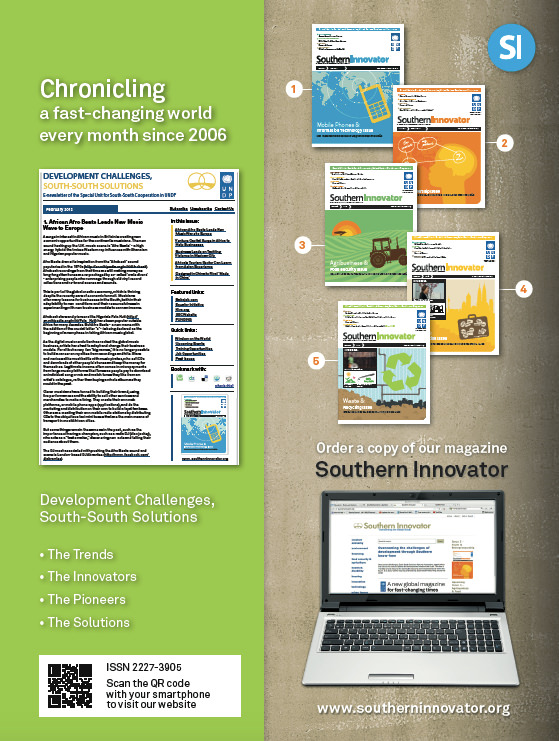
    Development Challenges, South-South Solutions was launched as an e-newsletter in 2006 by UNDP’s South-South Cooperation Unit (now the United Nations Office for South-South Cooperation) based in New York, USA. It led on profiling the rise of the global South as an economic powerhouse and was one of the first regular publications to champion the global South’s innovators, entrepreneurs, and pioneers. It tracked the key trends that are now so profoundly reshaping how development is seen and done. This includes the rapid take-up of mobile phones and information technology in the global South (as profiled in the first issue of magazine Southern Innovator), the move to becoming a majority urban world, a growing global innovator culture, and the plethora of solutions being developed in the global South to tackle its problems and improve living conditions and boost human development. The success of the e-newsletter led to the launch of the magazine Southern Innovator.  

    Follow @SouthSouth1

    Google Books: https://books.google.co.uk/books?id=oEP1Obs4gxYC&dq=development+challenges+august+2008&source=gbs_navlinks_s

    Slideshare: http://www.slideshare.net/DavidSouth1/development-challengessouthsouthsolutionsaugust2008issue

    Southern Innovator Issue 1: https://books.google.co.uk/books?id=Q1O54YSE2BgC&dq=southern+innovator&source=gbs_navlinks_s

    Southern Innovator Issue 2: https://books.google.co.uk/books?id=Ty0N969dcssC&dq=southern+innovator&source=gbs_navlinks_s

    Southern Innovator Issue 3: https://books.google.co.uk/books?id=AQNt4YmhZagC&dq=southern+innovator&source=gbs_navlinks_s

    Southern Innovator Issue 4: https://books.google.co.uk/books?id=9T_n2tA7l4EC&dq=southern+innovator&source=gbs_navlinks_s

    Southern Innovator Issue 5: https://books.google.co.uk/books?id=6ILdAgAAQBAJ&dq=southern+innovator&source=gbs_navlinks_s

    Creative Commons License

    This work is licensed under a
    Creative Commons Attribution-Noncommercial-No Derivative Works 3.0 License.

    ORCID iD: https://orcid.org/0000-0001-5311-1052.

    © David South Consulting 2023

  • Cities For All Shows How The World’s Poor Are Building Ties Across The Global South

    Cities For All Shows How The World’s Poor Are Building Ties Across The Global South

    By David SouthDevelopment Challenges, South-South Solutions

    SOUTH-SOUTH CASE STUDY

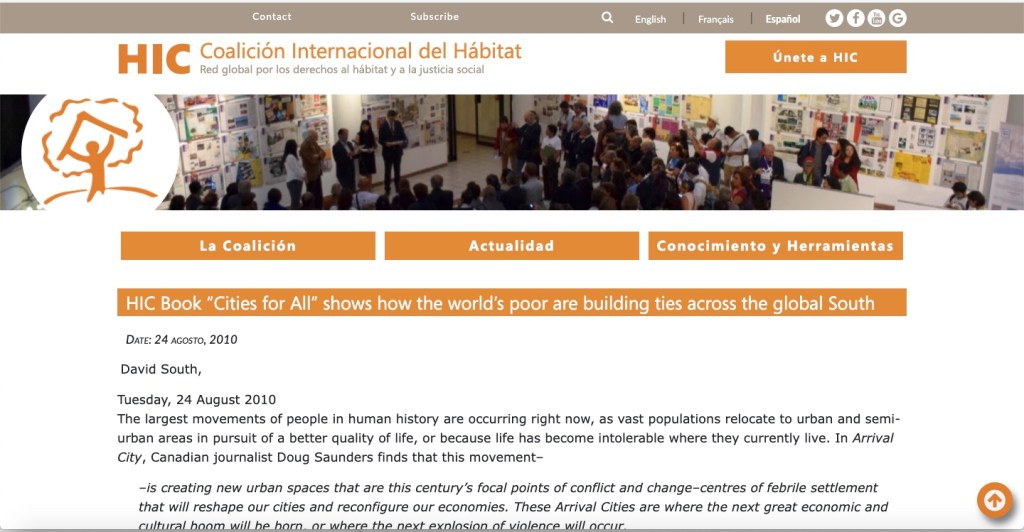
    Cities for All, recently published by Habitat International Coalition, draws together thinkers and innovators in a compilation of case studies addressing the challenges of inclusive cities in the global South. The book seeks to articulate experiences of South-South cooperation and enhance the links between different regions. David South interviews the co-editor, Charlotte Mathivet.

    Published: 24 August 2010

    Global Urbanist (http://globalurbanist.com/2010/08/24/cities-for-all-shows-how-the-worlds-poor-are-building-ties-across-the-global-south)

    The largest movements of people in human history are occurring right now, as vast populations relocate to urban and semi-urban areas in pursuit of a better quality of life, or because life has become intolerable where they currently live. In Arrival City, Canadian journalist Doug Saunders finds that this movement —

    — is creating new urban spaces that are this century’s focal points of conflict and change — centres of febrile settlement that will reshape our cities and reconfigure our economies. These Arrival Cities are where the next great economic and cultural boom will be born, or where the next explosion of violence will occur.

    For most, this process is chaotic, unplanned, and fraught with risk, hardship, poverty and stress; yet, because so many are also able to dramatically improve their life chances, many millions will continue to follow this path.

    The speed of urbanisation makes the question of how to build liveable cities increasingly urgent. A new book hopes to help people get closer to solutions to these vexing problems.

    Cities for All: proposals and experiences towards the right to the city, published by Habitat International Coalition (HIC) in Santiago, Chile, and co-edited by HIC’s Ana Sugranyes and Charlotte Mathivet, was launched during this year’s World Urban Forum in Rio de Janeiro, and highlights ways in which urban residents across the South are defining how they would like their cities to evolve, refusing to accept social exclusion and demanding a “right to the city”.

    The book is published in three languages — EnglishSpanish and Portuguese.

    “A lot of social initiatives based on the right to the city are coming from these ‘new cities of the South’”, says Mathivet. “The book highlights original social initiatives: protests and organising of the urban poor, such as the pavement dwellers’ movements in Mumbai where people with nothing, living on the pavements of a very big city, organise themselves to struggle for their collective rights, just as the park dwellers did in Osaka.”

    “Another innovative experience came from the children’s workshops in Santiago, aimed at including children in urban planning in order to make a children-friendly city.”

    The cities of Africa and Asia are growing by a million peole a week. If current trends continue, mega-cities and sprawling slums will be the hallmarks of this majority urban world. In sub-Saharan Africa, 72 per cent of the population lives in slum conditions. And by 2015, there will be 332 million slum-dwellers in Africa, with slums growing at twice the speed of cities.

    “The consequences have produced a deeper gap between the city and countryside, and also within the city between the rich and poor,” said Mathivet.

    Cities for All details African experiences from Nigeria, Cameroon, Ghana and South Africa. Mathivet believes “one common topic affecting these countries is the problem of forced evictions, due to the rural exodus and growing urbanisation. It is therefore very important for the right to the city to include a perspective of linking the struggle between rural and urban movements, because problems in cities and the countryside are closely connected, especially in Africa.”

    And the current surge to cities in Africa raises the issue of what type of development will occur. The book argues that cities aren’t automatically a solution to the plight of the poor. Cities need to be worked on, and many of the problems faced by the South’s fast-growing cities stem from a power imbalance.

    “A very important thing to realise is that a city life is not a synonym for a better life or a miracle solution for poor people, nor for the ‘capitalist’ way of life,” says Mathivet. “African nations and their people have to find effective solutions on their own to overcome poverty — which they are doing — without copying development models from the North.”

    “In my understanding, urban growth is not haphazard or poorly planned in ‘developing’ countries. Rather, I think that urban ‘planning’ or lack of planning is done with a goal of generating more benefits for powerful interests and fewer benefits for poor people.”

    The book argues for a two-way relationship with the people who make up the majority of these fast-growing cities. And it says each city will have to customise its solutions.

    “It is very difficult to apply social innovations to other countries without understanding the history and the social, economic, cultural and political context,” says Mathivet.

    “Hope comes from learning of different experiences. For example, if a social movement in South Africa succsesfully avoided an eviction from a slum, it may help another social movement in Brazil to strengthen its own strategy. One of the book’s goals was to articulate the various South-South experiences and enhance the links between different regions.”

    In one chapter, contributor David Harvey argues that “the right to the city is not simply the right to what already exists in the city; it is also the right to transform the city into something radically different.”

    “The right to the city itself will not stop the over-whelming phenomenon of urban growth,” believes Mathivet. “The consequences produced by implementing this collective right would rather change people’s daily lives by achieving more equality in cities as well as in the relationship between the city and coutnryside in regards to growing urban populations.”

    Cities for All highlights the existence of ‘cities without citizens’: the vast numbers of slum dwellers and the poor who live mostly ignored by authorities (unless they are in the way of commercial development).

    “The expression ‘cities without citizens’ means the exact opposite of the right to the city proposal,” Mathivet says. “This alternative to the present global paradigm proposes to allow people to participate in the process of creating the city in terms of urban planning, decision-making, budget, public policies, etc. It is possible for people to influence their own lives and the community.”

    “There is no miracle solution, and the right to the city is a banner around which people can organise themselves to articulate their struggles and demand social justice.”

    The book concludes by arguing for the advantages of a ‘slow city’ approach. But how does this work in fast-growing urban areas where people are looking to quickly escape poverty, or are seeking rapid improvements to their quality oflife? Would they not find a slow city approach frustrating?

    Mathivet believes a leap of imagination is required: “Cities for All is not intended to be a recipe book. The slow city experience was chosen as a conclusion to the book in order to present a different approach, but not to propose a clear solution to follow. Concluding with the slow city experience, which is radically different and difficult to apply in African and Asian cities, where the spread of urbanisation is uncontrollable and leads to major problems, emphasises that the fight for the right to the city involves imagination and the desire for another possible city …

    “Moreover, slow city experiences have been developed otuside of wealthy European countries, for example in some small Argentine and South Korean cities.”

    And with the coming decade unfolding, what will cities in the South be like? Are we on the cusp of a new, dark age akin to the misery of Europe’s cities during the industrial revolution?

    Mathivet acknowledges that “we can see a dark future where the interests of the most vulnerable will not be the priority. However, looking at the experiences by and for the people, we cannot consider them poor, but rich of knowledge, cognitive capital, and with courage to change their lives and their communities, through self-management and autonomy.

    Cities for All aimed to show this richness … the challenges are for civil society to deepen links between different movements to build a stronger global strategy, during events like the next World Social Forum in Dakar, February 2011.”

    David South is an international development consultant and writer. He writes the Development Challenges: South-South solutions e-newsletter for UNDP’s Special Unit for South-South Cooperation. He led the Communications Office for the UN in Ulaanbaatar from 1997 to 1999 and has worked for the UN in South Africa, Turkmenistan and Ukraine.

    The Special Unit for South-South Cooperation is mandated to promote, coordinate and support South-South and triangular cooperation on a global and UN-systemwide basis.

    This story is adapted from a piece in the July 2010 edition of Development Challenges.

    http://globalurbanist.com/2010/08/24/cities-for-all-shows-how-the-worlds-poor-are-building-ties-across-the-global-south

    https://www.hic-net.org/es/hic-book-cities-for-all-shows-how-the-worlds-poor-are-building-ties-across-the-global-south/

    Development Challenges, South-South Solutions was launched as an e-newsletter in 2006 by UNDP’s South-South Cooperation Unit (now the United Nations Office for South-South Cooperation) based in New York, USA. It led on profiling the rise of the global South as an economic powerhouse and was one of the first regular publications to champion the global South’s innovators, entrepreneurs, and pioneers. It tracked the key trends that are now so profoundly reshaping how development is seen and done. This includes the rapid take-up of mobile phones and information technology in the global South (as profiled in the first issue of magazine Southern Innovator), the move to becoming a majority urban world, a growing global innovator culture, and the plethora of solutions being developed in the global South to tackle its problems and improve living conditions and boost human development. The success of the e-newsletter led to the launch of the magazine Southern Innovator. 

    Creative Commons License

    This work is licensed under a
    Creative Commons Attribution-Noncommercial-No Derivative Works 3.0 License.

    ORCID iD: https://orcid.org/0000-0001-5311-1052.

    © David South Consulting 2021

  • Putting Quality and Design at the Centre of Chinese Fashion

    Putting Quality and Design at the Centre of Chinese Fashion

    By David SouthDevelopment Challenges, South-South Solutions

    SOUTH-SOUTH CASE STUDY

    Awareness of the sourcing of materials for fashion has been on the rise in the past decade. Concerns about how the global fashion industry functions and its impact on the environment have given rise to savvy retailers who take care over the sourcing of their materials and the working conditions of their employees. Consumers have shown a willingness to pay a little more to know that a garment is sustainably produced and has the lowest possible impact on the environment.

    The global textile industry is the second biggest consumer of water in the world. The dyeing processes used by these manufacturers do extensive damage to the water table that is used for drinking water.

    In China, there have been violent demonstrations over working conditions and increasing concern over the health consequences of many modern manufacturing methods. In order to get change, new business models need to emerge, and consumers and customers need to be educated and to demand better-quality, low- or non-polluting products.

    One business has accomplished something remarkable: it has succeeded in producing high-quality, ethically sourced products while also employing vulnerable people who have significant care duties and need a flexible and understanding employer.

    NuoMi (http://www.nuomishanghai.com) has three stores and a store/design studio in Shanghai, China. NuoMi means “sticky rice” in Mandarin (http://en.wikipedia.org/wiki/Mandarin_Chinese). It was founded by Filipino fashion designer Bonita Lim, a mother of four, who uses her business to help single mothers and the less fortunate.

    NuoMi is also pioneering sustainable and green goods for the Chinese market. This is unusual in a country more known for its sweatshop, low-wage manufacturing industries that have propelled the country into an economic powerhouse.

    NuoMi sells women’s clothing made from sustainable sources while creating jobs for people from disadvantaged communities. There are organic cotton, bamboo, silk and wool garments, and no artificial dyes or synthetic materials are used.

    The design team works on colourful knitwear, dresses and baby clothes. They also offer a custom order service.

    “When I was 13 or 14 years old, I dreamed of building a special company that could help people who have trouble finding a job,” Lim told the Global Times.

    “I called the name of my brand NuoMi, which is (the) Chinese name for sticky rice … Our company works like sticky rice; we support and love each other.”

    Born in the Philippines and educated in Canada, Lim had become frustrated while working with the Filipino government and wanted to help the poor. She started NuoMi in 2006 in Shanghai, a city booming as China’s economy continues to grow. It is also a city with a population with long-standing sophisticated consumer tastes. Shanghai had been home to various foreign concessions before the Communists took power and its population was exposed to foreign languages, cultures and tastes.

    Lim became a single mother after she divorced, and this experience made her sympathetic to how hard life is for single mothers. Drawing on her passion for fashion, she hired a designer to work with her on designing a line of clothing.

    “I was surprised that many of my friends really liked my designs, so they asked me to design clothes for them and introduced some clients to me,” Lim told Global Times. “I tried to design and sell clothes abroad. I got a lot of good feedback, but it exhausted me so I decided to work in Shanghai.”

    Despite starting out as a hobby, the business had built a network of 20 clients. It had become impossible to just do it part-time so she formalised the business as NuoMi.  She began hiring single mothers in prison in the Philippines and designed clothing that could be easily made by them.

    “Those single mothers in prison were very anxious because they had no way to help their children. Most of them committed crimes because they needed money for their kids,” Lim said.

    By 2008 she had built a professional design team and now had 60 clients. With the brand NuoMi growing, she opened its first store. This has grown to four stores in Shanghai. Most of the company’s workforce is now in Shanghai but they are still people living in a vulnerable situation.

    Nuomi’s newly opened store in 2008 carried a spring and summer collection of long dresses made from bamboo, cotton and soya. These fabrics were chosen for their breathability in the hot, steamy Shanghai weather.

    One of the employees is 52-year-old Zhu Linfang, who takes care of a stroke-damaged father and a mother with liver cancer. “I was introduced through a friend. They paid me more than other companies. At my age almost no company wants to hire me, but working for NuoMi, I earn between 2,000 yuan (US $300) and 3,000 yuan per month,” she said.

    Other employees look after ill children and have care duties that occupy much of their time. They do sewing and make toys for NuoMi.

    Lim takes the time to train the employees to make sure they can do the work to a high standard.

    “I tried to design products that were both suitable for them to make and could be sold in the market,” she said.

    NuoMi also sells environmentally friendly glycerine soaps in flavours from mango to chocolate, jewellery made from recycled industrial materials and bathwear, pillows, and purses. The stores even carry matching mother-daughter and father-son clothing.

    Wisely, service is offered in Chinese and English to customers – Shanghai is a popular destination for tourists. NuoMi is clearly a trail-blazer and a business to watch.

    Published: October 2011

    Resources

    1) Ecodesignfair: Eco Design Fair is a bi-annual grass-roots community event whose purpose is to showcase eco-conscious designers and products to general consumers. Website: http://www.ecodesignfair.cn

    2) Nest: Another eco-conscious design company in Shanghai. Its motto is “design with a conscience”. Website: http://www.nestshanghai.com/nest.html

    https://davidsouthconsulting.org/2021/02/09/african-fashions-growing-global-marketplace-profile/

    https://davidsouthconsulting.org/2021/01/05/afropolitan-african-fashion-scene-bursting-with-energy/

    https://davidsouthconsulting.org/2021/01/25/creating-green-fashion-in-china/

    https://davidsouthconsulting.org/2022/10/09/fashion-closes-gap-between-catwalk-and-crafts/

    https://davidsouthconsulting.org/2022/11/17/fashion-recycling-how-southern-designers-are-re-using-and-making-money/

    https://davidsouthconsulting.org/2022/11/16/favela-fashion-brings-women-work/

    https://davidsouthconsulting.org/2020/04/30/local-fashions-pay-off-for-southern-designers/

    https://davidsouthconsulting.org/2021/03/05/southern-innovator-issue-2/

    Development Challenges, South-South Solutions was launched as an e-newsletter in 2006 by UNDP’s South-South Cooperation Unit (now the United Nations Office for South-South Cooperation) based in New York, USA. It led on profiling the rise of the global South as an economic powerhouse and was one of the first regular publications to champion the global South’s innovators, entrepreneurs, and pioneers. It tracked the key trends that are now so profoundly reshaping how development is seen and done. This includes the rapid take-up of mobile phones and information technology in the global South (as profiled in the first issue of magazine Southern Innovator), the move to becoming a majority urban world, a growing global innovator culture, and the plethora of solutions being developed in the global South to tackle its problems and improve living conditions and boost human development. The success of the e-newsletter led to the launch of the magazine Southern Innovator.

    Creative Commons License

    This work is licensed under a
    Creative Commons Attribution-Noncommercial-No Derivative Works 3.0 License.

    ORCID iD: https://orcid.org/0000-0001-5311-1052.

    © David South Consulting 2023

  • Civet Cat Coffee Brews Filipino Opportunity

    Civet Cat Coffee Brews Filipino Opportunity

    By David SouthDevelopment Challenges, South-South Solutions

    SOUTH-SOUTH CASE STUDY

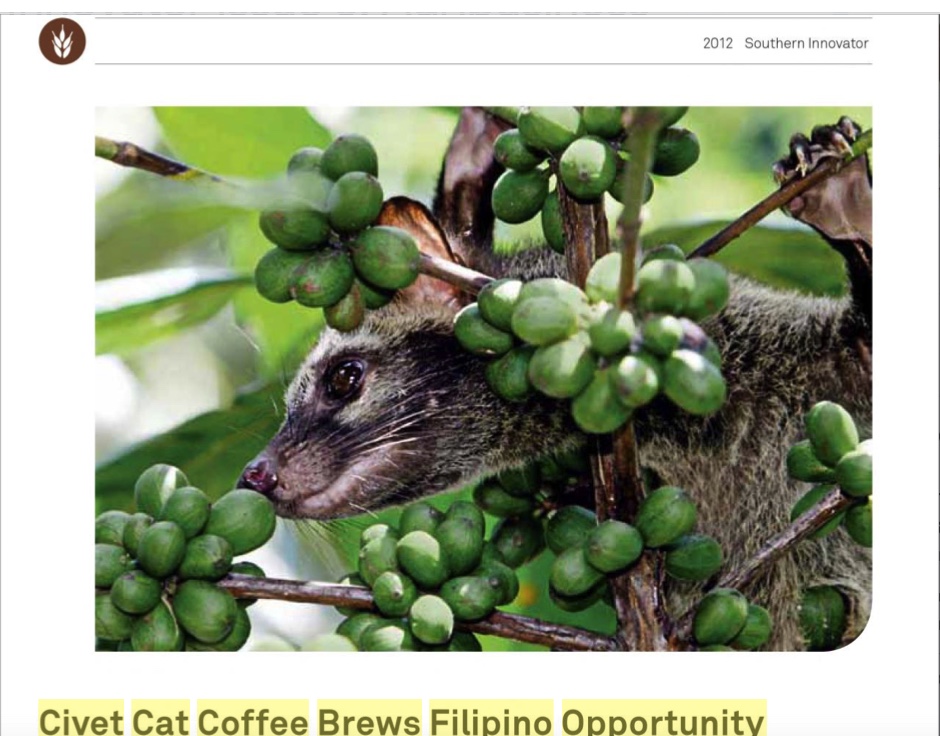
    In the Philippines, one animal’s call of nature has become a business opportunity.

    The civet cat, a member of the mongoose family, ingests the fruit of coffee plants, and expels the beans. This has created an unexpected by-product – a prized beverage for the world’s savvy coffee drinkers seeking the next taste sensation. The partially digested coffee beans are gathered from the faeces of the cat and used to make a much-coveted, smooth-flavoured cup of coffee.

    It is a good example of how value can be added to a product, in this case coffee beans, producing a substantially higher income. The coffee is startlingly expensive: 50 grams cost US $70, 100 grams US $90, and 1 kilogram is a whopping US $870. The coffee is a blend of Arabica, Liberica and Exelsa beans, all of which have passed through the civet cats.

    The highly prized coffee is driving a growing market for these rare beans around the world. But as demand rises, it becomes clear it is a market needing quality control and ethical practices.

    One business that is trying to do this is Coffee Alamid (www.arengga.com), based in Las Pinas in the Philippines. It bills the coffee as the “World’s Rarest Brew. The Philippines’ Pride.”

    Coffee Alamid’s founders, Basil and Vie Reyes, call themselves “coffee entrepreneurs” who started in the business from scratch.

    “When we started Cafe Alamid, we were not even coffee drinkers,” they explain on the company’s website. “We didn’t know anything about coffee at all!”

    Experienced in making Arengga vinegar (http://www.arengga.com/index.php/arengga-pinnata-its-not-just-a-vinegar.mpc), they discovered the civet cats that lived among the sugar palm trees used for making the vinegar. They did some research and were inspired by the Kopi Luwak, the Indonesian variety of civet cat coffee and wondered why they couldn’t do the same thing in the Philippines.

    They consulted with the local forest-dwellers of Indang, Cavite and Batangas, who confirmed they gathered the civet cat droppings to make into coffee, part for personal consumption, with the rest sold in local markets. Gathering the civet droppings provides an income to the forest residents, who collect an average of one kilogram a day.

    Some were sceptical of the idea: why bother with such a time-consuming product? But the Reyeses were inspired by the success of civet coffee in Indonesia and it inspired them to try it in the Philippines. They see themselves as “enlightened entrepreneurs” who believe in marrying business with social development.

    The coffee is made from the wild civet cat droppings harvested from the forest floors of mountains in Malarayat, Lipa, Batangas and Mount Matutum, General Santos and South Cotabato in the Philippines. The beans are roasted and exported to Japan, Taiwan, Korea, Australia, the United States and Italy. The company produces between 1 and 1.5 tons of beans a year.

    A proud moment for the business was becoming the first Filipino firm to participate in the Tea and Coffee World Cup in Geneva, Switzerland in 2007.

    The brand’s name, Alamid, is the local name for the civet cat (Paradoxorus Philippinensis). It belongs to the mongoose family and forages for food at night, eating the ripest and sweetest coffee cherries during the coffee season.

    By morning the civet cats excrete the undigested beans. While inside the cat’s stomach, enzymes and stomach acids go to work on the beans, altering their structure. The beans ‘ferment’ in the cat’s stomach, a process that has been analyzed by Dr. Massimo Marcone, a scientist from Canada’s University of Guelph.

    Marcone traveled to Ethiopia and Indonesia in 2003 to collect the rare coffee beans. He found the beans’ taste – described as “earthy, musty, syrupy, smooth and rich with jungle and chocolate undertones” – was due to the lack of protein in the bean.

    “The civet beans are lower in total protein, indicating that during digestion, proteins are being broken down and are also leaked out of the bean,” Marcone told the Luwak Kopi website. “Since proteins are what make coffee bitter during the roasting process, the lower levels of proteins decrease the bitterness of Kopi Luwak coffee.”

    “Civet beans are typically extensively washed under running water after collection, which dislodges bacteria,” he said.

    Marcone published his research into the beans in the paper “Composition and properties of Indonesian palm civet coffee (Kopi Luwak) and Ethiopian civet coffee.” (http://www.sciencedirect.com/science/article/pii/S0963996904001309)

    The beans are greenish-brown when they come out in the cat faeces. Marcone found the process in the civet cat removes some of the caffeine, giving a strong cup of coffee less kick; this also makes the flavour smoother.

    Supply is tight and this has led to some people forging the coffee or using unethical practices to get their hands on the beans. It is a business that needs to be run in an ethical way to ensure the rich profits are shared with everyone involved.

    Marcone warns against imitations. “About 42 percent of all the kopi luwaks that are presently on sale are either adulterated or complete fakes, unfortunately,” he told the Los Angeles Times.

    Coffee Alamid’s parent company, Bote Central, started as a family-owned company in 2002, with the idea of using agro-forestry products to create sustainable livelihoods and help preserve the environment. It wanted to introduce Fair Trade principles to the Philippines coffee industry.

    Structurally, the company uses community roasting business units (CRBU) across the Philippines, in particular the countryside, to improve the way coffee is sold and make it more profitable for local economies. There are currently 12 such units, and more are planned. The company has put together a guide book on best practice for harvesting Arabica coffee beans based on their first-hand experience. It also explains how they maintain quality control (http://www.scribd.com/doc/19991462/Production-Guide-for-Arabica-Coffee-by-Bote-Central-Inc-Maker-of-Coffee-Alamid).

    The company deals directly with farmers to avoid middlemen gouging profits, and tries to use technology to make the business more efficient and sustainable.

    To keep quality improving, the company has also produced a manual on how to grow and harvest Arabica coffee beans. It is designed to tackle the practical realities of coffee production and show how to improve current methods to produce a better-quality bean. This is critical for the overall business as competition is fierce and quality has to constantly be improved.

    Coffee Alamid has successfully positioned itself as a high-end, high-cost product. It is sold by Japan Airlines and by department stores in Japan and specialty coffee shops around the world.

    Civet cat coffee continues to develop new fans. In Britain, the Birmingham-based Urban Coffee Company (http://www.urbancoffee.co.uk) has started selling the coffee.

    ‘It’s actually really nice,” sales manager Mark Bridgens told the Daily Mail newspaper. “It has a unique, soft taste. I’d definitely buy a cup of it, it’s very different.”

    Published: June 2011

    Resources

    1)Fair Trade Foundation: Fairtrade is about better prices, decent working conditions, local sustainability, and fair terms of trade for farmers and workers in the developing world. Website: http://www.fairtrade.org.uk/

    2) The red dot logo stands for belonging to the best in design and business. The red dot is an internationally recognized quality label for excellent design that is aimed at all those who would like to improve their business activities with the help of design. Website: http://www.red-dot.de

    3) Small businesses looking to develop their brand can find plenty of free advice and resources here. Website: www.brandingstrategyinsider.com

    4) Brandchannel: The world’s only online exchange about branding, packed with resources, debates and contacts to help businesses intelligently build their brand. Website: www.brandchannel.com

    Development Challenges, South-South Solutions was launched as an e-newsletter in 2006 by UNDP’s South-South Cooperation Unit (now the United Nations Office for South-South Cooperation) based in New York, USA. It led on profiling the rise of the global South as an economic powerhouse and was one of the first regular publications to champion the global South’s innovators, entrepreneurs, and pioneers. It tracked the key trends that are now so profoundly reshaping how development is seen and done. This includes the rapid take-up of mobile phones and information technology in the global South (as profiled in the first issue of magazine Southern Innovator), the move to becoming a majority urban world, a growing global innovator culture, and the plethora of solutions being developed in the global South to tackle its problems and improve living conditions and boost human development. The success of the e-newsletter led to the launch of the magazine Southern Innovator.  

    Follow @SouthSouth1

    Google Books: https://books.google.co.uk/books?id=JIKYBgAAQBAJ&dq=development+challenges+june+2011&source=gbs_navlinks_s

    Slideshare: http://www.slideshare.net/DavidSouth1/development-challengessouthsouthsolutionsjune2011issue

    Southern Innovator Issue 1: https://books.google.co.uk/books?id=Q1O54YSE2BgC&dq=southern+innovator&source=gbs_navlinks_s

    Southern Innovator Issue 2: https://books.google.co.uk/books?id=Ty0N969dcssC&dq=southern+innovator&source=gbs_navlinks_s

    Southern Innovator Issue 3: https://books.google.co.uk/books?id=AQNt4YmhZagC&dq=southern+innovator&source=gbs_navlinks_s

    Southern Innovator Issue 4: https://books.google.co.uk/books?id=9T_n2tA7l4EC&dq=southern+innovator&source=gbs_navlinks_s

    Southern Innovator Issue 5: https://books.google.co.uk/books?id=6ILdAgAAQBAJ&dq=southern+innovator&source=gbs_navlinks_s

    Creative Commons License

    This work is licensed under a
    Creative Commons Attribution-Noncommercial-No Derivative Works 3.0 License.

    ORCID iD: https://orcid.org/0000-0001-5311-1052.

    © David South Consulting 2023