Category: Development Challenges, South-South Solutions Newsletters

The Development Challenges, South-South Solutions e-newsletter was published by the United Nations Office for South-South Cooperation (UNOSSC) from 2006 to 2014.

  • New African Film Proving Power of Creative Economy

    New African Film Proving Power of Creative Economy

    By David SouthDevelopment Challenges, South-South Solutions

    SOUTH-SOUTH CASE STUDY

    A new movie is generating excitement around life in the war-torn, chaotic and impoverished Democratic Republic of the Congo(http://en.wikipedia.org/wiki/Democratic_Republic_of_the_Congo – the central African nation – and proving how versatile and resilient a creative economy can be in a crisis.

    Viva Riva! (http://www.vivarivamovie.com) is set in the capital, Kinshasa, and gives a raw portrayal of sex, violence and gangsters in the city. The film has already won a fistful of awards, and will now be released in 18 African countries.

    Written and directed by Djo Tunda Wa Munga, it is being hailed as the first feature-length film to be made in the Democratic Republic of Congo in 25 years. The industry was shut down by long-serving dictator and President Mobutu Sese Seko, who was overthrown in 1997 in the First Congo War by Laurent-Désiré Kabila, who was supported by the governments of Rwanda, Burundi and Uganda.

    Africa has a rich film history but its movies have struggled to reach commercial audiences – both on the continent and around the world – outside of showcases at film festivals. Without access to a wide audience, filmmakers are not able to make the sort of profits possible for films with a wide commercial distribution. It has also been hard to compete with the big budgets and the big publicity machines of traditional film centres like Hollywood or Europe. But it looks like Viva Riva! could change that situation.

    Indigenous African filmmaking took off as countries became independent of their colonial European rulers in the 1960s and 1970s. One example is the Senegalese film comedy Xala (http://www.imdb.com/title/tt0073915/), directed by Ousmane Sembéne, and considered a classic. Previous portrayals of Africa have mostly been viewed through the cinematic lens of Europeans.

    As the second largest country in Africa, the Congo has an estimated population of over 71 million (2011 estimate), with Kinshasa home to more than 8 million people (CIA – The World Factbook). It has suffered badly from war and chaos and has some of the world’s worst statistics for rape and sexual violence brought about by these conditions. The so-called Second Congo War began in 1998 and is considered the world’s deadliest conflict since the Second World War.

    As a result, the world’s biggest United Nations peacekeeping mission is in the country in an attempt to stabilise the situation. (http://www.un.org/en/peacekeeping/missions/monuc/).

    Filmmaking forms part of the creative economy, a vital and growing sector in many countries. As the Creative Economy Report 2010 states: “A new development paradigm is emerging that links the economy and culture, embracing economic, cultural, technological and social aspects of development at both the macro and micro levels. Central to the new paradigm is the fact that creativity, knowledge and access to information are increasingly recognized as powerful engines driving economic growth and promoting development in a globalizing world.”

    For example,Nigeria’s US $2.75 billion annual film industry is the third largest in the world, following the U.S. and India. Nigeria’s ‘Nollywood’ produces more than 1,000 films a year, creating thousands of jobs, and is the country’s second most important industry after oil. In recognition of its importance, the country’s government has invested in the industry, reforming policies and providing training to promote film production and distribution.

    The Creative Economy Report 2010 has highlighted a few key trends for the global South. It found that creative industry products, especially domestically consumed ones like videos, music, video games and TV programmes, are weathering the global economic crisis well. It also found the creative economy can help boost economies and bring countries out of recession if the right government policies are in place.

    The exporting of creative goods and services continues to grow, doubling from 2002 to 2008. This represented a 14 percent per year growth rate. The global South’s exporting of creative goods reached a high of US $176 billion by 2008 and represented 43 percent of the world’s total creative industries trade.

    The majority of the world’s mobile phones are now in developing countries, representing a vast, new platform for distributing, sharing and selling cultural products and services. Broadband Internet is also being rolled out to more countries and represents an enormous emerging opportunity waiting for enterprising people to seize.

    The report also found more and more cities across the global South are placing creative economies at the centre of their urban development, emphasising culture and creative activities.

    For Viva Riva!, the next stop is Africa-wide release in Botswana, Burkina Faso, Kenya, Lesotho, South Africa, Swaziland and Uganda. The film’s producers have their sights set on even more countries in central and West Africa.

    “We want to show that you can release African films acrossAfrica,” co-producer Steven Markovitz told The Guardian. “As far as we can tell, it’s unprecedented. No one has tried to do an Africa-wide release in so many countries.”

    There is more at stake with the film than just Congolese pride: it is about proving an African film can successfully take on the slick and well-funded film distribution machines deployed byAmerica’s Hollywood and European film distributers.

    With the African middle class growing and a burgeoning African consumer class now clearly identified, many see this as the right time to make African film pay.

    “African cinemas have been dominated by Hollywood and European cultural programmes catering to the intellectual elite, not tapping into a growing middle class who are interested in seeing films about themselves and their neighbours,” Markovitz told The Guardian.

    “There is an audience, a real market for African films. They have disposable income and they want to be entertained. We hope that this will create a pipeline for further African titles on the continent.”

    Viva Riva! is in French and Lingala (http://en.wikipedia.org/wiki/Lingala_language). The story revolves around a hustler who makes quick cash stealing oil and celebrates by going on a hedonistic romp through Kinshasa’s night clubs.

    The film had its international debut at the 2010 Toronto International Film Festival and won the 2011 MTV Movie award for best African film.

    Markovitz is from South African film production company Big World Cinema (http://www.bigworld.co.za). The producers hope the film will appeal to both French speakers and English speakers.

    “There are distribution challenges in Africa but we thought this one presents an opportunity to make it happen,” he said. “Some African films have felt like homework but this is an entertaining action film and we think it can cross language barriers. We have to try things out.”

    Critics have said good things about the film. The Nigerian actor and director Akin Omotoso told The Guardian: “I loved Viva Riva! Absolute breath of fresh air, an adrenalin rush from top to bottom, a great gangster flick.”

    The film is unique as an African production that has “captured not just international attention but the continent’s attention”, he added.

    “I think it stands a good chance; as we know, it’s up to the audience but either way it has made history.”

    Published: November 2011

    Resources

    1) UNCTAD Global Database on the Creative Economy. Website:http://unctadstat.unctad.org/ReportFolders/reportFolders.aspx?sCS_referer=&sCS_ChosenLang=en

    2) Creative Economy Report 2010: Creative Economy: A Feasible Development Option. Website:http://www.unctad.org/Templates/WebFlyer.asp?intItemID=5763&lang=1

    4) Dictionary of African Filmmakers from Indiana University Press. Website:http://www.iupress.indiana.edu/product_info.php?products_id=76770

    6) The Filmmakers Guide to South Africa is the most recognised, established and representative brand marketing the South African film industry locally and internationally. Website: http://www.filmmakersguide.co.za

    7) Youth Filmmakers Africa: An initiative in Kenya to inspire the next generation of filmmakers. Website:http://www.indiegogo.com/Youth-Filmmakers-Africa

    Other Film Stories

    https://davidsouthconsulting.org/2022/03/30/angolan-film-grabs-attention-at-film-festival/

    https://davidsouthconsulting.org/2022/04/01/bolivian-film-schools-film-scene-paying-off/

    https://davidsouthconsulting.org/2022/10/21/local-animation-a-way-out-of-poverty/

    https://davidsouthconsulting.org/2021/02/04/new-cuban-film-seeks-to-revive-sector/

    https://davidsouthconsulting.org/2020/11/30/nollywood-booming-nigerian-film-industry/

    https://davidsouthconsulting.org/2022/03/30/riverwood-kenyan-super-fast-super-cheap-filmmaking/

    Creative Commons License

    This work is licensed under a
    Creative Commons Attribution-Noncommercial-No Derivative Works 3.0 License.

    ORCID iD: https://orcid.org/0000-0001-5311-1052.

    © David South Consulting 2023

  • Riverwood: Kenyan Super-fast, Super-cheap Filmmaking

    Riverwood: Kenyan Super-fast, Super-cheap Filmmaking

    By David SouthDevelopment Challenges, South-South Solutions

    SOUTH-SOUTH CASE STUDY

    The African film-making success story of Nigeria’s Nollywood has been joined by another fast-rising star: Kenya’s Riverwood. Both are beneficiaries of the digital revolution in filmmaking over the last decade, and both are using low-cost digital filmmaking and editing to tell local stories — in the process making money and creating thousands of jobs.

    The power of creative industries to create jobs and wealth has been a focus of UNESCO, through its Global Alliance for Cultural Diversity. UNESCO has been in the forefront in helping African countries re-shape their policies to take cultural industries into consideration. The promotion of cultural industries also has been incorporated into the New Partnership for Africa’s Development (NEPAD).

    What is particularly attractive about this phenomenon for the poor in the South is its rough-and-ready approach to filmmaking: combining low-cost digital cameras and film editing software on personal computers, with small budgets and fast turn-around times. Films are made on location using local people. These factors make getting into filmmaking accessible and within reach of more people.

    Riverwood is named after River Road, a bustling creative and business hub in Nairobi. Riverwood operates at a furious pace, with 20 to 30 films made every week. It adds up to 1,000 films a year selling 500,000 copies at 200 Kenyan shillings (US $2.60) a piece: 1 billion shillings (US $13 million) in the past two years.

    The whole industry is totally self-sufficient, and is following the well-trodden path laid down by Hollywood and India’s Bollywood.

    One of Kenya’s woman directors is leading the renaissance in filmmaking. “Movies are very important because I think they are the most important art in Kenya – in Africa,” said Wanjiru Kinyanjui in the film, “Riverwood, the Blooming of a Film Industry,” by the World Intellectual Property Organization (www.wipo.org). “Basically, because Africans have an oral tradition, and a visual one, there is a huge market for local films.”

    Riverwood films share a common characteristic of on-the-spot sets and a resourceful and cheap approach.

    “They are shot in two, three days and edited in a week,” she continued. “They are selling because people can identify with them. The films being in Riverwood are basically the lives of people, reflecting the Kenyan way of life and entertaining Kenyans. “

    And it is a new form of employment for many people:  “When I am making a movie, I need people: you employ very many people. And you also employ yourself. It is a real way of getting rid of poverty. Because all this talent, which is untapped, could be working.”

    And as Riverwood rising star director John E. Maina puts it: “Hollywood is the model for any society that wants to develop.”

    While still in its infancy compared to Nigeria’s Nollywood, Riverwood is already pioneering ways to protect the creative rights of filmmakers and build a financially-sustainable industry. Inspired by Hollywood’s ownership of creative material, Kenyan filmmakers have come up with some ingenious solutions. Each production company has a rubber stamp and signs on the sleeve of the DVD (digital video disc) – even if it is 1,000 copies.

    If a director finds a pirated copy, and even if pirates have forged the rubber stamp, the signature will look like a forgery.

    “It is based on a business model,” said director John E. Maina. ”It is commercial. So it is self-sustaining. This is how Bollywood is growing, this is how Nollywood is growing, this is how Hollywood developed.”

    As pioneers in copyright protection, Riverwood directors strongly believe they are an important part of the country’s development.

    “When you pirate a product, and the resources are not channelled back to the person who created that product, he is losing out on creating a new product for you tomorrow,” said Maina. “So you are the loser: tomorrow you will not have another product.

    “Riverwood, Nollywood, Hollywood, are the model for any society that wants to develop. No society will develop without an audiovisual industry. And I think the way to protect an audiovisual industry is through strong copyright laws,” he said.

    “If you go to most of the cafes and the pubs in Kenya, people only turn to TV at 7 o’clock, watch the news, after the news is over, they tell the management to put for them the local DVDs from Riverwood. Because they see themselves, they identify with those images. They don’t identify with the foreign American films, the soaps from South America.<

    “The audiovisual industry is a mirror. If you don’t have a mirror to see yourself, you don’t know who you are. If you don’t have that mirror to see yourself, you are lost.”

    Published: November 2008

    Resources

    • The global charity Camfed (dedicated to eradicating poverty in Africa through the education of girls and empowerment of women) has projects to teach women filmmaking skills. Website: http://uk.camfed.org
    • Festival Panafricain du Cinéma et de la Television de Ouagadoogou 2009: Africa’s biggest film festival. Website: http://www.fespaco.bf/
    • Naijarules: Billing itself as the “largest online community of lovers and critics of Nollywood”, an excellent way to connect with all the players in the business.Website: http://www.naijarules.com/vb/index.php
    • A film by the World Intellectual Property Organization about the Riverwood phenomenon and an introduction to its up-and-coming directors. Website: http://uk.youtube.com/watch?v=OwSu5kcUErE

    Citations

    Cited in The Liverpool Companion to World Science Fiction Film by Sonja Fritzsche (2014).

    Accentuating the positive: Building capacity for creative industries into the development agenda for global intellectual property law by Sean A. Pager, Michigan State University College of Law, American University International Law Review, 2012

    Cinema as cultural discourse: A study of cultural symbols in selected contemporary Gikuyu comedies by Stanley Mbugua Njoroge, School of Creative and Performing Arts, Film and Media Studies, Kenyatta University, 2019

    Other Film Stories

    https://davidsouthconsulting.org/2022/03/30/angolan-film-grabs-attention-at-film-festival/

    https://davidsouthconsulting.org/2022/04/01/bolivian-film-schools-film-scene-paying-off/

    https://davidsouthconsulting.org/2022/10/21/local-animation-a-way-out-of-poverty/

    https://davidsouthconsulting.org/2021/02/04/new-cuban-film-seeks-to-revive-sector/

    https://davidsouthconsulting.org/2020/11/30/nollywood-booming-nigerian-film-industry/

    Creative Commons License

    This work is licensed under a
    Creative Commons Attribution-Noncommercial-No Derivative Works 3.0 License.

    ORCID iD: https://orcid.org/0000-0001-5311-1052.

    © David South Consulting 2023

  • Model City to Test the New Urbanism Concept in India

    Model City to Test the New Urbanism Concept in India

    By David SouthDevelopment Challenges, South-South Solutions

    SOUTH-SOUTH CASE STUDY

    India’s phenomenal economic growth rate – forecast to be 7.9 percent this year by the Asian Development Bank, after averaging 7.7 percent per year over the past decade – has been the force behind an expanding middle class population, now estimated at 50 million people (McKinsey). Forecasts see it swelling from 5 percent of the population to 40 percent by 2025.

    India now boasts many fast-growing global companies and booming enterprise zones like the technology hub of Bangalore. But the country still comes in for heavy criticism of the way it has managed the growth of its cities. Poor planning and chaotic growth have left many cities with vast slum areas, congestion, poor hygiene and sanitation services, crumbling infrastructure and poor-quality transportation services. To more and more Indians it has become clear these factors are now serious impediments to economic growth and modernisation of the country and its economy.

    With 30 percent of the population living in urban areas and cities contributing 60 percent of the country’s GDP and 90 percent of government revenues (Wall Street Journal), city-dwellers’ fate is critical to the functioning of the economy.

    According to the 2001 Indian census, slums make up 25 percent of all housing, and 26 percent of urban households lack access to sanitation facilities.

    And as the middle class grows and its members accumulate savings, their desire to be better housed will also grow. They will be on the hunt for new places to live to realise their dreams. Those who can satisfy this strong urge will be those who will also profit.

    This is where the new city concept of Lavasa (www.lavasa.com) comes in. This new community sits nestled in picturesque mountains and features promenades, sidewalk cafes, and ice cream parlours, but none of the clichéd fixtures of today’s Indian cities: rickshaws, noise and pollution, poor sanitation and over-crowding. It has apartment houses in mustard, terra cotta, ochre, olive and beige. It is also going to have a medical campus, luxury hotels, boarding schools, sports academies, a golf course, a space camp, animation and film studios, software-development companies, biotech labs and law and architectural companies. A thoroughly ‘knowledge economy’ mix that India’s aspiring classes wish to see the country embrace for its future development.

    The people behind Lavasa see it as a new model of governance and urban development for India in the 21st century.

    Lavasa is located in Western Ghats, 200 kilometres southeast of Mumbai, India’s financial and entertainment capital, and 65 kilometres west of Pune, a centre for software programming and computer animation.

    Lavasa’s colourful and detailed website boasts it as a “private hill city being developed by Lavasa Corporation Limited where people can live, work, learn and play in harmony with nature.” It’s billed as “an inclusive city, based on the principles of New Urbanism.”

    The master plan is to house more than 300,000 people divided in to five linked towns.

    The first town, Dasve, will be completed in 2011. Its houses are selling well and are almost sold out, according to its developers.

    Lavasa is the concept of Ajit Gulabchand, chairman of Hindustan Construction Company, an Indian company with extensive experience building bridges and dams.

    The development is located in the remote hills along the Varasgaon Lake, a reservoir providing water to Pune. Lavasa Hill City covers “25,000 acres with 60 Kms of lakefront” according to its website. The land had originally been designated for holiday homes, but this seemed too small an aspiration.
    Lavasa will be governed by a private corporation. It is also being planned according to the principles of New Urbanism (www.newurbanism.org) – a belief in cities built around walkability not cars, where business and residential sit side-by-side, with mixed income housing and lots of green space for parks.

    The corporation will take responsibility for providing all major utilities: running water, electricity, sewage treatment, garbage collection and fibre optic connections.

    This thoroughly modern approach has startled prospective buyers of homes, puzzled there weren’t water tanks on the roofs and septic tanks for each house: something they had come to expect with current Indian cities.

    The Lavasa Corporation has hired an American city administrator, Scot Wrighton, to run the new city.

    He told The Atlantic magazine that Lavasa offered him “a chance to build a new governance model for a country where governance at the municipal level does not work.”

    The project seeks to exploit a portion of Maharashtra state law that lets corporations assume many of the responsibilities normally provided by, or in the domain of, the state. These do not include police powers or the ability to raise taxes but take in pretty much everything else.

    Lavasa has private security guards to watch over its residents and funds itself through home sales, renting, and business deals. The prices for apartments in the development range between US $17,000 and US $36,000. While cheap by Western standards, this is still expensive to middle class Indians.

    The project has come in for criticism for being just for the wealthy and being a pipe dream in chaotic India.

    In response to criticism, Gulabchand is introducing cheaper apartments targeting young professionals and starter homes that he claims will rent for US $11 a month. This far lower monthly rent could make the development affordable for more people, including domestic servants and laborers.

    Gulabchand admitted the plan was not without risks. “We’re worried we’ll still get slums,” he said. “Do we have all the answers yet? No. It is still an experiment, okay?”

    As for charges the development doesn’t look much like the ‘real’ India, Gulabchand says: “Why should we look to the past? India is a young society.”

    But Gulabchand doesn’t think India has the time to waste pondering these aesthetic questions: the country has a desperate need for better quality living conditions.

    “We may not get a perfect Singapore-style model city,” he told The Atlantic. “But this is a model for a more vibrant, inclusive, greener place that still has soul.”

    Published: September 2011

    Resources

    1) New documentary Urbanized gives a passionate over-view of the challenges facing the rapidly urbanizing world around us. Website: http://urbanizedfilm.com/

    https://davidsouthconsulting.org/2021/03/05/southern-innovator-issue-4/

    https://davidsouthconsulting.org/2022/09/28/model-cities-across-the-south-challenge-old-ways/

    https://davidsouthconsulting.org/2020/12/04/model-indian-villages-to-keep-rural-relevant/

    Creative Commons License

    This work is licensed under a
    Creative Commons Attribution-Noncommercial-No Derivative Works 3.0 License.

    ORCID iD: https://orcid.org/0000-0001-5311-1052.

    © David South Consulting 2022

  • Global South Eco-cities Show How the Future Can Be

    Global South Eco-cities Show How the Future Can Be

    By David SouthDevelopment Challenges, South-South Solutions

    SOUTH-SOUTH CASE STUDY

    The world is currently undergoing a high-stress transition on a scale not seen since the great industrial revolution that swept Europe in the 19th and 20th centuries. Today’s urban and industrial transition involves many more people and is taking place on a greater proportion of the planet. With rapid urbanization comes a demand for middle class lifestyles, with their high-energy usage and high consumption of raw materials.

    This is stretching the planet’s resources to breaking point. And as many have pointed out, if the world’s population is to continue past today’s 7 billion to reach 9 billion and beyond, new ways of living are urgently required. Radical thinking will be necessary to match the contradictory goals of raising global living standards for the world’s poor with pressured resources and environmental conditions.

    But there are innovative projects already under development to build a new generation of 21st-century cities that use less energy while offering their inhabitants a modern, high quality of life. Two examples are in China and the Middle East.

    Both projects are seen as a way to earn income and establish viable business models to build the eco-cities of the future. Each project is seeking to develop the expertise and intellectual capacity to build functioning eco-cities elsewhere. In the case of the Masdar City project in the United Arab Emirates, international businesses are being encouraged to set up in Masdar City and to develop technologies that can be sold to other countries and cities – in short, to create a green technology hub akin to California’s hi-technology hub ‘Silicon Valley’. Masdar City is also being built in stages as investors are found to help with funding. Both projects hope to prove there is money to be made in being green and sustainable.

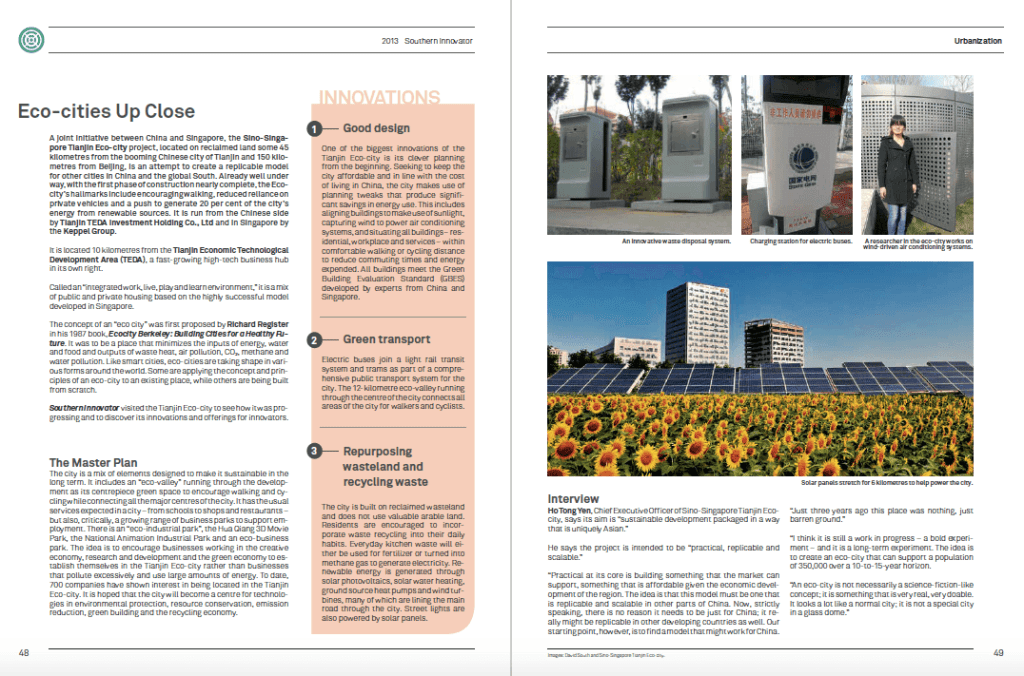
    The Tianjin Eco-city (tianjinecocity.gov.sg) project is a joint venture between China and Singapore to build a 30 square kilometre city to house 350,000 residents.

    Tianjin (http://en.wikipedia.org/wiki/Tianjin) is a large industrial city southeast of China’s capital, Beijing. It is a place that wears the effects of its industrial expansion on the outside. Air pollution is significant and the city has a grimy layer of soot on most outdoor infrastructure.

    China has received a fair bit of criticism for its polluted cities as the country has rapidly modernized in the past two decades. This sprint to be one of the world’s top economic powers has come at a cost to the environment. In this respect, China is not unusual or alone. Industrialization can be brutal and polluting, as Europe found out during its earlier industrial revolution.

    But China is recognizing this can’t go on forever and is already piloting many initiatives to forge a more sustainable future and bring development and high living standards back in line with what the environment can handle.

    Sino-Singapore Tianjin Eco-city is the second large-scale collaboration between the Chinese government and Singapore. The first was the Suzhou Industrial Park (http://www.sipac.gov.cn/english/).The Tianjin project came up in 2007 as both countries contemplated the challenges of rapid urbanization and sustainable development.

    The project’s vision, according to its website, is to be “a thriving city which is socially harmonious, environmentally-friendly and resource-efficient – a model for sustainable development.”

    The philosophy behind the project is to find a way of living that is in harmony, with the environment, society and the economy. It is also about creating something that could be replicated elsewhere and be scaled up to a larger size.

    The city is being built 40 kilometres from Tianjin centre and 150 kilometres from Beijing. It is located in the Tianjin Binhai New Area, considered one of the fastest growing places in China.

    Construction is well underway and can be followed on the project’s website (http://www.tianjinecocity.gov.sg/gal.htm). It will be completed in 2020.

    This year, the commercial street was completed and is ready for residents to move in.

    Residents will be encouraged to avoid motorized transport and to either use public transport or people-powered transport such as bicycles and walking.

    An eco-valley runs down the centre of the city and is meant to be a place for pedestrians and cyclists to enjoy.

    The basic building block of the Eco-city – its version of a city block – is called the Eco Cell. Each Eco Cell measures 400 metres by 400 metres, a comfortable walking distance. Four Eco Cells make a neighbourhood. Several Eco Neighbourhoods make an Eco District and there are four Eco Districts in the Eco-city. It is a structure with two ideas in mind: to keep development always on a walkable, human scale and also to provide a formula for scaling up the size of the Eco-city as the number of residents increases.

    It is a logical approach and seeks to address one of the most common problems with conventional cities: sprawling and unmanageable growth that quickly loses sight of human need.

    Agreement was also reached on the standards that should be achieved for a wide variety of criteria, from air and water quality to vegetation, green building standards, and how much public space there should be per person.

    An ambitious project in the United Arab Emirates is trying to become both the world’s top centre for eco cities and a living research centre for renewable energy. Masdar City (http://www.masdarcity.ae/en/)is planned to be a city for 40,000 people. It is billed as a high-density, pedestrian-friendly development where current and future renewable energy and clean technologies will be “marketed, researched, developed, tested and implemented.”

    The city hopes to become home to hundreds of businesses, a research university and technology clusters.

    This version of an eco-city is being built in three layers in the desert, 17 kilometres from the Emirati capital Abu Dhabi. The goal is to make a city with zero carbon emissions, powered entirely by renewable energy. It is an ambitious goal but there are examples in the world of cities that use significant renewable energy for their power, such as Reykjavik, Iceland in Northern Europe, which draws much of its energy from renewables and geothermal sources.

    Masdar City is designed by world-famous British architect Norman Foster (fosterandpartners.com) and will be 6.5 square kilometres in size.

    The design is highly innovative. The city will be erected on 6 metre high stilts to increase air circulation and reduce the heat coming from the desert floor. The city will be built on three levels or decks, to make a complete separation between transport and residential and public spaces.

    The lowest deck will have a transportation system based on Personal Rapid Transport Pods. These look like insect eyes and are automated, controlled by touch screens, using magnetic sensors for propulsion. On top of this transport network will be the pedestrian streets, with businesses, shops and homes. No vehicles will be allowed there, and people will only be able to use bicycles or Segway (segway.com) people movers to get around. An overhead light railway system will run through the city centre, all the way to Abu Dhabi City.

    “By layering the city, we can make the transport system super-efficient and the street level a much better experience,” Gerard Evenden, senior partner at Foster + Partners, told The Sunday Times. “There will be no car pollution, it will be safer and have more open spaces. Nobody has attempted anything like this.”

    Masdar City is being built in stages as funding comes, with the goal of completion by 2016. It hopes to achieve its aspiration to be the most technologically advanced and environmentally friendly city in the world. As for water supplies in the desert, there is a plan: dew collected in the night and morning and a solar-powered desalination plant turning salt water into drinking water.

    Electricity will come from a variety of sources. Solar panels will be on every roof and double as shade on alleyways. Non-organic waste will be recycled, while organic waste will be turned into fuel for power plants. Dirty water will be cleaned and then used to irrigate green spaces. Because of the design, the planners hope the city will just use a quarter of the energy of a conventional city.

    To keep the city smart and the project on top of developments in renewable energy, the Masdar Institute of Science and Technology (http://www.masdar.ac.ae/) will specialize in renewable energy technology.

    The cost for the city was pegged at US $22 billion in 2009.

    The chief executive of Masdar – Abu Dhabi’s renewable-energy company – is Sultan Al Jaber. He sees the city as a beacon to show the way for the rest of the Emirate to convert from a highly inefficient consumer of energy to a pioneer in green technology.

    “The problem with the renewable-energy industry is that it is too fragmented,” he told The Sunday Times. “This is where the idea for Masdar City came from. We said, ‘Let’s bring it all together within the same boundaries, like the Silicon Valley model (in California, USA).’”

    The project needs to gather much of its funding as it progresses. The United Nations’ Clean Development Mechanism (http://cdm.unfccc.int/) is helping with financing. Companies can earn carbon credits if they help fund a low-carbon scheme in the global South. The sultan is ambitious and sees this as a “blueprint for the cities of the future.” It has been able to bring on board General Electric (GE) and the Massachusetts Institute of Technology (MIT) to sponsor the university.

    It is possible to visit Masdar City and take a tour (http://www.masdarcity.ae/en/105/visit-masdar-city/) and it is also possible to view online what has been built so far (http://www.masdarcity.ae/en/32/built-environment/).

    Published: June 2012

    Resources

    1) Center for Innovation, Testing and Evaluation (CITE): Located in Texas, USA, CITE is a fully functioning city with no residents to test new technologies before they are rolled out in real cities. Website: http://www.pegasusglobalholdings.com/test-center.html

    2) Digital Cities of the Future: In Digital Cities, people will arrive just in time for their public transportation as exact information is provided to their device. The Citizen-Centric Cities (CCC) is a new paradigm, allowing governments and municipalities to introduce new policies. Website: http://eit.ictlabs.eu/action-lines/digital-cities-of-the-future/

    3) Eco-city Administrative Committee: Website: http://www.eco-city.gov.cn/

    4) Sino-Singapore Tianjin Eco-city, Investment and Development Co., Ltd. Website: tianjineco-city.com

    5) ‘The Future Build’ initiative, a new green building materials portal from Masdar City. Website: thefuturebuild.com

    6) UNHABITAT: The United Nations Human Settlements Programme is the UN agency mandated to promote socially and environmentally sustainable towns and cities with the goal of providing adequate shelter for all. Website: http://www.unhabitat.org

    Creative Commons License

    This work is licensed under a
    Creative Commons Attribution-Noncommercial-No Derivative Works 3.0 License.

    ORCID iD: https://orcid.org/0000-0001-5311-1052.

    © David South Consulting 2022