Category: Development Challenges, South-South Solutions Newsletters

The Development Challenges, South-South Solutions e-newsletter was published by the United Nations Office for South-South Cooperation (UNOSSC) from 2006 to 2014.

  • 3D Printing Gives Boy a New Arm in Sudan

    3D Printing Gives Boy a New Arm in Sudan

    By David SouthDevelopment Challenges, South-South Solutions

    SOUTH-SOUTH CASE STUDY

    3D printing is rapidly going mainstream and is now starting to make a big impact in health care. One innovative solution is using the technology to manufacture artificial arms for amputees harmed by war in Africa.

    While large-scale manufacturers use the machines to fabricate products and parts, from aircraft components to furniture, it is the smaller-scale use of 3D printing machines that has been getting many working in development excited.

    3D printing (http://en.wikipedia.org/wiki/3D_printing) usually involves a desktop-sized fabrication machine that builds a three-dimensional object following instructions from a digital computer file. It is an additive process, in which material is laid down in successive layers to create an object. The technology has been around since the 1980s but only became affordable for the general public in the past five years. Typically, 3D printers are used to make prototypes — for example architectural models or machine parts — or to manufacture one-off objects without the need to turn to mass production methods. But the technology is evolving quickly and, according to The Guardian, “20% of the output of 3D printers is now final products rather than prototypes.”

    For international development, 3D printing offers the potential to close the gap between what is available in developed and developing countries. Just as the Internet has closed the knowledge gap, and enabled people around the world to access news and knowledge at the same time, so 3D printing could make it possible for technological innovations to be available everywhere. Just upload the digital plans for an object, and people can download them and print the item, wherever they are.

    Some of the more enthusiastic proponents of 3D manufacturing see it as a game-changer in access to technology. They argue it could eliminate material want and place the power of manufacturing in the hands of billions, in the same way the rapid proliferation of mobile phones and the Internet transformed access to information. That is the dreamers’ dream, but it is closer than many think.

    The conflict in the new nation of South Sudan, which separated from the Republic of the Sudan in 2011, continues and involves UN peacekeeping forces (http://unmiss.unmissions.org). The violence has killed over 10,000 (International Crisis Group) and injured many more, ruining lives through lost limbs and capabilities. One young boy, Daniel Omar, 16, lost both his hands while trying to use a tree trunk to shield himself from an exploding bomb. Losing his hands was devastating enough, but he was also so depressed at not being of full use to his family that he wished he had died that day.

    He is not alone in being harmed by the conflict. In total, an estimated 50,000 people in South Sudan are physically disabled, according to the International Committee of the Red Cross (ICRC).
    Prosthetic limbs are very expensive and so far are not a priority for medical services in the country. Saving lives is the priority, with rehabilitation an expensive luxury.

    This is where Not Impossible Labs (notimpossiblelabs.com), based in Los Angeles, California, came in. The non-profit startup founded by Mick Ebeling specializes in “crowd-sourcing to crowd-solve previously insurmountable healthcare issues.” The solutions are then made public on the Internet and explained in online media to help innovators either replicate the solutions or be inspired to come up with their own ideas.

    The lab’s ingenious solutions include BrainWriter – a way to draw using brainwaves and a computer mouse that can allow disabled artists to carry on creating. Not Impossible Labs also developed a high-tech cane for the blind that draws on sonar technology and a laser to navigate the terrain and foresee upcoming obstacles.

    Emotionally touched after learning about Daniel’s plight, Ebeling decided to act.
    “I’ve got three little boys,” Ebeling told The Guardian newspaper. “It was hard for me to read a story about a young boy who had lost his arms.”

    Project Daniel (http://www.notimpossiblelabs.com/#!project-daniel/c1imu) set out to manufacture artificial hands for Daniel without him having to leave his country and his family. Daniel was living between the Yida refugee camp in South Sudan and his home in the Nuba Mountains.

    A team from Not Impossible Labs set up the 3D printing lab in the Nuba Mountains and trained and supervised the local team to print two prosthetic arms. The design for the arm was done in the U.S. at its headquarters in Venice, California and is available for free and is open source (http://en.wikipedia.org/wiki/Open_source). A “dream team of innovators” were assembled – including the South African inventor of the Robohand (http://www.robohand.net/), an Australian MIT (Massachusetts Institute of Technology) neuroscientist and a 3D printing company owner from Northern California – to crowd-solve the challenge of making a 3D-printable prostheses. A precision engineering company, Precipart (precipart.com/home), and Intel were also drafted in to support the project.

    Not Impossible believe the spirit behind the project will be globally transformative.

    “We are on the precipice of a can do maker community that is reaching critical mass,” said Elliot V. Kotek, Not Impossible’s content chief and co-founder. “There is no shortage of knowledge, and we are linking the brightest technical minds and creative problem-solvers around the globe. Project Daniel is just the tip of the proverbial iceberg.”

    Daniel’s new artificial arm and hand took a 3D printer several days to make and cost around US $100.

    In November 2013, Ebeling travelled to South Sudan with all the equipment required to “print” Daniel a new arm: 3D printers, spools of plastic and cables.

    The plastic arm printed by the 3D printer works by allowing the wearer to flex what remains of their arm to pull various cables that act as ligaments, like in a real limb. When the user flexes and bends, the cables pull back and in turn make the fingers close and open.

    It is not a solution for every amputee. “With the technology we currently have it’s hard to help people with no arm left,” said Kotek. “There needs to be at least a little bit of a stump.”

    Shy at first, once Daniel saw the arm, he was transformed. “It was a pretty amazing thing to see this boy come out of his shell,” said Ebeling. “Getting Daniel to feed himself was a highlight that was right up there with watching my kids being born.”

    Even more impressive has been the quick adoption of the technology by the local doctor, Dr. Tom Catena, who performs all the amputations in the area.

    With two 3D printing machines left behind by Ebeling, Dr. Catena has been able to print a prosthetic arm a week.

    The machines mostly work at night when it is cool. The printer parts are then assembled by eight local people trained to operate the machines and build the arms.

    But how do they ensure, over time, this 21st-century technology doesn’t just fall into disrepair and neglect as has been seen time and again with other attempts at technology transfer? Weekly phone calls are made to check on the project and the plastic used to make the arms is sent directly from Not Impossible Labs.

    And then there is community buy-in.

    “At first these kids wanted arms that matched their skin tone, because they didn’t want to stand out,” said Kotek.

    But in time the youths have been decorating the arms in many colors and customizing them. And the arms have been given a name: the Daniel Arm.

    Published: May 2014

    Resources

    1) The pioneer behind developing 3D technology has been the Massachusetts Institute of Technology’s Fab Labs based in the United States. It has been running experimental “Fab Labs” across the global South for the past few years, experimenting with ways to apply this technology to the challenges of development and to use this technology to turn people on to the power of technology to solve problems. These experiments have explored how a 3D printer could print everything a small community could require but would otherwise be expensive or difficult to purchase through normal markets. Fab Lab is the educational outreach component of MIT’s Center for Bits and Atoms (CBA), an extension of its research into digital fabrication and computation. Website: http://fab.cba.mit.edu/

    2) 3D Systems: 3D Systems envisions a future in which 3D printing will return humanity to a heritage of personalized, localized craftsmanship and improve quality of life. A new industrial revolution changing the human experience from health care to entertainment. Website: 3dsystems.com

    3) MakerBot: MakerBot makes a range of 3D printers for consumers. Website: makerbot.com

    4) Stratasys: Stratasys manufactures 3D printing equipment and materials that create physical objects directly from digital data. Its systems range from affordable desktop 3D printers to large, advanced 3D production systems, making 3D printing more accessible than ever. Website: http://www.stratasys.com/

    5)  3D Printing and Technology Fund: The Fund seeks long term capital appreciation through focused investment in global 3D printing and technology companies. Website: http://www.3dpfund.com/

    6) Digital Revolution: An Immersive Exhibition of Art, Design, Film, Music and Video Games: Running from July to September 2014 at the Barbican Centre in London, UK. Website: https://www.barbican.org.uk/bie/upcoming-digital-revolution

    https://davidsouthconsulting.org/2021/03/02/new-3d-technology-makes-innovation-breakthrough-and-puts-mind-over-matter/

    https://davidsouthconsulting.org/2022/09/26/3d-home-printing-landmark-10-houses-in-a-day/

    Creative Commons License

    This work is licensed under a
    Creative Commons Attribution-Noncommercial-No Derivative Works 3.0 License.

    ORCID iD: https://orcid.org/0000-0001-5311-1052.

    © David South Consulting 2023

  • 3D Home Printing Landmark: 10 Houses in a Day

    3D Home Printing Landmark: 10 Houses in a Day

    By David SouthDevelopment Challenges, South-South Solutions

    SOUTH-SOUTH CASE STUDY

    The global South is experiencing urban growth on a scale unprecedented in human history, far outstripping the great urbanization wave that swept across Europe and North America during the 19th and 20th centuries.

    Faced with growth at this pace, governments – both national and local – often become overwhelmed by the rate of change and find it difficult to cope. One of the most common complaints urban-dwellers around the world have is about their living conditions. Even in developed countries, creating enough housing to match demand can be a struggle.

    Quality housing is crucial to human development and quality of life. Adequate living space and access to running water make a significant contribution to people’s health and well-being. Despite this obvious conclusion, millions of urban dwellers live in squalid conditions with poor sanitation, overcrowding, crime, pollution, noise and a general feeling of insecurity. Insecure people find it difficult to access stable jobs and suffer stigma for living in poor-quality neighbourhoods.

    But many initiatives are seeking to speed up the pace of home construction.

    These include the Moladi construction system from South Africa (moladi.net). Moladi uses moulds to assemble houses, so that the building skills required are minimal and easily learned. Built to a template that has been tested for structural soundness and using a design that produces a high-quality home both in structure and appearance, the Moladi system seeks to provide an alternative to makeshift homes that are structurally unsound and vulnerable to fires, earthquakes and other natural disasters.

    Another clever approach is a home and dwelling assembly system developed by architect Teddy Cruz (http://estudioteddycruz.com) (http://visarts.ucsd.edu/faculty/teddy-cruz) that allows slum dwellers to gradually construct a building in stages as they can afford it. It is earthquake-safe and fire resistant.

    Another approach turns to the fast-growing technology of 3D printing (http://en.wikipedia.org/wiki/3D_printing). This technology has gone mainstream in the past five years in the form of desktop-sized 3D printers, or fabricators as they are sometimes called. The machines assemble objects in an additive fashion – layer-by-layer – using digital designs from a computer.

    3D printers can make a complex object without having to resort to mass manufacturing. An accurate, one-off object can be created with the same precision as a machined object. Architects, for example, use the technology to make 3D models of their designs. And now a company in China is hoping to use 3D printers to make houses.

    The WinSun Decoration Design Engineering Co. (http://www.yhbm.com/index.aspx) 3D printed 10 houses in 24 hours in Shanghai’s Qinpu district, reported Business Insider.

    This landmark achievement was accomplished with a giant printer – 152 meters long, 10 meters wide, and 6 meters high – which manufactured walls for the house from a mix of construction waste and cement.

    As a sign of the confidence the company has in the innovative construction technique, it built its own 10,000 square meter headquarters in one month using the same materials. The company’s chief executive officer, Ma Yihe, is also the inventor of the technique. It is a very flexible technology and the material can be tinted different colors according to the customer’s wishes. It is cheap to work with and is also less draining on environmental resources than traditional building materials.

    The 10 houses consist of two concrete side supporting walls with glass panels at the front and back and with a triangle roof. They will be used as offices at a high-tech industrial park in Shanghai. The company has big plans, hoping to use the technology to build more homes – and even skyscrapers.

    Competition is heating up as people around the world seek to perfect 3D technology to print houses to meet the growing demand for dwellings.

    In The Netherlands, Dutch architectural firm Dus Architects (dusarchitects.com)  commissioned the development of a leviathan 3D printer so it could print entire rooms. Modeled on a much smaller home desktop version, the Ultimaker (ultimaker.com), this printer creates whole rooms that are then assembled into custom-built houses.

    The 6-meter high KamerMaker (kamermaker.com), or “room builder”, is being used in Amsterdam to build a full-size house.

    The project is called “3D Print Canal House” (http://3dprintcanalhouse.com/). The printer assembles the rooms individually, and then they are snapped together to make a house. The internal structure of the building blocks are in a honey-comb pattern, which is then filled with a foam that becomes as hard as concrete.

    “For the first time in history, over half of the world’s population is living in cities,” Dus Architects founder Hans Vermeulen told cnet.com. “We need a rapid building technique to keep up the pace with the growth of the megacities. And we think 3D printing can be that technique.

    “We bought a container from the Internet and we transformed it into one of the biggest printers on this planet.”

    This technology can also easily use recycled waste materials and lower the pollution and cost of moving building materials around. The Dus Architects prototype house is expected to take three years to complete (so, still in its early development phase) and will look like a typical Dutch canal house with a pointy, gabled roof (http://www.build.com.au/gabled-roof).

    One of the pioneering advocates for using 3D technology to address the global South’s urbanization and housing challenge has been Larry Sass, director of the Digital Design Fabrication Group (http://ddf.mit.edu/) at the Massachusetts Institute of Technology (MIT).

    Three technologies have been developed at MIT since the 1950s that have made digital fabrication possible – computer numerical control (CNC), which enables computers to control machines; computer-aided design software in the 1960s; and 3D printing in the 1980s to make solid models using digital designs.

    Sass told MIT’s Spectrum newsletter (spectrum.mit.edu) that large-scale 3D printing would mean “buildings will rise faster, use fewer resources, cost less, and be more delightful to the eye than ever before.”

    He envisions a future in which architects will be able to send their designs by computer to a 3D printer and it will then be able to start “printing” the building or a house accurately according to the original designs.

    The conventional way of making buildings has been stuck in the same approach since the 1800s, according to Sass. It uses highly skilled and extensive labour, it is slow and plagued by weather disruptions and urban congestion, and it is expensive, often using materials brought from far away.

    Digitally fabricating buildings takes a radically different approach: the building is made in a series of precision-cut, interlocking parts and then assembled on site like a jigsaw puzzle.

    “It’s the right delivery system for the developing world, because the developing world doesn’t have an infrastructure of tools, air guns, saws and power,” Sass said.

    “Design and high-quality construction is mostly for the rich,” added Sass, who was raised in Harlem, a New York City neighbourhood with high poverty levels. “I’ve always wanted to figure out how to bring design choice and architectural delight to the poor.”

    Published: July 2014

    Resources

    1) 3D Printing Technologies: A website exploring the development of 3D technology. Website: http://www.3d-printing-technologies.com/index.html

    2) Sweet Home 3D: An open source, free interior design software application that allows users to draw the plan of their house, arrange furniture and view in 3D. Website: sweethome3d.com

    3) A video showing how it was done is here: http://www.businessinsider.com/this-video-shows-how-a-company-3-d-printed-10-houses-in-a-day-2014-4.

    4) 3-D Printed Buildings for A Developing World from MIT’s Spectrum. Website: http://spectrum.mit.edu/articles/3-d-printed-buildings-for-a-developing-world/


    This work is licensed under a Creative Commons Attribution 4.0 International License.

    ORCID iD: https://orcid.org/0000-0001-5311-1052.

    © David South Consulting 2023

  • Brazil Preserves Family Farms and Keeps Food Local and Healthy 

    Brazil Preserves Family Farms and Keeps Food Local and Healthy 

    By David SouthDevelopment Challenges, South-South Solutions

    (Havana, Cuba), November 2008

    SOUTH-SOUTH CASE STUDY

    Today’s global food crisis sparked by a toxic mix of events – high oil and commodity prices, food scarcity, growing populations, and environmental catastrophes – has woken many up to the urgent need to secure food supplies and help those who grow the world’s food. More and more countries are turning to local and small farms – or family farms – to offer food security when times get rough.

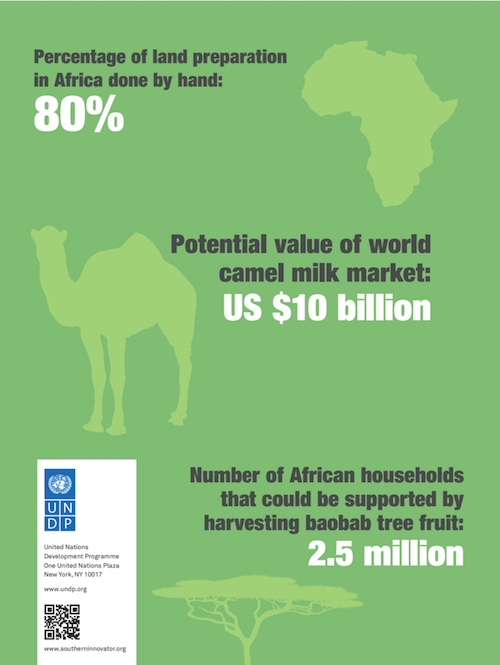
    Right now there are more than 862 million undernourished people around the world (FAO), and U.N. Secretary- General Ban Ki-moon has called for food production to increase 50 percent by 2030 just to meet rising demand. Three-quarters of the world’s poorest people living on less than US $1 a day live in rural areas in developing countries and 85 percent of the world’s farms are of less than two hectares in size.

    There has long been a tension between those who believe in very large farms, agribusiness and mono-crops (http://en.wikipedia.org/wiki/Mono-cropping), and those who believe in having a large number of smaller farms with a wide variety of crops and animals.

    Family farming has been seen as doomed for a long time. In the 19th century, figures like philosopher Karl Marx believed they would be split into capitalist farms and proletarian labour. Most modern economists regard family farming as an archaic way to grow food, destined to give way to agribusiness. Most family farms refute this, saying family farmers have been able to operate with success in both developed and developing countries.

    And small farms have endured. The livelihoods of more than 2 billion people depend on the 450 million smallholder farms across the world. With their families, they account for a third of the world’s population.

    Family farms are critical to weathering economic crises and ensuring a steady and secure food supply. The International Fund for Agricultural Development (IFAD) (www.ifad.org) called earlier this year for small family farms to be put at the heart of the global response to high food prices and to improve food security. And in Brazil, this call is being answered by a bold initiative to create what they call a “social technology”, combining a house building programme with diverse family farms.

    Brazil is currently buying up unused land and distributing it to people making land claims, including Brazil’s Landless Workers Movement (http://www.mstbrazil.org). When they receive land, family farmers often find there is no house on the land, or just a very basic dwelling.

    This is where the Brazilian farmer’s cooperative Cooperhaf: Cooperativa de Habitacao dos Agricultores Familiares (http://www.cooperhaf.org.br/), steps in. It has put together what it calls a “social technology” combining housing and farm diversification to support family farmers.

    “We see the house as the core issue,” said Adriana Paola Paredes Penafiel, a projects adviser with the Cooperhaf. “The farmers can improve their productivity but the starting point is the house.

    “Family farming is very important for the country – 70 percent of food for Brazilians comes from family farming,” said Penafiel. “The government wants to keep people in rural areas.”

    Started in 2001 by a federation of farmers unions, the Cooperhaf works in 14 Brazilian states with family farmers.

    “Family farmers had to organize themselves to deal with housing,” said Penafiel. “The cooperative was formed to mediate between farmers and the government. The farmers have a right in the law to a house.

    “We promote diversification to make farmers less vulnerable: if they lose a crop in macro farming, they lose everything. We encourage diversification and self-consumption to guarantee the family has food everyday. We help to set up a garden.”

    The concept is simple: a good quality home acts as an anchor to the family farm, making them more productive as farmers. The farmers receive up to 6,000 reals (US $2,290) for a house, and can choose designs from a portfolio of options from the Cooperhaf.

    As in other countries, the Cooperhaf and other coops encourage markets and certification programmes to promote family farmed food and raise awareness. Penafiel says promoting the fact that the food is family farmed is critical: to the consumer it is healthier, fresher and contains fewer chemicals than imported produce.

    “We sell a livelihood not a product. If you get to know the product, you are more conscious of what you eat.”

    In the US, there are almost 2 million farms, 80 percent of which are small farms, a large percentage family-owned. More and more of these farmers are now selling their products directly to the public.

    In the UK, family farms are on course to provide 10 percent of the country’s food and drink and be worth £15 billion a year.

    “If we forget them, we actually may get a situation where, while meeting the world’s immediate supply targets, we wind up with an even greater imbalance in the global supply system and greater food insecurity,” said IFAD President Lennart Båge.

    “Most agri business is for export,” said Penafiel. “If we don’t have food in the country, food for poor communities would not be available. This enables farmers to be more autonomous, not having to buy fertilizers and equipment and take on too much debt. That approach is not sustainable as we saw with the so-called Green Revolution.”

    Published: December 2008

    https://davidsouthconsulting.org/2020/12/14/african-farming-wisdom-now-scientifically-proven/

    https://davidsouthconsulting.org/2022/11/16/brazils-agricultural-success-teaches-south-how-to-grow/

    https://davidsouthconsulting.org/2022/10/10/cheap-farming-kit-hopes-to-help-more-become-farmers/

    https://davidsouthconsulting.org/2022/11/18/farmers-weather-fertilizer-crisis-by-going-organic/

    https://davidsouthconsulting.org/2022/11/01/indonesian-food-company-helps-itself-by-making-farmers-more-efficient/

    https://davidsouthconsulting.org/2022/11/23/kenyan-farmer-uses-internet-to-boost-potato-farm/

    https://davidsouthconsulting.org/2021/11/09/pocket-friendly-solution-to-help-farmers-go-organic/

    https://davidsouthconsulting.org/2021/09/16/small-fish-farming-opportunity-can-wipe-out-malnutrition/

    https://davidsouthconsulting.org/2022/11/11/urban-farming-to-tackle-global-food-crisis/

    https://davidsouthconsulting.org/2022/10/18/woman-wants-african-farming-to-be-cool/

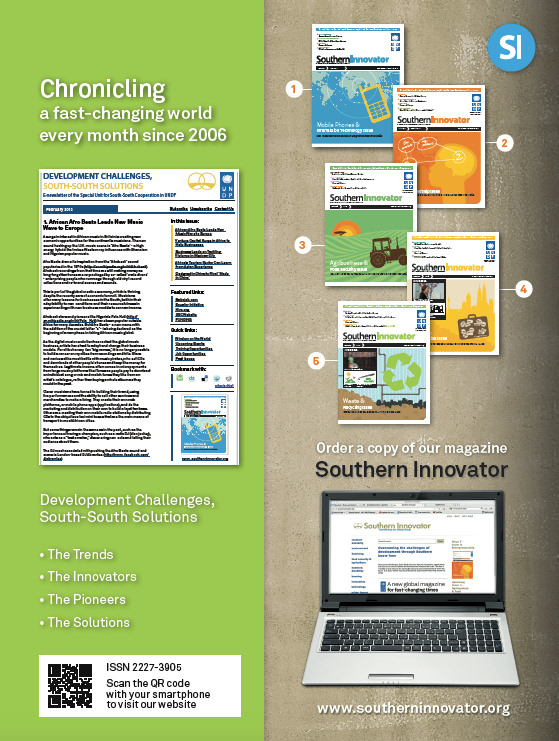
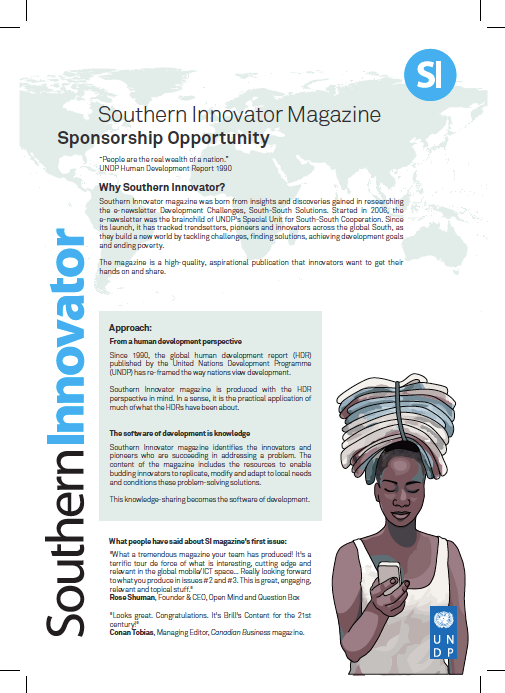
    Development Challenges, South-South Solutions was launched as an e-newsletter in 2006 by UNDP’s South-South Cooperation Unit (now the United Nations Office for South-South Cooperation) based in New York, USA. It led on profiling the rise of the global South as an economic powerhouse and was one of the first regular publications to champion the global South’s innovators, entrepreneurs, and pioneers. It tracked the key trends that are now so profoundly reshaping how development is seen and done. This includes the rapid take-up of mobile phones and information technology in the global South (as profiled in the first issue of magazine Southern Innovator), the move to becoming a majority urban world, a growing global innovator culture, and the plethora of solutions being developed in the global South to tackle its problems and improve living conditions and boost human development. The success of the e-newsletter led to the launch of the magazine Southern Innovator.  

    Follow @SouthSouth1

    Google Books: https://books.google.co.uk/books?id=YtEgTdyZioUC&dq=development+challenges+december+2008&source=gbs_navlinks_s

    Slideshare: http://www.slideshare.net/DavidSouth1/development-challengessouthsouthsolutionsdecember2008issue

    Southern Innovator Issue 1: https://books.google.co.uk/books?id=Q1O54YSE2BgC&dq=southern+innovator&source=gbs_navlinks_s

    Southern Innovator Issue 2: https://books.google.co.uk/books?id=Ty0N969dcssC&dq=southern+innovator&source=gbs_navlinks_s

    Southern Innovator Issue 3: https://books.google.co.uk/books?id=AQNt4YmhZagC&dq=southern+innovator&source=gbs_navlinks_s

    Southern Innovator Issue 4: https://books.google.co.uk/books?id=9T_n2tA7l4EC&dq=southern+innovator&source=gbs_navlinks_s

    Southern Innovator Issue 5: https://books.google.co.uk/books?id=6ILdAgAAQBAJ&dq=southern+innovator&source=gbs_navlinks_s

    https://davidsouthconsulting.org/2021/03/05/southern-innovator-issue-3/

    Creative Commons License
    This work is licensed under a
    Creative Commons Attribution-Noncommercial-No Derivative Works 3.0 License.

    ORCID iD: https://orcid.org/0000-0001-5311-1052.

    © David South Consulting 2023

  • Design Collaborations Revitalize Traditional Craft Techniques

    Design Collaborations Revitalize Traditional Craft Techniques

    By David SouthDevelopment Challenges, South-South Solutions

    SOUTH-SOUTH CASE STUDY

    Keeping alive traditional craft techniques and methods in the age of globalization is a tricky balance to get right. As countries seek to increase living standards and income, traditional craft-making methods are often jettisoned in favour of attracting manufacturing and other high-value activities – meaning rich and potentially lucrative skills can be lost.

    One promising new initiative is bringing craftspeople in the global South together with established and well-known designers in The Netherlands to create the market incentives to continue using traditional techniques. It is establishing a brand and a business model to sell unique and original craft products into the European marketplace. By doing this, it hopes to open up new markets in Europe – and in time, the rest of the world – for craft makers from the global South so they can continue to earn an income using their traditional skills and techniques.

    The brand is called Imperfect Design (http://www.imperfectdesign.nl/) and was founded in 2011 by Monique Thoonen, formerly the managing director of Dutch Design in Development (ddid.nl) – a matchmaker between Dutch designers, producers in developing countries and European importers. Imperfect Design takes the idea a step further: It is a brand dedicated to creating high-value, well-designed craft products for the European marketplace.

    The idea began to percolate in Thoonen’s mind in 2010. She received a good response from some of the Dutch designers she approached – who were keen to work with craft workers in developing countries – and this gave her the confidence to launch Imperfect Design.

    “We saw that many designers were very interested to work with craftsmen/small workshops in developing countries,” she explained, reflecting on her previous experience working with Dutch Design in Development. “The designers and the crafters learned a lot about the inspiring cooperation and it resulted often in good quality products/collections. However, it was hard to find good sales channels for the products. In 2010 the idea came about to set up an own brand.”

    Thoonen was seeking a business model that could be sustainable and rewarding for all the participants along the value chain (http://en.wikipedia.org/wiki/Value_chain).

    “The cooperation is inspiring for Dutch designers,” Thoonen said. “The craftsmen will learn a lot about product development during the project and will earn money from the orders. The idea is to build up long-term relations with producers in three countries in three continents – each continent one country.”

    For Thoonen, the business model approach is at the core of Imperfect Design.

    “The idea of my business model is not doing good. It must be a profitable business model, otherwise it can’t be sustainable. Making it profitable is a big challenge and also forces us to keep the commercial aspect every day in mind.”

    The criteria for selecting the designers includes a resourcefulness and creativity that can shape a high-quality craft product with the resources and tools at hand for the collaborating craft workers in the developing country. It is also crucial they understand how to shape the craft product into a high-value item that can command a high price back in Europe.

    According to Thoonen, “the products must be differentiated from the market, otherwise it can be copied easily by large producers in China. It is really important to create new things, as the prices are in general higher than from mass production, so the consumer must understand why the price is higher.”

    So far, Imperfect Design has begun working with craftspeople in Vietnam and Guatemala, and it is currently selecting a country in Africa. Craft workers can contact Imperfect Design about collaborating but the number of people it can work with is limited at this stage. Imperfect Design places emphasis in taking the time to build sustainable relationships.

    A common criticism of craft products sold in many markets is their sameness and sometimes poor and inconsistent production quality. Trying to enter an overseas market and understand what consumers want or desire is a very difficult thing for a craft worker to get right. This is where the experience and knowledge of a designer can make a big difference. Designers can help to hone the craft product, improve the production methods and position the product in the overseas marketplace.

    “The workshops have fantastic qualities and materials to work with,” says Thoonen. “When you combine that with the strength of our Dutch designers, you can create products which are commercial, of high quality, and beautiful.”

    One of the first collaborations to bear fruit is between Dutch designer Arian Brekveld (arianbrekveld.com) and craft workers in Vietnam. The collaborations have resulted in lacquer tables, trays and candlesticks, ceramic vases, iPad bags and throw cushions – all made using techniques and materials unique to Vietnam.

    Imperfect Design allows the designers to select which country they would like to work with. Brekveld’s previous experience travelling widely in Asia tipped his interest towards a country in that continent. He appreciated the friendly and welcoming contacts he had made in Vietnam, who showed a strong interest in collaborating.

    Brekveld wanted to bring a “designer’s eye” to the possibilities in Vietnam. He asked: “How could they make the crafts more beautiful and customized for the market in Europe?”

    He found Vietnam was not just an interesting place to work, but also a country undergoing significant change. As a result, he found it critical to go and see what was happening in the country and to see first-hand the working conditions in the workshops.

    This was a contrast to many of the design briefs he normally undertakes in Europe, where there often isn’t the intimacy of working directly with the craft workers in their workshops.

    The time spent in Vietnam was intense and involved visiting multiple workshops to see which would be the best partner.

    “We visited four or five lacquer companies to see what their skills were, looking for possibilities,” he said. “It is very special to see by yourself, to really to take a look by yourself, to see what companies do.”

    Brekveld was surprised to see that concepts that had been discussed and explored earlier in the day would be presented to him as completed works by the end of the day. The quick work pace and precision really impressed the designer, and the project took months to complete in comparison to the years required by some projects he works on in Europe.

    A group of women from the ethnic Catu (http://en.wikipedia.org/wiki/Co_Tu_people) community in central Vietnam weaved the fabrics for the iPad bags and cushions. It was very valuable to work with them in person because he could see what they were – and weren’t – capable of. The fabrics are made into iPad bags and cushions in the capital Hanoi by disabled craftsmen.

    Brekveld said visiting the remote workshop saved a lot of time and frustration.

    “It was a big difference compared to sitting behind a desk and sending designs. You really see all the possibilities that are there.”

    Brekveld is seeking to design products that do not fit in with a clichéd idea of what comes from a developing country.

    “If you look you can see the imperfections but they are not obvious. These designs would not necessarily sell in their own country. We try to design products showing the skills they have, using their techniques – not using patterns they would use for themselves. We look at their process and say ‘you can make that and that’. On the other hand, we don’t want to tell them to do something completely different. We look at the technique – a combination of European design language with their abilities.”

    But what about quality control? Brekveld says that is an issue he looks at right from the beginning of the design process. “I am a maker, try to make myself – try to think about it before hand.”

    He is ambitious for the collaboration to flourish.

    “We hope these relations are long-term relations,” he said. “We hope to expand the collection.”

    He will present the collections during Dutch Design Week at the end of October 2012 in Eindhoven (ddw.nl).

    For Thoonen, success will bring many benefits. “If we manage to sell the collection well in the market, then we can give more orders,” Thoonen said. “In short: it will create work, but also development in quality and design.”

    Published: September 2012

    Resources

    1) An online film showing Arian Brekveld’s trip to Vietnam and the craft collaborations. Website: http://imperfectdesign.nl/index.php?route=product/category&path=72_91

    2) Dutch Design in Development: DDiD is the agency for eco design, sustainable production and fair trade. They work with Dutch importers and designers and connect them to local producers in developing countries and emerging markets. Together products are made that are both profitable and socially and environmentally sustainableWebsite: http://www.ddid.nl/english/

    3) Dutch Design Week: Groundbreaking ideas, mind-blowing experiments and extraordinary forms of collaboration – that’s what it’s all about during DDW. With the boundless creativity of hundreds of renowned designers and young talents, each year the leading event offers a unique look into the future of design (Eindhoven, The Netherlands: 20-28 October 2012). Website: http://www.ddw.nl/

    Creative Commons License

    This work is licensed under a
    Creative Commons Attribution-Noncommercial-No Derivative Works 3.0 License.

    ORCID iD: https://orcid.org/0000-0001-5311-1052.

    © David South Consulting 2023