Category: Development Challenges, South-South Solutions Newsletters

The Development Challenges, South-South Solutions e-newsletter was published by the United Nations Office for South-South Cooperation (UNOSSC) from 2006 to 2014.

  • African Innovators Celebrated in Prize

    African Innovators Celebrated in Prize

    By David SouthDevelopment Challenges, South-South Solutions

    SOUTH-SOUTH CASE STUDY

    Innovation is increasingly being recognized as the key to tackling long-standing development problems in Africa, as well as across the developing and developed world. While it is easy to draw up a list of challenges facing the global South, it takes a special person to see not problems but solutions.

    Innovation tends to mean fresh thinking brought to bear to old problems, or completely radical new technologies, insights and ways of doing things that are transformative.

    The Oslo Manual for measuring innovation (http://www.oecd.org/innovation/inno/oslomanualguidelinesforcollectingandinterpretinginnovationdata3rdedition.htm) has defined four types of innovation: product innovation, process innovation, marketing innovation and organizational innovation (OECD).

    Product innovation is a good or service that is new or significantly improved. This includes significant improvements in technical specifications, components and materials, software in the product, user friendliness or other functional characteristics. Process innovation is a new or significantly improved production or delivery method. This includes significant changes in techniques, equipment and/or software. Marketing innovation is defined as a new marketing method involving significant changes in product design or packaging, product placement, product promotion or pricing. And finally, organizational innovation is a new organizational method in business practices, workplace organization or external relations.

    How quickly these can be brought to the marketplace, and the level of innovation in society, will be critical to a country’s success in the coming decade, according to the Organization for Economic Cooperation and Development (OECD). Importantly, innovation is being seen as the big driver of economic progress and well-being and the best way to deal with the plethora of challenges facing human health and the environment.

    As an example, in the past decade, communications innovation has given more and more of the world’s population access to mobile phones and the Internet. This has led to the success of many new companies, from the search engine giant Google to multiple software innovations such as Kenya’s M-Pesa mobile phone banking application (http://www.safaricom.co.ke/personal/m-pesa/m-pesa-services-tariffs/relax-you-have-got-m-pesa), to small and innovative companies spreading the innovation bug such as Pico Crickets (http://www.picocricket.com/) or the Raspberry Pi (http://www.raspberrypi.org/).

    As the OECD has said, “Not only has innovation moved to centre stage in economic policymaking, but there is a realization that a coordinated, coherent, ‘whole of government’ approach is required.

    “Even countries that have generally refrained from active industrial policy in recent years now seek new ways to improve the environment for innovation in order to boost productivity and growth. Today, innovation performance is a crucial determinant of competitiveness and national progress.”

    In the past, African innovators mostly went unacknowledged, unsupported and unrecognized. But this is changing, as new resources come online to support, finance, encourage and champion African innovators. Until very recently, people outside the continent heard little positive news about what was happening there. But the African innovator story is an inspiration to people around the world.

    The Innovation Prize for Africa (http://innovationprizeforafrica.org), begun in 2011, awards US $100,000 for the top innovation that matches its criteria of marketability, originality, scalability, social impact and business potential.

    The prize aims to encourage people to come up with practical solutions to the continent’s long-standing problems. This year’s prize received 900 applications from 45 countries.

    The 2013 prize went to the South Africa-based AgriProtein (http://www.agriprotein.com) team for an innovation that uses waste and fly larvae to produce animal feed. The solution collects biodegradable waste and then feeds it to flies. The larvae the flies produce are then ground into a protein which is used as a feed for animals. Not only does this approach improve the nutritional quality of the feed, it also lowers the cost for African processors and farmers.

    This year’s finalists offer a mixed bag of innovations, including creative ways to find new energy sources, improving access to clean water and preventing diseases.

    Joining a clutch of other South African finalists, Dr. Dudley Jackson has created the SavvyLoo, a waterless toilet for use in rural areas and makeshift settlements. It separates the waste into liquids and solids to reduce the risk of disease, odour, and harm to the environment and eases waste removal.

    Another South African, Professor Eugene Cloete, is the inventor of the TBag Water Filter that cleverly uses material recovered from tea bags to filter polluted water until it is completely safe to drink.

    When it comes to the thorny issue of finding new energy sources for an energy-hungry continent, the prize unearthed some interesting solutions. One is Justus Nwaoga, a Nigerian finalist, who developed a way to turn a common weed into a source of renewable solar energy.

    Nwaoga, a researcher from the Department of Pharmaceutical and Medicinal Chemistry at the University of Nigeria Nsukka (http://unn.edu.ng/), found the common tropical weed Mimosa pudica (http://en.wikipedia.org/wiki/Mimosa_pudica) surprisingly provides a way to tap into the sun’s energy.

    The weed has leaves which fold in on themselves when touched, but spring quickly back into their normal form when exposed to daylight. The plant opens up in the morning and closes in the evening – an indicator of how sensitive it is to sunlight.

    Nwaoga began to experiment with the plant, subjecting it to artificial light at night to see if the leaves would open up again. But they didn’t. He came to the conclusion there were properties in the leaves that only responded to natural, solar light. He further concluded it had something to do with electrical transmission in the leaves. He isolated the element that was making the leaves respond to solar light, finding it more sensitive than the silicon solar cell used in solar panels.

    Other innovators recognized by the prize include a Tunisian research and development startup called Saphon Energy (http://www.saphonenergy.com/), which makes bladeless wind turbines, and Muna Majoud Mahoamed Ahmed from Sudan, who has created the Agroforestry Model Farm in Khartoum.

    “We see a strong trend emerging of innovations that have significant social impact for Africa,” Dr.Francois Bonnici, director of the Bertha Centre for Social Innovation at the University of Cape Town’s Graduate School of Business, told Ventures Africa.

    The call for applications for the 2014 Prize will be announced in July 2013.

    Published: June 2013

    Resources

    1) Innovation Prize for Africa: Innovation Prize for Africa (IPA) is a joint initiative of the United Nations Economic Commission for Africa (ECA) and the African Innovation Foundation (AIF) started in 2011. Website: http://innovationprizeforafrica.org

    2) Appfrica: Accelerating the Growth of Africa’s Tech Sector: Appfrica has launched “The Cheetah Code”, an ongoing web series documenting the African tech and creative space. The series is a collection of mini-documentaries chronicling Africa’s young entrepreneurs, creative class, and emerging technology sector. The goal is to record high-quality video content that is entertaining, educational, and inspirational all at once. You can find all of this content and more at tv.cheetahcode.com. Website: http://blog.appfrica.com/2013/05/12/a-web-series-about-africas-entrepreneurs-creatives-and-technologists/?utm_medium=twitter&utm_source=twitterfeed

    3) Innovation and Growth: Rationale for an Innovation Strategy: Publisher: OECD. Website: http://www.oecd.org/science/inno/39374789.pdf

    4) Reverse Innovation: Ideas from the Global South. Website: http://urbantimes.co/2012/09/reverse-innovation-ideas-from-the-global-south/

    5) African Innovator Magazine: Technology insights for Africa’s decision makers. Website: http://www.africaninnovatormagazine.com/

    Southern Innovator logo

    London Edit

    31 July 2013

    Development Challenges, South-South Solutions was launched as an e-newsletter in 2006 by UNDP’s South-South Cooperation Unit (now the United Nations Office for South-South Cooperation) based in New York, USA. It led on profiling the rise of the global South as an economic powerhouse and was one of the first regular publications to champion the global South’s innovators, entrepreneurs, and pioneers. It tracked the key trends that are now so profoundly reshaping how development is seen and done. This includes the rapid take-up of mobile phones and information technology in the global South (as profiled in the first issue of magazine Southern Innovator), the move to becoming a majority urban world, a growing global innovator culture, and the plethora of solutions being developed in the global South to tackle its problems and improve living conditions and boost human development. The success of the e-newsletter led to the launch of the magazine Southern Innovator. 
    Creative Commons License

    This work is licensed under a
    Creative Commons Attribution-Noncommercial-No Derivative Works 3.0 License.

    ORCID iD: https://orcid.org/0000-0001-5311-1052.

    © David South Consulting 2023

  • Urban Farming to Tackle Global Food Crisis

    Urban Farming to Tackle Global Food Crisis

    By David SouthDevelopment Challenges, South-South Solutions

    SOUTH-SOUTH CASE STUDY

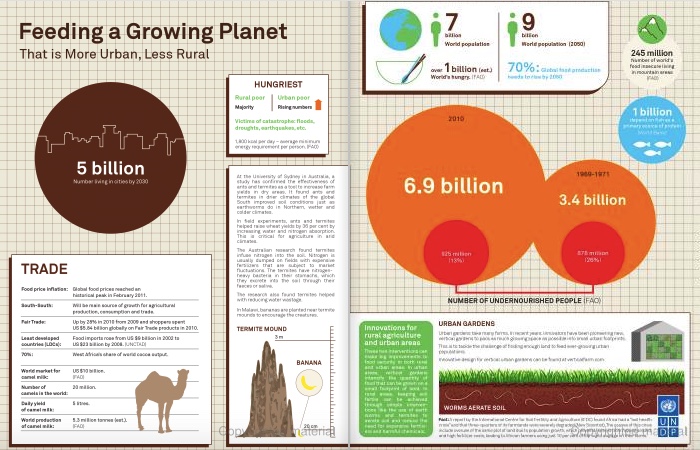
    The world’s population is becoming more urban by the day. By 2030, some five billion people around the world will live in cities. This year is the tipping point: urban dwellers (3.3 billion people) now outnumber rural residents for the first time (UNFPA’s State of the World Population 2007 Report). 

    But with rising food prices across the globe, many city-dwellers are experiencing hunger and real hardship. On international commodity markets, food prices have gone up 54 percent over the last year, with cereal prices soaring 92 percent (FAO – World Food Situation). While living in an urban environment means living cheek-by-jowl with other people, it doesn’t mean there aren’t ways to grow food and supplement urban dwellers’ tight budgets and boost diets.

    U.N. Secretary General Ban Ki-moon has called for food production to increase 50 percent by 2030 just to meet rising demand – and right now there are 862 million people undernourished (FAO). But one solution, urban farming, can make a huge difference, as the Caribbean island of Cuba has shown.

    Today, Cuba imports about 50 percent of its minimum fuel and food requirements – a cost that reached US $1.6 billion last year for food. (Reuters). The island has been buffeted by one food crisis after another in the past two decades, first by the collapse of its aid from the Soviet Union, and then by a fuel crisis. But now, urban farming in Cuba provides most of the country’s vegetables, thanks to urban gardens that have sprung up on abandoned land in the country’s cities and towns. And the food is pesticide-free: 70 percent of the vegetables and herbs on the island are organic (http://www.soilassociation.org/web/sa/saweb.nsf/Living/ whatisorganic.html).

    These urban farms mean fresh food is just a short walk away from the people who eat it. And in a world of rising fuel prices, Cuba has reduced the use of fossil fuels in the production and transportation of food.

    The urban farms have created 350,000 jobs that pay better than most government jobs. It has also improved Cuban’s health: many have moved from diets dominated by rice and beans and imported canned goods from Eastern Europe, to fresh vegetables and fruits.

    While Cubans receive at least a basic state ration of rice, beans and cooking oil, the rations do not include fresh fruit and vegetables. After the withdrawal of Soviet subsidies, the average Cuban’s daily calorie intake fell sharply. Between 1989 and 1993, daily calorie intake dropped from 3,004 to 2,323 (UN). But with the growth of urban farms, this has moved up to 3,547 calories a day – even higher than the amount recommended for Americans by the US government.

    The secret to this success has been the rise of entrepreneurs like Miladis Bouza, a 48-year-old former research biologist who had to abandon a comfortable middle class life after the collapse of the Soviet Union. Her government salary dropped to US $3 a month. Unable to make ends meet and provide food for her family, she quit her job.

    The Cuban government allowed people to turn unused urban land into mini farms. The cities have many vacant lots because the state owns most land and there isn’t competition from private developers, as in many other countries. Unusually for communist Cuba, 80 percent of the profits are kept by the farmers. This can be an average wage of US $71 per month.

    “Those salaries are higher than doctors, than lawyers,” Roberto Perez, an agronomist who runs the country’s first urban farm, told The Associated Press. “The more they produce, the more they make. That’s fundamental to get high productivity.”

    Miladis grabbed this opportunity to farm a half-acre plot near her home in Havana. Along with her husband, she grows tomatoes, sweet potatoes and spinach, and sells the vegetables at a stall on nearby busy street. This has enabled her monthly income to rise to between US $100 per month and US $250 per month, far more than the average government salary of US $19 per month.

    Cuba was inspired by greenbelt farms in Shanghai (http://en.shac.gov.cn/hjgl/jqgk/t20030805_82028.htm): but Cuba has gone even further to make urban farming a key part of the national food supply.

    All this urban farming is also all-natural farming. Farms have had to turn to natural compost as fertilizer, and natural pesticides like strong-smelling celery to ward off insects.

    So-called organoponicos (http://academicos.cualtos.udg.mx/Pecuarios/ PagWebEP/Lecturas/ORGANOPONICOS.htm ) gather together a wide variety of vegetables, fruits and herbs, as well as ornamental plants. Customers are offered mangos, plantains, basil, parsley, lettuce, garlic, celery, scallions, collard greens, black beans, watermelon, tomatoes, malanga, spinach and sweet potatoes.

    “Nobody used to eat vegetables,” said David Leon, 50, buying two pounds of Swiss chard at a Havana organoponico. “People’s nutrition has improved a lot. It’s a lot healthier. And it tastes good.”

    Published: June 2008

    Resources

    https://davidsouthconsulting.org/2020/12/14/african-farming-wisdom-now-scientifically-proven/

    https://davidsouthconsulting.org/2022/10/10/cheap-farming-kit-hopes-to-help-more-become-farmers/

    https://davidsouthconsulting.org/2023/01/16/hip-driven-pump-brings-water-to-parched-fields/

    https://davidsouthconsulting.org/2022/11/23/kenyan-farmer-uses-internet-to-boost-potato-farm/

    https://davidsouthconsulting.org/2022/10/31/new-kenyan-services-to-innovate-mobile-health-and-farming/

    https://davidsouthconsulting.org/2021/11/09/pocket-friendly-solution-to-help-farmers-go-organic/

    https://davidsouthconsulting.org/2021/09/16/small-fish-farming-opportunity-can-wipe-out-malnutrition/

    https://davidsouthconsulting.org/2022/10/18/woman-wants-african-farming-to-be-cool/

    Development Challenges, South-South Solutions was launched as an e-newsletter in 2006 by UNDP’s South-South Cooperation Unit (now the United Nations Office for South-South Cooperation) based in New York, USA. It led on profiling the rise of the global South as an economic powerhouse and was one of the first regular publications to champion the global South’s innovators, entrepreneurs, and pioneers. It tracked the key trends that are now so profoundly reshaping how development is seen and done. This includes the rapid take-up of mobile phones and information technology in the global South (as profiled in the first issue of magazine Southern Innovator), the move to becoming a majority urban world, a growing global innovator culture, and the plethora of solutions being developed in the global South to tackle its problems and improve living conditions and boost human development. The success of the e-newsletter led to the launch of the magazine Southern Innovator. 

    https://davidsouthconsulting.org/2021/03/05/southern-innovator-issue-3/

    Creative Commons License

    This work is licensed under a
    Creative Commons Attribution-Noncommercial-No Derivative Works 3.0 License.

    ORCID iD: https://orcid.org/0000-0001-5311-1052.

    © David South Consulting 2023

  • Havana’s Restaurant Boom Augers in New Age of Entrepreneurs

    Havana’s Restaurant Boom Augers in New Age of Entrepreneurs

    By David SouthDevelopment Challenges, South-South Solutions

    SOUTH-SOUTH CASE STUDY

    Cuba, the Caribbean island nation known for its 1959 revolution and its tourism industry, is undergoing a shift in its economic strategy. The country has had heavy state control of its industries and business activities since the country adopted the official policy of state socialism and joined the Communist economic sphere headed by the Soviet Union.

    When the Soviet Union fell apart in 1991, Cuba was pitched into an economic crisis as it lost access to preferential trade subsidies. This period is known as the ‘Special Period’ (http://en.wikipedia.org/wiki/Special_Period) and was marked by a severe reduction in access to fuel as supplies and subsidies from the Soviet Union disappeared. Some of the iconic images of the time include people abandoning their cars and turning to bicycles to get around, or using make-shift truck-buses packed with workers. Exports collapsed and slashed the size of the economy by a third.

    Fast-forward to today, and tourism is booming. A record 2.7 million tourists went to Cuba in 2011, earning the country US $2.3 billion. And it is catering to this tourism market that probably offers the best near-term opportunities. With wages still just 50 per cent of what they were in 1989 many are taking up this new opportunity to become entrepreneurs.

    To become an entrepreneur, Cubans need to apply for a pink identification card with their name and photo and the words “Autorizacion Para Ejercer el Trabajo por Cuenta Propria.” This gives authority “to work for your own account.” With the card, a person can start a business, hire staff and pay them what they like.

    Cuba’s economy has been through many phases since the revolution, swinging between loosening up the ability of people to establish private businesses – and pulling back, restricting private enterprise. But since 2008, there has been a significant shift to encouraging greater private enterprise, entrepreneurship and the ownership of private property – once banned – to stimulate the economy.

    “This is the most important thing to happen in Cuba since the revolution in 1959,” Juan Triana, senior fellow at the Centre for the Study of the Cuban Economy at Havana University, told The Sunday Times Magazine.

    One visible sign of this change is the flourishing of what is called locally ‘paladar’ (http://en.wikipedia.org/wiki/Paladar), or privately run restaurants.

    Paladares are usually located in a person’s home and staffed by family members. Their customers are a mix of tourists, expatriates living in Cuba, and Cubans with a high enough income to be able to afford restaurant meals.

    The cost of a meal in these restaurants can run from US $40 to US $60 for two people.

    Stocking the kitchen is not easy. Cuba experiences food shortages and there is still rationing for many. Basics like eggs can be hard to find. As for exotic, imported ingredients, many chefs rely on visitors to stock their larders.

    Cuba will have to re-build its food sector to make this a lasting improvement.

    The agriculture sector has declined and, where Cuba once provided a third of the world’s sugar harvest, the country now has to import half of its food supply. Measures are in the works to change this, with smallholder farmers now able to own 165 acres of land and sell their produce to private customers and hotels.

    One restaurant owner, Héctor Higuera Martinez, told The New York Times:“You dream up a recipe that you’d like to make but then you can’t find the ingredients.

    “One day you go out to get salt and there’s no salt. And I mean no salt,Anywhere.”

    Martinez trained with a well-known Cuban chef and did a stint in Paris before returning to Havana. He has turned a 19th-century mansion into the restaurant Le Chansonnier (http://www.cubajunky. com/havana/restaurant_le_chansonnier.html) and decorated the walls with the work of local artists.

    Martinez sees the paladares as a turning point in changing Cuba’s reputation for having boring food. “I believe we can play an important role in revolutionizing Cuban cuisine.”

    Cuba is making the difficult shift from having an economy where 80 per cent of activity is in the state sector, to a mixed model balanced between private and public ownership.

    Havana’s historic district offers tourists renovated colonial architecture mixed with shops, restaurants and bars. As a tourist strolls from the renovated district, they quickly come across the rest of Havana, which has beautiful buildings from the colonial period, 1950s American-influenced architecture with its fading retro signage, and more utilitarian Soviet-era architecture.

    While charming and home to most of the city’s residents, much of it is rundown and crowded and in need of investment and renovation.

    But things are changing fast. Oyaki Curbelo and Cedric Fernando use spices brought in by visitors for Bollywood, their restaurant in the Nuevo Vedado area (http://cubantripadvisor.com/destinations/havana-cityoutskirts/bollywood-paladar/). It has a small menu of Indian and Sri Lankan dishes, including shrimp curry with ginger and tamarind. The restaurant sources its curry leaves from a tree located in the Sri Lankan Embassy.

    Another restaurant, Atelier (http://www.cubaabsolutely.com/articles/travel/article_travel.php?landa=70),located in a mansion in the Vedado neighbourhood, serves European Continental food and has a roof terrace letting diners enjoy the a view of the Havana skyline.

    The restaurant Doña Eutimia (https://www.facebook.com/paladardona.eutimia) serves up Cuban favourites off the Cathedral Square. Specialties include a dish made of shredded beef with garlic, tomato, oregano and bay leaves.

    At Vistamer (http://www.stay.com/havana/restaurant/4249/paladar-vistamar/),diners can enjoy garlic-laden lobster tails and lemon meringue pie. At the paladar Café Laurent (http://www.cubaabsolutely.com/articles/travel/article_travel.php?landa=71), the menu includes meatballs with sesame seeds and mustard in red-wine and tarragon sauce, according to The New York Times.

    Habana Chef in the Vedado district (http://cubantripadvisor.com/destinations/havana-city-outskirts/habana-chefpaladar/) was started by Joel Begue and chef Ivan Rodriguez. Begue gained his experience in the state restaurant sector and took the opportunity to get a licence when the government offered them in 2011. He borrowed US $25,000 to start the restaurant and has been able to pay back half so far. His current success is prompting him to look into opening a second restaurant in the capital.

    An enthusiastic Andrew Macdonald, who is looking for investment opportunities for a half a billion dollar fund held by the Escencia Anglo-Cuban firm, told The Sunday Times magazine, “Cuba is the top emerging tourism market in the Caribbean by a mile, and it’s in the top five emerging markets globally.”

    Published: May 2012

    Resources

    1) Advice on starting a restaurant and links to additional resources. Website: runarestaurant.co.uk

    2) How to start a restaurant: From Entrepreneur magazine, a guide to the planning required to start a successful restaurant. Website: http://www.entrepreneur.com/article/73384

    3) AlaMesa: A directory of restaurants in Cuba. Website: alamesacuba.com

    4) Southern Innovator: Youth and Entrepreneurship Issue: The new global magazine is launching its second issue and is packed with innovative entrepreneurs and youth using business to tackle poverty. Website: http://www.scribd.com/doc/86451057/Southern-Innovator-Magazine-Issue-2

    https://davidsouthconsulting.org/2022/11/10/brazilian-restaurant-serves-amazonian-treats/

    https://davidsouthconsulting.org/2022/11/19/cooking-up-a-recipe-to-end-poverty/

    https://davidsouthconsulting.org/2022/10/24/latin-american-food-renaissance-excites-diners/

    https://davidsouthconsulting.org/2022/11/11/woman-restaurant-entrepreneur-embraces-brand-driven-growth/

    Development Challenges, South-South Solutions was launched as an e-newsletter in 2006 by UNDP’s South-South Cooperation Unit (now the United Nations Office for South-South Cooperation) based in New York, USA. It led on profiling the rise of the global South as an economic powerhouse and was one of the first regular publications to champion the global South’s innovators, entrepreneurs, and pioneers. It tracked the key trends that are now so profoundly reshaping how development is seen and done. This includes the rapid take-up of mobile phones and information technology in the global South (as profiled in the first issue of magazine Southern Innovator), the move to becoming a majority urban world, a growing global innovator culture, and the plethora of solutions being developed in the global South to tackle its problems and improve living conditions and boost human development. The success of the e-newsletter led to the launch of the magazine Southern Innovator. 

    https://davidsouthconsulting.org/2021/03/05/southern-innovator-issue-3/

    Creative Commons License

    This work is licensed under a
    Creative Commons Attribution-Noncommercial-No Derivative Works 3.0 License.

    ORCID iD: https://orcid.org/0000-0001-5311-1052.

    © David South Consulting 2023

  • Woman Restaurant Entrepreneur Embraces Brand-Driven Growth

    Woman Restaurant Entrepreneur Embraces Brand-Driven Growth

    By David SouthDevelopment Challenges, South-South Solutions

    SOUTH-SOUTH CASE STUDY

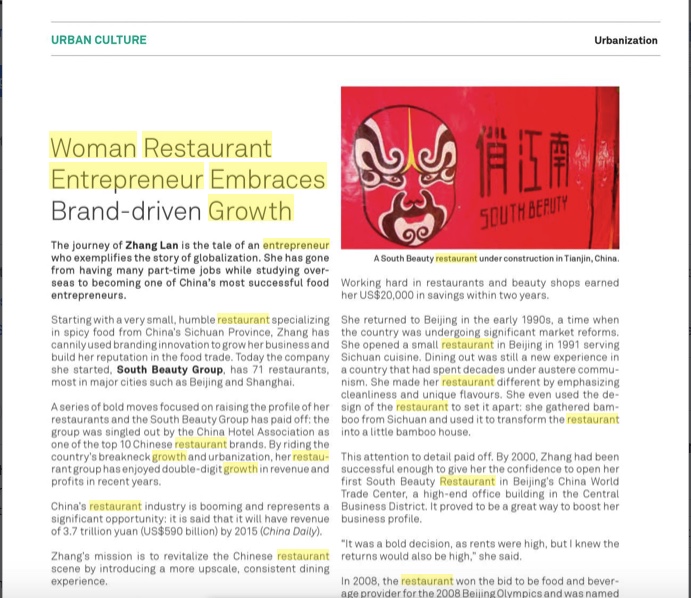
    The journey of Zhang Lan is the tale of an entrepreneur who exemplifies the story of globalization. She has gone from working many part-time jobs while studying overseas, to becoming one of China’s most successful food entrepreneurs.

    Starting with a very small and humble restaurant specializing in spicy food from China’s Sichuan province, Zhang has cannily used branding innovation to grow her business and build her reputation in the food trade. Today the company she started, South Beauty Group (southbeauty.com), has 71 restaurants, most in major cities such as Beijing and Shanghai.

    A series of bold moves focused on raising the profile of her restaurants and the South Beauty Group has paid off: the group was singled out by the China Hotel Association as one of the top 10 Chinese restaurant brands. By riding the country’s breakneck growth and urbanization, her restaurant group has enjoyed double-digit growth in recent years in revenue and profits.

    Zhang’s mission is to revitalize the Chinese restaurant scene by introducing a more upscale and consistent dining experience.

    China’s restaurant industry is booming and represents a significant opportunity: it is said it will have revenue of 3.7 trillion yuan (US $590 billion) by 2015 (China Daily).

    “Most people in China don’t know how to present food. I am happy that I have given some importance to the appearance of food,” Zhang told the China Daily newspaper.

    “I strike a balance between popular and high-end brands in my daily life. This also works for South Beauty Group, which aims to attract customers to a modern place to enjoy high-grade and popular Chinese cuisine.”

    Her business mission is to take the group outside of China and become a global brand.

    “Buoyed by the booming domestic high-end catering market, South Beauty Group is looking to be a major luxury brand in the global catering industry. It is not an easy task considering that there are different cultures and eating habits. But my past experience has taught me that opportunities often come along with challenges,” she told China Daily.

    Zhang’s business story started in a journey to Canada to pursue further education. To make ends meet, at one time she took on six part-time jobs, including washing dishes and food preparation.

    Anybody who has gone to another country to work and better their life knows how hard this can be: “During that period, I was so tired by the end of the day that I had to lift my legs onto the bed with my hands,” Zhang said.

    But working hard in restaurants and beauty shops earned her US $20,000 in savings within two years.

    She returned to Beijing in the early 1990s, a time when the country was undergoing significant market reforms. She opened a small restaurant in Beijing in 1991 serving Sichuan cuisine. Dining out was still a new experience in a country that had spent decades under austere communism. She made her restaurant different by emphasizing cleanliness and unique flavours for the food. She even used the design of the restaurant to set it apart: she gathered bamboo from Sichuan and used it to transform the restaurant into a little bamboo house.

    This attention to detail paid off. By 2000, Zhang had been successful enough to give her the confidence to open her first South Beauty Restaurant in Beijing’s China World Trade Center, a high-end office building in the Central Business District. It proved to be a great way to boost her business’s profile.

    “It was a bold decision, as rents were high, but I knew the returns would also be high,” she said.

    By 2006, she was successful enough to make another brave move: open a luxury restaurant called the Lan Club, in Beijing. Having learned about the importance of distinguishing herself in the ever-growing restaurant marketplace in China, she invited world-famous designer Philippe Starck (http://www.starck.com/en/) to design the restaurant.

    For Zhang, there was a bigger strategy at work: “I was not disheartened when some people said that I threw money away like dirt and 12 million yuan (US $1.92 million) was too much for a design draft. But I got great publicity and brand recognition with this design, far more than what is received by most companies which spend millions of yuan on television advertisements. Not everyone in China can boast of a Starck design in their restaurant.”

    In 2007, the company also started cooking meals for airlines flying between China and France, the Netherlands and South Korea. In 2008, it won the bid to be food and beverage provider for the 2008 Beijing Olympics and was named official caterer to the 2010 Shanghai World Expo.

    “These international events have given us great confidence in planning overseas expansion,” Zhang said.

    The hallmarks of the dining experience at a South Beauty Restaurant include dramatic food presentation, upscale décor, a pleasant dining atmosphere and critically, waiting staff who are informed about the dishes they are serving.

    Dramatic food preparation includes cooking food at the table for the diners and serving stir-fried shrimp on a plate with a goldfish bowl filled with live fish.

    “I want to change the cheap price and bad atmosphere tag that most Westerners have about Chinese food,” Zhang told China Daily.

    She has attracted investors to take a stake in the business and become the second richest female entrepreneur in China, according to the 2011 China Restaurant Rich List.

    While the international economic crisis is still damaging growth in the United States and Europe, Zhang still plans to go global. She is looking to initially expand into Asia before moving into Europe and North America.

    “Our mission is to promote authentic Chinese cuisine across the world. With (the) Chinese economy growing steadily and its cultural influence gaining, it will not be long before we see some big global Chinese catering companies, much like McDonald’s,” Zhang concluded. And it looks like South Beauty Group wants to lead the way.

    Published: November 2012

    Resources 

    1) Restaurant Branding: A website dedicated to discussing restaurant branding and how to do it. Website:http://www.restaurantbranding.com/

    2) How to Start a Restaurant: Tips from the Entrepreneur.com website. Website:http://www.entrepreneur.com/article/73384

    3) Top tips on opening a restaurant from successful celebrity chef Gordon Ramsay. Website:http://www.channel4.com/programmes/ramsays-kitchen-nightmares/articles/gordon-ramsays-top-tips-for-starting-a-restaurant

    4) Tips on how to handle the start-up costs of staring a restaurant. Website:http://www.inc.com/articles/201111/business-start-up-costs-restaurant.html

    https://davidsouthconsulting.org/2022/11/10/acai-berry-brazils-boon/

    https://davidsouthconsulting.org/2022/08/14/brazil-preserves-family-farms-keeping-food-local/

    https://davidsouthconsulting.org/2022/11/10/brazilian-restaurant-serves-amazonian-treats/

    https://davidsouthconsulting.org/2022/10/20/china-consumer-market-asian-perspective-helps/

    https://davidsouthconsulting.org/2022/11/19/cooking-up-a-recipe-to-end-poverty/

    https://davidsouthconsulting.org/2022/11/11/havanas-restaurant-boom-augers-in-new-age-of-entrepreneurs/

    https://davidsouthconsulting.org/2022/10/24/latin-american-food-renaissance-excites-diners/

    https://davidsouthconsulting.org/2022/11/11/urban-farming-to-tackle-global-food-crisis/

    Development Challenges, South-South Solutions was launched as an e-newsletter in 2006 by UNDP’s South-South Cooperation Unit (now the United Nations Office for South-South Cooperation) based in New York, USA. It led on profiling the rise of the global South as an economic powerhouse and was one of the first regular publications to champion the global South’s innovators, entrepreneurs, and pioneers. It tracked the key trends that are now so profoundly reshaping how development is seen and done. This includes the rapid take-up of mobile phones and information technology in the global South (as profiled in the first issue of magazine Southern Innovator), the move to becoming a majority urban world, a growing global innovator culture, and the plethora of solutions being developed in the global South to tackle its problems and improve living conditions and boost human development. The success of the e-newsletter led to the launch of the magazine Southern Innovator. 

    https://davidsouthconsulting.org/2021/03/05/southern-innovator-issue-2/

    Creative Commons License

    This work is licensed under a
    Creative Commons Attribution-Noncommercial-No Derivative Works 3.0 License.

    ORCID iD: https://orcid.org/0000-0001-5311-1052.

    © David South Consulting 2023