Category: Development Challenges, South-South Solutions Newsletters

The Development Challenges, South-South Solutions e-newsletter was published by the United Nations Office for South-South Cooperation (UNOSSC) from 2006 to 2014.

  • Farmers Weather Fertilizer Crisis by Going Organic

    Farmers Weather Fertilizer Crisis by Going Organic

    By David SouthDevelopment Challenges, South-South Solutions

    SOUTH-SOUTH CASE STUDY

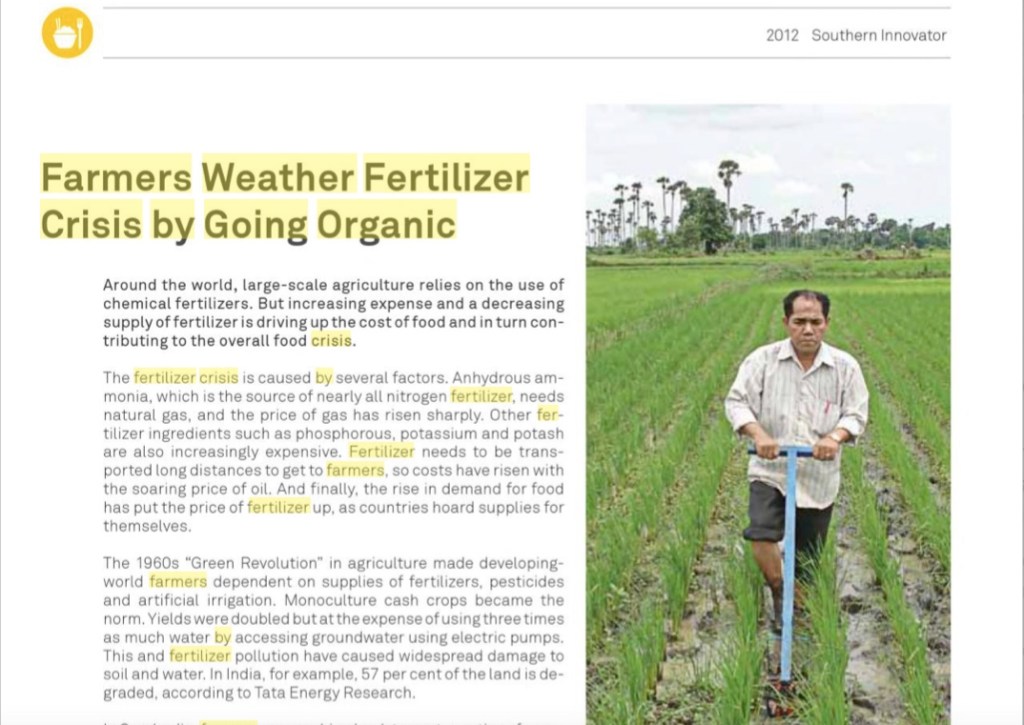
    Around the world, large-scale agriculture relies on the use of chemical fertilizers. But increasing expense and decreasing supply of fertilizer is driving up the cost of food, and in turn contributing to the overall food crisis.

    According to a soon-to-be-released UN report, prices have shot up and will stay high for at least three years. Prices have almost doubled and in some cases risen by 500 percent over 15 months.

    The fertilizer crisis is caused by several factors. Anhydrous ammonia, which is the source of nearly all nitrogen fertilizer, needs natural gas, and the price of gas has risen sharply. Other fertilizer ingredients like phosphorous, potassium and potash are also increasingly expensive. Fertilizer needs to be transported long distances to get to farmers, so costs have risen with the soaring price of oil. And finally, the rise in demand for food has put the price of fertilizer up, as countries hoard supplies for themselves.

    The 1960s ‘Green Revolution’ in agriculture made developing-world farmers dependent on supplies of fertilizers, pesticides and artificial irrigation. Monoculture cash crops became the norm. Yields were doubled, but at the expense of using three times as much water by accessing groundwater using electric pumps. This and fertilizer pollution has caused widespread damage to soil and water. In India, for example, 57 per cent of the land is degraded, according to Tata Energy Research.

    In Cambodia, farmers are reaching back to past practices for answers to the fertilizer crisis. One is to go organic. Taking this approach has many health and environmental advantages – and, best of all for farmers, it keeps costs down.

    Khim Siphay, a Cambodian farmer, has found he gets bigger crops of rice and vegetables while paying a lot less for fertilizers.

    “Using pesticide or fertilizers kills important insects, and causes the soil to become polluted,” he told Reuters. “I use compost and it helps keep the soil good from one year to another. All of my family members help make the compost.”

    The push to organic methods for Cambodia’s 13 million people relying on agriculture for a living comes from a non-governmental organization, the Cambodian Center for Study and Development in Agriculture (CEDAC). It has successfully moved to organic methods, starting from just a handful of 28 farmers in 2000, to the current 60,000 – and received an endorsement from the Cambodian Ministry of Agriculture.

    CEDAC says farms using the organic methods have been able to increase rice yields per hectare, while the seeds needed have fallen by 70 to 80 percent. By using a “System of Rice Intensification”, the mostly small-scale farmers are able to get more out of the land, with less labour. Add to that the fact that organic rice gets a premium price on world markets, and the result for the farmers has been a rise in income from US $58 to US $172 per hectare.

    “The important point of organic farming is that farmers don’t need to spend money on fertilizers and pesticide so they spend less money on farming,” said CEDAC official Yang Saing Koma.

    “They can sell the produce for a higher price. Also they can avoid being infected by pesticides and they will be healthier. It is also good for the environment,” he said.

    Rice and other produce can be used to feed chickens to produce organic poultry and eggs – another bonus for farmers looking to raise the value of their produce.

    “I started doing organic farming outside my rice paddy, but then I noticed production was double, so in the next season, I decided to grow organically on all of my land,” said farmer Ros Meo. “I spend less money now and I can grow more and I am not sick as I was before, my health is now good.”

    Going organic in Cambodia is something that is becoming more attractive to the country’s growing middle class, and the government hopes the country will gain a reputation as an organic producer.

    Another approach to cheap fertilizer comes from Caracas, Venezuala. Marjetica Potrc, an artist and architect who works closely with impoverished communities, has come up with a “dry toilet” which collects human waste and converts it to fertilizer.

    Developed after spending six months in the barrios of Caracas, the dry, ecologically safe toilet was built on the upper part of La Vega barrio, a district in the city without access to the municipal water grid. It is a place where about half the population receives water from municipal authorities no more than two days a week.

    Published: March 2014

    Resources

    • South African company Eat Your Garden: It provides urban dwellers and food businesses with their own food gardens bursting with juicy and tasty foods whilst at the same time reducing carbon footprints, and creating employment and provide training, helping poverty alleviation.
      Website: http://www.eatyourgarden.co.za/
    • Soil Association: The organization that establishes the standards necessary for food to be called organically grown.
      Website: http://www.soilassociation.org/
    • Patrick Kamzitu, a farmer in Malawi, on the impact of fertilizer prices:
      Website: www.guardian.co.uk/environment

    https://davidsouthconsulting.org/2022/11/21/agribusiness-food-security/

    https://davidsouthconsulting.org/2022/11/11/building-an-interactive-radio-network-for-farmers-in-nigeria/

    https://davidsouthconsulting.org/2022/05/30/carbon-credits-can-benefit-african-farmers-thanks-to-new-system/

    https://davidsouthconsulting.org/2022/10/10/cheap-farming-kit-hopes-to-help-more-become-farmers/

    https://davidsouthconsulting.org/2022/11/01/indonesian-food-company-helps-itself-by-making-farmers-more-efficient/

    https://davidsouthconsulting.org/2022/11/23/kenyan-farmer-uses-internet-to-boost-potato-farm/

    https://davidsouthconsulting.org/2022/10/21/a-new-african-beer-helps-smallholder-farmers/

    https://davidsouthconsulting.org/2021/11/09/pocket-friendly-solution-to-help-farmers-go-organic/

    https://davidsouthconsulting.org/2022/10/26/perfume-of-peace-helps-farmers-switch-from-drug-trade/

    https://davidsouthconsulting.org/2022/11/23/putting-worms-to-work/

    https://davidsouthconsulting.org/2022/10/17/small-scale-farmers-can-fight-malaria-battle/

    https://davidsouthconsulting.org/2021/03/05/southern-innovator-issue-3/

    https://davidsouthconsulting.org/2021/03/05/southern-innovator-issue-5/

    https://davidsouthconsulting.org/2022/02/10/urban-farmers-gain-from-waste-water/

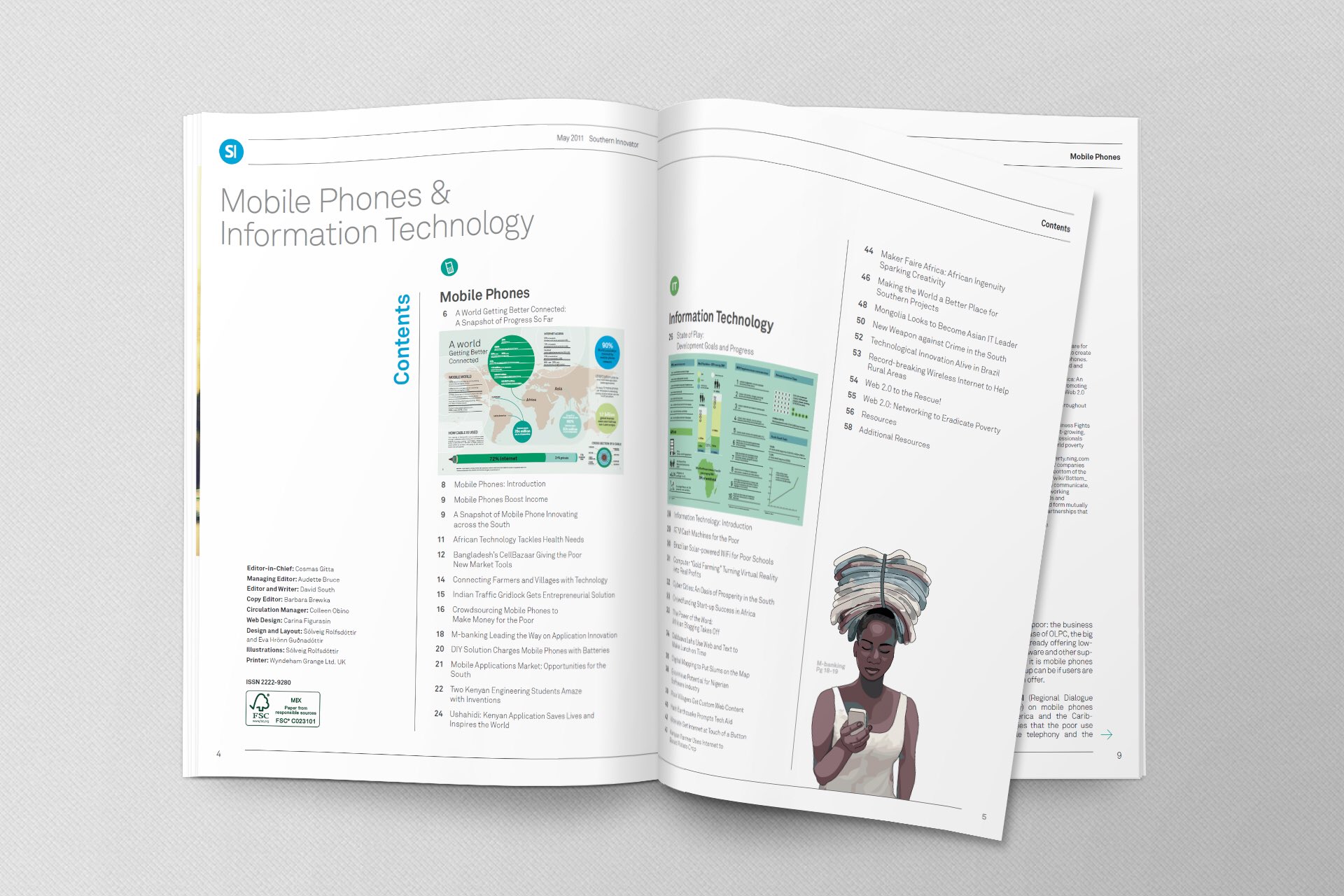
    Development Challenges, South-South Solutions was launched as an e-newsletter in 2006 by UNDP’s South-South Cooperation Unit (now the United Nations Office for South-South Cooperation) based in New York, USA. It led on profiling the rise of the global South as an economic powerhouse and was one of the first regular publications to champion the global South’s innovators, entrepreneurs, and pioneers. It tracked the key trends that are now so profoundly reshaping how development is seen and done. This includes the rapid take-up of mobile phones and information technology in the global South (as profiled in the first issue of magazine Southern Innovator), the move to becoming a majority urban world, a growing global innovator culture, and the plethora of solutions being developed in the global South to tackle its problems and improve living conditions and boost human development. The success of the e-newsletter led to the launch of the magazine Southern Innovator.

    Creative Commons License

    This work is licensed under a
    Creative Commons Attribution-Noncommercial-No Derivative Works 3.0 License.

    ORCID iD: https://orcid.org/0000-0001-5311-1052.

    © David South Consulting 2023

  • Finding Fortune in Traditional Medicine

    Finding Fortune in Traditional Medicine

    By David SouthDevelopment Challenges, South-South Solutions

    SOUTH-SOUTH CASE STUDY

    Traditional medicines and treatments could help provide the next wave of affordable drugs and medicines for the world. But a phenomenon known as ‘bio-prospecting’ – in which global companies grab a stake in these once-free medicines – has been placing traditional medicines out of reach of Southern entrepreneurs. Pharmaceutical patents (http://en.wikipedia.org/wiki/Patents) taken out by international drug companies are making traditional medicines expensive and inaccessible to the poor.

    Indian scientists have identified more than 5000 bio-prospecting patents, worth some US $150 million, taken out by companies outside India.

    Now governments in countries like India are moving to protect these recipes and the plants and animals they are made from.

    The Indian government has labelled 200,000 traditional treatments as public property and free for anyone to use. These treatments are key parts of the 5000-year-old Indian health system called Ayurvedic medicine (http://en.wikipedia.org/wiki/Ayurveda) – ayur means health in Sanskrit, veda means wisdom.

    “We began to ask why multinational companies were spending millions of dollars to patent treatments that so many lobbies in Europe deny work at all,” said Dr. Vinod Kumar Gupta, head of the Traditional Knowledge Digital Library, which lists in encyclopaedic detail the 200,000 treatments.

    “If you can take a natural remedy and isolate the active ingredient then you just need drug trials and the marketing. Traditional medicine could herald a new age of cheap drugs,” Gupta told The Guardian..

    Currently, it is very expensive to follow the Western approach to developing drugs. A so-called “blockbuster drug” can cost US $15 billion and take 15 years to bring to the market. With patents lasting 20 years, a drug company can have as little as five years to recover its development costs. This helps explain the high prices for drugs.

    Unlike traditional healers in the South, multinational corporations can marshal the money, time and legal resources to file patents.

    In the past, India has fought expensive and lengthy battles to revoke patents on traditional remedies. One example is the battle over the popular Indian spice turmeric powder (used for healing wounds, among other things). A patent awarded to the University of Mississippi in 1995 was successfully withdrawn after a legal battle by the Indian government.

    The Indian government’s move to make traditional medicines and therapies public property promises to unleash a new wave of natural remedies and drugs and to expand the market for Southern health entrepreneurs drawing on traditional knowledge and recipes.

    As the world’s economy continues to suffer, finding new ways to earn incomes and spark a whole new generation of businesses will be crucial to recovery.

    The World Health Organization (WHO) defines traditional medicine as “the sum total of knowledge, skills and practices based on the theories, beliefs and experiences indigenous to different cultures that are used to maintain health, as well as to prevent, diagnose, improve or treat physical and mental illnesses.”

    The importance of traditional medicines in primary health care can be seen in Asia and Africa, where its usage reaches 80 percent of the population in some countries (WHO). Herbal medicines alone are worth billions of dollars a year in sales. Examples of traditional remedies include antimalarial drugs developed from the discovery and isolation of artemisinin from Artemisia annua L., a plant used in China for almost 2000 years. In 2003, doctors found scientific evidence supporting the use of traditional Ghanaian plants to help wounds heal. Parts of the African tulip tree and the Secamone afzelli are made into pastes which are applied to wounds.

    The downside of traditional medicine is the urgent need for better regulation and safety standards. While more than 100 countries have regulations for herbal medicines, counterfeit, poor quality or adulterated herbal medicines are still a major problem.

    Herbal treatments are the most popular form of traditional medicine, and are highly lucrative in the international marketplace. Annual revenues in Western Europe reached US $5 billion in 2003-2004.. In China, sales of products totalled US $14 billion in 2005. Herbal medicine revenue in Brazil was US $160 million in 2007 (WHO).

    One initiative is ensuring there is a solid future for traditional medicine in India. Charity Bodytree India, set up in 2004 by a group of health, human rights and education workers, addresses issues surrounding access to health care and the disappearing traditional medical practices amongst isolated indigenous communities. Bodytree has established a successful educational programme that trains young people from different indigenous communities to become community health workers and operates programmes of health education for community groups (http://www.bodytree.org/index.html).

    Almost four-fifths of India’s billion people use traditional medicine and there are 430,000 Ayurvedic medical practitioners registered by the government in the country. The department overseeing the traditional medical industry, known as Ayush, has a budget of 10 billion rupees (US $260 million).

    In the state of Kerala in India’s South, Ayurveda medical tourism has become a good income generator. And it is so popular in the nearby nation of Sri Lanka, hotels can have Ayurveda included in the name.

    Indian entrepreneurs are drawing on increasing awareness of the importance of healthy living and rising interest in vegetarian diets – what were once holidays are now health experiences. With global obesity rates rapidly rising, along with the attended diseases like cancer and diabetes, more and more people are looking for a dramatic change to their eating and lifestyle habits to ensure long-term health. And traditional medicine has solutions.

    Published: March 2009

    Resources

    Development Challenges, South-South Solutions was launched as an e-newsletter in 2006 by UNDP’s South-South Cooperation Unit (now the United Nations Office for South-South Cooperation) based in New York, USA. It led on profiling the rise of the global South as an economic powerhouse and was one of the first regular publications to champion the global South’s innovators, entrepreneurs, and pioneers. It tracked the key trends that are now so profoundly reshaping how development is seen and done. This includes the rapid take-up of mobile phones and information technology in the global South (as profiled in the first issue of magazine Southern Innovator), the move to becoming a majority urban world, a growing global innovator culture, and the plethora of solutions being developed in the global South to tackle its problems and improve living conditions and boost human development. The success of the e-newsletter led to the launch of the magazine Southern Innovator.

    Creative Commons License

    This work is licensed under a
    Creative Commons Attribution-Noncommercial-No Derivative Works 3.0 License.

    ORCID iD: https://orcid.org/0000-0001-5311-1052.

    © David South Consulting 2022

  • Southern Drinks Challenge Corporate Dominance

    Southern Drinks Challenge Corporate Dominance

    By David SouthDevelopment Challenges, South-South Solutions

    SOUTH-SOUTH CASE STUDY

    Across the global South, its thirsty people have long been a target market for Northern drinks companies. The ubiquity of the American soft drink Coca Cola, or even its rival Pepsi Cola, is testimony to that. Even the most remote village on the impoverished island of Haiti can offer an ice-cold Coke.

    But the marketing power of these companies has a down side: it has pushed aside local drink brands based on traditional formulations. But in some countries, local brands are fighting back.

    In India, the Cow Protection Department of the Rashtriya Swayamsevak (called RSS) based in Hardwar (www.hardwar.com), one of the four holy cities on the River Ganges, has produced a soft drink made from recycled cow urine. They call it ‘gau jal’ (Sanskrit for ‘cow water’) and it is set for a launch at the end of 2009.

    The urine is highly processed to make the drink. “Don’t worry, it won’t smell like urine and will be tasty too,” Om Prakash told the Daily Mail. “Its unique selling point will be that it’s going to be very healthy. It won’t be like carbonated drinks and will be devoid of any toxins.”

    The price will be less than American brands such as Coca Cola.

    “We’re going to give them good competition as our drink is good for mankind,” he continued. “We may also think of exporting it.”

    The drink contains not only cow urine but a blend of medicinal and ayurvedic herbs. Ayurveda is the 5,000-year-old ancient Indian health system.

    The RSS was founded in 1925 and claims to have eight million members.

    Cows are sacred to India’s Hindu population and killing them is illegal in many parts of India.Finding ways to make a living from cows’ waste products is common. Cow dung (manure) is already used as a fertilizer in villages. It is claimed the new soda pop will help with cancer, obesity and liver disease.

    Another drink that has been consumed for its health-giving properties is Mongolian mare’s (female horse) milk. Studies by female scientists from Mongolia, South Korea and China for UNDP in the late 1990s found the milk was packed with vitamins and minerals and effective in treating liver diseases, cancer, intestine inflammations and tuberculosis.

    Mongolians have used mare’s milk for centuries in their traditional diet. The drink, called airag in Mongolian, is consumed especially during traditional holidays.

    There are eight times as many horses in Mongolia as the human population, which numbers 2.7 million, so the potential for this drink is enormous. The Food and Biotechnology Institute of the Mongolian University of Science and Technology (www.must.edu.mn/beta_new/) in association with the Swiss International Development Agency (www.sdc.admin.ch), has been developing technology to process mare’s milk, and make value-added products with it to create rural jobs. Under the project, eight kinds of beauty products have been manufactured so far using mare’s milk.

    Published: July 2009

    Resources

    Just Food is a web portal packed with the latest news on the global food industry and packed with events and special briefings to fill entrepreneurs in on the difficult issues and constantly shifting market demands. Website: www.just-food.com

    Brandchannel: The world’s only online exchange about branding, packed with resources, debates and contacts to help businesses intelligently build their brand. Website: www.brandchannel.com

    Small businesses looking to develop their brand can find plenty of free advice and resources here. Website: www.brandingstrategyinsider.com

    Growing Inclusive Markets, a new web portal from UNDP packed with case studies, heat maps and strategies on how to use markets to help the poor. Website: www.growinginclusivemarkets.org

    Asia-Pacific Traditional Medicine and Herbal Technology Network: an excellent first stop for any entrepreneur, where they can find out standards and regulations and connect with education and training opportunities. Website: www.apctt-tm.net

    Development Challenges, South-South Solutions was launched as an e-newsletter in 2006 by UNDP’s South-South Cooperation Unit (now the United Nations Office for South-South Cooperation) based in New York, USA. It led on profiling the rise of the global South as an economic powerhouse and was one of the first regular publications to champion the global South’s innovators, entrepreneurs, and pioneers. It tracked the key trends that are now so profoundly reshaping how development is seen and done. This includes the rapid take-up of mobile phones and information technology in the global South (as profiled in the first issue of magazine Southern Innovator), the move to becoming a majority urban world, a growing global innovator culture, and the plethora of solutions being developed in the global South to tackle its problems and improve living conditions and boost human development. The success of the e-newsletter led to the launch of the magazine Southern Innovator.

    Southern Innovator’s online archive portal was launched in New York City, U.S.A. (home to the UN’s headquarters) in 2011 (southerninnovator.org).
    Creative Commons License

    This work is licensed under a
    Creative Commons Attribution-Noncommercial-No Derivative Works 3.0 License.

    ORCID iD: https://orcid.org/0000-0001-5311-1052.

    © David South Consulting 2024

  • Web 2.0: Networking to Eradicate Poverty

    Web 2.0: Networking to Eradicate Poverty

    By David SouthDevelopment Challenges, South-South Solutions

    SOUTH-SOUTH CASE STUDY

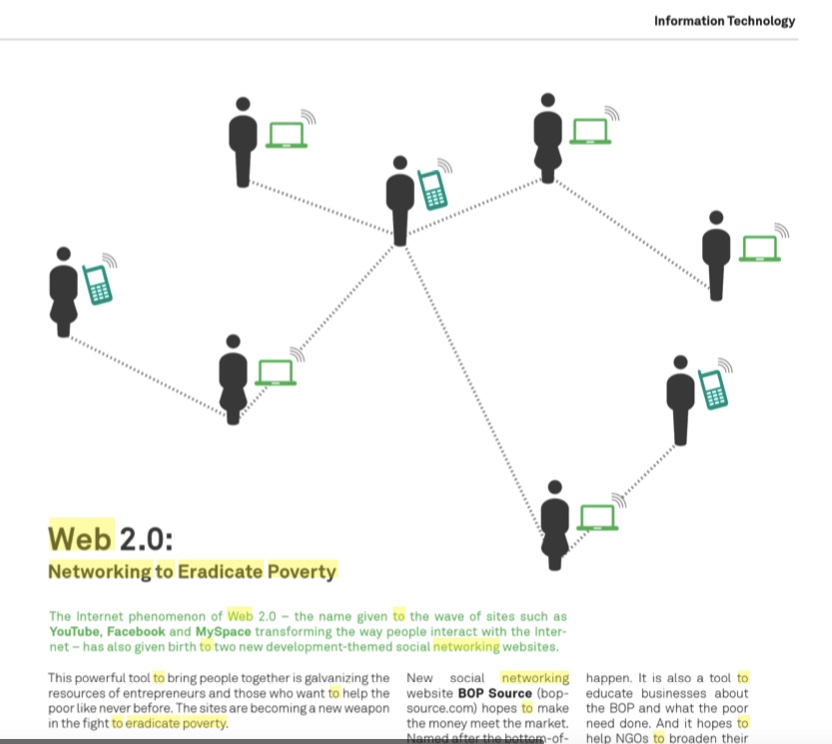
    The internet phenomenon of Web 2.0 (http://en.wikipedia.org/wiki/Web_2.0) – the name given to the wave of internet businesses and websites such as YouTube (www.youtube.com), Facebook and MySpace transforming the way people interact with the ‘Net – has also given birth to two new development-themed social networking websites.

    This powerful tool to bring people together is galvanizing the resources of entrepreneurs and those who want to help the poor like never before. The sites are becoming a new weapon in the fight to eradicate poverty.

    Social networking websites use various tools and applications (or ‘apps’ for short) to enhance the ability of users to connect and get things done. By bringing together a community of like-minded people, they are able to shorten the time it takes to organize and kick-start events. Web 2.0 can be used to build communities and social and business networks. By being able to store vast quantities of information online, it becomes faster to work and reduces the painful delays brought on by slow connections.

    All these new tools are making it easier and easier for entrepreneurs to work from home, in internet centres, or anywhere there is a wireless connection – and it is slashing the costs of managing a business. All the applications are online so there is no need to be hidebound by one operating system or hardware capability.

    Two newly launched social networking sites are targetting the poverty-eradication community.

    One is named after the Bottom of the Pyramid (BOP) concept as conceived by C.K. Prahalad. The BOP is the 4 billion people at the base of the global economic pyramid. As Prahalad sees it, they represent a vast market of unmet needs for entrepreneurs to tackle.

    New social networking website BOP Source hopes to make the money meet the market. Started by Jenara Nerenberg, BOP Source wants to put social networking tools into the hands of the world’s poor. It is a place to post business ideas and collaborate with others to make them happen. It is also a tool to educate businesses about the BOP and what the poor need done. And it hopes to help NGOs broaden their relationships with their constituencies and companies.

    While marketers can learn about the needs of the BOP, individuals can directly express their needs on the website and seek out the right people to solve problems.

    Another social networking website is Business Fights Poverty. Already at 1,000 members, it is a multimedia offering, with podcasts, videos, interviews and discussions about the role of business in addressing development goals.

    Published: November 2008

    Resources

    • BOP Source is a platform for companies and individuals at the BOP to directly communicate, ultimately fostering close working relationships, and for NGOs and companies to dialogue and form mutually valuable public-private partnerships that serve the BOP. Website: http://bopsource.ning.com/
    • Business Fights Poverty: Business Fights Poverty is the free-to-join, fast-growing, international network for professionals passionate about fighting world poverty through good business. Website: http://businessfightspoverty.ning.com/
    • Afriville is a Web 2.0 service and an African Caribbean social network. Afriville is a community website along the lines of the famous MySpace. Users are free to message and post profiles. The difference is that the user is able to choose how closed or open the networks are. The site features a state of the art music management system which allows African and Caribbean artists to get straight in touch with their fans.
    • Both Yahoo! And Google offer extensive free online tools for entrepreneurs and businesses that integrate seamlessly with their email services.
    • Kabissa: Space for Change in Africa: An online African web community promoting and supporting the transition to Web 2.0 services in Africa. Offers lots of opportunities to meet people throughout Africa and learn more.
    • Global Voices: An initiative from the Reuters news agency to aggregate the global conversation online from countries outside the US and Western Europe.
    • Information, Knowledge and Communication: Web 2.0 in Development Cooperation Bonn, Germany, 27-28 November 2008, Gustav Heinemann Haus. Website: http://www.eadi.org/index.php?id=994
    • 3rd IEEE/ACM International Conference on Information and Communication Technologies and Development (ICTD2009). Website: http://www.ictd2009.org

    https://davidsouthconsulting.org/2022/10/14/anti-bribery-website-in-india-inspires-others/

    https://davidsouthconsulting.org/2022/06/24/dabbawallahs-use-web-and-text-to-make-lunch-on-time/

    https://davidsouthconsulting.org/2022/03/07/david-south-consulting-ranked-in-the-top-10-million-websites/

    https://davidsouthconsulting.org/2021/05/25/ger-mongolias-first-web-magazine-and-a-pioneering-web-project-for-the-united-nations-12-january-2016/

    https://davidsouthconsulting.org/2022/06/25/shoes-with-sole-ethiopian-web-success-story/

    https://davidsouthconsulting.org/2022/10/21/social-networking-websites-a-way-out-of-poverty/

    https://davidsouthconsulting.org/2021/05/14/un-ukraine-web-development-experience-2000/

    https://davidsouthconsulting.org/2022/06/16/web-2-0-to-the-rescue-using-web-and-text-to-beat-shortages-in-africa/

    Development Challenges, South-South Solutions was launched as an e-newsletter in 2006 by UNDP’s South-South Cooperation Unit (now the United Nations Office for South-South Cooperation) based in New York, USA. It led on profiling the rise of the global South as an economic powerhouse and was one of the first regular publications to champion the global South’s innovators, entrepreneurs, and pioneers. It tracked the key trends that are now so profoundly reshaping how development is seen and done. This includes the rapid take-up of mobile phones and information technology in the global South (as profiled in the first issue of magazine Southern Innovator), the move to becoming a majority urban world, a growing global innovator culture, and the plethora of solutions being developed in the global South to tackle its problems and improve living conditions and boost human development. The success of the e-newsletter led to the launch of the magazine Southern Innovator. 

    Southern Innovator’s online archive portal was launched in New York City, U.S.A. (home to the UN’s headquarters) in 2011 (southerninnovator.org).
    Creative Commons License

    This work is licensed under a
    Creative Commons Attribution-Noncommercial-No Derivative Works 3.0 License.

    ORCID iD: https://orcid.org/0000-0001-5311-1052.

    © David South Consulting 2023