Categories
Archive Blue Sky Bulletin

Traffic Signs Bring Safety To The Streets

By David South, UNDP Mongolia Communications Coordinator

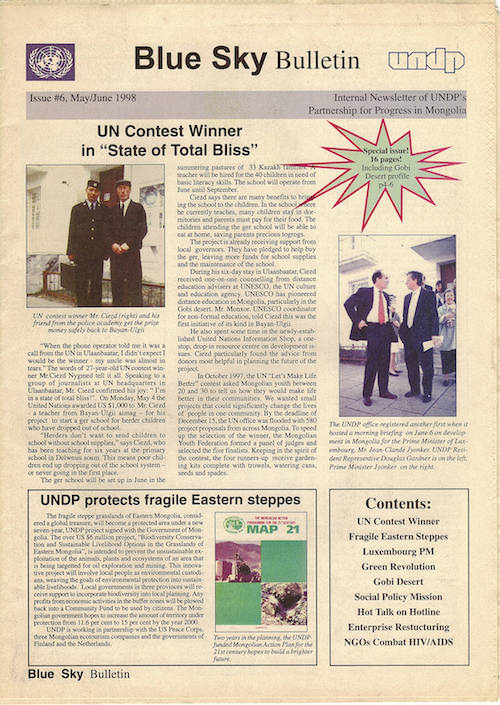
Ulaanbaatar, Mongolia (Blue Sky Bulletin, Issue Number 6, May/June 1998)

Cars, mostly olive green Russian jeeps, weave in and out of the five-storey apartment blocks of downtown Dalanzadgad. Running through the centre of the capital of Omnogobi is a gardened boulevard, where families hide from the hot sun under trees.

That one road, and the few feeding into it, are the only enforced guides for drivers. It can be seen across Mongolia – settlements crisis-crossed by drivers looking for the shortest route to their destination. It doesn’t help that there are no natural or manmade barriers to prevent drivers going their own way.

In Dalanzadgad, a UNDP project to protect the environment from off-road driving has had an unexpected outcome: it has galvanized the community to make the streets safer by adding over 100 traffic signs. The project “Soil and Road” under UNDP’s Environmental Public Awareness Programme (EPAP), started modestly. According to project director and local Khural head Mr. Byambasuren, the number of vehicles in the area shot up from 800 three years ago, to 1,500 today. Most of these vehicles drive off-road, kicking up dust and destroying flora, contributing to desertification.

“The disease rate here is very high because of the dust and we have many traffic accidents involving children,” says Byambasuren.

With a small grant of Tg 2.5 million from EPAP the project was able to organize workshops for local drivers where they signed a contract to not drive off-road, facing stiff penalties from the traffic police if caught.

A media campaign was also organized and posters and brochures distributed. The local traffic police were so impressed by the project they decided to chip in a further Tg 2 million to construct traffic signs and install concrete calming barriers.

At first they explored the possibility of buying ready-made signs but found the costs too prohibitive.

“We wanted to get signs that glowed at night but they were too expensive. We decided to make our own out of old oil drums.”

In a room thick with the smell of fresh paint sits the traffic signs. They all use internationally recognized symbols and only upon closer inspection, reveal their past life sitting on top of an oil drum. Each sign costs Tg 2,000 to make. In addition to the signs traffic calming concrete barriers have been installed in 20 places throughout Dalanzadgad.

Next year Byambasuren will target the large ger districts that surround the centre of Dalanzadgad. He has a message for any driver who doesn’t obey: “We will be banging on their heads with lectures if they break the rules!,” he says with a laugh.

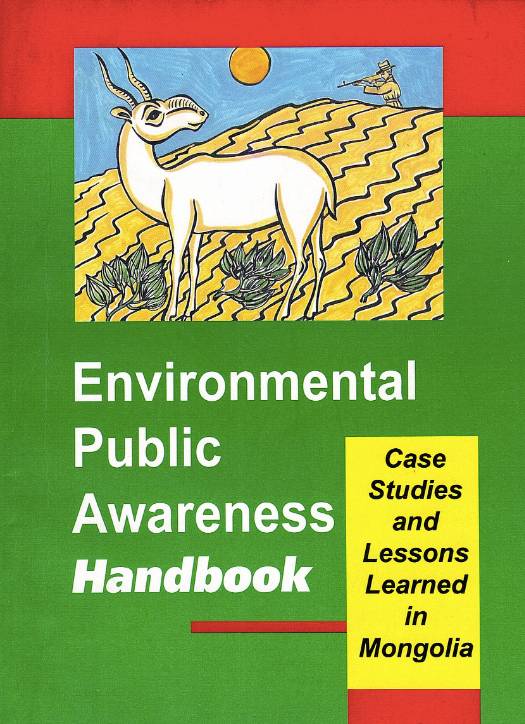
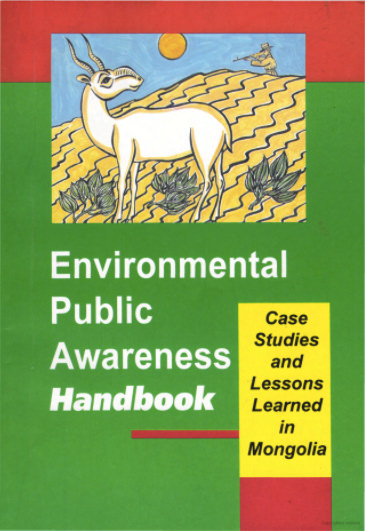
The Environmental Public Awareness Handbook: Case Studies and Lessons Learned in Mongolia by Robert Ferguson can be found here: http://openlibrary.org/b/OL169160M/Environmental-Public-Awareness-Handbook
Creative Commons License

This work is licensed under a
Creative Commons Attribution-Noncommercial-No Derivative Works 3.0 License.

ORCID iD: https://orcid.org/0000-0001-5311-1052.

© David South Consulting 2022
Categories
Archive Blue Sky Bulletin UNDP Mongolia 1997-1999 United Nations Development Programme

Blue Sky Bulletin

Editor: David South

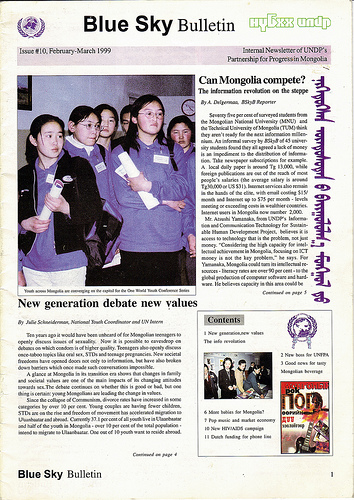
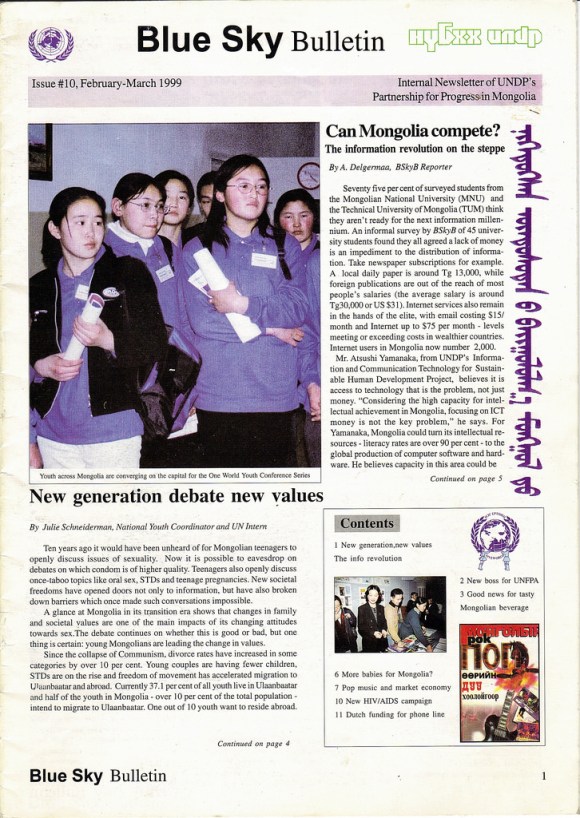
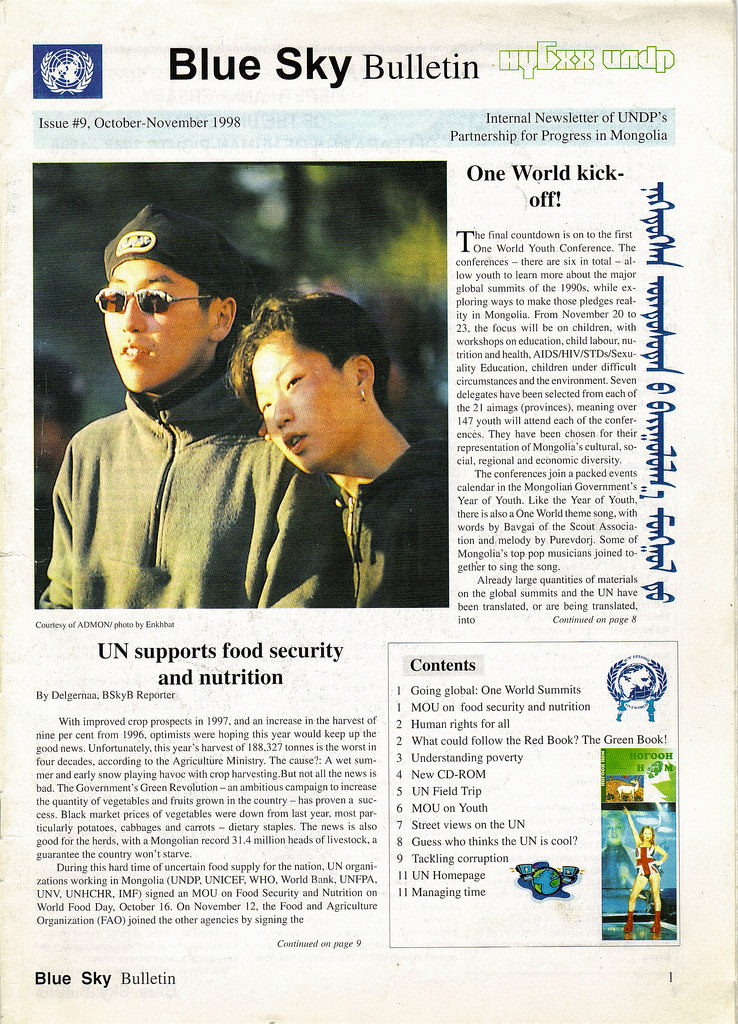
First launched in 1997, Blue Sky Bulletin was the monthly newsletter for the United Nations mission in Mongolia.

Issue 1

Issue 2

Issue 3

Issue 4

Issue 5

Issue 6

Issue 7

Issue 8

Issue 9

Issue 10

More UNDP newsletters here:

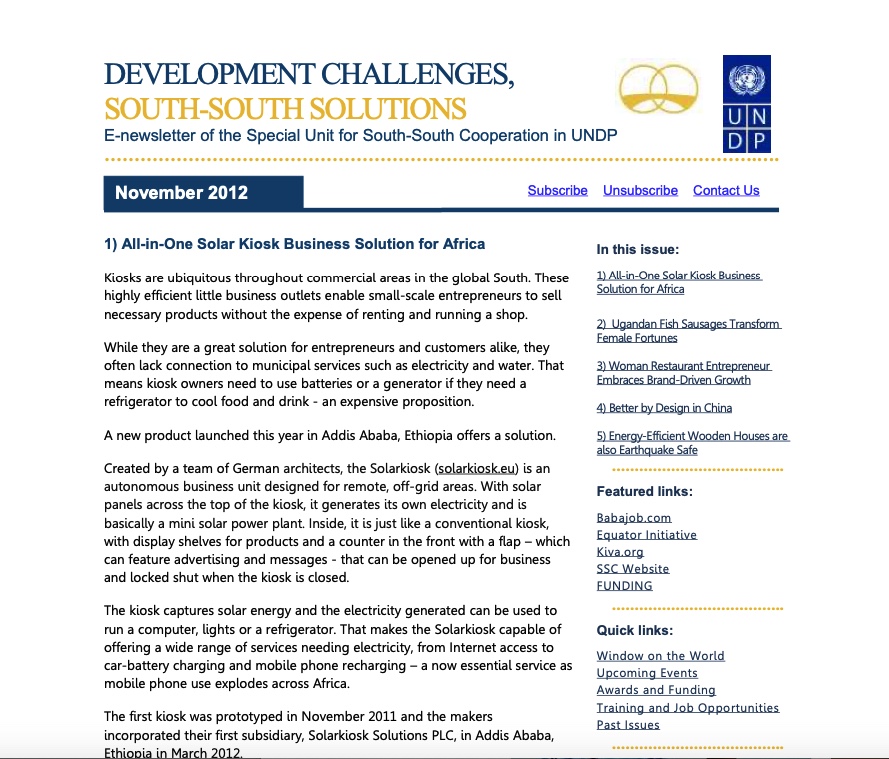
Development Challenges, South-South Solutions Newsletter

ORCID iD: https://orcid.org/0000-0001-5311-1052.

© David South Consulting 2021

Categories
Archive Blue Sky Bulletin UNDP Mongolia 1997-1999

Development Profile: UNDP In The Southern Gobi Desert | May-June 1998

By David South, Blue Sky Bulletin (Dalanzadgad, Mongolia), May-June 1998

Development Profile: UNDP in the Southern Gobi Desert

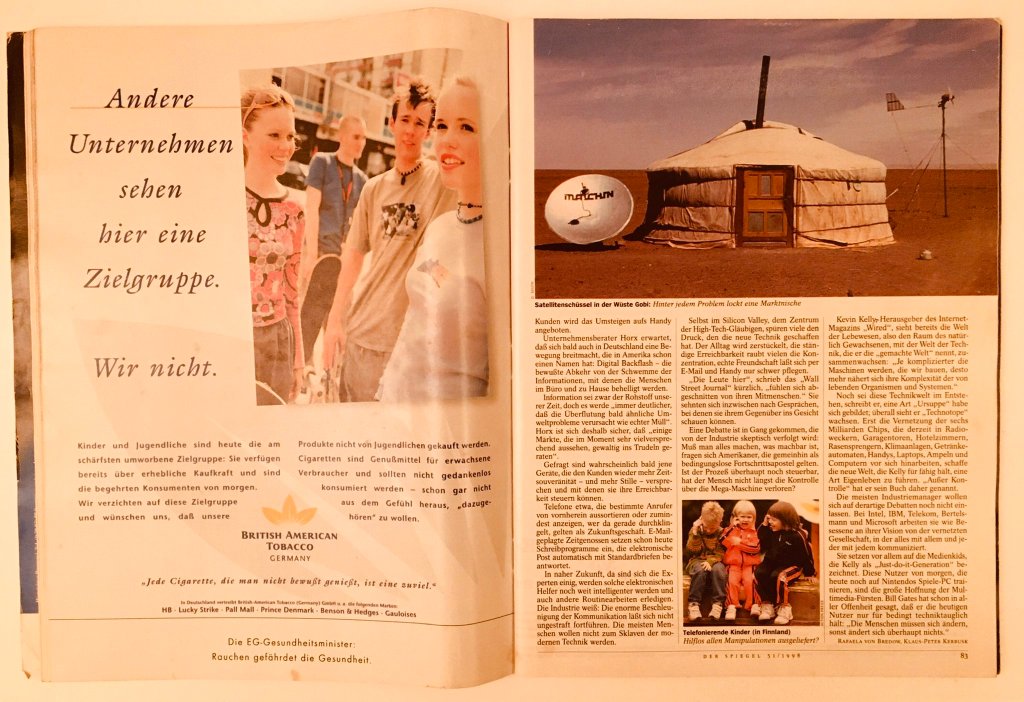
In late May UNDP visited its environment and poverty projects in Omnogobi or South Gobi on the border with China and in the heart of the Gobi Desert. The aimag (province) is home to 45,000 people spread over a territory of 165,000 kilometers. It is a harsh environment where temperatures can plummet to minus 40 degrees Celsius in winter and shoot up to plus 40 in summer. What is striking about the capital of Omnogobi, Dalanzadgad, is how well things are working. It is a garden capital – despite being in the desert the central boulevard is covered in trees – and trade with China has brought a prosperity for some herdsmen, many of whom buzz around the town on Planeta motorcycles. The offices of the Malchin television company are hidden by a bouquet of white satellite dishes – it is not an uncommon sight to see a ger with a satellite dish in South Gobi. 

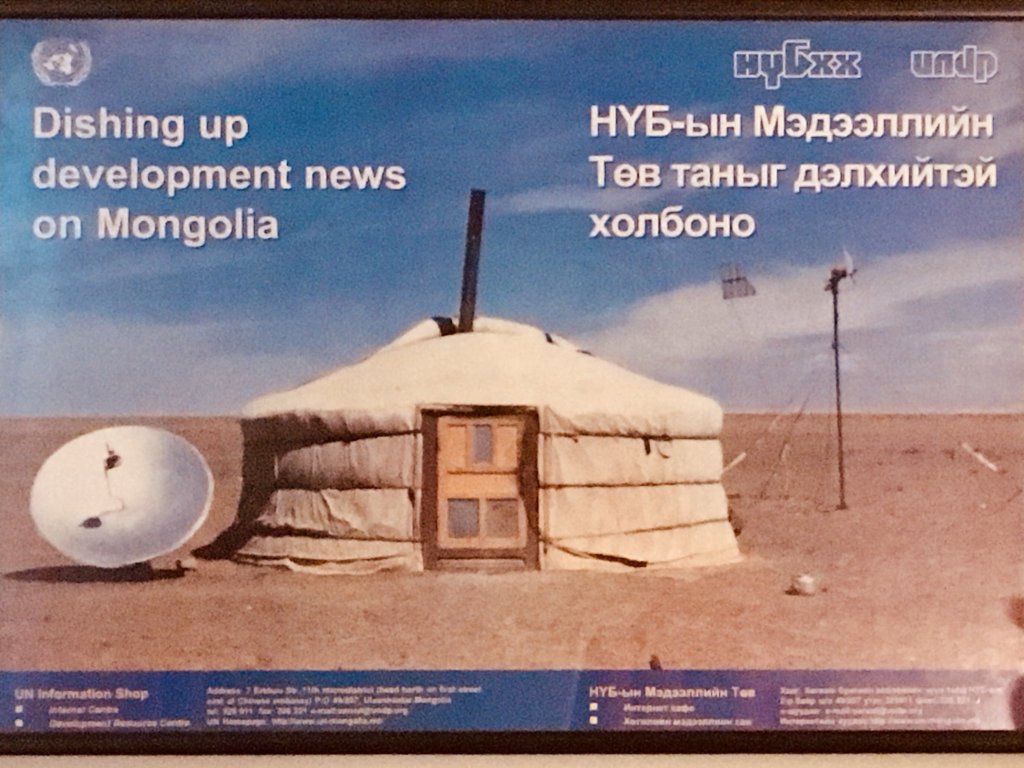
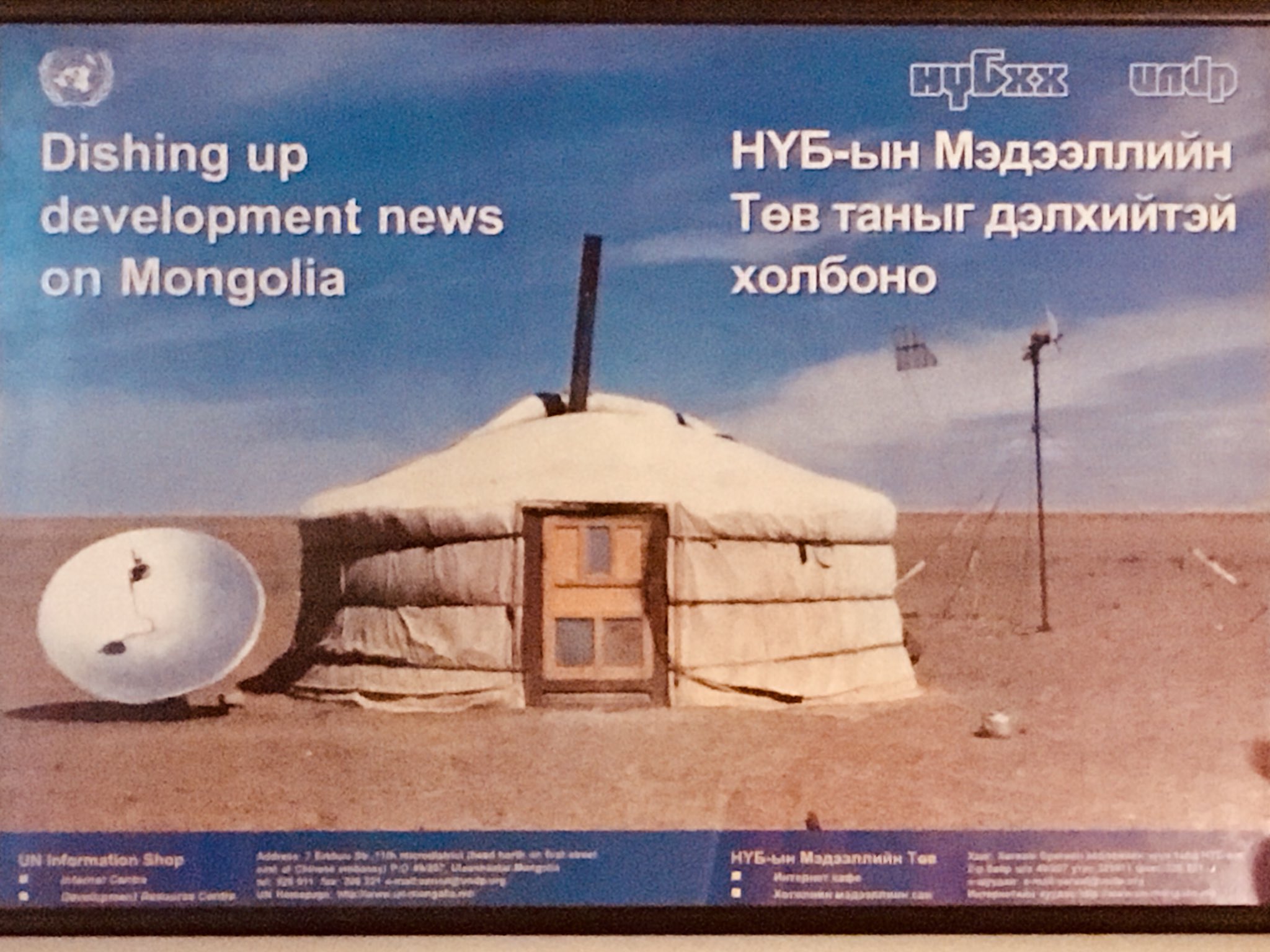
“Dishing up development news on Mongolia”: a UNDP Mongolia Communications Office poster campaign from the late 1990s. Photo: David South.
In 1998 Der Spiegel’s “Kommunikation total” issue profiled the global connectivity revolution underway and being accelerated by the Internet boom of the late 1990s. It chose my picture of a satellite dish and a ger in the Gobi Desert to symbolise this historic event.

“The transformation of Mongolia from a largely rural nomadic society of herdsmen to a community dominated by the increasingly ultra-globalized city of Ulan Bator, where almost a third of the population lives, is nothing short of astounding.” The New Mongolia: From Gold Rush to Climate Change, Association for Asian Studies, Volume 18:3 (Winter 2013): Central Asia

Der Spiegel is a German weekly news magazine and is one of Europe’s largest publications of its kind. It chose my photo taken in the Gobi Desert for its profile of the Internet revolution in 1998.

English translation: “Total communication: the seventh continent – 
The cell phone society was just the beginning: Experts see a new continent emerging in the spheres of the Internet. The information elite live here, surrounded by PCs, pagers and power books. The multimedia industry is becoming the key industry of the 21st century – with serious consequences for society.” (http://t-off.khd-research.net/Spiegel/10.html)

Electricity in the air – 85 women discover the Women’s Development Fund

The Mongolian Human Development Report singled out South Gobi for having the highest poverty incidence in Mongolia (41.9 per cent). While this ranking is hotly debated by locals who say it is a statistical anomaly resulting from their low population, there is no question life is hard in the Gobi. 

In a crowded room in the Governor’s building, 85 of the poorest women in Dalanzadgad have gathered to hear about an innovative UNDP-initiated fund. The meeting, organised by the NGO the Liberal Women’s Brain Pool, is introducing the Women’s Development Fund. Many questions are asked as to why some of the women were passed over when the local government started distributing poverty alleviation funds. 

With the assistance of the British Government who donated Tg 12 million, these women are getting a chance. The Women’s Development Fund was founded in partnership with the Poverty Alleviation Programme Office to take account of the unique role women have in the prosperity of families. Support is key and the women will be assisted by community activists as they develop their project ideas and begin to implement them. In early June they started to receive funding for their projects. 

Note: This story was part of a series highlighting life and the state of human development in Mongolia’s Gobi Desert after the publishing of the country’s first human development report in 1997

ORCID iD: https://orcid.org/0000-0001-5311-1052.

© David South Consulting 2020

Categories
Archive Blogroll Blue Sky Bulletin

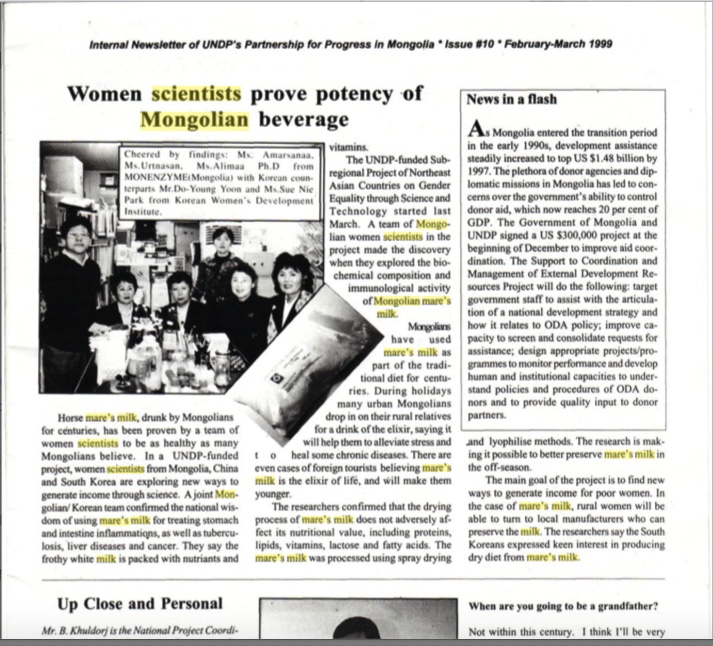
Women scientists prove potency of Mongolian beverage

By David South, Blue Sky Bulletin (Ulaanbaatar, Mongolia), Issue 10, February-March 1999

Horse mare’s milk, drunk by Mongolians for centuries, has been proven by a team of women scientists to be as healthy as many Mongolians believe. In a UNDP-funded project, women scientists from Mongolia, China and South Korea are exploring new ways to generate income through science. A joint Mongolian/Korean team confirmed the national wisdom of using mare’s milk for treating stomach and intestine inflammations, as well as tuberculosis, liver diseases and cancer. They say the frothy white milk is packed with nutrients and vitamins.

The UNDP-funded Subregional Project of Northeast Asian Countries on Gender Equality through Science and Technology started last March. A team of Mongolian women scientists in the project made the discovery when they explored the bio-chemical composition and immunological activity of Mongolian mare’s milk.

Mongolians have used mare’s milk as part of the traditional diet for centuries. During holidays many urban Mongolians drop in on their rural relatives for a drink of the elixir, saying it will help them to alleviate stress and to heal some chronic diseases. There are even cases of foreign tourists believing mare’s milk is the elixir of life, and will make them younger.

The researchers confirmed that the drying process of mare’s milk does not adversely affect its nutritional value, including proteins, lipids, vitamins, lactose and fatty acids. The mare’s milk was processed using spray drying and lyophilise methods. The research is making it possible to better preserve mare’s milk in the off-season.

The main goal of the project is to find new ways to generate income for poor women. In the case of mare’s milk, rural women will be able to turn to local manufacturers who can preserve the milk. The researchers say the South Koreans expressed keen interest in producing dry diet from mare’s milk.

The Blue Sky Bulletin newsletter provided timely and valuable updates on Mongolia in the late 1990s. In particular, it was able to highlight urgent health needs for a population undergoing extreme crisis resulting from food supply disruptions, loss of income, social distress (alcoholism, family breakdown etc.), sexually transmitted diseases, and extreme weather. Stories from the newsletter have been cited in many journals and books since 2000, and the high quality of its contributers is evident in their scholarship and career success since. An example is below:

Poor Nutrition Taking its Toll on the Health of Mongolians By Jacinda Mawson

Rickets very prevalent in Mongolia – 1998

Prevalence of rickets in Mongolia

Asia Pacific J Clin Nutr (1998) 7(3/4): 325-328
U Tserendolgor1 MD pubhealth@magicnet.mn, JT Mawson2 MA, AC MacDonald3 MSc and M Oyunbileg1 MD, PhD

“The high prevalence of rickets in Mongolian children is a serious public health concern. In addition to the adverse effects on growth, development and immune function, it is probably indicative of widespread subclinical vitamin D deficiency.”

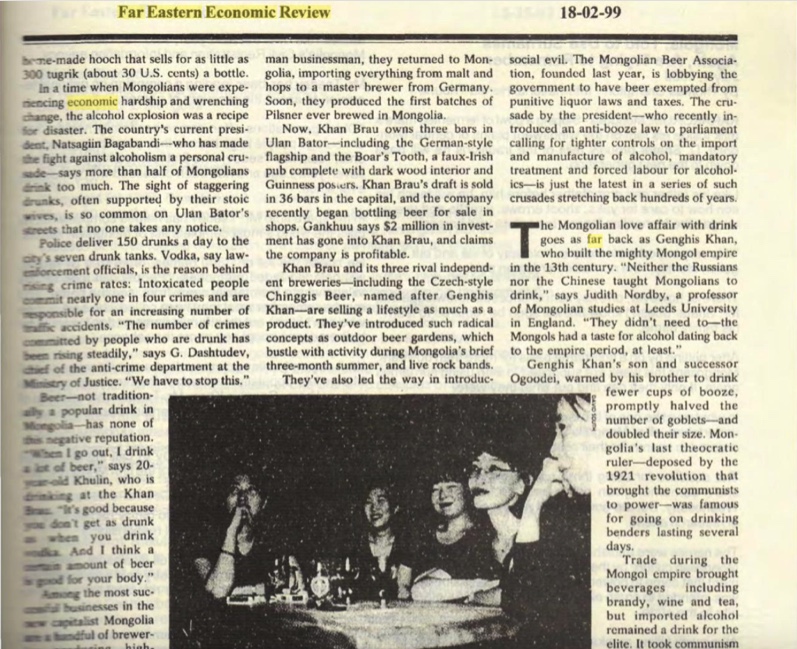
Another beverage was catching the interest of Mongolians in the late 1990s: beer. 

From The Far Eastern Economic Review, February 18, 1999

A New Brew: As Mongolia changes under the influence of economic reforms, the country’s elite are trading fermented mare’s milk and vodka for a new status symbol: beer 

Story by Jill Lawless

Photo by David South

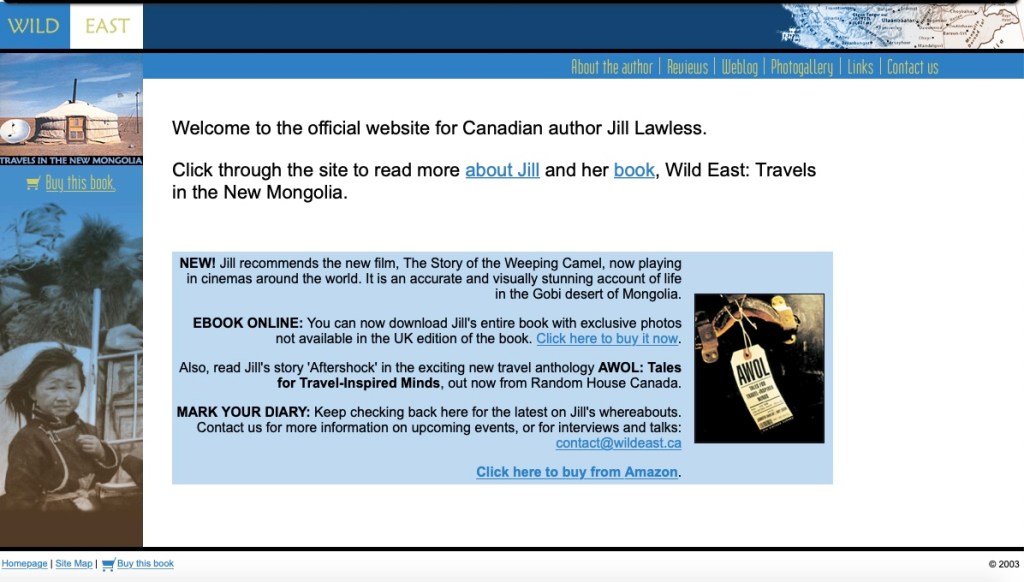
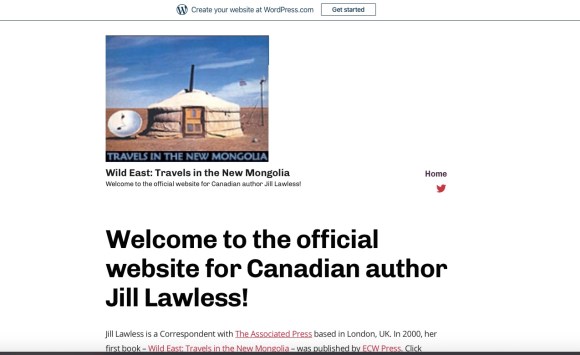
Jill Lawless has two websites about her book, Wild East: Travels in the New Mongolia.

Designed in London, the first website for Wild East: Travels in the New Mongolia launched in 2003.
The new brand site for Jill Lawless is currently under construction.

More of Jill Lawless‘ journalism for The Far Eastern Economic Review here: https://www.google.co.uk/books/edition/Far_Eastern_Economic_Review/SkuvAAAAIAAJ?hl=en&gbpv=1&bsq=david%20south,%20Mongolian%20rock

https://davidsouthconsulting.org/2022/06/24/can-we-talk-hannah-promotes-communication-between-medical-schools/

https://davidsouthconsulting.org/2021/06/02/case-study-5-gosh-ich-child-health-portal-2001-2003/

https://davidsouthconsulting.org/2020/04/25/china-pushing-frontiers-of-medical-research/

https://davidsouthconsulting.org/2021/03/08/the-dawn-of-the-genetics-revolution-2001-2003/

https://davidsouthconsulting.org/2021/05/25/ger-mongolias-first-web-magazine-and-a-pioneering-web-project-for-the-united-nations-12-january-2016/

https://davidsouthconsulting.org/2017/10/18/hannah-institute-for-the-history-of-medicine-1992-1994/

https://davidsouthconsulting.org/2021/05/27/het-wilde-oosten-reizen-in-het-moderne-mongolie%cc%88/

https://davidsouthconsulting.org/2021/03/12/mongolia-prepares-for-a-magazine-explosion-1998/

https://davidsouthconsulting.org/2023/01/09/mongolia-update-1998/

https://davidsouthconsulting.org/2023/02/07/mongolian-rock-and-pop-book-mongolia-sings-its-own-song/

https://davidsouthconsulting.org/2022/11/11/online-free-knowledge-sharing/

https://davidsouthconsulting.org/2020/12/17/philippine-conference-tackles-asias-aids-crisis/

https://davidsouthconsulting.org/2021/10/20/research-reviews-2001-2002/

https://davidsouthconsulting.org/2021/04/19/reviews-wild-east-the-new-mongolia/

https://davidsouthconsulting.org/2022/11/18/southern-drink-challenges-corporate-dominance/

https://davidsouthconsulting.org/2020/04/17/taking-medicine-to-the-people-four-innovators-in-community-health/

Like our content? Help contribute to the costs of keeping it online. 

Scan code with your phone and help us out.

ORCID iD: https://orcid.org/0000-0001-5311-1052

© David South Consulting 2023