Author: David South Consulting

  • Carbon Credits Can Benefit African Farmers Thanks to New System

    Carbon Credits Can Benefit African Farmers Thanks to New System

    By David SouthDevelopment Challenges, South-South Solutions

    SOUTH-SOUTH CASE STUDY

    The global carbon credit trading schemes emanating from the Kyoto Protocol are now creating a multi-billion dollar market – the European carbon market was worth €14.6 billion in 2006 – and represents one of the fastest growing business opportunities in the world. Being green has finally come of age. Yet all the benefits of this are largely bypassing Africa despite more than 70 percent of the continent’s inhabitants earning a living off the land.

    The World Agroforestry Centre – whose mission is to advance the science and practice of agroforestry to transform the lives and landscapes of the rural poor in developing countries – in partnership with Michigan State University has developed a method using satellite imagery and infrared sensing that measures carbon storage in African farmland. They have completed a pilot programme in western Kenya and are ready to encourage poor farmers to plant trees as soon as the European Union allows carbon credits under the Kyoto Protocol to be awarded for this kind of scheme. Further pilot projects will be rolled out in 2007 in partnership with CARE International and the WWF.

    But European Union policies on carbon credits are holding back this significant opportunity to enhance African livelihoods. Europe’s Emissions Trading Scheme (ETS) is at present not willing to recognize the new method of verifying carbon storage in farmland. The ETS is the largest multi-country, multi-sector greenhouse gas emission trading scheme in the world. The issue of carbon storage, or carbon “sinks” as they are known, is very controversial in the world of Kyoto agreement implementation. Non-government organizations that advocate for forests and indigenous people have worked hard to exclude the use of forestry credits to offset fossil fuel burning, arguing that forestry offsets to date have been for big monoculture plantations of fast-growing eucalyptus or pine trees. It is claimed they are net carbon emitters over their lifetimes and also cause additional environmental and social problems.

    But the World Agroforestry Centre’s approach is very different from a monoculture plantation. Their scheme is to help rural Africans to integrate more trees into their agricultural production systems, with benefits besides storing carbon. They argue that the right kinds of trees can increase the productivity and resilience of the land. Trees provide food, fuel, fertilizer, and medicine – medicinal trees are the main source of medication for 80 percent of Africa’s population.

    Louis Verchon, the lead scientist for climate change at the World Agroforestry Centre, believes that if the EU would put in place a new scheme to credit farmers who capture carbon in their land, “millions of dollars in carbon credits could begin flowing to the world’s rural poor.” At present, Verchon says two-thirds of the carbon credit business is being captured by Asian countries who are mostly offering industrial solutions. “Africa has something to offer on this – it can’t compete with the likes of South Korea on industrial solutions, but it has plenty of land.”

    In order to make the scheme work, two things will need to be improved: Africa’s institutional weakness and the paucity of qualified carbon credit verifiers. A network of verifiers would be required to inspect farm sites and make the calculations required to allocate carbon credits to poor farmers. At present, there are no qualified African-born verifiers in Africa according to Verchon.

    The WAC are working with WWF and CARE to build up NGO capacity and start demonstration projects to prove it can work – two pilot projects are already up and running in Kenya. They are also automating much of the process by building a web portal.

    Verchon says the WAC “are in it for the long-haul and we will see this grow over the next ten years.”

    Published: January 2007

    Resources

    • More on emissions trading: Click here
    • Kenya’s Greenbelt Movement: Founded by Nobel Peace Prize winner Wangari Maathai, it provides income and sustenance to millions of people in Kenya through the planting of trees.
    Creative Commons License


    This work is licensed under a
    Creative Commons Attribution-Noncommercial-No Derivative Works 3.0 License.

    ORCID iD: https://orcid.org/0000-0001-5311-1052.

    © David South Consulting 2023
  • New Seniors’ Group Boosts ‘Grey Power’: Grey Panthers Chapter Opens With A Canadian Touch

    New Seniors’ Group Boosts ‘Grey Power’: Grey Panthers Chapter Opens With A Canadian Touch

    By David South

    Today’s Seniors (Canada), April 1993

    Check your prejudices at the door, look beyond your self-interest, and open your mind, because the Grey Panthers are here in Canada.

    Joe Moniz, the 26-year-old founder of the Canadian Grey Panthers, is confident that his ambitious plans for a new national seniors’ organization are just what Canadian seniors need. 

    That’s right: 26-years-old. Modelled on the U.S. Grey Panthers, the Canadian Grey Panthers believe in harnessing the power of all age groups, making the connection that everybody will eventually be a senior and that seniors benefit from a better society for everyone. 

    “The major difference between us and any other organization is our slogan, “Age and Youth Working Together,” he says. “Look at our pension fund. It’s depleting. I’m concerned about my future as a senior citizen – will there be a pension fund? We want to act now, to bring youth and age together to improve the situation of seniors today and improve our situation in the future. 

    “Membership is open to all age groups. We want to bring seniors into day care to interact with children. We want to deal with the universities, give people the opportunity to discuss and unite. It’s a different approach, but it can make a huge difference.”

    Moniz has already organized the group’s first chapter, in Hamilton, complete with a board of retired university professors and doctors. The group has put together insurance packages that will “blow the others out of the water.”

    “All seniors’ attempts at lobbying in the past have been short term,” says a blunt Moniz. “We are the organization that will make the difference. We will lobby provincially, federally, and municipally, and we are non-partisan.

    “The reason I’m introducing the Grey Panthers is to keep grey power alive in Canada, and to provide the necessary channels to do so through lobbying efforts. If anyone has problems with local politicians, they can call us, and we in turn let them know the channels they should use. There are a lot of seniors out there being cheated, and it is up to us to help them.”

    The Canadian Grey Panthers (which uses the British spelling, as opposed to its American counterpart) will initially concentrate on four issues: pensions, drug plans, affordable housing and long-term care, and will communicate information through newsletters, surveys and meetings. 

    Moniz promises to make the Panthers accessible to all, no matter what their income. He plans to hit the streets and visit institutions to inform seniors of the group’s presence. As if to prove the group’s potential for excitement, an enthusiastic gentleman from a local retirement home interrupts Moniz during a coffee shop interview. “That’s the best thing I’ve heard from a young person in Toronto,” he says. 

    The U.S. Panthers were formed by political activist Maggie Kuhn and five friends in 1970. Back then, their name wasn’t as exciting. It was the convoluted and unsexy “Consultation of Older and Younger Adults for Social Change.” In 1972, they adopted the media’s pet name – a grey twist on radical African-American rights organization the Black Panthers. 

    The radical milieu of political activism was contagious – and the Panthers symbolized its jump from the youth of America to other generations. 

    “When we formed, we were an intergenerational group,” says Panthers’ U.S. national chair, Charlotte Flynn. “The first issue the group addressed was mandatory retirement. We combat the stigma of ageism, which is making decisions about people based on chronological age. Ageism isn’t just confined to the elderly – ageism exists for young people as well.”

    The agenda of the Panthers is just as radical today. Flynn, who is candid about the group’s failures as well as its successes, admits that it isn’t the easiest route to popularity. With membership at about 45,000, the U.S. Panthers have spoken out on now-popular issues like health care, the environment, affordable housing – and taken brave stands against mainstream opinion when it came to the Gulf War and the invasion of Panama. 

    And they think big. Not content with just influencing the American political scene, the Panthers have taken on the world, gaining official advisor status at the United Nations. 

    Although involved in a broad range of issues, Flynn says the Panthers are primarily seen as a strong voice for the rights of American seniors. 

    “We have tried very hard to let people know we are not a special interest group for the elderly,” says Flynn. “But we are always getting called upon to highlight what any legislation is doing to older people.” 

    With Panther groups sprouting in Europe and now in Canada, the important issue of maintaining the integrity of the Panther name has arisen, says Flynn. She points to the flip side of having a reputation for action: people want to start branches without being interested in the full agenda of the Panthers, using the name for shock value. At the last convention in November 1992, the Panthers formed a committee to act as quality control monitors for the name. 

    One thing is clear from the ambitious agenda of the Grey Panthers – they aren’t for everyone. 

    But Moniz’s pragmatic approach seems distinct from the American Panthers. He shies away from some of the American group’s positions, emphasizing a balance between insurance policies and political policies. 

    “If you read the American Panthers’ position sheet, it’s anti-this and anti-that,” he says. “We aren’t going to take that approach. It would be suicide.”

    But he is quick in his praise of the group and its founder Maggie Kuhn. “People may consider her actions to be radical, but they’re not. Look at the achievements. She is one of the top 25 active women in the U.S.

    “The Gray Panthers are achievers. They have proven the effectiveness of intergenerational attempts at social justice.”

    A quick call to seniors’ groups drew many surpised faces. 

    “I can’t say anything about them – I don’t know who they are,” responded Murray Morgenthau, executive director of the Canadian Association of Retired Persons (CARP). 

    Jane Leitch at the United Senior Citizens of Ontario had heard something was happening but wonders why a new group is forming “with so many groups out there.”

    One Voice spokesperson Andrew Aitkens says his group is closer to the American Association of Retired Persons than the Panthers in their approach, and that they “have found that there are much more effective ways for advocacy. We don’t march on the Hill at the drop of the hat.”

    But Flynn says the Panthers embody a philosophy distinct from all other seniors’ groups. “As Maggie Kuhn said, ‘those of us who are older are the elders of the tribe and should be concerned about survival.’ We look at all issues that deny people the ability to realize their full potential, whether young or old. We are really interested in empowering people rather than being a special interest for the elderly.” 

    More from Canada’s Today’s Seniors

    Feds Call For AIDS, Blood System Inquiry: Some Seniors Infected

    https://davidsouthconsulting.org/2020/12/18/feds-call-for-aids-blood-system-inquiry-some-seniors-infected/

    Government Urged To Limit Free Drugs For Seniors

    https://davidsouthconsulting.org/2020/06/14/government-urged-to-limit-free-drugs-for-seniors/

    Health Care On The Cutting Block: Ministry Hopes For Efficiency With Search And Destroy Tactics

    https://davidsouthconsulting.org/2021/02/05/health-care-on-the-cutting-block-ministry-hopes-for-efficiency-with-search-and-destroy-tactics/

    Seniors Falling Through The Health Care Cost Cracks

    https://davidsouthconsulting.org/2020/06/14/seniors-falling-through-the-health-care-cost-cracks/

    Creative Commons License

    This work is licensed under a
    Creative Commons Attribution-Noncommercial-No Derivative Works 3.0 License.

    ORCID iD: https://orcid.org/0000-0001-5311-1052.

    © David South Consulting 2023

  • UNDP Travelling Seminar: Environment and Development | Mongolia 1998

    UNDP Travelling Seminar: Environment and Development | Mongolia 1998

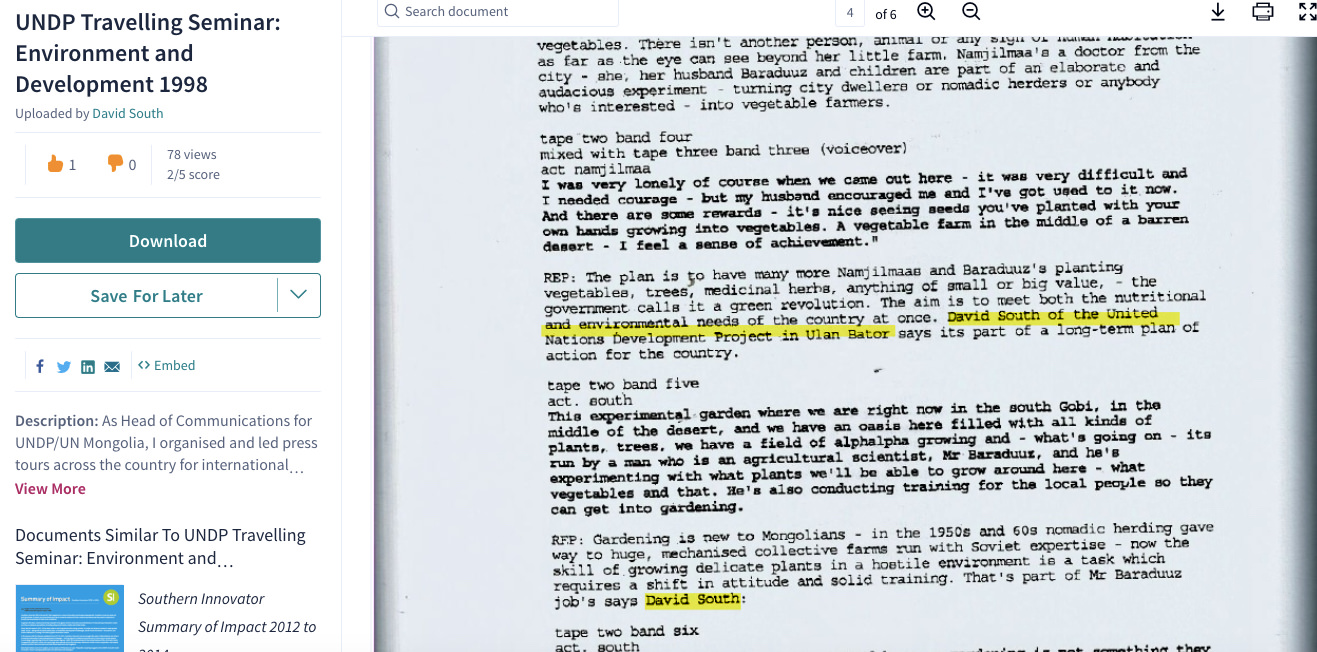
    As head of communications for UNDP/UN Mongolia, I organised and led press tours across the country for international journalists in 1997 and 1998.

    Library catalogue description: https://www.e-varamu.ee/item/NG6OSO3DWRMB4NGGULKHVE434XN4KJ4R

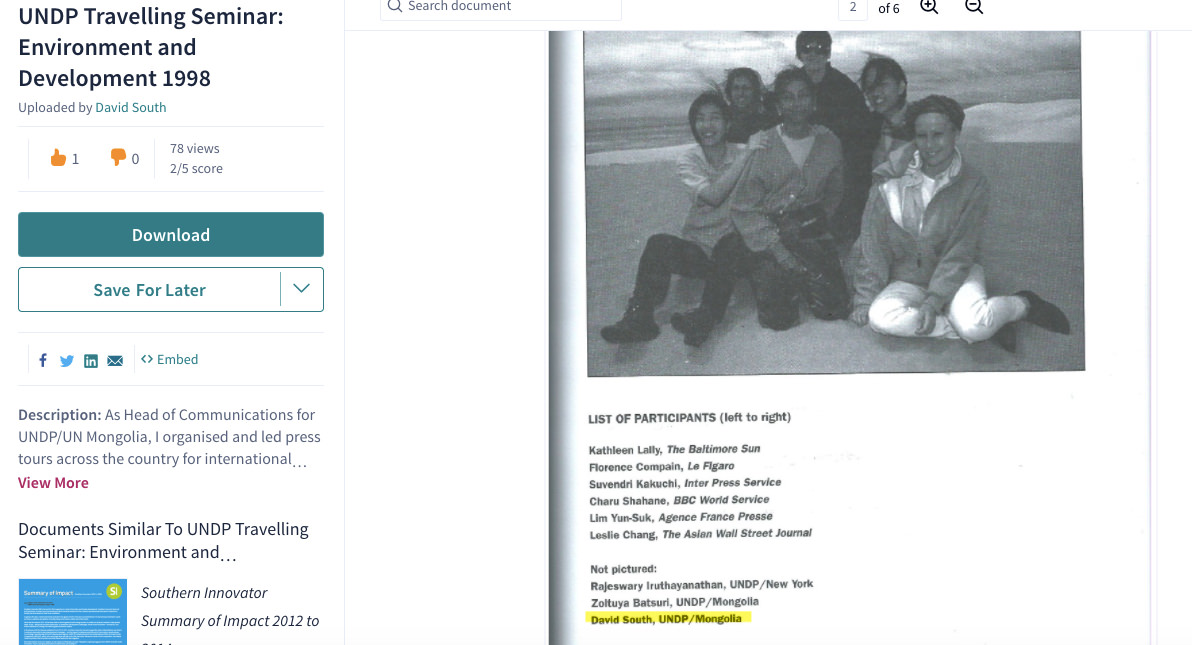
    The media tour of Mongolia included the following journalists: Kathleen Lally (The Baltimore Sun), Florence Compain (Le Figaro), Suvendrini Kakuchi (Inter Press Service), Charu Shahane (BBC World Service), Lim Yun-Suk (Agency France Presse), Leslie Chang (The Asian Wall Street Journal).
    An Interoffice Memorandum from Djibril Diallo, Director, Division of Public Affairs, UNDP, to Mr. Nay Htun, Assistant Administrator and Director, Regional Bureau for Asia and the Pacific.
    An interview with the BBC World Service while visiting gardens in the Gobi Desert, 1998. I led media tours of Mongolia while serving as the UN/UNDP Mongolia Communications Coordinator from 1997-1999.
    The UNDP Mongolia Communications Office would reach out to journalists to help tell the story of Mongolia’s late 1990s transition to free markets and democracy.
    The BBC’s Charu Shahane joined other journalists on a UNDP Mongolia media tour in 1998.
    UNDP Mongolia staff photo 1997. I served for two years as the UNDP Mongolia Head of Communications (1997-1999).

    “Mongolia is not an easy country to live in and David [South] showed a keen ability to adapt in difficult circumstances. He was sensitive to the local habits and cultures and was highly respected by his Mongolian colleagues. … David’s journalism background served him well in his position as Director of the Communications Unit. … A major accomplishment … was the establishment of the UNDP web site. He had the artistic flare, solid writing talent and organizational skills that made this a success. … we greatly appreciated the talents and contributions of David South to the work of UNDP in Mongolia.” Douglas Gardner, UN Resident Coordinator and UNDP Resident Representative Mongolia

    ORCID iD: https://orcid.org/0000-0001-5311-1052.

    © David South Consulting 2023
    Creative Commons License

    This work is licensed under a
    Creative Commons Attribution-Noncommercial-No Derivative Works 3.0 License.