Author: David South Consulting

  • Brazil Preserves Family Farms and Keeps Food Local and Healthy 

    Brazil Preserves Family Farms and Keeps Food Local and Healthy 

    By David SouthDevelopment Challenges, South-South Solutions

    (Havana, Cuba), November 2008

    SOUTH-SOUTH CASE STUDY

    Today’s global food crisis sparked by a toxic mix of events – high oil and commodity prices, food scarcity, growing populations, and environmental catastrophes – has woken many up to the urgent need to secure food supplies and help those who grow the world’s food. More and more countries are turning to local and small farms – or family farms – to offer food security when times get rough.

    Right now there are more than 862 million undernourished people around the world (FAO), and U.N. Secretary- General Ban Ki-moon has called for food production to increase 50 percent by 2030 just to meet rising demand. Three-quarters of the world’s poorest people living on less than US $1 a day live in rural areas in developing countries and 85 percent of the world’s farms are of less than two hectares in size.

    There has long been a tension between those who believe in very large farms, agribusiness and mono-crops (http://en.wikipedia.org/wiki/Mono-cropping), and those who believe in having a large number of smaller farms with a wide variety of crops and animals.

    Family farming has been seen as doomed for a long time. In the 19th century, figures like philosopher Karl Marx believed they would be split into capitalist farms and proletarian labour. Most modern economists regard family farming as an archaic way to grow food, destined to give way to agribusiness. Most family farms refute this, saying family farmers have been able to operate with success in both developed and developing countries.

    And small farms have endured. The livelihoods of more than 2 billion people depend on the 450 million smallholder farms across the world. With their families, they account for a third of the world’s population.

    Family farms are critical to weathering economic crises and ensuring a steady and secure food supply. The International Fund for Agricultural Development (IFAD) (www.ifad.org) called earlier this year for small family farms to be put at the heart of the global response to high food prices and to improve food security. And in Brazil, this call is being answered by a bold initiative to create what they call a “social technology”, combining a house building programme with diverse family farms.

    Brazil is currently buying up unused land and distributing it to people making land claims, including Brazil’s Landless Workers Movement (http://www.mstbrazil.org). When they receive land, family farmers often find there is no house on the land, or just a very basic dwelling.

    This is where the Brazilian farmer’s cooperative Cooperhaf: Cooperativa de Habitacao dos Agricultores Familiares (http://www.cooperhaf.org.br/), steps in. It has put together what it calls a “social technology” combining housing and farm diversification to support family farmers.

    “We see the house as the core issue,” said Adriana Paola Paredes Penafiel, a projects adviser with the Cooperhaf. “The farmers can improve their productivity but the starting point is the house.

    “Family farming is very important for the country – 70 percent of food for Brazilians comes from family farming,” said Penafiel. “The government wants to keep people in rural areas.”

    Started in 2001 by a federation of farmers unions, the Cooperhaf works in 14 Brazilian states with family farmers.

    “Family farmers had to organize themselves to deal with housing,” said Penafiel. “The cooperative was formed to mediate between farmers and the government. The farmers have a right in the law to a house.

    “We promote diversification to make farmers less vulnerable: if they lose a crop in macro farming, they lose everything. We encourage diversification and self-consumption to guarantee the family has food everyday. We help to set up a garden.”

    The concept is simple: a good quality home acts as an anchor to the family farm, making them more productive as farmers. The farmers receive up to 6,000 reals (US $2,290) for a house, and can choose designs from a portfolio of options from the Cooperhaf.

    As in other countries, the Cooperhaf and other coops encourage markets and certification programmes to promote family farmed food and raise awareness. Penafiel says promoting the fact that the food is family farmed is critical: to the consumer it is healthier, fresher and contains fewer chemicals than imported produce.

    “We sell a livelihood not a product. If you get to know the product, you are more conscious of what you eat.”

    In the US, there are almost 2 million farms, 80 percent of which are small farms, a large percentage family-owned. More and more of these farmers are now selling their products directly to the public.

    In the UK, family farms are on course to provide 10 percent of the country’s food and drink and be worth £15 billion a year.

    “If we forget them, we actually may get a situation where, while meeting the world’s immediate supply targets, we wind up with an even greater imbalance in the global supply system and greater food insecurity,” said IFAD President Lennart Båge.

    “Most agri business is for export,” said Penafiel. “If we don’t have food in the country, food for poor communities would not be available. This enables farmers to be more autonomous, not having to buy fertilizers and equipment and take on too much debt. That approach is not sustainable as we saw with the so-called Green Revolution.”

    Published: December 2008

    https://davidsouthconsulting.org/2020/12/14/african-farming-wisdom-now-scientifically-proven/

    https://davidsouthconsulting.org/2022/11/16/brazils-agricultural-success-teaches-south-how-to-grow/

    https://davidsouthconsulting.org/2022/10/10/cheap-farming-kit-hopes-to-help-more-become-farmers/

    https://davidsouthconsulting.org/2022/11/18/farmers-weather-fertilizer-crisis-by-going-organic/

    https://davidsouthconsulting.org/2022/11/01/indonesian-food-company-helps-itself-by-making-farmers-more-efficient/

    https://davidsouthconsulting.org/2022/11/23/kenyan-farmer-uses-internet-to-boost-potato-farm/

    https://davidsouthconsulting.org/2021/11/09/pocket-friendly-solution-to-help-farmers-go-organic/

    https://davidsouthconsulting.org/2021/09/16/small-fish-farming-opportunity-can-wipe-out-malnutrition/

    https://davidsouthconsulting.org/2022/11/11/urban-farming-to-tackle-global-food-crisis/

    https://davidsouthconsulting.org/2022/10/18/woman-wants-african-farming-to-be-cool/

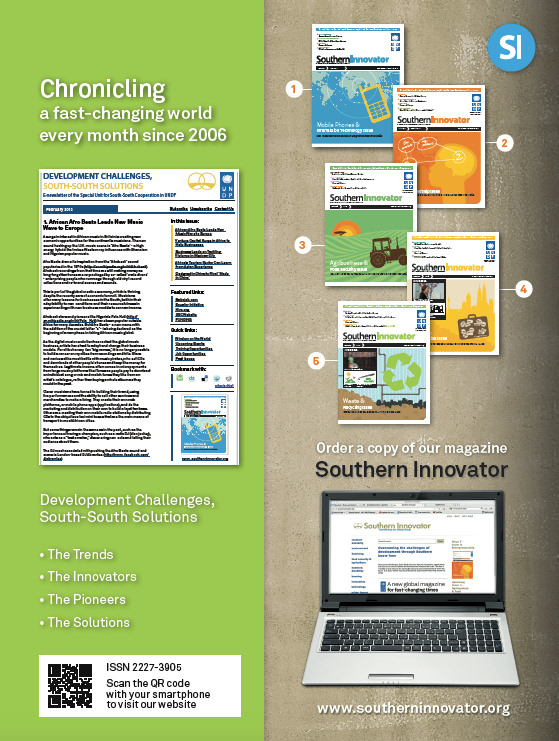
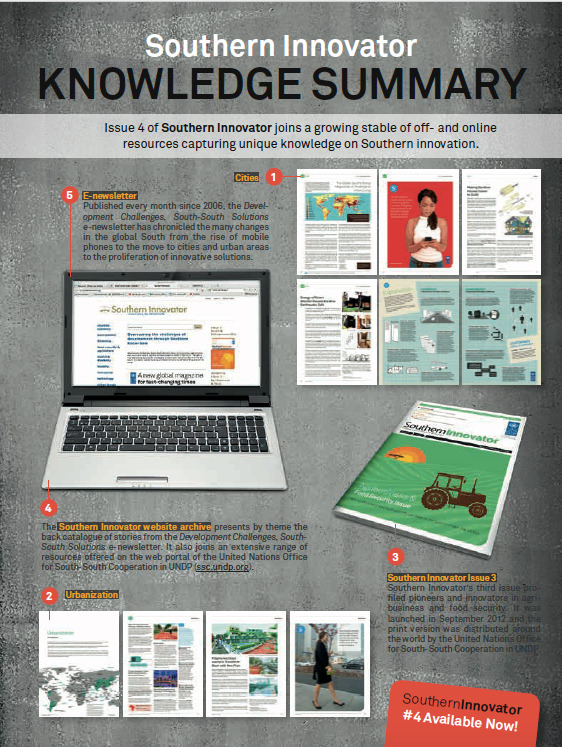
    Development Challenges, South-South Solutions was launched as an e-newsletter in 2006 by UNDP’s South-South Cooperation Unit (now the United Nations Office for South-South Cooperation) based in New York, USA. It led on profiling the rise of the global South as an economic powerhouse and was one of the first regular publications to champion the global South’s innovators, entrepreneurs, and pioneers. It tracked the key trends that are now so profoundly reshaping how development is seen and done. This includes the rapid take-up of mobile phones and information technology in the global South (as profiled in the first issue of magazine Southern Innovator), the move to becoming a majority urban world, a growing global innovator culture, and the plethora of solutions being developed in the global South to tackle its problems and improve living conditions and boost human development. The success of the e-newsletter led to the launch of the magazine Southern Innovator.  

    Follow @SouthSouth1

    Google Books: https://books.google.co.uk/books?id=YtEgTdyZioUC&dq=development+challenges+december+2008&source=gbs_navlinks_s

    Slideshare: http://www.slideshare.net/DavidSouth1/development-challengessouthsouthsolutionsdecember2008issue

    Southern Innovator Issue 1: https://books.google.co.uk/books?id=Q1O54YSE2BgC&dq=southern+innovator&source=gbs_navlinks_s

    Southern Innovator Issue 2: https://books.google.co.uk/books?id=Ty0N969dcssC&dq=southern+innovator&source=gbs_navlinks_s

    Southern Innovator Issue 3: https://books.google.co.uk/books?id=AQNt4YmhZagC&dq=southern+innovator&source=gbs_navlinks_s

    Southern Innovator Issue 4: https://books.google.co.uk/books?id=9T_n2tA7l4EC&dq=southern+innovator&source=gbs_navlinks_s

    Southern Innovator Issue 5: https://books.google.co.uk/books?id=6ILdAgAAQBAJ&dq=southern+innovator&source=gbs_navlinks_s

    https://davidsouthconsulting.org/2021/03/05/southern-innovator-issue-3/

    Creative Commons License
    This work is licensed under a
    Creative Commons Attribution-Noncommercial-No Derivative Works 3.0 License.

    ORCID iD: https://orcid.org/0000-0001-5311-1052.

    © David South Consulting 2023
  • Truckus Maximus: The Big Boys With The Big Toys Do Some Hardcore Pogo At Monster Truck Show

    Truckus Maximus: The Big Boys With The Big Toys Do Some Hardcore Pogo At Monster Truck Show

    “I got laid off too many times. Now, I work harder for less money. But I get to do what I want to do. Not many people get that.”

    By David South

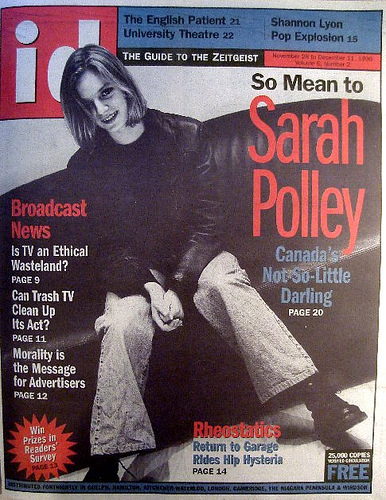
    Id Magazine (Canada), February 6 to 19, 1997

    The little tiger-striped four-by-four is definitely going too fast. In an instant, the diminutive Suzuki stands balanced, its front wheels squashed at 90 degrees. A millisecond later, it’s on its back like a ladybug flipped over by the wind. The cacophony of the crowd reaches a crescendo. But the noise had been building; the Skydome crowd saw the writing on the wall for the little jeep. 

    Frantic helpers pry open the door of the jeep, wrestling free the driver, Dwayne Robichaud. He emerges in an orange jump suit and prances around, looking vaguely like the Oklahoma bomber. The audience lets out an even louder cheer as he walks away, smug and happy. 

    Half an hour earlier, two monster trucks, Young Gun and Samson, line up behind a pile of crushed cars, with a dirt ramp at each end. The methanol engines let out a roar like the mother of all hairdryers. The revving turns into a drag race. The pulsating white noise rattles the cavernous Dome. The effect on the audience is almost sexual: the stomach rattles, the heart skips a few beats. It is a short buzz, but it is good. And the noise? I begin to notice that everyone around me has ear plugs and I realize I’m going to regret this in 20 years. 

    The exhaust fumes are starting to reach toxic levels 40 minutes into the rally. I shake my head and feel the motion a few seconds later. I’m getting a CO2 buzz, too. It’s the USA Motor Spectacular monster truck derby at Toronto’s Skydome. But monster trucks are just a small part of the show, there for the crowd to ogle while they get off on the noise. There is the amateur truck rally involving the tippy Suzuki and other monster-truck wannabees, and a ridiculous car-eating, fire-breathing robot called Robosaurus for the kids. The metal bashing of the demolition derby serves to satiate the audience’s thirst for damage – and is truly the highlight of the night. 

    I can’t get out of my mind comparisons to spectacles in Roman times. Titans of spectacle, the Romans set the benchmark by which all other public entertainment must be judged. On the spectacular scale, Roman bloodsports involving gladiators, wild animals and the sacrificing of Christians definitely rate a 10 – anything else falls below. I figure monster trucks rate about 4. Watching pick-up trucks with over-sized $10,000 tractor tires crush cars can’t match the gore and death of ancient Rome but it will do for now. 

    If monster trucks join professional wrestling and American Gladators as today’s answer to blood sports, why does this spectacle seem to lack that je ne sais quoi? Maybe it’s the sanitization of risk. The cabin of a monster truck coddles the driver. There are cushioned seats, a kidney brace, a five-point racing harness, neck braces, helmet restraints and a roll bar. Several drivers tell me that the job only looks dangerous. At half time, Young Gun’s Saskatoon-based driver, Kevin Weenks, tells me he doesn’t seek out danger. “I think some of those (amateur) guys are nuts and want to do the crowd a big favour [die]. You don’t want to run it hard. A win isn’t worth flipping over.” 

    Derby destruction

    Thirty demolition derby wrecks crawl into the centre of the Skydome. The flag is dropped and an orgy of car crushing begins. It goes on for half an hour. Now I’m not bored. Cars are still driving despite engine fires and rear-ends that stand at 45 degrees. It is down to two cars: one more or less intact, the other driving on its hubs, engine on fire, half its back a mangled piece of crumpled paper. The driver doesn’t give up. His engine stops, then starts again. This is repeated three times until, exhausted, he concedes defeat. 

    After the derby it’s time for Robosaurus. The press release claims the hunk of grey metal stands five stories tall and costs $2.1 million. The driver flicks on the switch on a very expensive stereo system and Robosaurus starts to growl like Godzilla. Two guys with radio headsets help direct the beast onto the floor. It burps and farts for a while before picking up a pre-cut car. It crushes it, drops it to the floor and incinerates it with a flame thrower. The crowd roars.

    It seems things haven’t changed with spectacles. The Romans drew on slaves, freed men, foreigners and the lower social orders to provide fodder for their spectacles. Monster trucks are driven by farmers hired for six months at a time. The amateur drivers are a hodgepodge of laid-off workers, farm labourers and guys who make a meagre living fixing four-by-fours. 

    Wearing a waist-length monogrammed racing jacket is Don Frankish. The shy and patient Alberta grain farmer owns two of the four monster trucks in Canada. He has been racing for seven years and divides his year 50/50 between farming and tours on the monster truck circuit, which mostly takes him through the U.S. 

    He is definitely attracted to the excitement of the stadium, but not necessarily a love of death-defying acts. “It’s the rush of the crowd as they get behind you, talking to the kids who look at you as a superhero,” he says. “I like the speed, the unpredictability. We know the risks. There is a danger to it. But the Monster Truck Racing Association makes sure we have a killer radio to shut off the engines if the truck is out of control. The worst I’ve ever seen is a truck going end over end three times – it just destroyed the truck.” I ask him about insurance and he laughs. “We can’t get insurance!”

    Pit boys

    Down in the pit, the air is thick with exhaust fumes. The pit boys are milling about, patting each other on the back. A sprinkling of pit girls hang around, with hairstyles straight out of Xena: Warrior Princess. The dress for today is black: black t-shirts and black jeans. Don McGuire, 32-year-old partner in the Three Stooges four-by-four shop in Brampton, sports a mischievous grin as he tells me with pride about his chosen vocation: mud bog racing. It’s the messier outdoor version of tonight’s amateur truck rally. McGuire has been a mud bog racer for 10 years and isn’t doing it for the money. “First prize is just $200 – I spring for more money than I would ever win,” he says. “We do this for the pure adrenaline. It’s just heart and soul. It takes bucks per cubic inch to win in this business,” he says resentfully, looking across the Skydome to where the monster trucks are parked. Big Foot’s sponsorship by Ford seems to be a sore point with racers who spend thousands of their own dollars to come here. 

    McGuire gave up a $700 a week job to earn $300 a week and race. “I got laid off too many times. Now, I work harder for less money. But I get to do what I want to do. Not many people get that.”

    “We do this for the pure adrenaline. It’s just heart and soul. It takes bucks per cubic inch to win in this business”

    https://davidsouthconsulting.org/2021/07/20/case-study-3-id-magazine-1996-1997-2/

    https://davidsouthconsulting.org/2020/06/16/casino-calamity-one-gambling-guru-thinks-the-province-is-going-too-far/

    https://davidsouthconsulting.org/2020/11/17/land-of-the-free-home-of-the-bored/

    https://davidsouthconsulting.org/2021/03/17/province-for-sale-step-right-up-for-an-opportunity-to-buy-what-you-already-paid-for/

    https://davidsouthconsulting.org/2021/01/20/pulling-the-plug-on-hate-rock-1996/

    https://davidsouthconsulting.org/2021/01/16/redneck-renaissance-a-coterie-of-journalists-turn-cracker-culture-into-a-leisure-lifestyle/

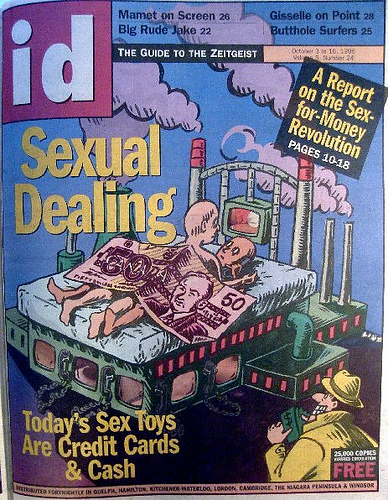
    https://davidsouthconsulting.org/2021/01/14/from-special-report-sexual-dealing-todays-sex-toys-are-credit-cards-cash-a-report-on-the-sex-for-money-revolution/

    https://davidsouthconsulting.org/2021/02/03/swing-shift-sexual-liberation-is-back-in-style/

    https://davidsouthconsulting.org/2020/04/22/state-of-decay-haiti-turns-to-free-market-economics-and-the-un-to-save-itself/

    https://davidsouthconsulting.org/2020/12/11/tvs-moral-guide-in-question-again/

    Creative Commons License

    This work is licensed under a
    Creative Commons Attribution-Noncommercial-No Derivative Works 3.0 License

    ORCID iD: https://orcid.org/0000-0001-5311-1052.

    © David South Consulting 2023

  • Turning Animal Waste Into Paper

    Turning Animal Waste Into Paper

    By David SouthDevelopment Challenges, South-South Solutions

    SOUTH-SOUTH CASE STUDY

    Animal waste is a messy fact of daily life in rural communities across the global South. This byproduct of life has many uses – but an ingredient for making writing paper is probably not the first that springs to mind.

    But animal dung is cleverly being recycled into high-value products in Sri Lanka and Thailand. Both countries have elephants who are under threat. In Sri Lanka (http://en.wikipedia.org/wiki/Sri_Lanka) the large but endangered elephant population is considered a nuisance. They damage crops and are often killed for this reason. There are upwards of 3,000 elephants in the country – down from 14,000 in the 1800s. Nonetheless, they create vast quantities of excrement. In Sri Lanka, they face many threats: ivory poachers, being killed to protect crops and houses, starvation from drought and deforestation.

    Animal waste (http://en.wikipedia.org/wiki/Feces) has many uses: it can be turned into fertilizer for crops, fuel for cooking, placed in a digester and fermented into bio-gas for heating and cooking, and if from a herbivore animal, into fibrous products like paper and cardboard. Packing boxes can also be made from the excrement.

    As a vegetarian animal, elephants’ excrement and dung is made up of vegetable matter and is rich in cellulose (http://en.wikipedia.org/wiki/Cellulose). And cellulose is what makes up the majority of traditional wood-pulp paper (http://en.wikipedia.org/wiki/Pulp_%28paper%29).

    Re-using the waste is also a good way to make elephants valuable to local people, rather than just being perceived as a nuisance.

    Dung produces a natural, recycled paper. While harvesting trees for paper is an expensive and energy-wasting process, the elephant’s digestive tract does the hard work by breaking down the cellulose, making it ideal for the next stage in becoming a paper product.

    According to the Environmental Paper Network (http://www.environmentalpaper.org/stateofthepaperindustry/confirm.htm), 50 percent of the world’s forests have been destroyed, and 80 percent of the remaining forests are in a degraded state.  By turning to alternative sources to make paper, trees are saved and vast quantities of energy reduced. Traditional paper-making also uses many chemicals in the process, something that is avoided in using animal dung. Vegetable products are used to bind the paper together and water-soluble dyes are used to colour the paper.

    Dung paper has earned some high-profile fans as well. The Turner Prize-winning British/Nigerian artist Chris Ofili (http://en.wikipedia.org/wiki/Chris_Ofili), uses elephant dung paper in his works.

    The Elephant Dung Paper company (www.elephantdungpaper.com) in Thailand was one of the first to pioneer the technique. This business was started by dung paper pioneer Mr. Wan Chai. He tells a story of how he became enchanted by the paper-making process when he walked past a paper factory one day. Later, when he was at the Thai Elephant Conservation Center in Lampang, northern Thailand (http://www.changthai.com), he noticed the elephant dung was rich in fibres like those used in making paper from wood pulp.

    Inspired, he embarked on a process of trial and error using his wife’s food processor to turn elephant dung into a fibrous stew that is then shaped, dyed and dried to make paper (http://www.elephantdungpaper.com/process.html).

    Wan Chai has gone on to be a formative influence in the founding of a sheep dung paper making operation in Britain, Creative Paper Wales.

    Another dung paper business is Mr. Ellie Pooh (http://www.mrelliepooh.com/) in Sri Lanka. Established with the goal of reducing conflict between humans and elephants, it has turned to making paper products to boost local incomes and create a direct economic incentive to protect the elephants. It is setting up handmade paper workshops in rural areas and teaming them with artisans to add value to the products and make them more desirable. Design is critical to making any product – no matter how ethically produced and how green – desirable to consumers.

    The dung products Mr. Ellie Pooh makes include a wide variety of coloured papers, scrapbooks, note boxes, stationery pouches, greeting cards, ‘to do’ list pads, memo books, and a children’s book.

    The process of making elephant dung paper takes about 13 days – three days of sorting, boiling and disinfecting, followed by 10 days to pulp, mix, press and dry the paper. Mr. Ellie Pooh makes about 1,000 sheets a day and 30,000 a month. Each sheet makes six A4-size pieces of paper.

    The company was founded by Dr. Karl Wald and Thusitha Ranasinghe, and is managed by recycled paper firm Ecomaximus (http://www.ecomaximus.com/) based in Colombo, Sri Lanka, with a workshop in Kegalle.

    Ecomaximus was started in 1997 by its Managing Director, Ranasinghe, who was following a family tradition going back three generations of working in printing.

    The business started recycling waste printing paper and then moved into recycling a wide variety of other cellulose waste: rice paddy straw, cinnamon and banana bark. It now employs over 35 people on two sites.

    It is proof that it just takes creativity and a new perspective to turn something considered as waste into wealth: and jobs and sustainable incomes.

    Resources

    1) Creative Paper Wales: Makers of Sheep Poo Paper, this company in Wales uses sheep dung to make a range of paper products. Sheep are plentiful in Wales and are found all over the hills grazing. Website: http://www.creativepaperwales.co.uk/index.aspx

    2) Paper High sells online paper products made from Sri Lankan elephant dung. This includes note books, greeting cards, photo frames, and photo albums. Website: http://www.paperhigh.com/products/srilanka/srilanka.htm?gclid=CKbHrdaZv6YCFQkf4Qod-hzaHg

    3) Red Dot: Red dot stands for belonging to the best in design and business. It champions design in business through awards and events. Website: http://en.red-dot.org/

    Creative Commons License

    This work is licensed under a
    Creative Commons Attribution-Noncommercial-No Derivative Works 3.0 License.

    ORCID iD: https://orcid.org/0000-0001-5311-1052.

    © David South Consulting 2022

  • Design Collaborations Revitalize Traditional Craft Techniques

    Design Collaborations Revitalize Traditional Craft Techniques

    By David SouthDevelopment Challenges, South-South Solutions

    SOUTH-SOUTH CASE STUDY

    Keeping alive traditional craft techniques and methods in the age of globalization is a tricky balance to get right. As countries seek to increase living standards and income, traditional craft-making methods are often jettisoned in favour of attracting manufacturing and other high-value activities – meaning rich and potentially lucrative skills can be lost.

    One promising new initiative is bringing craftspeople in the global South together with established and well-known designers in The Netherlands to create the market incentives to continue using traditional techniques. It is establishing a brand and a business model to sell unique and original craft products into the European marketplace. By doing this, it hopes to open up new markets in Europe – and in time, the rest of the world – for craft makers from the global South so they can continue to earn an income using their traditional skills and techniques.

    The brand is called Imperfect Design (http://www.imperfectdesign.nl/) and was founded in 2011 by Monique Thoonen, formerly the managing director of Dutch Design in Development (ddid.nl) – a matchmaker between Dutch designers, producers in developing countries and European importers. Imperfect Design takes the idea a step further: It is a brand dedicated to creating high-value, well-designed craft products for the European marketplace.

    The idea began to percolate in Thoonen’s mind in 2010. She received a good response from some of the Dutch designers she approached – who were keen to work with craft workers in developing countries – and this gave her the confidence to launch Imperfect Design.

    “We saw that many designers were very interested to work with craftsmen/small workshops in developing countries,” she explained, reflecting on her previous experience working with Dutch Design in Development. “The designers and the crafters learned a lot about the inspiring cooperation and it resulted often in good quality products/collections. However, it was hard to find good sales channels for the products. In 2010 the idea came about to set up an own brand.”

    Thoonen was seeking a business model that could be sustainable and rewarding for all the participants along the value chain (http://en.wikipedia.org/wiki/Value_chain).

    “The cooperation is inspiring for Dutch designers,” Thoonen said. “The craftsmen will learn a lot about product development during the project and will earn money from the orders. The idea is to build up long-term relations with producers in three countries in three continents – each continent one country.”

    For Thoonen, the business model approach is at the core of Imperfect Design.

    “The idea of my business model is not doing good. It must be a profitable business model, otherwise it can’t be sustainable. Making it profitable is a big challenge and also forces us to keep the commercial aspect every day in mind.”

    The criteria for selecting the designers includes a resourcefulness and creativity that can shape a high-quality craft product with the resources and tools at hand for the collaborating craft workers in the developing country. It is also crucial they understand how to shape the craft product into a high-value item that can command a high price back in Europe.

    According to Thoonen, “the products must be differentiated from the market, otherwise it can be copied easily by large producers in China. It is really important to create new things, as the prices are in general higher than from mass production, so the consumer must understand why the price is higher.”

    So far, Imperfect Design has begun working with craftspeople in Vietnam and Guatemala, and it is currently selecting a country in Africa. Craft workers can contact Imperfect Design about collaborating but the number of people it can work with is limited at this stage. Imperfect Design places emphasis in taking the time to build sustainable relationships.

    A common criticism of craft products sold in many markets is their sameness and sometimes poor and inconsistent production quality. Trying to enter an overseas market and understand what consumers want or desire is a very difficult thing for a craft worker to get right. This is where the experience and knowledge of a designer can make a big difference. Designers can help to hone the craft product, improve the production methods and position the product in the overseas marketplace.

    “The workshops have fantastic qualities and materials to work with,” says Thoonen. “When you combine that with the strength of our Dutch designers, you can create products which are commercial, of high quality, and beautiful.”

    One of the first collaborations to bear fruit is between Dutch designer Arian Brekveld (arianbrekveld.com) and craft workers in Vietnam. The collaborations have resulted in lacquer tables, trays and candlesticks, ceramic vases, iPad bags and throw cushions – all made using techniques and materials unique to Vietnam.

    Imperfect Design allows the designers to select which country they would like to work with. Brekveld’s previous experience travelling widely in Asia tipped his interest towards a country in that continent. He appreciated the friendly and welcoming contacts he had made in Vietnam, who showed a strong interest in collaborating.

    Brekveld wanted to bring a “designer’s eye” to the possibilities in Vietnam. He asked: “How could they make the crafts more beautiful and customized for the market in Europe?”

    He found Vietnam was not just an interesting place to work, but also a country undergoing significant change. As a result, he found it critical to go and see what was happening in the country and to see first-hand the working conditions in the workshops.

    This was a contrast to many of the design briefs he normally undertakes in Europe, where there often isn’t the intimacy of working directly with the craft workers in their workshops.

    The time spent in Vietnam was intense and involved visiting multiple workshops to see which would be the best partner.

    “We visited four or five lacquer companies to see what their skills were, looking for possibilities,” he said. “It is very special to see by yourself, to really to take a look by yourself, to see what companies do.”

    Brekveld was surprised to see that concepts that had been discussed and explored earlier in the day would be presented to him as completed works by the end of the day. The quick work pace and precision really impressed the designer, and the project took months to complete in comparison to the years required by some projects he works on in Europe.

    A group of women from the ethnic Catu (http://en.wikipedia.org/wiki/Co_Tu_people) community in central Vietnam weaved the fabrics for the iPad bags and cushions. It was very valuable to work with them in person because he could see what they were – and weren’t – capable of. The fabrics are made into iPad bags and cushions in the capital Hanoi by disabled craftsmen.

    Brekveld said visiting the remote workshop saved a lot of time and frustration.

    “It was a big difference compared to sitting behind a desk and sending designs. You really see all the possibilities that are there.”

    Brekveld is seeking to design products that do not fit in with a clichéd idea of what comes from a developing country.

    “If you look you can see the imperfections but they are not obvious. These designs would not necessarily sell in their own country. We try to design products showing the skills they have, using their techniques – not using patterns they would use for themselves. We look at their process and say ‘you can make that and that’. On the other hand, we don’t want to tell them to do something completely different. We look at the technique – a combination of European design language with their abilities.”

    But what about quality control? Brekveld says that is an issue he looks at right from the beginning of the design process. “I am a maker, try to make myself – try to think about it before hand.”

    He is ambitious for the collaboration to flourish.

    “We hope these relations are long-term relations,” he said. “We hope to expand the collection.”

    He will present the collections during Dutch Design Week at the end of October 2012 in Eindhoven (ddw.nl).

    For Thoonen, success will bring many benefits. “If we manage to sell the collection well in the market, then we can give more orders,” Thoonen said. “In short: it will create work, but also development in quality and design.”

    Published: September 2012

    Resources

    1) An online film showing Arian Brekveld’s trip to Vietnam and the craft collaborations. Website: http://imperfectdesign.nl/index.php?route=product/category&path=72_91

    2) Dutch Design in Development: DDiD is the agency for eco design, sustainable production and fair trade. They work with Dutch importers and designers and connect them to local producers in developing countries and emerging markets. Together products are made that are both profitable and socially and environmentally sustainableWebsite: http://www.ddid.nl/english/

    3) Dutch Design Week: Groundbreaking ideas, mind-blowing experiments and extraordinary forms of collaboration – that’s what it’s all about during DDW. With the boundless creativity of hundreds of renowned designers and young talents, each year the leading event offers a unique look into the future of design (Eindhoven, The Netherlands: 20-28 October 2012). Website: http://www.ddw.nl/

    Creative Commons License

    This work is licensed under a
    Creative Commons Attribution-Noncommercial-No Derivative Works 3.0 License.

    ORCID iD: https://orcid.org/0000-0001-5311-1052.

    © David South Consulting 2023