Author: David South Consulting

  • 3D Home Printing Landmark: 10 Houses in a Day

    3D Home Printing Landmark: 10 Houses in a Day

    By David SouthDevelopment Challenges, South-South Solutions

    SOUTH-SOUTH CASE STUDY

    The global South is experiencing urban growth on a scale unprecedented in human history, far outstripping the great urbanization wave that swept across Europe and North America during the 19th and 20th centuries.

    Faced with growth at this pace, governments – both national and local – often become overwhelmed by the rate of change and find it difficult to cope. One of the most common complaints urban-dwellers around the world have is about their living conditions. Even in developed countries, creating enough housing to match demand can be a struggle.

    Quality housing is crucial to human development and quality of life. Adequate living space and access to running water make a significant contribution to people’s health and well-being. Despite this obvious conclusion, millions of urban dwellers live in squalid conditions with poor sanitation, overcrowding, crime, pollution, noise and a general feeling of insecurity. Insecure people find it difficult to access stable jobs and suffer stigma for living in poor-quality neighbourhoods.

    But many initiatives are seeking to speed up the pace of home construction.

    These include the Moladi construction system from South Africa (moladi.net). Moladi uses moulds to assemble houses, so that the building skills required are minimal and easily learned. Built to a template that has been tested for structural soundness and using a design that produces a high-quality home both in structure and appearance, the Moladi system seeks to provide an alternative to makeshift homes that are structurally unsound and vulnerable to fires, earthquakes and other natural disasters.

    Another clever approach is a home and dwelling assembly system developed by architect Teddy Cruz (http://estudioteddycruz.com) (http://visarts.ucsd.edu/faculty/teddy-cruz) that allows slum dwellers to gradually construct a building in stages as they can afford it. It is earthquake-safe and fire resistant.

    Another approach turns to the fast-growing technology of 3D printing (http://en.wikipedia.org/wiki/3D_printing). This technology has gone mainstream in the past five years in the form of desktop-sized 3D printers, or fabricators as they are sometimes called. The machines assemble objects in an additive fashion – layer-by-layer – using digital designs from a computer.

    3D printers can make a complex object without having to resort to mass manufacturing. An accurate, one-off object can be created with the same precision as a machined object. Architects, for example, use the technology to make 3D models of their designs. And now a company in China is hoping to use 3D printers to make houses.

    The WinSun Decoration Design Engineering Co. (http://www.yhbm.com/index.aspx) 3D printed 10 houses in 24 hours in Shanghai’s Qinpu district, reported Business Insider.

    This landmark achievement was accomplished with a giant printer – 152 meters long, 10 meters wide, and 6 meters high – which manufactured walls for the house from a mix of construction waste and cement.

    As a sign of the confidence the company has in the innovative construction technique, it built its own 10,000 square meter headquarters in one month using the same materials. The company’s chief executive officer, Ma Yihe, is also the inventor of the technique. It is a very flexible technology and the material can be tinted different colors according to the customer’s wishes. It is cheap to work with and is also less draining on environmental resources than traditional building materials.

    The 10 houses consist of two concrete side supporting walls with glass panels at the front and back and with a triangle roof. They will be used as offices at a high-tech industrial park in Shanghai. The company has big plans, hoping to use the technology to build more homes – and even skyscrapers.

    Competition is heating up as people around the world seek to perfect 3D technology to print houses to meet the growing demand for dwellings.

    In The Netherlands, Dutch architectural firm Dus Architects (dusarchitects.com)  commissioned the development of a leviathan 3D printer so it could print entire rooms. Modeled on a much smaller home desktop version, the Ultimaker (ultimaker.com), this printer creates whole rooms that are then assembled into custom-built houses.

    The 6-meter high KamerMaker (kamermaker.com), or “room builder”, is being used in Amsterdam to build a full-size house.

    The project is called “3D Print Canal House” (http://3dprintcanalhouse.com/). The printer assembles the rooms individually, and then they are snapped together to make a house. The internal structure of the building blocks are in a honey-comb pattern, which is then filled with a foam that becomes as hard as concrete.

    “For the first time in history, over half of the world’s population is living in cities,” Dus Architects founder Hans Vermeulen told cnet.com. “We need a rapid building technique to keep up the pace with the growth of the megacities. And we think 3D printing can be that technique.

    “We bought a container from the Internet and we transformed it into one of the biggest printers on this planet.”

    This technology can also easily use recycled waste materials and lower the pollution and cost of moving building materials around. The Dus Architects prototype house is expected to take three years to complete (so, still in its early development phase) and will look like a typical Dutch canal house with a pointy, gabled roof (http://www.build.com.au/gabled-roof).

    One of the pioneering advocates for using 3D technology to address the global South’s urbanization and housing challenge has been Larry Sass, director of the Digital Design Fabrication Group (http://ddf.mit.edu/) at the Massachusetts Institute of Technology (MIT).

    Three technologies have been developed at MIT since the 1950s that have made digital fabrication possible – computer numerical control (CNC), which enables computers to control machines; computer-aided design software in the 1960s; and 3D printing in the 1980s to make solid models using digital designs.

    Sass told MIT’s Spectrum newsletter (spectrum.mit.edu) that large-scale 3D printing would mean “buildings will rise faster, use fewer resources, cost less, and be more delightful to the eye than ever before.”

    He envisions a future in which architects will be able to send their designs by computer to a 3D printer and it will then be able to start “printing” the building or a house accurately according to the original designs.

    The conventional way of making buildings has been stuck in the same approach since the 1800s, according to Sass. It uses highly skilled and extensive labour, it is slow and plagued by weather disruptions and urban congestion, and it is expensive, often using materials brought from far away.

    Digitally fabricating buildings takes a radically different approach: the building is made in a series of precision-cut, interlocking parts and then assembled on site like a jigsaw puzzle.

    “It’s the right delivery system for the developing world, because the developing world doesn’t have an infrastructure of tools, air guns, saws and power,” Sass said.

    “Design and high-quality construction is mostly for the rich,” added Sass, who was raised in Harlem, a New York City neighbourhood with high poverty levels. “I’ve always wanted to figure out how to bring design choice and architectural delight to the poor.”

    Published: July 2014

    Resources

    1) 3D Printing Technologies: A website exploring the development of 3D technology. Website: http://www.3d-printing-technologies.com/index.html

    2) Sweet Home 3D: An open source, free interior design software application that allows users to draw the plan of their house, arrange furniture and view in 3D. Website: sweethome3d.com

    3) A video showing how it was done is here: http://www.businessinsider.com/this-video-shows-how-a-company-3-d-printed-10-houses-in-a-day-2014-4.

    4) 3-D Printed Buildings for A Developing World from MIT’s Spectrum. Website: http://spectrum.mit.edu/articles/3-d-printed-buildings-for-a-developing-world/


    This work is licensed under a Creative Commons Attribution 4.0 International License.

    ORCID iD: https://orcid.org/0000-0001-5311-1052.

    © David South Consulting 2023

  • Opinion: Canada is allowing U.S. to dictate Haiti’s renewal: More news and opinion on what the UN soldiers call the “Haitian Vacation”

    Opinion: Canada is allowing U.S. to dictate Haiti’s renewal: More news and opinion on what the UN soldiers call the “Haitian Vacation”

    By David South

    Id Magazine (Canada), August 22 to September 4, 1996

    An August 19 attack on the Port-au-Prince police headquarters by pissed-off former Haitian soldiers should be a wake up call to Canadians. So far, the Haiti UN mission has seemed as safe as the soldiers’ quip, the “Haitian Vacation”. The UN soldiers patrol the capital in rickety Italian trucks, stopping to chat with the locals. On the surface, this mission looks like summer camp compared to the nightmare of enforcing peace in the former Yugoslavia.

    But for one crucial factor: The UN troops are propping up an increasingly unpopular government. A government that is seen by many Haitians to be getting its orders from Washington, not Port-au-Prince. Canadian troops lead the UN mission in Haiti and make up 700 of the 1500 soldiers stationed there (the rest are from Pakistan and Bangladesh). There is a serious danger they will be caught in the crossfire of any uprising or coup attempt.

    Canadian troops shadow president Rene Preval 24 hours a day and also guard the National Police. When I visited the dilapidated palace in July, with its handful of Canadian troops banging away on laptop computers, I could only hope nobody will want to mess with the UN.

    The two prongs of Haitian renewal – reforming the economy and the justice system – are both being directed by the U.S.. Haitian senator Jean-Robert Martinez had a theory about the August 19 attack, which killed a shoeshine boy. Martinez believes it was in retaliation for government plans to privatize Haiti’s rotting nationalised industries – a condition for receiving loans from the U.S. and the Washington-based International Monetary Fund and the World Bank.

    Haiti is a good example of the carnage of cynical U.S. foreign policy. The U.S. wooed and then coddled the corrupt Haitian elite to run its sweatshops. As the “development” organization USAID once said, Haiti could be the “Taiwan of the Caribbean”. The U.S. trained the Haitian death squad Front pour l’Avancement et le Progres Haitien (FRAPH), who then littered the outskirts of Port-au-Prince with the bodies of former president Jean-Bertrand Aristide’s supporters during the dark days of the 1991 coup.

    Three weeks ago American troops from the 82nd Airborne plopped down on the streets of Port-au-Prince to spend a week patrolling. What kind of message does this send? This tells the Haitians that the UN isn’t the real deal; that if they get out of line, the Americans will kick their butts. Why does Canada allow the U.S. to undermine the credibility of our peacekeeping mission?

    More visits by the Americans can be expected. It is no accident that a medical team attached to the 82nd Airborne remains on duty at the American base in Port-au-Prince.

    The so-called justice reforms are mostly window dressing. Canada spent $4,750,000 to build and renovate court houses for the same corrupt judges that were the problem in the first place. That’s the equivalent of punishing a thief by buying him/her some new furniture.

    Rather than telling the Haitians to tighten their buckles around hungry bellies, Canada should be leading the fight to pave roads and provide clean water and social services to all. Canada should not be helping to impose austerity economics on the Western hemisphere’s poorest country.

    David South is the Features Editor of id Magazine

    “U.S. Elections Update: Clinton is using Canada to keep control of Haiti”.
    Creative Commons License

    This work is licensed under a
    Creative Commons Attribution-Noncommercial-No Derivative Works 3.0 License.

    ORCID iD: https://orcid.org/0000-0001-5311-1052.

    © David South Consulting 2022

  • Banning of Plastic Bags and Containers Brings New Opportunities

    Banning of Plastic Bags and Containers Brings New Opportunities

    By David SouthDevelopment Challenges, South-South Solutions

    SOUTH-SOUTH CASE STUDY

    This month, Uganda bans plastic bags, outlawing their import, manufacture and use and joining a growing list of African countries seeking to sweep cities of this menace. Uganda’s ban follows similar moves in Kenya and in Tanzania, where even plastic drinks containers will soon be banished. Rwanda, also a member of the East African Community, has gone further – in 2005 the country banned any products made of very thin plastic below 100 microns. The thinner plastic found in plastic bags (under 30 microns) is particularly troublesome because it is easily blown around by the wind. The proliferation of plastic bags and plastic containers across the developing world has not only become an eyesore, it is also an environmental catastrophe that is poisoning the land.

    In Uganda’s capital, Kampala, discarded plastic has combined with toxic waste management practices to make the problem worse. While Kampala has 30 companies dealing in solid waste management, the process is mired in corruption. Poor areas of the city receive no service because it is more profitable for the companies to target wealthy areas for the user fees they collect to remove rubbish.

    Scavengers in the municipal dump of Kampala earn 50 Ugandan pence a day collecting plastic bags. Most plastic bags do not make it to the dump, ending up blown around the city by the wind, washed into drains and water courses. Worse, the rich soil around Uganda’s towns and villages is now covered in plastic bags. A new layer of polythene and contaminated soil has formed in many areas, with an impenetrable crust that stops rain from soaking through. It leaves water stagnating in pools gurgling with methane gas bubbles.

    For entrepreneurs, tackling the mountains of plastic waste is an opportunity – as is providing a replacement once they are banned. A boon time is emerging for the market in recycled and reusable materials and biodegradable alternatives.

    The So Afr-Eco Community Upliftment Project for Rural Women in South Africa is a common example. A project that proves money can be made from recycling discarded plastic bags into useful items. Based in the Obanjeni district in Kwazulunatal, it was founded by Jenny Kirkland, who was disgusted with the proliferation of plastic bags littering South Africa’s countryside. She decided to do something that would also hire rural women and give them an income. The plastic bags are cut into strips of twine and then woven together to make hats, bags, doormats and waistcoats. Run as a for-profit business, it now employs 132 families and exports products to 19 countries, including Australia, the USA, the UK, Canada, Sweden and Poland. South African schools are now provided with sun hats and companies order hats for use at conferences. The profits made from sales are significant by local standards. For example, the sale of one beach bag can feed a small family for two weeks, a hat feeds a family for a week, and a doormat for a month.

    Anita Ahuja, president of the NGO Conserve, has set up a business making fashionable handbags, wallets and shopping bags from recycled plastic bags in New Delhi, India. Begun in 2003, the project collects plastic bags on the streets and keeps 60 women employed. The recycling process does not require additional dyes or inks and is non-toxic. The bags are sold in London, UK and will soon be sold in Italy by the Benetton clothing chain.

    “We braided them and tried weaving them, but the plastic would come loose. Then we hit upon the idea of pressing them to make sheets,” Ahuja said.

    But this issue can be more complex than it first seems. After South Africa banned plastic bags of less than 30 microns in 2003, many poor entrepreneurs have complained that it hit hard their making of hats, handbags, purses and scrubbing brushes from them – something that had become a good livelihood.

    After the bags are banned, environmentalists say the best option is to use reusable bags made of materials that don’t harm the environment during production and don’t need to be discarded after use.

    Alternatives to plastic bags include traditional African baskets or kiondos as they are known in Kenya. Made from sisal and sometimes with leather or wooden handles, the handmade bags support many local women (http://www.propoortourism-kenya.org/african_bags.htm).

    In Kenya, entrepreneurs have also stepped in to offer alternatives to plastic and kiondos. Supermarkets and shops in the country distributed 11 million plastic shopping bags a year, so Joseph Ayuka of Greensphere Enterprises has begun to market cotton bags for their easy portability. “People don’t want to carry bulky bags to the supermarket”, he said.

    Resources

    Creative Commons License

    This work is licensed under a
    Creative Commons Attribution-Noncommercial-No Derivative Works 3.0 License.

    ORCID iD: https://orcid.org/0000-0001-5311-1052.

    © David South Consulting 2022

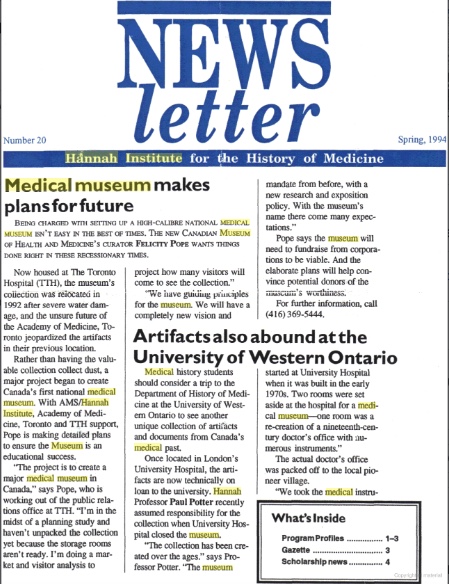
  • Medical museum makes plans for future

    Medical museum makes plans for future

    By David South

    Hannah Institute for the History of Medicine Newsletter (Toronto, Canada), Number 20, Spring, 1994

    Being charged with setting up a high-calibre national medical museum isn’t easy in the best of times. The new Canadian Museum of Health and Medicine’s curator Felicity Pope wants things done right in these recessionary times. 

    Now housed at The Toronto Hospital (TTH), the museum’s collection was relocated in 1992 after severe water damage, and the unsure future of the Academy of Medicine, Toronto jeopardized the artifacts in their previous location. 

    Rather than having the valuable collection collect dust, a major project began to create Canada’s first national medical museum. With AMS/Hannah Institute, Academy of Medicine, Toronto and TTH support, Pope is making detailed plans to ensure the museum is an educational success. 

    “The project is to create a major medical museum in Canada,” says Pope, who is working out of the public relations office at TTH. “I’m in the midst of a planning study and haven’t unpacked the collection yet because the storage rooms aren’t ready. I’m doing a market and visitor analysis to project how many visitors will come to see the collection.”

    “We have guiding principles for the museum. We will have a completely new vision and mandate from before, with a new research and exposition policy. With the museum’s name there come many expectations.”

    Pope says the museum will need to fundraise from corporations to be viable. And the elaborate plans will help convince potential donors of the museum’s worthiness. 

    Artifacts also abound at the University of Western Ontario 

    Medical history students should consider a trip to the Department of History of Medicine at the University of Western Ontario to see another unique collection of artifacts  and documents from Canada’s medical past. 

    Once located in London’s University Hospital, the artifacts are now technically on loan to the university. Hannah Professor Paul Potter recently assumed responsibility for the collection when University Hospital closed the museum. 

    “The collection has been created over the ages,” says Professor Potter. “The museum started at University Hospital when it was built in the early 1970s. Two rooms were set aside at the hospital for a medical museum – one room was a re-creation of a nineteenth-century doctor’s office with numerous instruments.”

    The actual doctor’s office was packed off to the local pioneer village. 

    “We took the medical instruments and doctors’ ledgers. I took the things that were more interesting from a medical history perspective.”

    And what’s there to see? For shock value there are the gruesome instruments of Victorian medicine – bloodletting knives and cups and surgical saws. Also on display is London’s first electro-cardiogram machine and microscopes dating back to the mid-1800s. 

    For Professor Potter, the collection livens up medical school lectures and provides a valuable research resource at the university.

    Creative Commons License

    This work is licensed under a
    Creative Commons Attribution-Noncommercial-No Derivative Works 3.0 License.

    ORCID iD: https://orcid.org/0000-0001-5311-1052.

    © David South Consulting 2022