Author: David South Consulting

  • Brewing Prosperity Creates Good Jobs

    Brewing Prosperity Creates Good Jobs

    By David SouthDevelopment Challenges, South-South Solutions

    SOUTH-SOUTH CASE STUDY

    In the Democratic Republic of Congo – home to the world’s largest United Nations peacekeeping mission and decades of bloody civil war – a brewery has not only survived, it has thrived to become a popular brand throughout central Africa. By being a success, the Brasimba brewery has brought prosperity and high-quality jobs to Congo’s second largest city, Lubumbashi (http://en.wikipedia.org/wiki/Lubumbashi), and proven that a modern business can do well there despite the obstacles.

    The Brasimba brewery has an ultra-modern factory (http://www.viddler.com/explore/kaysha/videos/298/) complete with high-tech laboratories to constantly test the quality of the beer. It employs 700 people – most of whom are Congolese – and produces 250,000 bottles of Simba beer every day, according to Monocle magazine. The company’s beer brands are Simba Biere du Lion and Tembo Biere and its slogan is a proud Notre Biere (Our Beer).

    Lubumbashi is a city described by the BBC as without “child beggars, without potholes and where there are no festering mounds of rubbish.”

    A study of the economic impact of breweries in Uganda and Honduras found that more than 100 local jobs, from farmers to truck drivers, depended on every person employed by a brewery (http://www.inclusivebusiness.org/2009/10/sabmiller-impact-assessment.html). Markets across the South are seen as growth areas for beer companies: China’s beer consumers now outnumber those in the U.S. By 2003, world sales of beer reached 148 billion hectolitres (Euromonitor). Overall, it is forecast that global beer consumption will rise by 3.5 percent by 2015, mostly in the South.

    Apart from creating steady employment, breweries also help to improve the development of the advertising and marketing businesses of a community as they promote their various brands, and they support local activities like sport with team sponsorship. They also offer a local example of how to run a modern beverage business, with mechanized production, distribution systems and laboratories to ensure hygiene and quality standards are maintained.

    Brasimba has been operating in Lubumbashi for eight decades, through the twists and turns of the country’s history. The city has prospered from its copper mines and wisely used that wealth to improve the city’s general prosperity.

    The brewery has successfully become a regional favourite, producing beer that is drunk not only in the surrounding Katanga province, but also in Zimbabwe and Zambia. It’s an impressive accomplishment for a company operating in such a turbulent environment. Distribution of the beer by truck is not easy, with the trip taking between six days and two weeks depending on the weather and the condition of the roads.

    And the beer is not cheap, at around US $1.48 for a big bottle — a sure sign there is money to be made.

    The healthy economic environment has also spawned a beer war with rivals Bralima, owned by the multinational Heineken. With five breweries in Congo and its head office in the capital Kinshasa, Heineken claims the lessons it has learned in Congo are helping it to change its marketing and business strategies far away in the United States.

    It recently transferred its commercial director of Congo operations to head up operations in the United States. Heineken Chief Executive Officer Jean-Francois van Boxmeer told the Bloomberg news agency that working in Africa was “certainly worth three times Harvard Business School.”

    Heineken’s market share doubled in the Democratic Republic of Congo in just four years and Africa has become a significant market for the brewer.

    Published: December 2009

    Resources

    • Small businesses looking to develop their brand can find plenty of free advice and resources here: Website: http://www.brandingstrategyinsider.com
    • A Brandchannel: The world’s only online exchange about branding, packed with resources, debates and contacts to help businesses intelligently build their brand. Website: http://www.brandchannel.com
    • Just Food is a web portal packed with the latest news on the global food industry and packed with events and special briefings to fill entrepreneurs in on the difficult issues and constantly shifting market demands. Website: http://www.just-food.com

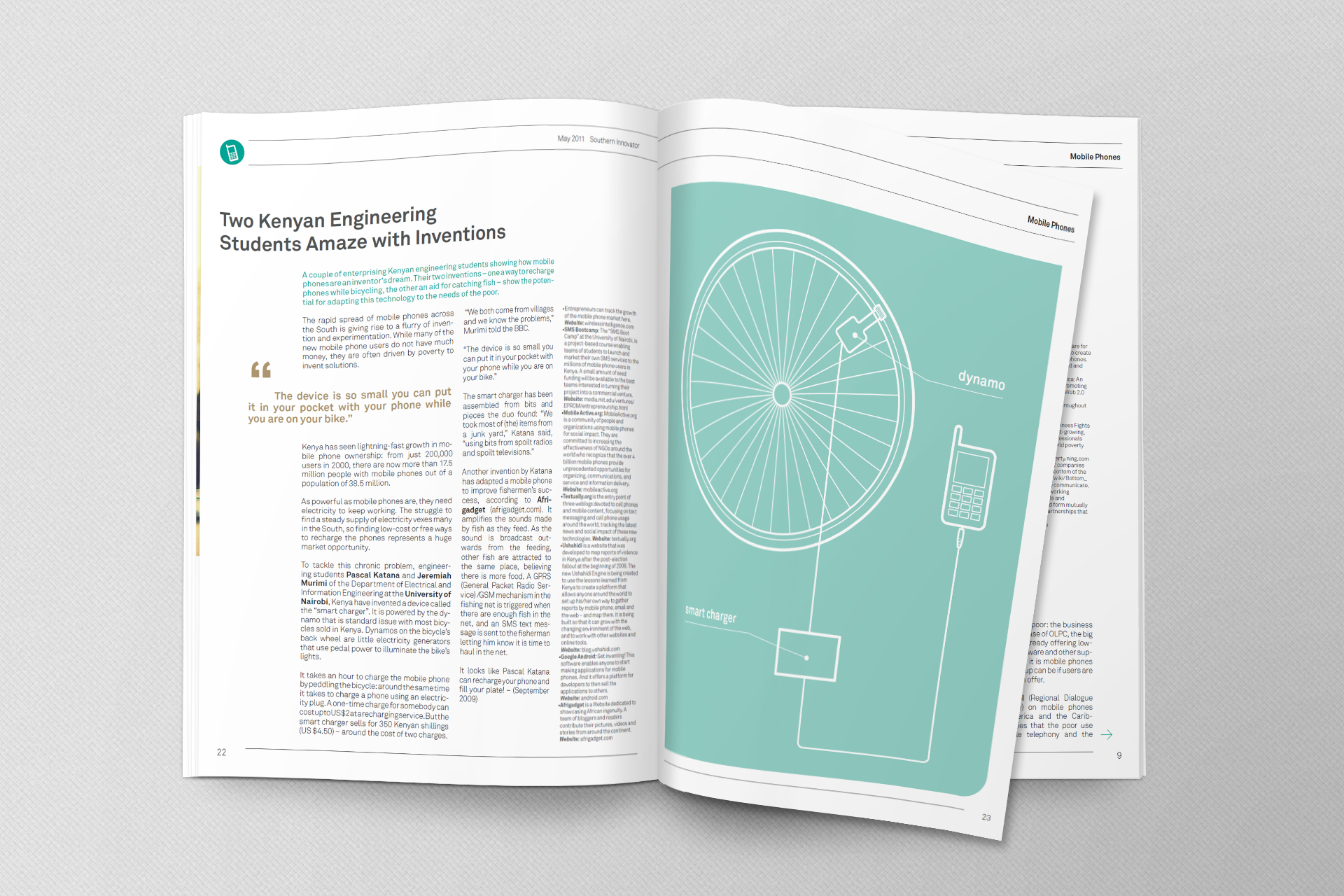
    Development Challenges, South-South Solutions was launched as an e-newsletter in 2006 by UNDP’s South-South Cooperation Unit (now the United Nations Office for South-South Cooperation) based in New York, USA. It led on profiling the rise of the global South as an economic powerhouse and was one of the first regular publications to champion the global South’s innovators, entrepreneurs, and pioneers. It tracked the key trends that are now so profoundly reshaping how development is seen and done. This includes the rapid take-up of mobile phones and information technology in the global South (as profiled in the first issue of magazine Southern Innovator), the move to becoming a majority urban world, a growing global innovator culture, and the plethora of solutions being developed in the global South to tackle its problems and improve living conditions and boost human development. The success of the e-newsletter led to the launch of the magazine Southern Innovator. 

    Creative Commons License

    This work is licensed under a
    Creative Commons Attribution-Noncommercial-No Derivative Works 3.0 License.

    ORCID iD: https://orcid.org/0000-0001-5311-1052.

    © David South Consulting 2023

  • New Beer Helping to Protect Elephants

    New Beer Helping to Protect Elephants

    By David SouthDevelopment Challenges, South-South Solutions

    SOUTH-SOUTH CASE STUDY

    How to match the often conflicting goals of protecting animal habitats and supporting local economies? One clever solution may draw amusement but is actually a sharp marketing strategy to get attention for a product that is helping to preserve the elephants of Thailand’s Golden Triangle (http://en.wikipedia.org/wiki/Golden_Triangle_(Southeast_Asia).

    A beer flavored with a special ingredient – coffee beans that have passed through elephants – is generating profits that are plowed back into improving health services for the animals. The coffee beans excreted by elephants are roasted and turned into a high-quality coffee by a company in Thailand; this coffee is then used by a Japanese company to make a special beer brand that is getting attention and winning rave reviews.

    The elephant dung coffee beans used in the beer are called Black Ivory (http://www.blackivorycoffee.com) and come from Thailand’s Golden Triangle Asian Elephant Foundation (http://www.helpingelephants.org). According to The Drinks Business, the coffee beans retail for US $100 per 35 grams.

    The beans are of the Thai Arabica variety and grow at an elevation of 1,500 metres. Elephants consume the coffee cherries and excrete the beans as part of their diet. Once the elephants have excreted the beans in their faeces they are harvested, processed, sun dried and roasted.

    It takes 10,000 beans to make a kilogram of roasted coffee, according to the Black Ivory website. A total of 33 kilograms of coffee cherries are consumed by the elephants to make a kilogram of the Black Ivory coffee.

    Elephants in Thailand are used for various activties, from heavy work to providing rides for tourists. The riders of the elephants – called mahouts (http://en.wikipedia.org/wiki/Mahout) – and their wives also benefit from the manufacturing and sale of the coffee. The income is used to pay for health costs, school fees, food and clothing.

    Additionally, 8 per cent of the proceeds from the sale of the coffee beans pays for a veterinarian to provide care to the elephants. The money is also used to pay for their medicine and the setting up of a laboratory.

    Elephants are much-revered in Thailand and feature in the country’s national iconography. They are listed as Protected Animals under Thailand’s Conservation Act 1992 (FAO). Many believe they should be classified as endangered. The last survey on the population was conducted in 1991 and elephant numbers were recorded as 1,900 (FAO).

    The main threat to elephants comes from humans – in the form of poaching for the animals’ ivory tusks, their abuse in begging on the streets, and the destruction of forests where the elephants live.

    The natural habitat and feeding grounds for the elephants have shrunk over the past decades. It is estimated the forest area in Thailand shrank from 80 per cent to 20 per cent between 1957 and 1992. Causes include major infrastructure projects, increasing farmland and the building of large resorts, all encroaching on the elephants’ territory. Limited space means elephants increasingly come into conflict with humans and this can lead to them being poisoned or killed.

    But the success of the Japanese-brewed Kono Kuro beer is creating a new funding source for helping the elephants and doing some good.

    The beer is brewed by Sankt Gallen brewery (http://www.sanktgallenbrewery.com) in Kanagawa, Japan using the Black Ivory coffee beans, imparting the beer with an earthy flavour. It may sound like a gimmick, but consumers have remarked on the beer’s distinctive taste, and sales do not lie: it has been a quick success, selling out within minutes of its launch in Japan.

    The beer comes in dark bottles with a sandy coloured label elegantly illustrated with pictograms showing the process of turning the beans excreted by the elephants into beer. It is a humorous visual tale that makes the label stand out from other beer brands.

    Brewer Sankt Gallen calls it a “chocolate stout” because of its rich, earthy flavour (it does not contain any chocolate, however).

    Although bottles of the stout sold out after going on sale on the Sankt Gallen website, the brewery has said that it has plans to put the beer on tap at its new shop, which opened in Tokyo recently.

    Published: June 2013

    Resources

    1) Coffee Alamid: Ethically produces the coffee harvested from the droppings of civet cats in the Philippines. Website: http://www.botecentral.net/

    2) Save the Elephants: A campaign to stop the poaching of elephant ivory. Website: http://www.savetheelephants.org/

    3) BBC Nature: Background on elephants. Website: http://www.bbc.co.uk/nature/life/African_elephant

    4) WWF: Facts and background on elephants. Website: http://worldwildlife.org/species/elephant

    Southern Innovator logo

    London Edit

    31 July 2013

    Development Challenges, South-South Solutions was launched as an e-newsletter in 2006 by UNDP’s South-South Cooperation Unit (now the United Nations Office for South-South Cooperation) based in New York, USA. It led on profiling the rise of the global South as an economic powerhouse and was one of the first regular publications to champion the global South’s innovators, entrepreneurs, and pioneers. It tracked the key trends that are now so profoundly reshaping how development is seen and done. This includes the rapid take-up of mobile phones and information technology in the global South (as profiled in the first issue of magazine Southern Innovator), the move to becoming a majority urban world, a growing global innovator culture, and the plethora of solutions being developed in the global South to tackle its problems and improve living conditions and boost human development. The success of the e-newsletter led to the launch of the magazine Southern Innovator. 

    Creative Commons License

    This work is licensed under a
    Creative Commons Attribution-Noncommercial-No Derivative Works 3.0 License.

    ORCID iD: https://orcid.org/0000-0001-5311-1052.

    © David South Consulting 2023

  • A New African Beer Helps Smallholder Farmers

    A New African Beer Helps Smallholder Farmers

    By David SouthDevelopment Challenges, South-South Solutions

    SOUTH-SOUTH CASE STUDY

    Africa’s growth in the past decade has held steady despite the trauma of the global economic crisis and the tumult of the “Arab Spring” in several countries of North Africa. African economies are growing because of a number of resilient trends. These include growing regional trade links, greater investment in infrastructure and the remarkable rise of China to become Africa’s number one trade partner, pushing the United States to second place (Technology + Policy). This has given birth to a growing consumer marketplace and consumer class – some 300 million people earning about US $200 a month (Africa Rising).

    The continent as a whole now stands as the 10th largest economy in the world.

    How will Africans spend this new money in their pockets (or more than likely, on their mobile phones)? They could go for the big, famous global brands that they see advertised in magazines or on television. Or they could also spend it on local products and services that seem just as enticing and life-improving. Creating local African products and services with strong brands will have an important knock-on effect of creating new wealth and jobs within Africa.

    One new product being introduced to the West African country of Ghana’s thirsty beer drinkers is the Eagle beer brand. But this is not just any beer made from the traditional ingredients of water, hops, malted barley and yeast (http://en.wikipedia.org/wiki/Beer) – it is brewed from the root vegetable cassava.

    A staple of many African diets, cassava (http://en.wikipedia.org/wiki/Cassava) is a starchy, tuberous root vegetable and a common crop across the continent.

    It is believed that 70 per cent of Ghana’s farms are just 3 hectares in size or smaller. They grow many things, but cassava is the most common crop.

    Cassava soon spoils once it has been harvested and needs to be consumed quickly. Currently, too much of it goes to waste. In Ghana, according to The Guardian, there is an annual surplus of some 40 per cent of cassava produced.

    The Accra Brewery Limited (ABL) (http://www.sabmiller.com/index.asp?pageid=1156) decided to find a way to put the cassava from smallholder farms to good use and stop the waste. The brewery had observed the success of parent company SABMiller (http://www.sabmiller.com/index.asp?pageid=27) elsewhere in Africa, in turning cassava and the grain sorghum from smallholder farmers into beer. Farmers had directly benefited from the purchase of their surplus product.

    Eagle brand cassava beer is creating opportunities for business, consumers and smallholder farmers in Ghana. According to The Guardian, the company hopes to source cassava from 1,500 smallholders.

    By having a guaranteed purchase from the brewery on a regular basis, farmers are able to move beyond subsistence agriculture and turn themselves into functioning businesses.

    The spare income from selling the cassava also can be used to improve a farmer’s household access to healthcare and education.

    The Accra Brewery provides advice on agricultural techniques and growing a diverse range of crops, to ensure farmers are not dependent on a monocrop harvest. It also offers advice on business and developing commercial relationships.

    The Eagle brand cassava beer will be sold at a 30 per cent discount to low-income drinkers in order to lure them away from illicit and informal alcohol drinks of dubious quality.

    Professor Ethan Kapstein of business school INSEAD found that ABL and its water business Voltic (GH) Ltd. was a creator and supporter of high-quality jobs in Ghana and supported 17,600 jobs throughout the Ghanaian economy.

    Adjoba Kyiamah (http://www.sabmiller.com/index.asp?pageid=1766&blogid=172), corporate and legal affairs director at Accra Brewery, told The Guardian she believes Eagle brand beer will help create even more jobs, boost government revenues and expand consumer choice.

    This is an innovative first, as cassava beer had never been made before in Ghana on a commercial scale. This had not been possible in the past because of the challenge of collecting fresh cassava from farms widely spread out over a large territory. As well as spoiling quickly, Cassava is heavy, being mostly made up of water, and is difficult to transport over large distances.

    “Part of our strategy across Africa is to make high quality beer which is affordable for low-income consumers while simultaneously creating opportunities for smallholder farmers in our markets. The launch of Eagle in Ghana ticks both these boxes,” said Mark Bowman, Managing Director of SABMiller Africa.

    “Eagle is aimed at attracting low-income consumers away from illicit alcohol. This is a virtuous circle: smallholder cassava farmers have a guaranteed market for their crop, which is then used to make consistently high quality, affordable beer for consumers; and the government realises increased revenues as people trade up into formal, taxable alcohol consumption.”

    ABL is using a mobile processing unit developed by DADTCO (Dutch Agricultural Development and Trading Company) Cassava Processing Ghana Ltd. It is designed to process the cassava on site, preserving the integrity of the starch.

    Eagle is sold in 375 millilitre bottles at a price 70 per cent lower than that charged for other lager beers. The use of local ingredients, and a reduced excise tax awarded to the brand because is it is boosting local agriculture, allows for the lower price.

    Production of cassava beer got its start first in Mozambique, with the launch of the Impala brand (http://www.sabmiller.com/index.asp?pageid=149&newsid=1748), the first commercial-scale cassava-based clear beer, in October 2011.

    Published: April 2013

    Resources

    1) Southern Innovator Magazine Issue 3: Agribusiness and Food Security. Packed with information, insights and business models to turn smallholder farmers into agribusinesses. Website: http://www.scribd.com/doc/106055665/Southern-Innovator-Magazine-Issue-3-Agribusiness-and-Food-Security

    2) Cassava can become Africa’s new cash crop: Cassava is abundant in sub-Saharan Africa, and could be an ideal crop to improve food security for millions of people. Website: http://www.guardian.co.uk/global-development-professionals-network/2013/mar/28/cassava-food-security-sub-saharan-africa

    3) Cassava recipes from the BBC. Website: http://www.bbc.co.uk/food/cassava

    Southern Innovator logo

    London Edit

    31 July 2013

    Development Challenges, South-South Solutions was launched as an e-newsletter in 2006 by UNDP’s South-South Cooperation Unit (now the United Nations Office for South-South Cooperation) based in New York, USA. It led on profiling the rise of the global South as an economic powerhouse and was one of the first regular publications to champion the global South’s innovators, entrepreneurs, and pioneers. It tracked the key trends that are now so profoundly reshaping how development is seen and done. This includes the rapid take-up of mobile phones and information technology in the global South (as profiled in the first issue of magazine Southern Innovator), the move to becoming a majority urban world, a growing global innovator culture, and the plethora of solutions being developed in the global South to tackle its problems and improve living conditions and boost human development. The success of the e-newsletter led to the launch of the magazine Southern Innovator. 

    Creative Commons License

    This work is licensed under a
    Creative Commons Attribution-Noncommercial-No Derivative Works 3.0 License.

    ORCID iD: https://orcid.org/0000-0001-5311-1052.

    © David South Consulting 2022

  • African Media Changing to Reach Growing Middle Class

    African Media Changing to Reach Growing Middle Class

    By David SouthDevelopment Challenges, South-South Solutions

    SOUTH-SOUTH CASE STUDY

    Africa’s growing middle classes are being targeted by a new generation of media entrepreneurs. This growing group of Africans is ambitious and intelligent, and they want media that matches their aspirational ways. Clever media people are stepping up to feed this trend.

    The continent as a whole forms the 10th largest economy in the world. Of Africa’s more than 1 billion people, 900 million can be classified as part of the consumer economy. Out of this group, there a third – approximately 300 million people – make modest sums by Western standards, about US $200 a month, but have spare cash to buy things like mobile phones, DVDs and new clothes, or pay for better schools. They are the population that is overlooked when attention is focused only on the very poor living on less than US $2 a day.

    Pulitzer Prize-winning Nigerian journalist Dele Olojede is one of several African media pioneers re-shaping the continent’s media and taking it to the next level. Another is Godfrey Mwampembwa, whose popular puppet television show satirizes contemporary politics and current events and brings a welcome local flavour to a programming schedule packed with foreign imports.

    A book by University of Texas professor Vijay Mahajan, Africa Rising, details the phenomenon of Africa’s middle class consumer society. He calls this group of middle class consumers ‘Africa 2’, with the desperately poor called Africa 3s, and the extremely rich Africa 1s.

    This new group has expanded far beyond just the ruling elites and government workers. Many of its members work in the private sector, as secretaries, computer entrepreneurs, merchants and others who have benefited from consistent growth rates in many African countries.

    And because these people consume products and services – and advertising products and services are the lifeblood of private media – the opportunities are plentiful.

    “I’m convinced that Africa is going to be built by Africa 2s,” Mahajan told the Washington Post newspaper. “These are the people sending their kids to school . . . who are the most optimistic, the most forward-thinking.”

    Olojede, owner and publisher of Next newspaper (http://234next.com/csp/cms/sites/Next/Home/index.csp) in Nigeria’s biggest city, Lagos, has been able to grab readers by breaking original stories and offering a quality, well-designed publication. Launched in 2008, it has its sights set on going continent-wide by 2011.

    “There is a need for a newspaper for the African metropolitan middle classes, along the lines of the International Herald Tribune,” he told Monocle magazine.

    Olojede cut his teeth as a foreign editor for the US newspaper Newsday and has used this experience to make Next such a success.

    Next has become the number one news website in Nigeria’s highly competitive media scene.

    Wisely, Olojede put design at the centre of making his newspaper and website stand out from the competition. He commissioned the experienced newspaper design team of Garcia Media (http://garciamedia.com/blog/articles/in_west_africa_a_new_newspaper_is_born_—online_first) – who have designed for The Wall Street Journal, The Miami Herald and Die Zeit – to develop the template and prototypes.

    Kenyan economist James Shikwati (http://en.wikipedia.org/wiki/James_Shikwati) believes Africa’s middle-income consumers are also a driving force for political change.

    “It’s empowering,” he told the Washington Post. “If you give people a sense of freedom in the economic sector, then you deny it in the political sector, you have a problem.”

    Kenya-based newspaper cartoonist Gado (Godfrey Mwampembwa) has profited from this phenomenon. Fed up with TV channels sticking to a menu of foreign imports and dull news programmes, he looked to famous puppet TV shows Spitting Image (from Britain) and Les Guignols (from France) for inspiration. The result is the XYZ Show (http://xyzshow.com/blog), which features grotesque puppet caricatures of well-known public and political figures. The show’s blog makes for an excellent entry point into African TV programme-making and its ups and downs. The show is broadcast on Citizen TV in Kenya’s capital, Nairobi.

    “I moved to Nairobi in 1992 when I was 23,” Mwampembwa explained to Monocle. “The Daily Nation, the biggest newspaper in Kenya, had lost its editorial cartoonist so they ran a competition to look for his replacement. I sent in my drawings and came second.”

    “I took a year off in 2000-2001 to study film and animation in Vancouver. When I got back to Nairobi I started thinking about the sort of TV programme I would like to make. Kenya needed a show that would make fun of our politicians and expose hypocrisy and I thought a puppet show like Les Guignols or Spitting Image would be a great way to do it.”

    “We managed to raise funds for a pilot in 2007 and Citizen TV (http://www.facebook.com/pages/Citizen-TV-Kenya/261061365404), a private station, eventually agreed to broadcast a series.”

    Each episode costs US $16,740 and the puppets are US $3,600 to make. The programme-makers could only get money from foreign donors: the French, Dutch, and Finnish embassies and the Ford Foundation.

    Despite initial complaints from politicians, the show is preparing for its second season – and, Mwampembwa said, “there will be a lot of big stories for us to cover.”

    Making a popular TV show is not an easy thing to do. Mwampembwa maintains a furious work pace to straddle his many roles:

    “I have to draw a cartoon every day but editorial cartooning is not a nine-to-five job, it’s 24/7. Whenever I get ideas I have to sketch them.

    “It was a steep learning curve in the first season. The show is important for Kenyan TV and everything is done here in Nairobi. We won’t change any of the politics though. We are very hard-hitting and we will stay that way.

    “Over the years I’ve got nasty letters, emails and phone calls but that’s OK, it’s part of it.”

    As these media innovators show, there is nothing but opportunity for entrepreneurs feeding the hungry news and information appetite of the continent’s ambitious middle class.

    And Mwampembwa says becoming better informed doesn’t have to be dull: “We are informing the public but I’d like to think we are entertaining them too.”

    Published: September 2010

    Resources

    • Africa Rising: A book by Professor Vijay Mahajan on how Africa’s consumer economy is growing and growing. Website: http://tinyurl.com/2vk3m9n

    Development Challenges, South-South Solutions was launched as an e-newsletter in 2006 by UNDP’s South-South Cooperation Unit (now the United Nations Office for South-South Cooperation) based in New York, USA. It led on profiling the rise of the global South as an economic powerhouse and was one of the first regular publications to champion the global South’s innovators, entrepreneurs, and pioneers. It tracked the key trends that are now so profoundly reshaping how development is seen and done. This includes the rapid take-up of mobile phones and information technology in the global South (as profiled in the first issue of magazine Southern Innovator), the move to becoming a majority urban world, a growing global innovator culture, and the plethora of solutions being developed in the global South to tackle its problems and improve living conditions and boost human development. The success of the e-newsletter led to the launch of the magazine Southern Innovator. 

    Creative Commons License

    This work is licensed under a
    Creative Commons Attribution-Noncommercial-No Derivative Works 3.0 License.

    ORCID iD: https://orcid.org/0000-0001-5311-1052.

    © David South Consulting 2023