Categories
Archive Blogroll

Memoranda Of Understanding And Negotiator | 1997 – 2014

DS Consulting logo copy

Astute negotiation skills have been required to see through complex, multi-partner projects, or to see through difficult transitions (in particular digital). While working for the United Nations in Mongolia (1997-1999), I led negotiations on three Memoranda of Understanding with the Government of Mongolia: Youth, Food Security and Nutrition and Human Rights (Blue Sky Bulletin).

As head of the UNDP Mongolia Communications Office (1997-1999), I was at the centre of a fast-expanding UN mission in the midst of a major crisis (called “one of the biggest peacetime economic collapses ever”, Mongolia’s Economic Reforms: Background, Content and Prospects, Richard Pomfret, University of Adelaide, 1994). Everything we did required solid negotiation skills that were sensitive to the culture and understood how to get things done in that context. People were under a great deal of pressure and the times were characterized as “volatile ones for Mongolia, with revolving door governments, the assassination of a minister, emerging corruption, a banking scandal, in-fighting within the ruling Democratic Coalition, frequent paralysis within the Parliament, and disputes over the Constitution. Economically, the period was unstable and rife with controversies.” Mongolia in 1998 and 1999: Past, Present, and Future at the New Millennium by Sheldon R. Severinghaus, Asian Survey, Vol. 40, No. 1, A Survey of Asia in 1999 (Jan. – Feb., 2000). pp. 130-139 (Publisher: University of California). 

Award-winning, this work was called a “role model” for the wider UN and country offices.

While heading a multi-institutional major project for the UK’s National Health Service (2001-2003) under the Modernisation Plan, I had to daily negotiate with colleagues and staff across professions, institutions and with senior managers and executives. Introducing new ways of doing things requires a fineness of touch and a strategic mind to see how small steps eventually achieve goals. Award-winning, this work was called one of the “three most admired websites in the UK public and voluntary sectors”, and a UK Government assessment called the overall GOSH Child Health Web Portal a role model for the NHS.

Since 2007, I have been working on media products for the United Nations Office for South-South Cooperation (UNOSSC). This has required contacting and networking with people across the global South. The goal was to raise the profile of South-South cooperation in the UN system and the profile of the growing numbers of innovators across the global South resulting from the rapid expansion of mobile and information technologies, and in turn transform the UN’s strategic and funding priorities. This was successful and acknowledged in the Strategic Plan for UNDP 2014-2017 and its first UNDP Youth Strategy 2014-2017.

© David South Consulting 2017

Categories
Archive Blogroll

Vision + Strategy | 1991 – 2014

DS Consulting logo copy

From experience, the importance of crafting a vision prior to the execution of a strategy is key to success and inspiring others. If done well, the vision can do much of the work for you. An inspiring vision will bring others on board, aligning them to your strategy. Some examples of vision leading to strategic success can be found in the following Case Studies from David South Consulting:

Crisis Recovery

Case Study 4: UN + UNDP Mongolia | 1997 – 1999

Case Study 7: UNOSSC + UNDP | 2007 – 2016

Digital Transformation

Case Study 5: GOSH/ICH Child Health Portal | 2001 – 2003

Global Transformation

Case Study 7: UNOSSC + UNDP | 2007 – 2016

Media Start-up

Case Study 2: Watch Magazine | 1994 and 1996

David South Consulting practice areas icons_mini

© David South Consulting 2017

Categories
Archive Blogroll

Stories @ David South Consulting | 1991 – 2017

DS Consulting logo copy

I worked as a journalist for magazines and newspapers from 1991 to 1997 in Canada and the United Kingdom and as a radio host for a weekly spoken word interview programme, Word of Mouth (CKLN-FM). This included working as an investigative journalist for Now Magazine, “Toronto’s alternative news and entertainment source”, as a Medical and Health Correspondent for Today’s Seniors, and as an investigative journalist and reporter for two Financial Times newsletters, New Media Markets and Screen Finance.  

From 2007, I researched and wrote stories for two United Nations publications: e-newsletter Development Challenges, South-South Solutions and magazine Southern Innovator. Links to a small sample of published stories by theme are below: 

Themes

Health and Medical

African Health Data Revolution

African Technology Tackles Health Needs

Changing Health Care Careers a Sign of the Times

Feds Call for AIDS, Blood System Inquiry: Some Seniors Infected

Health Care in Danger

Health Care on the Cutting Block: Ministry Hopes for Efficiency with Search and Destroy Tactics

Mobile Phone Microscopes to Revolutionize Health Diagnostics

Safe Healthcare is Good Business and Good Health

Take Two Big Doses of Humanity and Call Me in the Morning

Taking Medicine to the People: Four Innovators in Community Health

Thai Organic Supermarkets Seek to Improve Health

US Health Care Businesses Chasing Profits into Canada

Innovation and Innovators

Frugal Innovation Trend Meets Global South’s Innovation Culture

Innovation from the Global South

Innovation Villages Tackling MDGs

Innovations in Green Economy: Top Three Agenda

Innovative Stoves to Help the Poor

Kenyan Mobile Phone Innovations

Next Generation of Innovation for the Grassroots

Technological Innovation Alive in Brazil

International Development

Aid Organization Gives Overseas Hungry Diet Food: Diet Giant Slim-Fast Gets Tax Write-Off for Donating Products

Philippine Conference Tackles Asia’s AIDS Crisis

Starting from Scratch: the Challenge of Transition

State of Decay: Haiti Turns to Free-Market Economics and the UN to Save Itself

Traffic Signs Bring Safety to the Streets

Investigative Journalism

Counter Accusations Split Bathurst Quay Complex: Issues of Sexual Assault, Racism at Centre of Local Dispute

False Data Makes Border Screening Corruptible

New Student Group Seeks 30 Percent Tuition Hike

Somali Killings Reveal Ugly Side of Elite Regiment

Study Says Jetliner Air Quality Poses Health Risks: CUPE Takes on Airline Industry with Findings

Top Reporters Offer Military Media Handling Tips

Science

Affordable Space Programmes Becoming Part of South’s Development

African Botanicals to be Used to Fight Against Parasites

African Digital Laser Breakthrough Promises Future Innovation

African Farming Wisdom Now Scientifically Proven

An Innovator’s ‘Big Chicken Agenda’ for Africa

China Pushing Frontiers of Medical Research

New 3D Technology Makes Innovation Breakthough and Puts Mind Over Matter

Putting Worms to Work

Creative Commons License

This work is licensed under a
Creative Commons Attribution-Noncommercial-No Derivative Works 3.0 License

ORCID iD: https://orcid.org/0000-0001-5311-1052.

© David South Consulting 2022

Categories
Archive Blogroll UNDP Mongolia 1997-1999

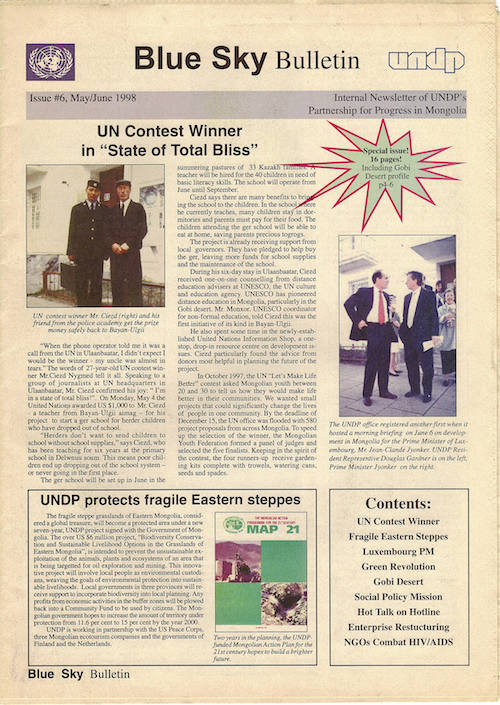
UN Contest Winner In State Of Total Bliss

DS Consulting logo copy

In the autumn of 1997, a national contest – Let’s Make Life Better! – was launched to inspire and mobilise Mongolian youth between the ages of 20 and 30. The idea was simple: for youth to come up with the best ideas to “design their own small and local development project.”

Launched with a cross-country advertising campaign, the prize of US $1,000 to implement the winning project (a substantial sum of money at the time) drew 580 project proposals by the contest deadline of December 15, 1997.

So many of the ideas were excellent, they were later to receive support from either the government, NGOs or international organisations. Read the story in the Blue Sky Bulletin newsletter about the contest’s winner below:

Editor: David South

Publisher: UNDP Mongolia Communications Office

Published: Blue Sky Bulletin, Issue Number Six, May/June 1998 

“When the phone operator told me it was a call from the UN in Ulaanbaatar, I didn’t expect I would be the winner – my uncle was almost in tears.”

The words of 27-year-old UN contest winner Mr. Ciezd Nygmed tells it all. Speaking to a group of journalists at UN headquarters in Ulaanbaatar, Mr. Ciezd confirmed his joy: “I’m in a state of total bliss!”

On Monday, May 4 the United Nations awarded US $1,000 to Mr. Ciezd – a teacher from Bayan-Ulgii aimag – for his project to start a ger school for herder children who have dropped out of school.

“Herders don’t want to send children to school without school supplies,” says Ciezd, who has been teaching for six years at the primary school in Delwnuu soum. This means poor children end up dropping out of the school system – or never going in the first place.

The ger school will be set up in June in the summering pastures of 33 Kazakh families. A teacher will be hired for the 40 children in need of basic literacy skills. The school will operate from June until September.

Ciezd says there are many benefits to bringing the school to the children. In the school where he currently teaches, many children stay in dormitories and parents must pay for their food. The children attending the ger school will be able to eat at home, saving parents precious togrogs.

The project is already receiving support from local governors. They have pledged to help buy the ger, leaving more funds for school supplies and the maintenance of the school.

During his six-day stay in Ulaanbaatar, Ciezd received one-on-one counselling from distance education advisers at UNESCO, the UN culture and education agency. UNESCO has pioneered distance education in Mongolia, particularly in the Gobi desert. Mr. Monxor, UNESCO coordinator for non-formal education, told Ciezd this was the first initiative of its kind in Bayan-Ulgii.

He also spent some time in the newly-established United Nations Information Shop, a one-stop, drop-in resource centre on development issues. Ciezd particularly found the advice from donors most helpful in planning the future of the project.

In October 1997, the UN “Let’s Make Life Better!” contest asked Mongolian youth between 20 and 30 to tell us how they would make life better in their communities. We wanted small projects that could significantly change the lives of people in one community. By the deadline of December 15, the UN office was flooded with 580 project proposals from across Mongolia. To speed up the selection of the winner, the Mongolian Youth Federation formed a panel of judges and selected the five finalists. Keeping in the spirit of the contest, the four runners-up receive gardening kits complete with trowels, watering cans, seeds and spades.

BSKYB 6_mini
Cover stories: UN contest winner and visit of Jean-Claude Juncker to UNDP Mongolia (pictured with UNDP Resident Representative Douglas Gardner).
DSC web address in green_mini (1)

ORCID iD: https://orcid.org/0000-0001-5311-1052.

© David South Consulting 2017