Author: David South Consulting

  • Mongolia Looks to Become Asian IT Leader

    Mongolia Looks to Become Asian IT Leader

    By David SouthDevelopment Challenges, South-South Solutions

    SOUTH-SOUTH CASE STUDY

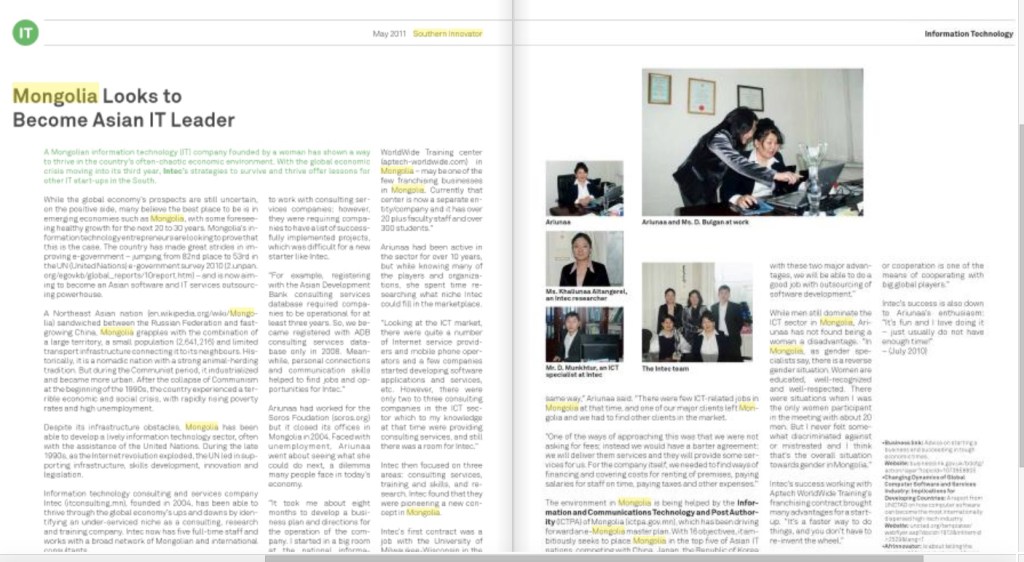
    A Mongolian information technology company founded by a woman has shown a way to thrive in the country’s often-chaotic economic environment. With the global economic crisis moving into its third year, Intec’s strategies to survive and thrive offer lessons for other IT start-ups in the South.

    While the global economy’s prospects are still uncertain, on the positive side, many believe the best place to be is in emerging economies like Mongolia, with some foreseeing healthy growth for the next 20 to 30 years. Mongolia’s information technology entrepreneurs are looking to prove this is the case. The country has made great strides in improving e-government – jumping from 82nd place to 53rd in the UN e-government survey 2010 (http://www2.unpan.org/egovkb/global_reports/10report.htm) – and is now aiming to become an Asian software and IT services outsourcing powerhouse.

    A Northeast Asian nation (http://en.wikipedia.org/wiki/Mongolia) sandwiched between Russia and fast-growing China, Mongolia grapples with the combination of a large territory, a small population (2,641,216) and limited transport infrastructure connecting it to its neighbours. Historically, it is a nomadic nation with a strong animal herding tradition. But during the Communist period, it industrialized and became more urban. After the collapse of Communism at the beginning of the 1990s, the country experienced a terrible economic and social crisis, with rapidly rising poverty rates and high unemployment.

    Despite its infrastructure obstacles, Mongolia has been able to develop a lively information technology sector, often with the assistance of the United Nations. During the late 1990s, as the internet revolution exploded, the UN led on supporting infrastructure, skills development, innovation and legislation.

    Information technology consulting and services company Intec (www.itconsulting.mn) , founded in 2004, has been able to thrive through the global economy’s ups and downs by identifying an under-serviced niche as a consulting, research and training company. Intec now has five full-time staff and works with a broad network of Mongolian and international consultants.

    As is often the case with new businesses, Intec initially found that many doors were closed to start-up enterprises.

    “The major challenges which I faced were to make people understand about the consulting services,” said Intec’s founder, Lkhagvasuren Ariunaa. “The consulting services concept was new to Mongolia and Mongolians at that time and not many organizations were willing to work with consulting services. The international and donor organizations were keen to work with consulting services companies; however, they were requiring companies to have a list of successfully implemented projects, which was difficult for a new starter like Intec.

    “For example, registering with the Asian Development Bank consulting services database required companies to be operational for at least three years. So, we got registered with ADB consulting services database only in 2008. Meanwhile, personal connections and communication skills helped to find jobs and opportunities for Intec.”

    Ariunaa had worked for the Soros Foundation (http://www.soros.org/) but it closed its offices in Mongolia in 2004. Faced with unemployment, Ariunaa went about seeing what she could do next: a dilemma many people face in today’s economy.

    “It took me about eight months to develop a business plan and directions of operation of the company. I started in a big room at the national information technology park building with one table, chair and computer.

    “It has been quite challenging years for bringing a company to the market and finding niches for us. We have franchised the Indian Aptech WorldWide Training center (http://www.aptech-worldwide.com) in Mongolia – may be one of the few franchising businesses in Mongolia. Currently that center is now a separate entity/company and it has over 20 plus faculty staff and over 300 students.”

    Ariunaa had been active in the sector for over 10 years, but while knowing many of the players and organizations, she spent time researching what niche Intec could fill in the marketplace.

    “Looking at the ICT market, there were quite a number of internet service providers, mobile phone operators, a few companies started developing software applications, and services etc. However, there were only two to three consulting companies in the ICT sector which to my knowledge at that time were providing consulting services, and still there was a room for Intec.”

    Intec then focused on three areas: consulting services, training and skills, and research. Intec found they were pioneering a new concept in Mongolia.

    Intec’s first contract was a job with the University of Milwaukee-Wisconsin in the United States to organize a three week course for American students to learn about the digital divide in Mongolia. But the global economic crisis hit Mongolia hard in 2009.

    “It was challenging to survive and continue working the same way,” Ariunaa said. “There were few ICT-related jobs in Mongolia at that time, and one of our major clients left Mongolia and we had to find other clients in the market.

    “One of the ways of approaching this was that we were not asking for fees, instead we would have a barter agreement – we will deliver them services and they will provide some services for us. For the company itself, we needed to find ways of financing and covering costs for renting of premises, paying salaries for staff on time, paying taxes and other expenses.”

    The environment in Mongolia is being helped by the Information and Communications Technology and Post Authority (ICTPA) of Mongolia (http://www.ictpa.gov.mn) , which has been driving forward an e-Mongolia master plan. With 16 objectives, it ambitiously seeks to place Mongolia in the top five of Asian IT nations, competing with South Korea, Singapore, Japan and China.

    Ariunaa believes Mongolia has many competitive advantages. “Mongolia is known for a high-literacy rate and math-oriented training and education, and ICT specialists are targeting to become a software outsourcing country for other countries. Another advantage of Mongolians is that they can easily learn other languages: we are fluent in Russian, English, Japanese, Korean, German and we believe that with these two major advantages, we will be able to do a good job with outsourcing of software development.”

    While men still dominate the ICT sector in Mongolia, Ariunaa has not found being a woman a disadvantage. “In Mongolia, as gender specialists say, there is a reverse gender situation. Women are educated, well-recognized and well-respected. There were situations, when I was the only women participant in the meeting with about 20 men. But I never felt somewhat discriminated or mis-treated and I think that’s the overall situation towards gender in Mongolia.”

    Intec’s success working with Aptech WorldWide Training’s franchising contract brought many advantages for a start-up. “It’s a faster way to do things, and you don’t have to re-invent the wheel.”

    As a Mongolian company, Intec has found it best to play to its local strengths. “National companies have knowledge, expertise and experience of local situations, know players and understand about legal, regulatory matters. … partnership or cooperation are one of the means of cooperating with big global players.”

    Intec’s success is also down to Ariunaa’s enthusiasm: “It’s fun and I love doing it – just usually do not have enough time!”

    Published: July 2010

    Resources

    1)  Advice on starting a business and succeeding in tough economic times. Website:http://www.businesslink.gov.uk/bdotg/action/layer?topicId=1073858805

    2) Changing Dynamics of Global Computer Software and Services Industry: Implications for Developing Countries: A report from UNCTAD on how computer software can become the most internationally dispersed high-tech industry. Website:http://www.unctad.org/templates/webflyer.asp?docid=1913&intitemid=2529&lang=1

    3) Afrinnovator: Is about telling the stories of African start-ups, African innovation, African made technology, African tech entrepreneurship and entrepreneurs. Their mission is to ‘Put Africa on the Map’ by covering these kinds of stories from all over Africa. As their website says, “if we don’t tell our own story, who will tell it for us?” Website:http://afrinnovator.com

    4) TechMasai: Pan-African start-up news and reviews. Website: www.techmasai.com

    5) Ger Magazine Project: Mongolia’s first online magazine pioneered communicating on the web. Website: http://en.wikipedia.org/wiki/Ger_magazine

    Development Challenges, South-South Solutions was launched as an e-newsletter in 2006 by UNDP’s South-South Cooperation Unit (now the United Nations Office for South-South Cooperation) based in New York, USA. It led on profiling the rise of the global South as an economic powerhouse and was one of the first regular publications to champion the global South’s innovators, entrepreneurs, and pioneers. It tracked the key trends that are now so profoundly reshaping how development is seen and done. This includes the rapid take-up of mobile phones and information technology in the global South (as profiled in the first issue of magazine Southern Innovator), the move to becoming a majority urban world, a growing global innovator culture, and the plethora of solutions being developed in the global South to tackle its problems and improve living conditions and boost human development. The success of the e-newsletter led to the launch of the magazine Southern Innovator. 

    Creative Commons License

    This work is licensed under a
    Creative Commons Attribution-Noncommercial-No Derivative Works 3.0 License.

    Launched in 1997 in a major crisis, the UN Mongolia Development Portal (www.un-mongolia.mn) became the country’s largest online bilingual publisher and an award-winning pioneer of web content. It proved Mongolia had the potential to innovate in digital.
    Story featured in the UN E-Government Knowledgebase and E-Government Survey in Media.
    Posted in 2010 on the Unuudur.com (“The latest news of Mongolia in the world”) website.
    Creative Commons License

    This work is licensed under a
    Creative Commons Attribution-Noncommercial-No Derivative Works 3.0 License.

    ORCID iD: https://orcid.org/0000-0001-5311-1052.

    © David South Consulting 2023

  • Top Reporters Offer Military Media Handling Tips

    Top Reporters Offer Military Media Handling Tips

    Ryerson’s course on handling media has raised eyebrows

    By David South

    Now Magazine (Toronto, Canada), November 12-18, 1992

    The whimsical Certificate of Military Achievement hanging in the offices of the Ryersonian newspaper at Ryerson journalism school is testament to the warm relationship between the armed forces and one of Canada’s top journalism schools.

    But a two-month crash course in journalism for military public affairs officers hosted by Ryerson this summer has left a bad taste in the mouths of some participants and critics.

    The course, which involved 18 soldiers, included two weeks of classes in each of print, radio and TV journalism, wrapping up with two weeks of “crisis management” training. The 60 instructures included such prominent journalists as Ann Medina and Pamela Wallin.

    According to an administration newsletter, the course netted Ryerson more than $350,000. Organizers say the course was merely an exercise in familiarizing soldiers with the needs of working journalists. But given the often conflicting roles of the military and the media, some fear journalistic ethics may have taken some collateral damage.

    “The course had nothing to do with national defence or the armed forces,” says course teacher and organizer Shelley Robertson. “They just wanted to understand the roles of journalists from the other side. The military didn’t ask us to teach what we teach our students.”

    Robertson says the course also benefited the participating journalists by giving them contacts in the military.

    But according to media critic Barrie Zwicker, the exercise blurs what should be the distinctly different interests of journalists and the military. “It’s similar to press and politicians. By getting close to the politician, journalists can get information they couldn’t normally obtain. The negative side is that the media can get sucked in and lose a larger perspective. The same tensions exist with covering the military.

    Managing media

    “It’s up to the media to break the rules and try and get the story. The military always wants to hide its victims. If a Ryerson journalist strikes up a friendship with a public affairs officer, will the reporter be true to their journalistic tradition?”

    Colloquially known as spin doctors, hype-meisters and flak catchers, public affairs officers perform much the same tasks in the military as their civilian counterparts in industry and government – including managing information that gets to the public or media.

    In the past, Canadian soldiers had to go to the US for special training at the Defense Information School at Fort Benjamin Harrison. But, according to Robertson, the armed forces were looking for a Canadian spin.

    With 4,600 Canadian peacekeepers now stationed around the world, including a contingent in the dangerous and volatile former Yugoslav republics, the chances for conflict – and casualties – have increased.

    Lieutenant-commander Glen Chamberlain, who helped coordinate the course, says the military’s increased profile means that the forces have to become more adept at media relations. “There is a great desire among Canadians to know what troops on peacekeeping duties are up to. We have a wonderful story to tell.”

    Chamberlain says he works on journalists’ behalf with stubborn military commanders. “The armed forces are finding there is a real benefit to having specialized PA officers. We want to help journalists to tell our story well.”

    The crisis management section of the course offered participants a hands-on approach to managing journalists. The officers were presented with two scenarios – a murder at Moss Park armoury and a highway helicopter crash – and then practised handling a group of journalists investigating the events.

    Course lecturer Kevin Donovan, who covered the Gulf war for the Toronto Star, remembers the effectiveness and sophistication of PA officers in the field.

    “When I was in Riyadh, Saudi Arabia, I walked into a hotel and on the wall were pool reports – news briefs written by US military public affairs officers – that journalists were encouraged to use for stories. There were some journalists going out into the field to cover stories, but a huge number just sat in this beautiful hotel.”

    “Canadian journalists are ignorant of the military and could do with getting closer. You almost never find a full-time journalist in Canada who knows anything about them. The more you know about the military, the less you will be manipulated.”

    Stop information

    Donovan feels uncomfortable about teaching on the course.

    “I was asked by Ryerson to give a talk on my experiences in Saudi Arabia, Kuwait and Iraq,” he says. “My initial reaction was no. I hate the existance of public affairs people with a passion. Their job is to stop information.

    “I’m uncomfortable with Ryerson being hired by the department of national defence. One officer in the course got very upset when I told them to make contacts with the media and leak stories.”

    Course organizer Clive Vanderburgh admits organizers had concerns about conflicts between the role of journalists and military officers. “There was a lot of discussion concerning the potential for conflict – especially that the people hired to teach might think they were there to help the department of national defence to avoid the media

    “But we were trying to give a general understanding of the media’s needs. We didn’t sell the country down the drain.”

    Another teacher was Robert Fulford, the well-known writer and lecturer on journalistic ethics. “I don’t have a problem with Ryerson teaching the military,” says Fulford. “It’s a way of spreading journalistic technique to people in the DND. It seems to be a natural extension of the work of Ryerson.

    “Canadian journalists are ignorant of the military and could do with getting closer. You almost never find a full-time journalist in Canada who knows anything about them. The more you know about the military, the less you will be manipulated.”

    But Gideon Forman, coordinator of the Canadian Peace Alliance, fears Ryerson may be helping the military mislead the public.

    “Why do these guys practise handling the media so much of there’s nothing to hide? This is just better packaging for the military so they can get what they want from the public.

    “I have problems with public money being spent teaching the military to be more effective with the media, while other organizations have their budgets cut or eliminated.

    “Is there a similar program for food banks or women’s shelters?”

    Note on story context: This story was researched and written after two key events involving Canada’s military: the first Gulf War from 1990-1991; and the Oka Crisis in 1990, where the Canadian Armed Forces confronted an armed group of Mohawk “Warriors” in Oka, Quebec.

    More investigative journalism here: 

    Peaceniks Questioning Air-Raid Strategy In Bosnia

    Somali Killings Reveal Ugly Side Of Elite Regiment

    Study Says Jetliner Air Quality Poses Health Risks: CUPE Takes On Airline Industry With Findings Of Survey

    Creative Commons License

    This work is licensed under a
    Creative Commons Attribution-Noncommercial-No Derivative Works 3.0 License.

    ORCID iD: https://orcid.org/0000-0001-5311-1052.

    © David South Consulting 2023

  • TV’s Moral Guide In Question – Again

    TV’s Moral Guide In Question – Again

    By David South

    Id Magazine (Canada), November 28-December 11, 1996

    Television programmers are under attack once again. Thanks to Guelph activist Patricia Herdman’s Coalition for Responsible Televsion (CORT), two violent television shows – Poltergeist (CTV) and Millennium (Fox/Global) – have lost several advertisers in recent weeks due to pressure from CORT. It’s just another wave in a new assault on the immorality of television.

    Positive Entertainment Alternatives for Children Everywhere (PEACE), a Montreal group founded after the murder of 14 young women in that city in 1989, staged a press conference last week, complete with sweet-faced children, to announce its “Toxic TV” list. Who is toxic? Old favourites like Bugs Bunny, Batman and Robin and The Simpsons. PEACE also produced a list of “Positive” TV shows. It included a wrist-slashing selection of insipid programming, such as Barney and Friends, Fresh Prince of Bel-Air and Kratt’s Creature.

    But critics of television overlook the strong and often simplistic moral messages that infuse most programming. Some even argue the mostly Judeo-Christian morality comes at the expense of atheistic and agnostic perspectives.

    University of Guelph philosophy professor Jay Newman argues that religious moralists are making television the scapegoat for all of society’s ills.

    He argues television, rather than being a moral vacuum, is heavily influenced by Judeo-Christain values – often in shows many people don’t suspect.

    Newman sharply criticizes religious moralists, who he says, neglect to observe the same contradictions in their own beliefs that they see in television.

    In Newman’s view, religion shares many sins with television. Religion promotes passivity (“The meek shall inherit the earth”), disrupts family life (who needs to talk to that “immoral” gay brother/sister?), does a questionable job of moral education, invents celebrities (the saints), sacrifices spiritual wisdom for meaningless ritual and entertainment (the Mass), and promotes violent behaviour (who can forget the Crusades or the Spanish Inquisition?).

    Leaning back in his chair at his University of Guelph office, the irascible New York-born Newman enthusiastically defends television.

    “When we assess TV as bad,” he says, “I’m not convinced religion is the only moral teacher, and it has not been the best moral teacher. Religion has been a very important force of hatred, whereas Star Trek teaches us to respect other cultures.

    “TV has been of great value in promoting pluralism and an increase in tolerance.”

    Newman isn’t talking about gore-soaked TV like Poltergeist and Millennium, shows he says speak more about their producers than about the medium of television. “Wanton slaughter can’t be blamed on TV. But I do agree with psychologists that some television inures us to violence.”

    He sees Star Trek as a moral force for both pluralism and tolerance, strong values that are essential to democracies with many ethnic, cultural and racial groups. “This show promotes tolerance towards people who appear different. It shows aliens have aspirations and desires just like us.”

    Newman does take offence to one race of aliens on the popular series: the Ferengi. While the Ferengi are supposed to be the equivalent of used car dealers in Star Trek’s universe, they draw criticism from Newman for their anti-semitic undertones. But even here, says Newman, TV can’t beat the pantheon of Christain anti-semites.

    As for the bumbling antics of Bart Simpson and his dad Homer, Newman says The Simpsons also contain positive morals. “The Simpsons teaches us to accept the foibles of others and empathize. It does it in a gentle way without passing a very austere judgement.”

    Newman even sees hope in the dreamy world of daytime soap operas. They teach people to develop empathy. They also use negative role models to show that hatred and contempt backfire on people; that promiscuity and adultry don’t come without a cost.”

    As for Seinfeld, a sitcom about a group of friends who seem to never do anything, Newman says, “I’m a New Yorker and I can’t sit through it.”

    Newman, an expert on religious fanaticism and hypocrisy, has responded to religious critics of television in his new book, appropriately titled Religion vs. Television. Newman sees religious critics of television as at best hypocrites, at worst specious claimants to higher moral ground.

    “[Religious leaders] make judgements to show the usefulness of their institutions in an attempt to restore the lustre of religious authority.”

    Newman believes the debate surrounding violence on TV is misguided. He believes the root causes of violence should be dealt with first.

    “Television is a convenient scapegoat. Its criticism parallels religious bigotry. They don’t focus on the individual, just the medium. And this is accepted by people who call themselves liberal!”

    TV immoral?

    But critics of TV say any decent moral messages that slip through are undermined by television’s subservience to a higher God: consumerism. For Rose Anne Dyson of Canadians Concerned About Violence in Television (C-CAVE), this corrupted morality can’t be ignored. “There is only one over-riding religion today: consumerism. Its main purveyor is TV.

    “Television is a major socializer today. Parents and teachers are key to modifying that influence. But most of television is very bad and just teaches consumer-driven values. There isn’t a single children’s programme that isn’t infused with commercial values.”

    Dyson believes the negative effects aren’t just psychological. “Watching too much TV is bad – it causes obesity and hyperactivity.”

    Dyson’s claims were recently backed up by a new study showing unhealthy minds may lead to unhealthy bodies. A study conducted by Columbia University claimed the more that children watched TV, the fatter they got. Researcher Dr Barbara Dennison found children who watched 14 hours of television a week had diets with 35 per cent of their calories from fat. The study blamed the high representation of junk food in television ads and the fact they promoted couch potato dining. Canadian children on average watch 18 hours a week of television.

    Dyson does agree with Newman’s criticism of organized religions’ spurious claims to higher ground. “Judeo-Christian religions have gotten us into a lot of trouble!”

    To control this morally wayward TV, Dyson looks forward to more entertainment conglomerates self-regulating their programming. “The cornerstone of democracy is to obey rules.

    “A lot of cultural studies people tend to underestimate the impact of TV – there is too much of a value-free approach.”

    Id was published in Guelph, Ontario, Canada in the 1990s.

    Further Reading:

    Channel Regulation: Swedes Will Fight Children’s Advertising All The Way

    From Special Report: NMM (New Media Markets) Spotlight On The Emergence Of Satellite Porn Channels In The UK

    Undercurrents: A Cancellation At CBC TV Raises A Host Of Issues For The Future

    https://davidsouthconsulting.org/2021/02/05/channel-regulation-swedes-will-fight-childrens-advertising-all-the-way/

    https://davidsouthconsulting.org/2021/02/03/do-tv-porn-channels-degrade-and-humiliate/

    https://davidsouthconsulting.org/2021/03/03/kommunikation-total-der-siebte-kontinent/

    https://davidsouthconsulting.org/2021/12/08/new-media-markets-and-screen-finance/

    https://davidsouthconsulting.org/2022/04/21/nsd-partners-in-bitter-row-over-choice-of-satellite-as-brussels-deadline-nears/

    https://davidsouthconsulting.org/2021/02/01/playboy-is-not-for-sad-and-lonely-single-men/

    https://davidsouthconsulting.org/2022/11/22/popular-characters-re-invent-traditional-carving/

    https://davidsouthconsulting.org/2022/10/27/reality-television-teaches-business-skills-in-sudan/

    https://davidsouthconsulting.org/2021/01/14/from-special-report-nmm-new-media-markets-spotlight-on-the-emergence-of-satellite-porn-channels-in-the-uk/

    https://davidsouthconsulting.org/2021/02/01/uk-laws-on-satellite-porn-among-toughest-in-europe/

    https://davidsouthconsulting.org/2020/12/11/undercurrents-a-cancellation-at-cbc-tv-raises-a-host-of-issues-for-the-future/

    Creative Commons License

    This work is licensed under a
    Creative Commons Attribution-Noncommercial-No Derivative Works 3.0 License.
    ORCID iD: https://orcid.org/0000-0001-5311-1052.

    © David South Consulting 2023

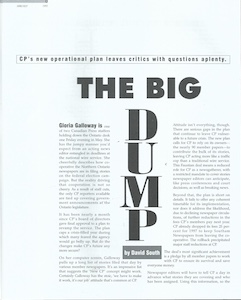
  • The Big Dump: CP’s New Operational Plan Leaves Critics With Questions Aplenty

    The Big Dump: CP’s New Operational Plan Leaves Critics With Questions Aplenty

    By David South

    Scan Magazine (Toronto, Canada), June/July, 1997

    Gloria Galloway is one of two Canadian Press staffers holding down the Ontario desk one Friday evening in May. She has the jumpy manner you’d expect from an acting news editor entangled in deadlines at the national wire service. She cheerfully describes how cooperative the Northern Ontario newspapers are in filing stories on the federal election campaign. But the reality driving that cooperation is not so cheery. As a result of staff cuts, the only CP reporters available are tied up covering government announcements at the Ontario legislature.

    It has been nearly a month since CP’s board of directors gave final approval to a plan to revamp the service. The plan caps a crisis-filled year during which many feared the agency would go belly up. But do the changes make CP’s future any more secure?

    On her computer screen, Galloway pulls up a long list of stories filed that day by various member newspapers. It’s an impressive list that suggests the ‘New CP’ concept might work. Certainly Galloway has the stoic, ‘we have to make it work, it’s our job’ attitude that’s common at CP.

    Attitude isn’t everything, though. There are serious gaps in the plan that continue to leave CP vulnerable to a future crisis. The new plan calls for CP to rely on its owners – the nearly 90 member papers – to contribute the bulk of its stories, leaving CP acting more like a traffic cop than a traditional wire service. This Faustian deal means a reduced role for CP as a newsgatherer, with a restricted mandate to cover stories newspaper editors can anticipate, like press conferences and court decisions, as well as breaking news.

    Beyond that, the plan is short on details. It fails to offer any coherant timetable for its implementation, nor does it address the likelihood, due to declining newspaper circulations, of further reductions in the fees CP’s members pay next year. CP already dropped its fees 25 percent for 1997 to keep Southam Newspapers from leaving the cooperative. The rollback precipitated major staff reductions at CP.

    The deal’s most significant achievement is a pledge by all member papers to work with CP to ensure its survival and save everyone money.

    Newspaper editors will have to tell CP a day in advance what stories they are covering and who has been assigned. Using this information, so the theory goes, it will be possible to avoid assigning several reporters from competing papers to cover a story when one will do. A reporter will not only be working for his or her own paper that day, but for every CP paper, and will be expected to file updates throughout the day to a CP editor, who in turn will write the story that is then ‘wired’ to all the members. That way, it is hoped, no superfluous stories will be going out on the wire. Member papers will still file analytical and feature stories to CP but, as is the case now, they are under no obligation to give away their prized family jewels – exclusive stories – to other CP papers.

    In practical terms, the new approach has been creeping into CP’s way of doing things by stealth rather than command. CP has been increasing its reliance on member papers to pick up the slack when CP reporters aren’t available. The most recent example was the federal election campaign: only one CP reporter was assigned full-time to cover the whole campaign. The rest of the coverage was handled by a combination of CP bureau staff and member paper reporters.

    While many smaller papers are dependent on CP for their provincial, national and international stories, the bigger papers, who are the main sources of these stories, can afford to be blase’. Their willingness to co-operate will decide the success or failure of the member-exchange component of CP.

    Southam’s vice-president of editorial, Gordon Fisher, maintains his papers will support the plan because it will save his company approximately $2.5 million a year. “We pay a significant amount of money towards this cooperative,” he maintains. “A member exchange is one of the more efficient ways we can find to deliver news without incurring a huge amount of expense.”

    “What is CP needs a story earlier than a reporter normally files?” asks managing editor Jane Perves of Halifax’s Chronicle-Herald and Mail-Star. “Theoretically, they should be spending all their time doing the story for our paper.”

    Jane Purves is an enthusiastic supporter of CP. Nonetheless she wonders if CP editors will be caught in a contest of wills with editors at member papers. She would like to see a reporter’s CP obligations involve simply calling in a quote or raw data. She would have a problem if a reporter working on a major story for her paper was distracted by CP’s needs.

    The Globe and Mail is conidering hiring a full-time co-ordinator to handle the heavy volume of stories that paper generates for CP. Newspaper managers elsewhere are split on the question of whether the plan will increase workloads. The extent that it does so will be a crucial test of their commitment.

    Not only will editors need to regularly ‘loan’ reporters to CP, they will have to change how they do things on a daily basis if the plan is to work. Editors will have to file an assignment list one day in advance to CP, a task that could get easily overlooked when papers get hit with multiple big stories.

    “It’s pretty minor stuff,” says Perry Beverley, the co-publisher of Brockville’s Recorder and Times. Although the Recorder and Times is an afternoon paper where copy is edited in the morning, Beverley has no plans to switch an editor to an evening shift to fit CP’s deadlines.

    Deadlines are a particularly thorny question in a country that spans six time zones. Newspapers on the East coast can file stories at the end of the day and still meet CP deadlines that are pegged at Toronto time. The problem is with newspapers west of Ontario; they will have to file stories well before the end of the day. In the case of B.C., filing will have to be done in the morning so that stories picked up by CP will be ready in time for East coast papers.

    The copy will have to go out to CP unedited.

    At the Edmonton Sun, editor-in-chief Paul Stanway isn’t sanguine about sending out unedited copy. Stanway had editorial deadlines pushed back to 6 p.m. 18 months ago as part of a re-organization at the paper, but they still mean copy would be sent straight from reporters to CP, where copy needs to be in between 4 p.m. and 9 p.m. Toronto time. Stanway is concerned the CP staff will not have the time to fact-check stories to weed out mistakes, which would reflect poorly on his paper.

    The anticipated deadline crunch has been nicknamed “the big dump” in CP circles: a tidal wave of material hitting the wire service’s desks all at once, leaving editors scrambling to do re-writes before newspapers are put to bed.

    CP general manager Jim Poling, who vacates he job in June, believes this problem will be solved by the restructuring, not exacerbated by it. “The volume of copy has already dropped significantly,” he says. “We are hoping for a wider spectrum of deadlines. Hopefully you are going to get your copy spread out over a longer period, instead of over the course of a couple of hours. You might not need a massive shift of people to a certain time.”

    Poling claims the resolution is in better planning which will result in fewer unwanted stories. Fewer stories, so Poling maintains, means more time for editors to re-write.

    At CP’s Winnipeg bureau, Canadian Media Guild vice-president Scott Edmonds is sceptical. He isn’t convinced the slimmed down CP will have the staff to handle what he sees as an increasing workload.

    “It sounds like the meatgrinder approach to journalism,”says Edmonds. “There is no way these desks are going to be able to cope with any degree of thoughtfulness with this copy. The pressure is going to be too great.”

    Edmonds also sees a bigger problem in staff moral. “The majority of people working for Canadian Press don’t want their career to end up as a re-writer… It will require a lot more attention on the desk for this material, so we will be taking resources away from reporting. In other words, taking somebody away from doing the story to redoing the story.”

    CP’s raison d’etre is its ability to turn out stories written in a homogenous national voice that can be tailored for a specific paper’s readers. Another important asset is the agency’s ability to quickly add knowledge and background to stories, drawing on the experience of its reporters and editors. According to Martin O’Hanlon at CP’s Ontario Desk, cut-backs have compromised this ability. Three business reporters have been poached by the Financial Post, including Ian Jack and Sandy Rubin. Over 40 talented reporters and editors took buyouts in the fall of 1996.

    This means CP isn’t as well equipped as it once was to turn raw copy from reporters into high-quality journalism that can draw the respect and admiration of its subjects.

    “Our reporters are not trained to write for a national audience,” emphasizes Jane Purves in Halifax.

    Scott Edmonds doesn’t believe member contributors are a substitute for CP staff. “I’m very concerned about attempting to replace quality staf-written material that caters to a national audience and is written to uniform standards, with material picked up from newspapers that in some cases may be very good, but in some cases may not be of the same quality.”

    There is a great deal of confusion over when the plan is supposed to kick in. One camp, which includes Jim Poling, sees it more as a gradual, evolutionary change that will take several years to fine tune. There are others who want to see trial runs. Still others believe there will be a date set for a total national switch-over.

    Perry Beverley favours test sites and single switch-over date.

    “Once that D-Day time is chosen for the switch-over into the restructured CP,” she says, “there will be an appointed person in the newsroom responsible for sending the schedule to CP.”

    Purves favours a gradual switch. “A shot-gun approach might backfire. I’d rather have a gradual approach providing we had a starting date and an aim.”

    “We don’t have to have a roll-out day,” says Poling. “But if all the managers and staff rise up and say ‘shit, we need test sites,’ then I will listen. Anybody who is waiting for a date will be disappointed. All of this started a long time ago and is a continuing process that will take a couple of years to get everything in place.”

    Seven regional news committees will co-ordinate and oversee this new approach, each one staffed by representatives from member papers and CP. According to the plan, these regional news committees will act as enforcers for the new regime. They will work out the logistics of member exchange and use fines to penalize papers that miss deadlines or obstruct exchange.

    How such an approach would work in practice is still up in the air. “At some point everybody is going to act against the interests of the co-op,” maintains Purves. “They will be wondering, ‘will I be fined for this?’”

    Nobody contacted by SCAN could tell us what these fines would be, how violations would be investigated or what constituted offences. Purves wondered what deterrence value the fines would have if a paper thought it had acted in its best interests. If paper X decided to hold back a juicy scoop that was supposed to be that day’s CP story, a fine of $2,000 might be worth incurring if it sells more newspapers. It was generally agreed none of these committees would meet until after the federal election at the earliest.

    For now, Poling is generally optimistic (though he won’t around past June and a replacement has yet to be found). He is talking about raising salaries for the first time in five years, about hiring new staff, about stabilizing life at CP.

    The lower fees have lured back one newspaper group, British Columbia’s Sterling. A trial use of CP stories started at the beginning of May. It remains to be seen whether New Brunswick’s Telegraph Journal/Times Globe papers will return, after pulling out of CP in 1993 and hiring more of its own reporters with the money saved. Publisher Jamie Milne remains coy as to his interest in returning to CP, but Poling thinks a deal will be worked out by the fall.

    And what about the mood of the man charged with overseeing CP’s transition? Jim Poling, as some CP staffers like to mention, is losing that cautious reserve managers usually have for talking to the media. He isn’t happy with the state of the print media in Canada.

    “There has been a lot of cutting in this industry,” says an audibly frustrated Poling. “The fact of the matter is this: cutting isn’t the only answer to having an efficient operation. There has to be some money available to allow journalists to walk around a bit. People who walk around and poke at things and stare at things write good stories.”

    With phones ringing all around us, Galloway begins to think out loud about possible wrinkles in the new CP plan: how newspaper reporters at trials will have to keep leaving the courtroom to file updates for CP, how stories written for local papers will translate for national readers, how hard it can be for local, non-CP reporters to cover elections when they don’t know what questions have been asked elsewhere on the campaign trail.

    But Galloway has to get back to work. She has to push the Toronto Star to file a story early so the Hamilton Spectator can pick it up.

    Scan magazine was published for media professionals in Toronto, Canada in the 1990s.
    “The Big Dump”
    Breaking the news to CP staff.

    https://davidsouthconsulting.org/2022/10/21/african-media-changing-to-reach-growing-middle-class/

    https://davidsouthconsulting.org/2021/06/14/case-study-1-investigative-journalism-1991-1997-2/

    https://davidsouthconsulting.org/2021/07/14/freedom-of-expression-introducing-investigative-journalism-to-local-media-in-mongolia-1999-25-january-2016/

    https://davidsouthconsulting.org/2021/05/25/ger-mongolias-first-web-magazine-and-a-pioneering-web-project-for-the-united-nations-12-january-2016/

    https://davidsouthconsulting.org/2022/05/16/high-impact-communications-in-a-major-crisis-undp-mongolia-1997-1999-18-february-2016/

    https://davidsouthconsulting.org/2021/07/25/in-their-own-words-selected-writings-by-journalists-on-mongolia-1997-1999-6-january-2010/

    https://davidsouthconsulting.org/2022/11/01/indian-newspapers-thrive-with-economy/

    https://davidsouthconsulting.org/2022/05/27/media/

    https://davidsouthconsulting.org/2022/11/01/new-journal-celebrates-vibrancy-of-modern-africa/

    https://davidsouthconsulting.org/2021/12/08/new-media-markets-and-screen-finance/

    https://davidsouthconsulting.org/2022/10/04/popular-chinese-social-media-chase-new-markets/

    https://davidsouthconsulting.org/2022/11/23/publications/

    https://davidsouthconsulting.org/2021/01/16/redneck-renaissance-a-coterie-of-journalists-turn-cracker-culture-into-a-leisure-lifestyle/

    https://davidsouthconsulting.org/2021/01/14/from-special-report-nmm-new-media-markets-spotlight-on-the-emergence-of-satellite-porn-channels-in-the-uk/

    https://davidsouthconsulting.org/2020/12/11/top-reporters-offer-military-media-handling-tips/

    https://davidsouthconsulting.org/2020/12/11/undercurrents-a-cancellation-at-cbc-tv-raises-a-host-of-issues-for-the-future/

    https://davidsouthconsulting.org/2022/05/27/undp-travelling-seminar-environment-and-development-mongolia-1998/

    Creative Commons License

    This work is licensed under a
    Creative Commons Attribution-Noncommercial-No Derivative Works 3.0 License.

    ORCID iD: https://orcid.org/0000-0001-5311-1052.

    © David South Consulting 2023