Author: David South Consulting

  • UNRISD Blog

    UNRISD Blog

    A Report from the UN Conference on the Social and Political Dimensions of the Global Crisis: Implications for Developing Countries (12-13 November 2009)

    Organised by the United Nations Research Institute for Social Development (UNRISD), Geneva, Switzerland. Held at the Palais des Nations.

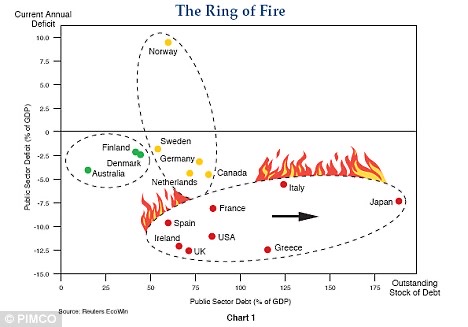
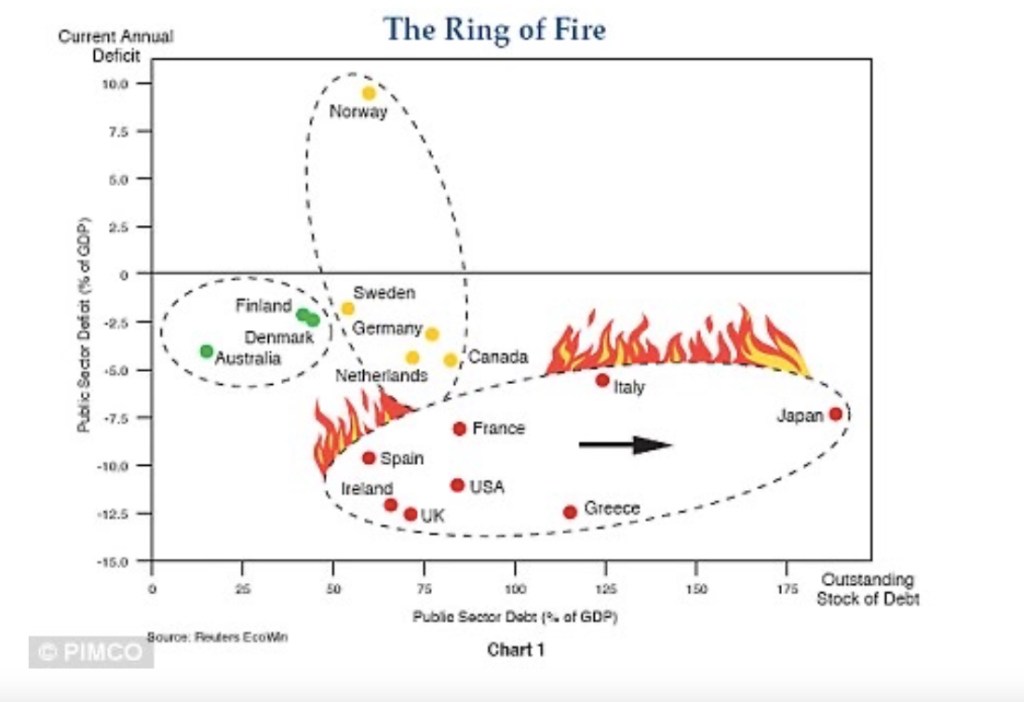
    Just as this chart showed at the time of the Global Financial Crisis, the countries in “The Ring of Fire” have experienced exceptional turbulence and turmoil in the years after the crisis. For example, the UK has had austerity budgets, a no-growth economy, Brexit and the ‘shock therapy’ of the COVID-19 pandemic. The US, on the other hand, has clashed with its allies, seen a new cold war emerge with rivals China and Russia, and experienced significant domestic unrest, culminating in the storming of its seat of Government, the Capitol.
    Just as now (2021) 2009 was a year in which the questions revolved around receiving a vaccine (for H1N1) and how best to affirm a person’s identity and citizenship. Photo: David South
    Iceland saw its banking system collapse during the Global Financial Crisis, sparking demonstrations (October 2008-2011) and the “Pots and Pans Revolution”. Photo: David South

    A conference in Geneva struck a pessimistic note on the current global financial crisis and any hope for a new social and economic order. The conference asked “whether current policy reforms are conducive to a transformative social change or if they only reproduce the status quo.”

    A March 2009 IMF report on the downturn’s affect on the Global South and developing countries found that “fluctuating commodity prices, high fuel costs, the rise in food prices in addition to a decrease in remittances, foreign direct investment and aid flow could mean an increase in the financing needs of low-income countries by at least US $25 billion.”

    The presenters at the conference painted a picture of a robust neo-liberal economic order that is already in the process of dusting itself off from the crisis and restoring its dominance.

    Bob Jessop, from the University of Lancaster, captured the paralysis of opposition to the neo-liberal order by saying “They are busy doing it and we are busy talking about it.”

    To paraphrase philosopher Friedrich Nietzsche, that which does not kill us makes us stronger. Neo-liberalism may in fact be strengthened by the crisis, according to presenters. It will evolve and take on new forms, they argued.

    The world’s business elites have an enormous capacity to re-shape the rules of the economic game back in their favour. While the massive state support to the banking sector had led some to believe governments were restoring faith in public investments, in fact state support is seen as “timely, targeted and temporary.”

    When asked about the future as the crisis passes and countries come out of recession, the presenters believed this was a short-term recovery, and that far worse economic crises would be coming in the next five to 10 years.

    Andrew Martin Fischer, from the Institute for Social Studies at Erasmus University, believes the harmful effects of the bailouts will be pushed to the periphery over the next five to 10 years, harming the poor. He also believes a major financial crisis is brewing in China. He called ‘China the fault line in the future.’

    The powerful, he pointed out, displaced the costs of their mistakes onto other people. Proponents of different approaches had missed the moment because they were not able to present off-the-shelf strategies that could be deployed in a crisis on short notice. Thus, they had left the field open to neo-liberal solutions.

    The global crisis in the short-term has not been worse because of unprecedented global cooperation. Keynsian measures have been used to solve the crisis, but are also used to preserve Wall Street. Also, the enormous contribution of growth in China and India means there are other sources of wealth in the world than just the North.

    Getting back to normal should not be what we are doing, the panellists concluded at the conference’s final session. Governments should look at new opportunities for social policy. The panellists were disturbed that the International Monetary Fund (IMF) is seen as part of the solution. This means deep cuts in public expenditure are coming. There will not be a trickle down of wealth and the imbalances from before the crisis will remain. In short, the system was not working before the crisis.

    Some policy suggestions put forward included: rural income guarantees, managed migration to support development goals, making a gender perspective critical to development. Governments should take a preventive approach to tackle future crises. Unfortunately, it now seems no money is left to address these problems. Yet business as usual is not an option with so many inequalities and imbalances.

    “This conference on the social and political consequences of crisis is a critical subject for debate at this juncture,” said UNRISD’s director, Dr. Sarah Cook. “We are now at a point where many countries, particularly in the North, are emerging out of the severe shock of immediate crisis. Discussions of alternative policies and institutional arrangements at national and global levels may become less urgent; the status quo is reasserting itself and the space for ideas and policies that offer the possibilities of more stable, sustainable and equitable development will quickly shrink.”

    Session 1: Impacts, Coping Strategies and Livelihoods

    Session 2: Social Policy: Country and Regional Perspectives

    Session 3: Social Policy: Global Perspective

    Session 4: Political Economy Dimensions of Crisis

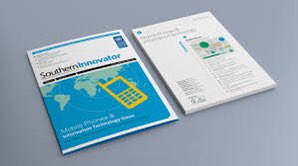
    Southern Innovator Magazine was developed from 2008-2010 in London, New York and Iceland by the United Nations in response to the Global Financial Crisis and was launched in 2011.

    Business Insider has reproduced a fascinating presentation about the crisis put together by the French bank, Societe Generale (SocGen). The presentation can be found here: http://www.businessinsider.com/socgen-prepare-yourself-for-the-worst-case-scenario-2009-11#first-it-starts-with-sky-high-public-debt-1

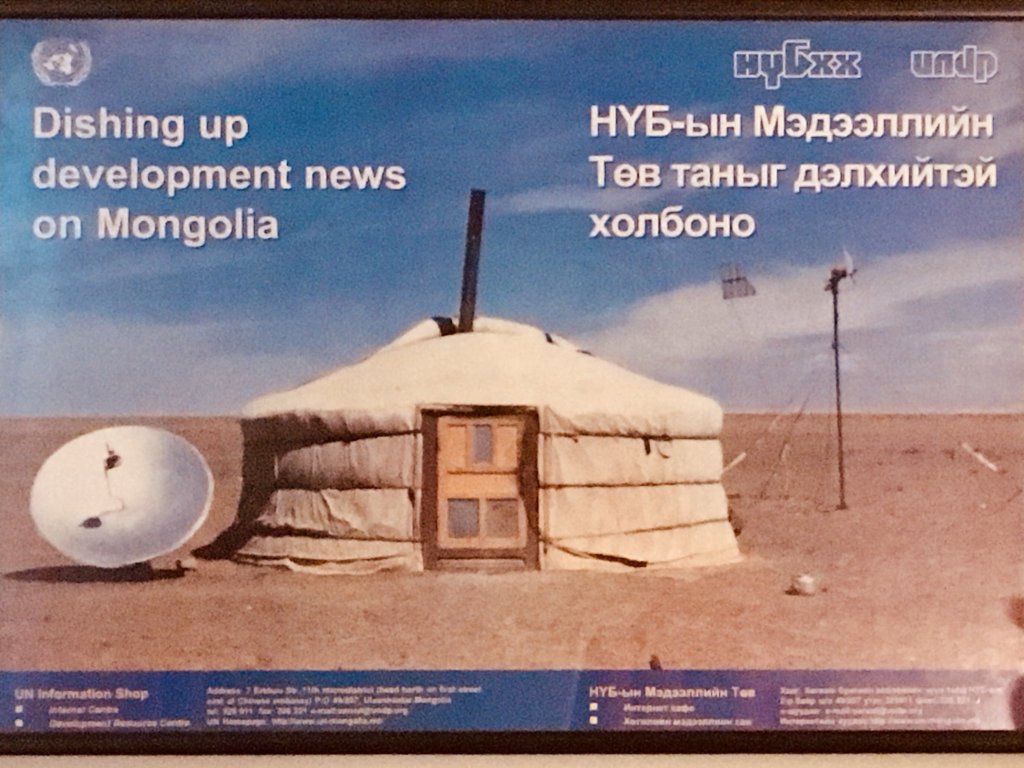
    From 1997 to 1999, I worked as the head of communications for the United Nations mission in Mongolia. The country was already experiencing a severe economic crisis as a result of its transition to free markets and democracy from the Soviet economic system. The scale of the economic collapse following the fall of communism was described at the time as the worst peacetime, post-WWII economic collapse. On top of this challenge, the Asian economic crisis erupted.

    You can read the Mongolia Update 1998 book I wrote here: http://www.scribd.com/doc/20864541/Mongolia-Update-1998-Book. It shows how chaotic events are in the middle of a major crisis. Some of the key lessons we learned during this time include: 1) transparency: trust was critical and all our work was done under the full glare of public and media scrutiny, 2) action: with our existing budgets we made sure to keep doing and spending to hire people, 3) strategy: to encourage the growth of businesses and innovation, in particular the take-up of new information technologies.

    This work is licensed under a Creative Commons Attribution 4.0 International License.

    ORCID iD: https://orcid.org/0000-0001-5311-1052.

    © David South Consulting 2021
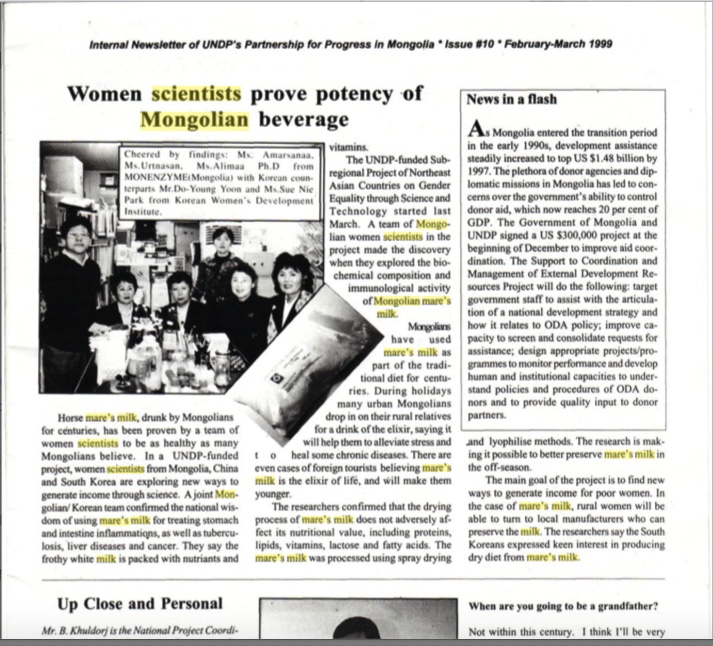
  • Women scientists prove potency of Mongolian beverage

    Women scientists prove potency of Mongolian beverage

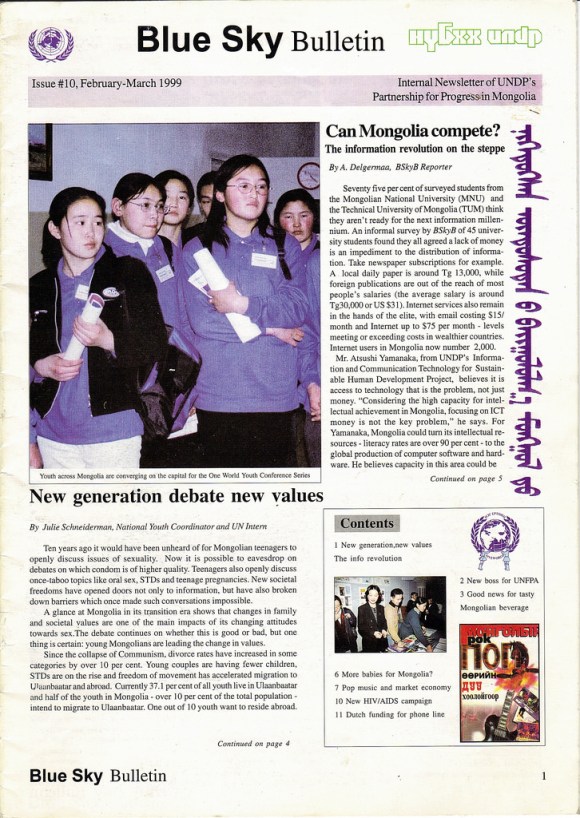
    By David South, Blue Sky Bulletin (Ulaanbaatar, Mongolia), Issue 10, February-March 1999

    Horse mare’s milk, drunk by Mongolians for centuries, has been proven by a team of women scientists to be as healthy as many Mongolians believe. In a UNDP-funded project, women scientists from Mongolia, China and South Korea are exploring new ways to generate income through science. A joint Mongolian/Korean team confirmed the national wisdom of using mare’s milk for treating stomach and intestine inflammations, as well as tuberculosis, liver diseases and cancer. They say the frothy white milk is packed with nutrients and vitamins.

    The UNDP-funded Subregional Project of Northeast Asian Countries on Gender Equality through Science and Technology started last March. A team of Mongolian women scientists in the project made the discovery when they explored the bio-chemical composition and immunological activity of Mongolian mare’s milk.

    Mongolians have used mare’s milk as part of the traditional diet for centuries. During holidays many urban Mongolians drop in on their rural relatives for a drink of the elixir, saying it will help them to alleviate stress and to heal some chronic diseases. There are even cases of foreign tourists believing mare’s milk is the elixir of life, and will make them younger.

    The researchers confirmed that the drying process of mare’s milk does not adversely affect its nutritional value, including proteins, lipids, vitamins, lactose and fatty acids. The mare’s milk was processed using spray drying and lyophilise methods. The research is making it possible to better preserve mare’s milk in the off-season.

    The main goal of the project is to find new ways to generate income for poor women. In the case of mare’s milk, rural women will be able to turn to local manufacturers who can preserve the milk. The researchers say the South Koreans expressed keen interest in producing dry diet from mare’s milk.

    The Blue Sky Bulletin newsletter provided timely and valuable updates on Mongolia in the late 1990s. In particular, it was able to highlight urgent health needs for a population undergoing extreme crisis resulting from food supply disruptions, loss of income, social distress (alcoholism, family breakdown etc.), sexually transmitted diseases, and extreme weather. Stories from the newsletter have been cited in many journals and books since 2000, and the high quality of its contributers is evident in their scholarship and career success since. An example is below:

    Poor Nutrition Taking its Toll on the Health of Mongolians By Jacinda Mawson

    Rickets very prevalent in Mongolia – 1998

    Prevalence of rickets in Mongolia

    Asia Pacific J Clin Nutr (1998) 7(3/4): 325-328
    U Tserendolgor1 MD pubhealth@magicnet.mn, JT Mawson2 MA, AC MacDonald3 MSc and M Oyunbileg1 MD, PhD

    “The high prevalence of rickets in Mongolian children is a serious public health concern. In addition to the adverse effects on growth, development and immune function, it is probably indicative of widespread subclinical vitamin D deficiency.”

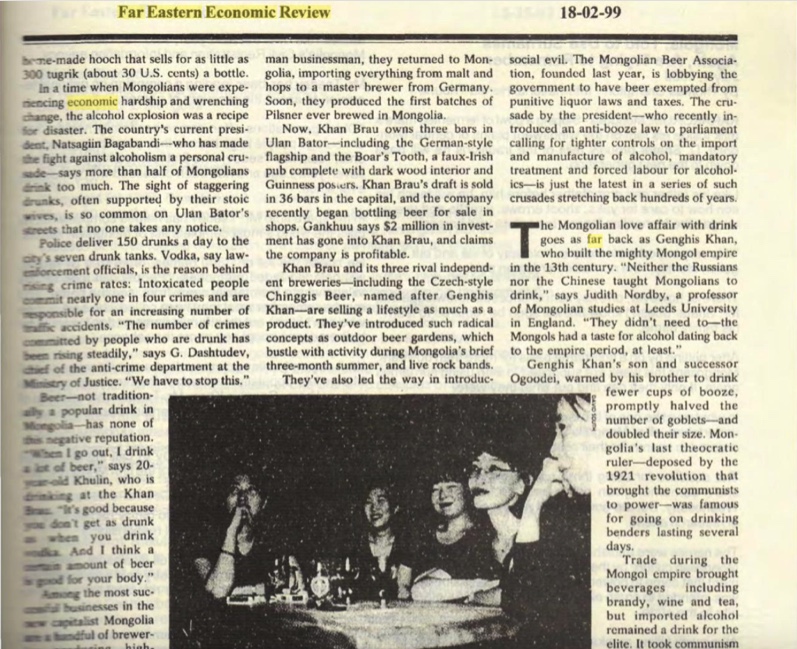
    Another beverage was catching the interest of Mongolians in the late 1990s: beer. 

    From The Far Eastern Economic Review, February 18, 1999

    A New Brew: As Mongolia changes under the influence of economic reforms, the country’s elite are trading fermented mare’s milk and vodka for a new status symbol: beer 

    Story by Jill Lawless

    Photo by David South

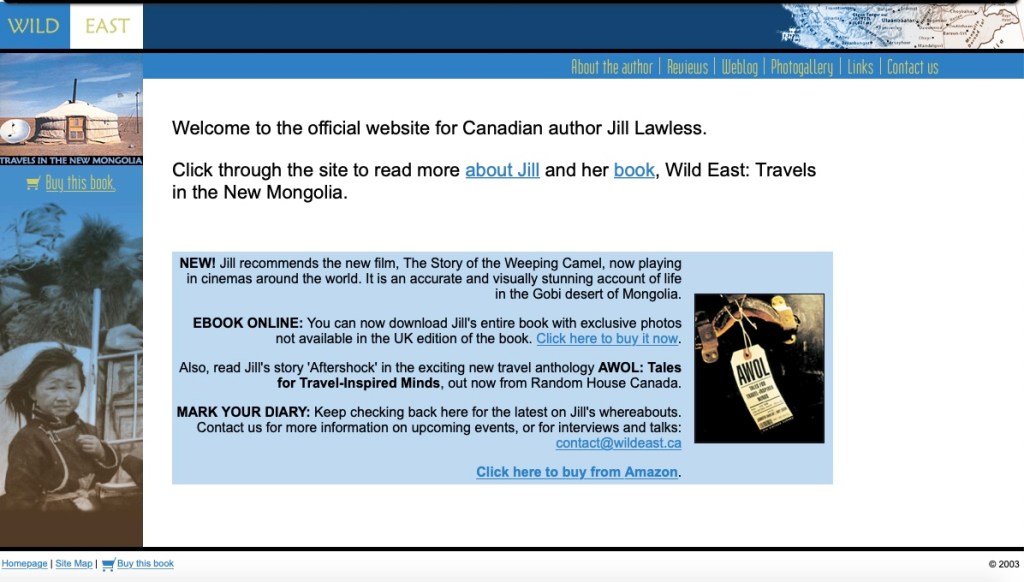
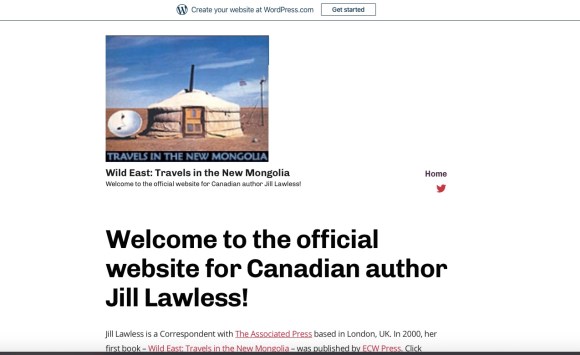
    Jill Lawless has two websites about her book, Wild East: Travels in the New Mongolia.

    Designed in London, the first website for Wild East: Travels in the New Mongolia launched in 2003.
    The new brand site for Jill Lawless is currently under construction.

    More of Jill Lawless‘ journalism for The Far Eastern Economic Review here: https://www.google.co.uk/books/edition/Far_Eastern_Economic_Review/SkuvAAAAIAAJ?hl=en&gbpv=1&bsq=david%20south,%20Mongolian%20rock

    https://davidsouthconsulting.org/2022/06/24/can-we-talk-hannah-promotes-communication-between-medical-schools/

    https://davidsouthconsulting.org/2021/06/02/case-study-5-gosh-ich-child-health-portal-2001-2003/

    https://davidsouthconsulting.org/2020/04/25/china-pushing-frontiers-of-medical-research/

    https://davidsouthconsulting.org/2021/03/08/the-dawn-of-the-genetics-revolution-2001-2003/

    https://davidsouthconsulting.org/2021/05/25/ger-mongolias-first-web-magazine-and-a-pioneering-web-project-for-the-united-nations-12-january-2016/

    https://davidsouthconsulting.org/2017/10/18/hannah-institute-for-the-history-of-medicine-1992-1994/

    https://davidsouthconsulting.org/2021/05/27/het-wilde-oosten-reizen-in-het-moderne-mongolie%cc%88/

    https://davidsouthconsulting.org/2021/03/12/mongolia-prepares-for-a-magazine-explosion-1998/

    https://davidsouthconsulting.org/2023/01/09/mongolia-update-1998/

    https://davidsouthconsulting.org/2023/02/07/mongolian-rock-and-pop-book-mongolia-sings-its-own-song/

    https://davidsouthconsulting.org/2022/11/11/online-free-knowledge-sharing/

    https://davidsouthconsulting.org/2020/12/17/philippine-conference-tackles-asias-aids-crisis/

    https://davidsouthconsulting.org/2021/10/20/research-reviews-2001-2002/

    https://davidsouthconsulting.org/2021/04/19/reviews-wild-east-the-new-mongolia/

    https://davidsouthconsulting.org/2022/11/18/southern-drink-challenges-corporate-dominance/

    https://davidsouthconsulting.org/2020/04/17/taking-medicine-to-the-people-four-innovators-in-community-health/

    Like our content? Help contribute to the costs of keeping it online. 

    Scan code with your phone and help us out.

    ORCID iD: https://orcid.org/0000-0001-5311-1052

    © David South Consulting 2023

  • Man Out Of Time: The World Once Turned On The Ideas Of This Guelph Grad, But Does The Economist John Kenneth Galbraith Know The Way Forward?

    Man Out Of Time: The World Once Turned On The Ideas Of This Guelph Grad, But Does The Economist John Kenneth Galbraith Know The Way Forward?

    By David South

    Id Magazine (Canada), January 23 to February 5, 1997

    John Kenneth Galbraith was photographed by David South at the University of Toronto.

    It was with hungry enthusiasm that I rushed to hear the great liberal economist John Kenneth Galbraith speak. It was with enormous disappointment that I found a genius emptied of solutions to the current political battles in today’s Ontario.

    For those unfamiliar with Galbraith, think of him as a hybrid of the liberalism of former prime minister Pierre Trudeau and the manner of Jimmy Stewart. Now 88, the former Guelph agricultural economist became a servant of the US government just as president Franklin Roosevelt was beginning to introduce the New Deal – today’s rusting welfare state – as a solution to the cruel hardships imposed on Americans as a result of the Great Depression. Galbraith rode out the Second World War in a senior government position as Roosevelt’s price-control czar. He later advised Democratic presidents John F. Kennedy and Lyndon Johnson, before seeing his influence in American economic thought wane under Ronald Reagan’s Republicans.

    Galbraith has long followed the ideas of British economist John Maynard Keynes, who believed goverments should keep money tight in good times, but should spend their way out of bad times to avoid undue hardship. Galbraith also made the plight of the poor one of the pillars of his economic theory, and criticized the unnecessary appetites and demands created by the goliath American advertizing industry. He has supported wage and price controls and once, in the 1930s, even wanted to join the American Communist Party.

    Last week, Galbraith breezed into Toronto with his ivy league roadshow. Speaking to a stodgy crowd of liberals (and Liberals, including former prime minister Pierre Trudeau and failed Ontario leadership candidate Gerrard Kennedy) at the University of Toronto, Galbraith was at an institution that comes as close as Canada gets to his current stomping ground, Harvard.

    Symbolically, Galbraith couldn’t have visited Ontario at a better time. The Conservative government of Mike Harris is in the middle of an ambitious campaign to reverse everything that Galbraith has stood for: budget deficits to avoid depressions; social programmes to prevent poverty; taxes on the rich to fund those programmes; government policy subservient to public good. Harris oozes contempt out of every pore for the pillars of Galbraith’s thinking. In fact Ontario, once the bedrock of Canadian liberalism, is now joining Alberta in dismantling the welfare state.

    A graduate of the University of Guelph when it was still the Ontario Agricultural School, Galbraith took his bitter memories of farming in southern Ontario to the University of California, Berkeley and subsequently to the Roosevelt government.

    In his day, Galbraith was amongst a rare species of mainstream economists that earned respect from the once-abundant Marxists who cluttered universities. Not that the Marxists liked his compromises and complicity with the American government, or his assertions that he could save capitalism. But they thought he softened up the system for some body blows to be delivered by the workers’ revolution.

    I am a member of a generation that grew up on government largesse, well-funded public schools, family allowance, university grants, and make-work progammes. But we have seen a lot of that eroded over the past eight years, during a period of high unemployment not seen since the Depression. It was time to see if this titan of liberal thought had something new to say.

    Galbraith’s talk had two main points: the market economy is the best system going; he supports a guaranted minimum salary to prevent poverty. Other than that, Galbraith’s speech was a rehash of the same ideas he has been mulling over for the past 50-plus years. It could be called Liberalism 101.

    His speech was peppered with euphamisms like the “socially concerned.” Perhaps he was pulling his punches so as not to offend the “distinguished” audience. The most exciting moments displayed his dry wit: “In the United States , the war against the poor having now been won,” or “We, the socially concerned, do not seek the euthanasia of the rentier class.”

    He struck out against annual balanced budgets because they have been used as an excuse in the US to cut off benefits to the poor. He also slammed the globalization-uber-alles philosophy that sees welfare policies as uncompetitive – a sentiment that doesn’t seem to be in vogue these days with liberals. Last week, Prime Minister Jean Chretien told the South Koreans they need to remove jobs-for-life provisions to join the global marketplace.

    His ideas and his approach to communicating those ideas come from a special historical time. A time when governments under pressure from trade unions and the far-left and right political parties decided to make capitalism a little friendlier. But they needed advisers who could speak the language of the elite. Eloquent, confident, pragmatic – advisers who felt comfortable in the courts of the democratic government. They didn’t want hot-headed union guys or hectoring left-wing demagogues.

    Galbraith takes credit for civilizing capitalism and ensuring its survival: “It would not have survived had it not been for our successful civilizing efforts. We, the socially concerned, are the custodians of the political tradition and action that saved classical capitalism from itself. We are frequently told to give credit where credit is due. Let us accept it when it is ours.”

    Galbriath’s economic theories have always been grounded by morality, preferring to avoid being a servant to flow charts. It is his most insightful side. When many fear to speak in broad terms about current economic problems, where many fear to make connections, Galbraith has pieced the complex puzzle together, much to the frustration of those who believe capitalism should be left unfettered. It is his worthiest legacy.

    The Galbraith Interview

    You point out it is reforms that have given capitalism a new lease on life. What policies would alleviate the worst aspects of today’s capitalism?

    We still have the oldest problem. (That is) to eliminate the cruelties that are inherent in the system. In the United States, and I imagine also in Canada, we still have the terrible problems of the urban poor, of the people who do not make it. I see one of the central tasks of our time is to do two things: to provide a safety net so that in a modern rich society we don’t let people starve, and that we provide the means for escape from urban poverty.

    How would you elliminate poverty?

    No novelty about that. Two things are absolutely essential. One, that there be a basic safety net. That we accept in a modern society that there has to be a level of income below which people are not allowed to go. I do not join this attack on welfare, this notion the poor should be allowed to starve. Another thing is a strong educational system, which allows people to escape from poverty in the next generation. Those are the two absolute essentials.

    Should government just concentrate on ending poverty and abandon universal programmes like public health care?

    You can always have a conversation that separates itself from the reality. I think in Canada if some politician or some political group wanted to repeal the health system, they would soon find themselves in considerable disfavour. If they were committed to allowing the poor to starve, they would get a reputation for cruelty that no civilized society would tolerate. And if they started saving money on the schools, as some already have, we would find out how absolutely essential good education is for economic and social well-being. So we have a difference between what is possible in oratory and what is possible in reality … When the axing comes, it is a good deal less popular than it is in the previous rhetoric.

    Who do you think, within or outside political movements, represents the socially concerned today?

    I don’t speak generally on this. There is in all countries a substantial voting and politically expressive group. In the United States it is the political left, in Britain it is the Labour Party, in France it is the socialists, in Germany the social democrats. They are broadly committed to the welfare state and I think will remain so.

    Would you include the Liberal Party in Canada amongst those?

    I would include a substantial part of the Liberal Party in the United States. The Liberal Party in Canada, like the Democrats in the United States, have a double orientation, on one hand to the welfare state and on the other hand a more centrist attitude. Both parties have an internal problem to resolve.

    Do you think they have lost interest in the welfare state?

    To some extent I regret that. We must take some responsibility for human suffering and human well-being.

    You don’t see that with the Democrat Party?

    I prefer it to the Republicans.

    Are some of these policies like welfare reform in the US making it harder for the poor?

    I was not in favour of welfare reform.

    I grew up in a very poor household but was able to go to the University of Toronto because of various government policies. In fact, they have kept me from destitution. You have written about a culture of contentment that prevents further social reforms. Will it whither?

    Those of us who have been associated with the welfare state have made a lot of people comfortable, happy and conservative. We have undermined our own political influence by our success.

    Do you think current levels of high unemployment and economic stagnation might erode that contentment?

    No, if we suffer another recession there will be a desperate effort to have the government do something about it. The present conservatism is an aspect of good times. We had it in the 1980s under Reagan.

    Are we still in good times?

    We still have a lot of people who have a problem. We should have sympathy.

    Do you see any political parties in Canada who defend the welfare state?

    I’ve lived all my life in the the United States and I’ve always avoided coming back to give Canada advice. As I said in my lecture, anybody who does that should have stayed in Canada for his own lifetime. Let Canadians look after their affairs in Canada.

    You said the socially concerned don’t seek income equality. I guess that is where you split with socialists?

    I accept the inevitable, that people are going to be different in aspirations, ability and luck and probably different in parentage. All of this is going to mean differences in income.

    Citations

    Political Governance of Capitalism: A Reassessment Beyond the Global Crisis by Helmut WillkeGerhard Willke, Edward Elgar, 2012

    https://davidsouthconsulting.org/2021/07/20/case-study-3-id-magazine-1996-1997-2/

    https://davidsouthconsulting.org/2022/11/16/canadian-magazines-newspapers-1990s/

    This work is licensed under a Creative Commons Attribution 4.0 International License.

    ORCID iD: https://orcid.org/0000-0001-5311-1052.

    © David South Consulting 2023

  • Affordable Space Programmes Becoming Part Of South’s Development

    Affordable Space Programmes Becoming Part Of South’s Development

    By David SouthDevelopment Challenges, South-South Solutions

    SOUTH-SOUTH CASE STUDY

    Space: the final frontier. At least that was how heading off into the stars was portrayed in cult television and film series Star Trek. While many countries are working to raise living standards and eradicate poverty on earth, some are also looking to space for solutions to earth-bound problems.

    Traditional space programmes were government-led and state-financed. They involved enormous armies of technicians, engineers and scientists. Each launch and mission had to be overseen by a vast mission control centre with row upon row of technicians watching computer screens in real time. Space technology advanced rapidly in the 1950s and 1960s with so many bright brains hard at work and with brave people willing to put their lives at risk, leading to humans walking on the surface of the moon in 1969.

    All of this expensive expertise meant few governments had the resources to set up space programmes – and it was even out of the hands of most of the private sector. In time, these leviathan space efforts lost the financial support of governments and the pace of new developments and achievements slowed. Nobody has set foot on the moon in 40 years – or on any other planet, for that matter.

    But various developments are changing the space scene today and promising a bright future and a return to rapid innovation.

    Space programmes are playing a greater role in the economic and innovation strategies of countries in the global South. New technologies and trends are turning space exploration into more affordable, small-scale operations within the reach of many countries.

    New information technologies and innovations in miniaturization mean satellites can be very small and light. These developments bring down costs considerably, and also reduce the number of people needed to monitor space missions.

    For example, on 14 September 2013 Japan’s space agency, JAXA, proved a slimmed-down space launch can work when it fired off its Epsilon rocket with a small satellite onboard. What made this mission different was how little it took to monitor the mission: just two laptop computers  and a small team of eight people. Previously, similar missions required a team of 150 people.

    Fewer people meant the launch was much cheaper. One of the reasons for having many people involved in the launch of a rocket is the need to perform multiple systems checks to make sure the launch is successful. The Epsilon is a “smart” rocket and saves on the need for people to micro-manage the launch procedures by having its own on-board computer with artificial intelligence (AI) capable of doing the laborious checklists before launch.

    Billing itself as “The first Latin American space development company,” Colombia’s Sequoia Space (sequoiaspace.com) was established in 2008 to build miniature satellites (called nano or pico satellites) that are affordable to countries in the global South.

    Located in Bogota’s trendy neighbourhood of Chapinero, Sequoia has set itself up to exploit the technological trend towards making things smaller and smaller.

    The firm manufactures satellites that range in size from 1.3 kilograms to 16 kilograms and are custom built for the customer’s needs. One satellite it is working on for the Colombian air force weighs 4.5 kilograms. It can make satellites to conduct missions in earth observation, remote sensing, micro-gravity experiments and other scientific experiments.

    The company was launched in 2007 by a team of Colombian engineers, who turned their extensive experience in developing satellites for the aerospace industry into a start-up. Their dream is to further develop the aerospace industry in Latin America and grow its role in the global space industry. They hope to make it possible for more and more countries in Latin America to carry out space missions.

    The company currently has clients in Colombia, Chile, Ecuador and Peru.

    Other Latin American space programmes include Peru’s CONIDA (http://www.conida.gob.pe/). Its mission is to “To promote, to research, to develop and to disseminate science and space technology for national interests, in order to create unique and differentiated services driving national development.”

    Ecuador’s Ecuadorean Civilian Space Agency (EXA) (http://www.exa.ec/index-en.html) has had a rough ride with its space programme with the failure of the Pegasus nano-satellite. Ultra-small, Pegasus was a small cube measuring just 10 centimeters along its edge and weighing just 1.2 kilograms (BBC). It was launched on 25 April 2013 from the Chinese spaceport of Jiuquan (http://www.cgwic.com/LaunchServices/LaunchSite/JSLC.html) but collided with a cloud of particles from an old Soviet-era rocket. It was declared lost by August 2013, having cost the government US $700,000.

    A second satellite, Krysaor (http://www.exa.ec/nee-02-eng.htm), is set to be launched in November 2013. It is intended as a partner to Pegasus and is for educational uses and also to monitor space debris, its website states.

    Other trends in the space race include radical changes in how space missions can be funded and the range of players who can do it. Space entrepreneurs who are using their own private wealth to finance space missions and technology development are now driving innovation.

    Pioneers in this new frontier include two US-based private companies. SpaceX (spacex.com), headed by Internet entrepreneur Elon Musk, boasts of having “the world’s first reusable rockets.” Started in 2002, it now employs more than 3,000 people and has an ultimate goal of creating the technological capability for humans to live on other planets.

    The way SpaceX offers access to space as a service is also radical. The company website shows how the re-usable rockets work and then offers potential customers a price list and various options for delivering payloads to space (spacex.com/falcon9).

    Another pioneering company is run by the founder of the online shopping service Amazon (amazon.com). Jeff Bezos’ Blue Origin (blueorigin.com) seeks to lower the costs of getting humans into space.

    Inspired by the revolution in project funding brought about by the Internet, Denmark’s Copenhagen Suborbitals (http://www.copenhagensuborbitals.com/) is looking to crowd-fund space missions from donations and says it will use the money to launch peaceful-purpose suborbital spacecraft.

    “We aim to show the world that human space flight can be different from the usual expensive and government controlled project,” its website says.

    How are these companies relevant to countries coping with wide-scale poverty and economic underdevelopment? There are many space technology applications that can aid poor countries. They can improve communications technology and provide more sophisticated communications services. Satellites can monitor weather and agriculture and conduct sophisticated mapping activities. This can help with planning for fast-growing urban areas.

    The West African country of Nigeria is running one of Africa’s largest space programmes to boost its effectiveness as an agricultural economy. Nigeria announced its space programme in 2003 and launched its first satellite in 2007 with the Chinese. Unfortunately, this satellite failed and fell out of orbit.

    But Nigeria did not give up and now has three satellites in space.

    In 2011, President Goodluck Johnathan said the satellites would “substantially reduce the annual expenditure of over $1 billion arising from the use of foreign bandwidth for GSM Communications, cable television, e-commerce and e-government by both public and private users in the country” (allAfrica).

    The Nigerian government is using these satellites to help with its planning and monitoring of disaster-prone areas.

    Two countries of the global South, India and China, got involved in space programmes early on in the global space race. India started its space programme in the late 1960s and launched its first satellite in 1975. China began its space programme more than 50 years ago but did not launch its first satellite until the early 1970s. Since then, the country has also launched human beings into space.

    And their ambitions are rising: both India and China have their sights set on large-scale space voyages, including missions to the planet Mars.

    China is now working on a 60-ton space station to orbit around the earth which is planned to be finished by 2020. Ambitiously, the country is also working towards sending human beings to the planet Mars sometime around 2040 to 2060.

    Published: September 2013

    https://davidsouthconsulting.org/2021/01/14/from-special-report-nmm-new-media-markets-spotlight-on-the-emergence-of-satellite-porn-channels-in-the-uk/

    https://davidsouthconsulting.org/2021/03/24/frugal-innovation-trend-meets-global-souths-innovation-culture/

    https://davidsouthconsulting.org/2017/10/18/innovation-agenda-and-timeline-2007-2015/

    https://davidsouthconsulting.org/2020/04/27/innovation-from-the-global-south/

    https://davidsouthconsulting.org/2021/03/03/kommunikation-total-der-siebte-kontinent/

    https://davidsouthconsulting.org/2022/10/09/next-generation-of-innovation-for-the-grassroots/

    https://davidsouthconsulting.org/2022/04/21/nsd-partners-in-bitter-row-over-choice-of-satellite-as-brussels-deadline-nears/

    https://davidsouthconsulting.org/2016/04/14/southern-innovator-and-the-growing-global-innovation-culture-14-april-2016/

    https://davidsouthconsulting.org/2022/11/01/southern-innovator-magazine-2010-2014/

    https://davidsouthconsulting.org/2021/02/01/uk-laws-on-satellite-porn-among-toughest-in-europe/

    Development Challenges, South-South Solutions was launched as an e-newsletter in 2006 by UNDP’s South-South Cooperation Unit (now the United Nations Office for South-South Cooperation) based in New York, USA. It led on profiling the rise of the global South as an economic powerhouse and was one of the first regular publications to champion the global South’s innovators, entrepreneurs, and pioneers. It tracked the key trends that are now so profoundly reshaping how development is seen and done. This includes the rapid take-up of mobile phones and information technology in the global South (as profiled in the first issue of magazine Southern Innovator), the move to becoming a majority urban world, a growing global innovator culture, and the plethora of solutions being developed in the global South to tackle its problems and improve living conditions and boost human development. The success of the e-newsletter led to the launch of the magazine Southern Innovator.  

    Follow @SouthSouth1

    Google Books: https://books.google.co.uk/books?id=bfhcAwAAQBAJ&dq=development+challenges+september+2013&source=gbs_navlinks_s

    Slideshare: http://www.slideshare.net/DavidSouth1/september-2013-development-challenges

    Southern Innovator Issue 1: https://books.google.co.uk/books?id=Q1O54YSE2BgC&dq=southern+innovator&source=gbs_navlinks_s

    Southern Innovator Issue 2: https://books.google.co.uk/books?id=Ty0N969dcssC&dq=southern+innovator&source=gbs_navlinks_s

    Southern Innovator Issue 3: https://books.google.co.uk/books?id=AQNt4YmhZagC&dq=southern+innovator&source=gbs_navlinks_s

    Southern Innovator Issue 4: https://books.google.co.uk/books?id=9T_n2tA7l4EC&dq=southern+innovator&source=gbs_navlinks_s

    Southern Innovator Issue 5: https://books.google.co.uk/books?id=6ILdAgAAQBAJ&dq=southern+innovator&source=gbs_navlinks_s

    Creative Commons License
    This work is licensed under a
    Creative Commons Attribution-Noncommercial-No Derivative Works 3.0 License.

    ORCID iD: https://orcid.org/0000-0001-5311-1052.

    © David South Consulting 2023