For many decades, strong American and multinational food brands have penetrated markets in the South. This is a global business success story for those companies, but the downside has been the marginalizing of local alternatives. This not only reduces wealth-creating opportunities for local entrepreneurs, but also leads to products like sugary soda pops (http://tinyurl.com/yzwal98) pushing aside healthier, local alternatives like tea.
But one company in Indonesia has been pioneering a healthy local drinks empire while also seeing off aggressive foreign rivals. Teh Botol Sosro, a tea drink in Indonesia bottled by family-owned business Sosro, was not only the first bottled tea brand in the country, but also in the world, it claims. The company started bottling the jasmine-flavoured black tea drink in the 1970s.
The Indonesian company has shown that it is possible for local flavours to beat powerful international brands like Coca Cola in the battle for drinkers’ palates. While Coca Cola has tried to sell many bottled tea drinks in the Indonesian market, they have not been able to push aside the local product, The Teh Botol Sosro. Brewed by the Sinar Sosro company, it has captured 70 percent of the non-carbonated drinks market.
It is a drink of cool, black, sweetened tea with a hint of jasmine. Invented by the Indonesian family of Sosrodjojos, Sosro (http://www.sosro.com/) was founded in central Java in the 1940s.
Culturally, Indonesians have either coffee or tea with their meals. The brand’s marketing slogan plays on this: “Whatever you eat, you drink Teh Sosro.”
The company has aggressively fought off competition not only from local rivals, but also from Coca Cola’s Frestea brand and Pepsi Cola’s Tekita. The company stayed sharp in its business strategy, never letting a rival product take hold. Just as a rival would introduce a new product, Sosro would reply with a new drink attuned to Indonesian tastes. This ability to not be complacent about the company’s success, and to use its knowledge of local tastes to always outsmart foreign competition, has kept the company where it is today.
Sosro pioneered bottled drinking tea with its launch in 1970 and started with a dried tea only distributed in Central Java.
The journey to cold, bottled tea is an amusing one. The company first wanted to promote its tea in Jakarta, the capital, by having public tastings. But by brewing the tea on the spot, the too-hot tea took too long to drink for impatient Jakartens. The solution was to not brew the tea on the spot, but instead to brew it off-site and deliver to markets in big pans on trucks. But the bad roads made this a bit of a mistake as well: the tea would spill on the journey.
The ‘aha’ moment came when the idea arose to store the brewed tea in bottles. The bottles were eye-catching and have evolved in design over the years.
The drink now comes in various packages, from a returnable glass bottle (220 ml) to a Tetra Pak (1 litre, 250 ml, and 200 ml) and a 230 ml pouch.
The Botol Sosro (http://www.sosro.com/teh-botol-sosro.php) is not the company’s only product: it also brews Fruit Tea, The Botol Kotak and S-Tee. The economic benefits of these popular brands stay local, as Sosro gets the tea from PT Gunung Slamet, which operates three tea estates covering 1,587 hectares in Indonesia.
Published: March 2010
Resources
1) Just Food is a web portal packed with the latest news on the global food industry and packed with events and special briefings to fill entrepreneurs in on the difficult issues and constantly shifting market demands. Website:http://www.just-food.com
2) Brandchannel: The world’s only online exchange about branding, packed with resources, debates and contacts to help businesses intelligently build their brand. Website:http://www.brandchannel.com
4) Growing Inclusive Markets, a web portal from UNDP packed with case studies, heat maps and strategies on how to use markets to help the poor. Website:http://www.growinginclusivemarkets.org
5) Tea Genius: A website from Taiwan packed with information on tea, its health benefits and rituals. Website: http://www.teagenius.com/
To tackle diseases in the developing world, the most important first step is diagnosis. Without effective diagnosis, it is difficult to go to the next steps of either treatment or cure. While much attention is given to the high costs involved in treating and curing ailments, screening for diagnosis is also expensive, especially if it involves lots of people. Anything that can reduce the cost of diagnosis will free up resources to expand the number of people who can be checked, and help eradicate contagious diseases.
One innovation is an inexpensive microscope that could allow diagnosing diseases such as malaria to be done on a much larger scale. Called the Foldscope (foldscope.com), it is made from paper, comes in a variety of bright colors and resembles the cardboard, three-dimensional cut-and-keep models regularly found in children’s books and magazines.
Foldscope’s designs are developed on a computer and then printed. Foldscopes are made from thick paper, glue, a switch, a battery and a light-emitting diode (LED) (http://en.wikipedia.org/wiki/Light-emitting_diode).
Inspired by the ancient Japanese paper-folding craft of Origami (http://en.wikipedia.org/wiki/Origami), Foldscope’s makers at the Prakash Lab at Stanford University (http://www.stanford.edu/~manup/) are trying to create “scientific tools that can scale up to match problems in global health and science education”, according to their website.
Once assembled, a user places a standard glass microscope slide in the Foldscope, turns on the LED light and uses their thumbs to guide the lens to view the slide.
Each Foldscope can magnify up to 2000 times with a sub-micron resolution of 800 nm. The battery can last up to 50 hours on a single button-cell battery and requires no further external power. Its makers claim it can survive being stepped on or dropped from a three-storey building. It can perform a wide variety of microscopy techniques.
Its makers hope to manufacture billions of Foldscopes a year by exploiting the cheapness of the material and the simplicity of construction.
A beta test called “Ten Thousand Microscopes” will enlist 10,000 people to test the Foldscope in the field. Participants will contribute to helping write a field manual for the Foldscope prior to mass manufacturing. The Foldscope costs just US $0.50 to make for the basic model and US $1 for a higher-magnification version.
Field tests are taking place in the United States, Uganda and India.
Foldscope is designed to be used where more sophisticated lab analysis is not possible or affordable. It can also be an educational tool to give students experience in hands-on microscopy, or build awareness in the general population of how infectious diseases are spread by unseen lifeforms.
Foldscope’s makers hope their creation will help diagnose common but devastating diseases including Plasmodium falciparum (malaria), Trypanosome cruzi (Chagas disease), Giradia lamblia (giardiasis), Leishmania donovani (leishmaniasis), Dirofilaria immitis (filariasis), Human Sickle Cell (sickle-cell anaemia), E. Coli and Bacillus and Pine strobilus.
The quantity of people that need to be checked for diseases is vast and means, in countries where incomes and resources are low, it just isn’t possible to undertake diagnostic services using conventional methods.
“There is definitely a huge gap between where we are and where we want to be,” Stanford School of Medicine Assistant Professor for Bioengineering Manu Prakash explained on the university’s website.
“When you do get it (malaria), there is this simple-minded thing ‘forget diagnostics, let’s just get that tablet’ – and that’s what happens in most of the world. But the problem is there is many different strains, there are many different medications, you could potentially make the problem even worse by not realizing that you have malaria. And at the same time, the people who get a severe case – they are not detected at all.
“What is that one thing that you could almost distribute for free that starts to match the specificity of what detection requires? For malaria, the standard is to be able to image, and sit on a microscope and essentially go through slides.
“What we found as a challenge, if you truly want to scale, you should be really testing more than a billion people every year: that’s a billion tests a year. Any platform that you can imagine needs to scale to those numbers to make an impact.
“One of these things that have been shown over and over again – if you can put (in place) an infrastructure to fight malaria that is scalable and sustainable, then you get retraction of malaria in different regions.”
2) WHO: Ten Facts on Malaria: About 3.4 billion people – half of the world’s population – are at risk of malaria. In 2012, there were about 207 million malaria cases (with an uncertainty range of 135 million to 287 million) and an estimated 627,000 malaria deaths (with an uncertainty range of 473,000 to 789,000). Website: http://www.who.int/features/factfiles/malaria/en/
4) Microscope adapter app for smartphones: iPhone, Android, Blackberry or any Smartphone, with an attachment and an app, can be turned into a microscope. Website: http://internetmedicine.com/iphone-microscope/
5) Stanford University: Stanford University, located between San Francisco and San Jose in the heart of California’s Silicon Valley, is one of the world’s leading teaching and research universities. Website: stanford.edu
6) MaRS: Located in Toronto, Canada, MaRS is where science, technology and social entrepreneurs get the help they need. Where all kinds of people meet to spark new ideas. And where a global reputation for innovation is being earned, one success story at a time. Website: marsdd.com
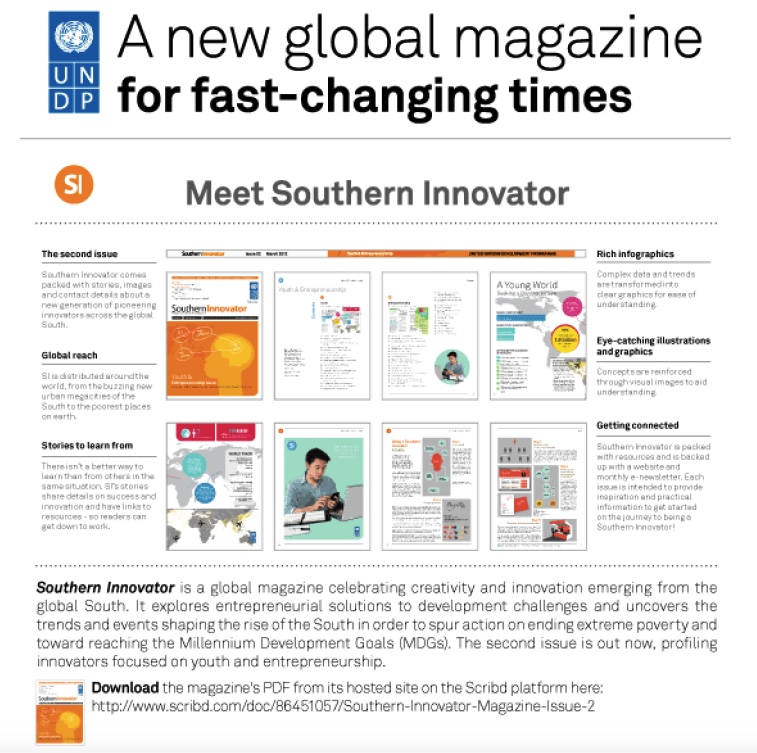
Development Challenges, South-South Solutions was launched as an e-newsletter in 2006 by UNDP’s South-South Cooperation Unit (now the United Nations Office for South-South Cooperation) based in New York, USA. It led on profiling the rise of the global South as an economic powerhouse and was one of the first regular publications to champion the global South’s innovators, entrepreneurs, and pioneers. It tracked the key trends that are now so profoundly reshaping how development is seen and done. This includes the rapid take-up of mobile phones and information technology in the global South (as profiled in the first issue of magazine Southern Innovator), the move to becoming a majority urban world, a growing global innovator culture, and the plethora of solutions being developed in the global South to tackle its problems and improve living conditions and boost human development. The success of the e-newsletter led to the launch of the magazine Southern Innovator.
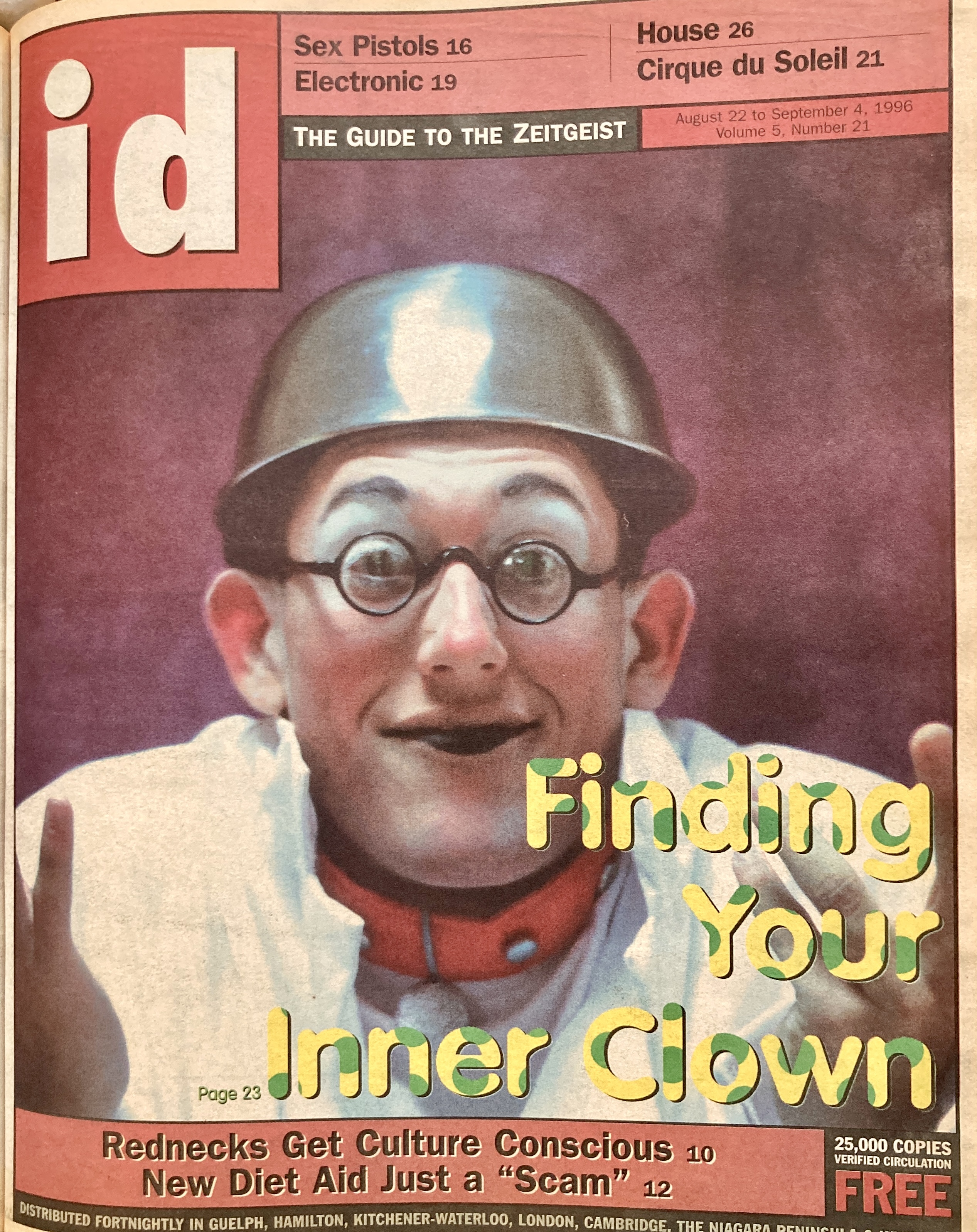
What happens when rednecks pick up a lesson or two from the world of identity politics? Mostly ridiculed by smug urbanites, or just plain ignored by the general population at large as cultural fads come and go, angry rednecks are standing tall in these conservative times.
Part Mark Twain-like satire, reverence and condescension, a cottage industry promoting the southern American redneck lifestyle is starting to resemble past struggles for cultural pride.
Just think of the gay rights movement in the 70s and 80s, which turned the derogatory word queer into a touchstone of homosexual pride.
In the 90s, dismissing rednecks as a bunch of dumb crackers can not only ensure free dental work in many an American bar, it can also be seen as an affront to white American values. But while some want to stereotype this culture as the heart and soul of white working-class American ideals, it is hard not to be disturbed by this phenomenon. Can God, beer, the American Constitution and guns weave together a stable lifestyle?
Author, radio personality and Redneck Olympics MC Bo Whaley was interviewed in a phone booth across from the bomb site at Atlanta’s Centennial Olympic park. During the interview Bo was kicked out of the phone booth by Atlanta police for talking too long. He picked up the interview from a truckstop near Dublin, Georgia.
id: What is a redneck?
Bo: A redneck to me is a lifestyle, that’s what it is. I relate rednecks to people who work hard, men of the soil. They look for the common things in life. They enjoy the outdoors, enjoy hunting and fishing. They aren’t too interested in status or setting the world on fire. They like to do their own thing. Real close to being what we call a good ole boy. They enjoy life – they work hard and they party hard.
There is nothing put on by them. They are down to earth. I really enjoy them, they are on the level. If you ask them a question they will tell you the truth. They aren’t trying to impress anybody, just trying to be themselves.
Go to the local bar and they are listening to the juke-box, smoking cigarettes and drinking beer. We can make fun of ourselves down here, we enjoy it. We laugh at ourselves. Poke a lot of fun. I’m having fun with people who live on farms, live in small towns. Like to hunt, like to fish. They drink beer. I have lived in the south for 24 years. I try to look at people and write what I see. I also wrote The Field Guide to Southern Women.
id: I heard the Redneck Olympics didn’t go down so well with the city council.
The chamber of commerce was concerned about the image. We attract a lot of industry to the town, they were afraid what was going out was a negative image of the lifestyle that is going on in Dublin.
We didn’t know it was going to catch on like it did. At the opening ceremony we were expecting maybe 250 maybe 350 people – and we had 4,000! The national and international media has got into it.
id: Are rednecks all right-wing?
On the right of the political spectrum, yeah. Happy with Newt Gingrich. I don’t think we take politics as seriously as up north. (Former U.S. president) Jimmy Carter is not very popular with the rural people here in Georgia. Well, I think when he went to Washington his values changed. I can name many, many people including me, who don’t like him. Right now I’m five minutes from the Carter Centre in Atlanta. I’ve never been to it. Not really interested in what Carter is doing.
He is trying to solve all the problems of the world. He looks at himself as more of a missionary than an ex-president. He goes to Haiti, he goes to South Africa, Bosnia. He calls these peace conferences and by-passes the established government in the United States to try to do his own thing. It’s a self-serving thing.
id: What do you think about the militia movement?
I do not agree with them. Right now I’m standing across from Olympic park where they had the bomb go off. People that I talked to have no sympathy for the militia, they say let the established investigators handle it and they don’t have any use for (the militia) at all.
id: Do you think the militias are a symbol of the frustration a lot of rednecks are feeling?
I agree. But they do a lot more talking than they do acting.
id: Why do they distrust the federal government and imagine black helicopters are helping the U.N. to set up a totalitarian state?
I think what they feel is that they know more about handling a situation than the government does and they want to do it on their own. I don’t agree with that. The government’s not perfect here nor in Canada. As long as it is the government I’m going to support it. I was not a Clinton fan but once he was elected he became my president. I have to support him until he gets out. But I don’t support everything he does.
id: Is the redneck style locked in the 70s?
The redneck symbol is more popular than it has ever been. A lot of people in offices in stuffed shirts and ties who would love to get out and live this way but they can’t do it on account of losing their jobs. They like to get in a jeep or ride on a motorcycle and say “whee” and to the heck with it. Everybody in the world needs some quiet time, time to yourself to do what you want to do.
id: Do you think rednecks are in danger of extinction in the age of the Internet?
They are on the increase. They don’t know about high-tech stuff. They haven’t even got into electric typewriter yet – they are still on manual typewriter.
id: Do they have any heroes or heroines?
They are beer people, and if they have any drug they smoke marijuana.
id: I mean heroes.
Many are country music fans, like Garth Brooks and Hank Williams Jr. They are big on country music. Female rednecks admire shows like Designing Women.
Oh lord, they love T-shirts. The T-shirts say “Opry land,” “Dollywood,” “Get your heart in America or get your ass out.” They don’t like plain T-shirts.
id: Can you give an estimate of the number of rednecks in the U.S.?
I travel more in the South Eastern states. In my hometown, in my home county, there are 37,000 people. Most of the people there, I’d say 75 per cent are working people, they either farm or work in factories. Out of those people, I’d say 20 to 25 per cent fall in the category of what I call redneck – they work hard all day and they play hard all night. Nationwide, I have no idea. I can tell you towns that have a lot of rednecks. Chattanooga, Tennessee – lot of rednecks. Columbus, Georgia, it’s a military town. In Montgomery, Alabama they work real hard at being rednecks.
id: Is there a problem with blurring rednecks with more negative elements like the Ku Klux Klan?
No, I really don’t see that. Most of the people I know can’t stand the Klan. They give country people a bad name.
id: Some guy at the Redneck Olympics had a Klan T-shirt on.
I’m not surprised by that. The main thing you are going to see them wearing if they have anything to do with a symbol of patriotism is a Confederate flag saying “God bless America” and “God bless the South.”
id: What about the rebel flag?
They do not want to give it up. There is some legislator in Atlanta who is trying to ban it, and this has to do with trying to appease a faction for their votes. But you get out into rural Georgia, rural Alabama, they want to keep that flag. To be truthful it has a lot to do with the civil rights movement.
id: That it means it’s an affront to the civil rights movement?
Yeah.
id: Are there yuppie rednecks?
I know a neuro-surgeon living in Birmingham, Alabama, I met him through his wife while I was signing books. She came up and said “I’ve got to have one of those Redneck Handbooks,” and I said “Why?” She said, “Because my husband is a neuro-surgeon and he’s from Arkansas and all day long on in his office he’s got his blue buttoned-down shirt, his navy blue suit and his spit shine shoes and driving his Mercedes. When he gets home in the afternoon he puts on his blue jeans, and denim shirt gets the pick-up truck, the dog gets in back and he starts riding in the woods.” He’s a Dr. Jekyll and Mr. Hyde type. I see a lot of that. They kind of let their hair down. It’s a release for them.
id: Do you see the redneck lifestyle as a different kind of leisure lifestyle, a more working-class leisure lifestyle?
I think so, David. They put on ragged jeans, say to the world “I am a redneck.”
What they like to do is go fishing. They will go to the coast and go deep sea fishing. Especially they like to go to stock car races. Big stock car fans. The faster that car goes the better they like it, and the more wrecks they have the better they like it.






 David South Consulting
You must be logged in to post a comment.