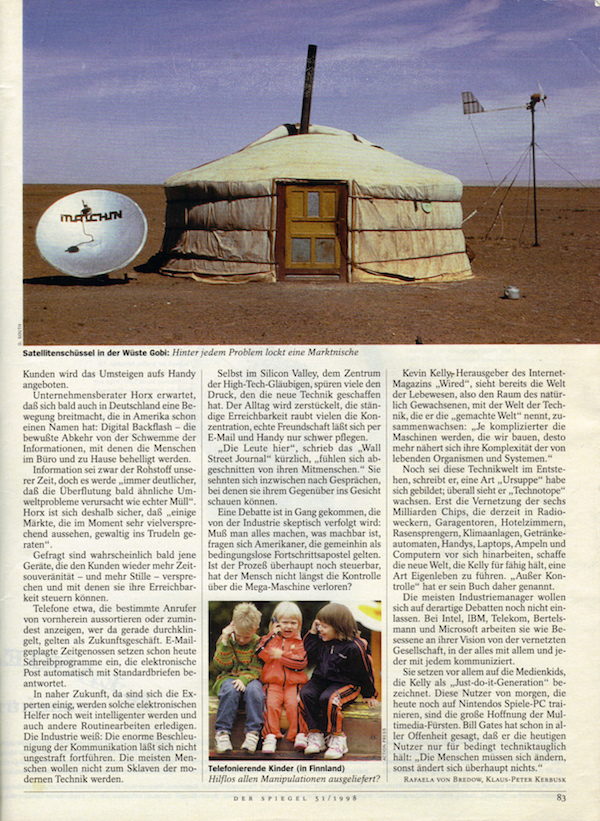
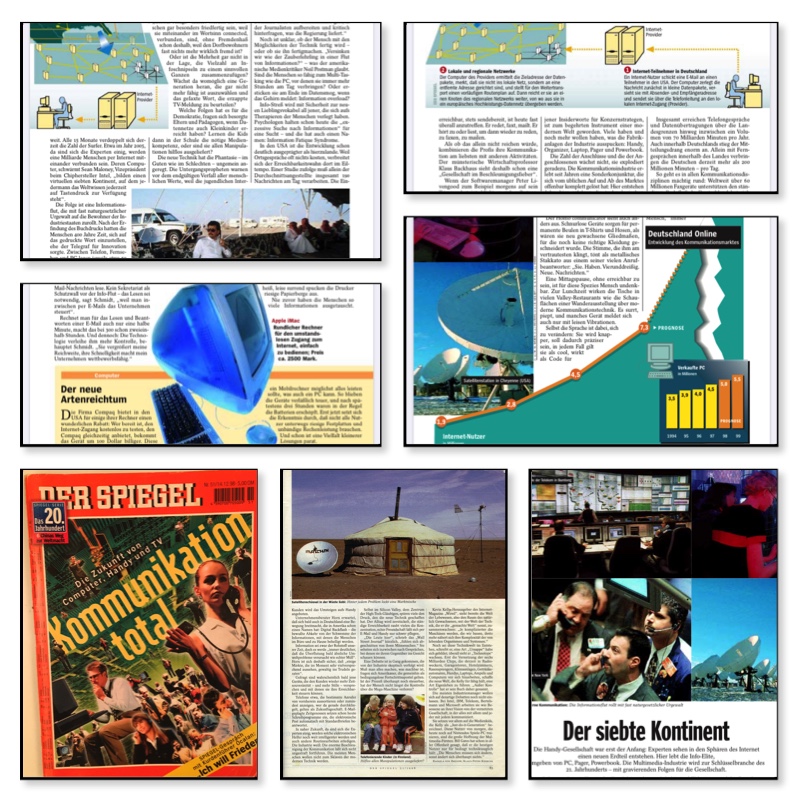
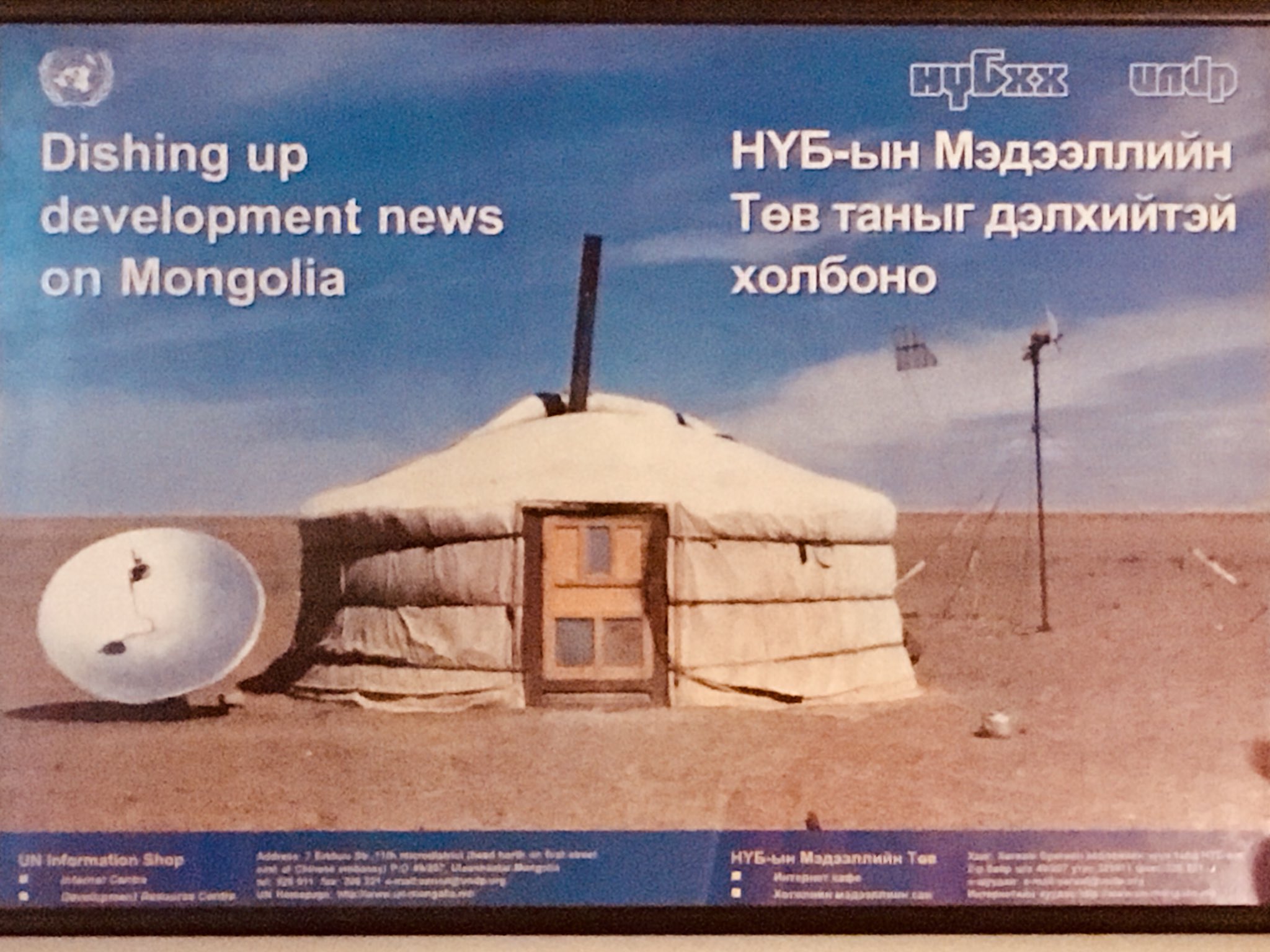
In 1998 Der Spiegel’s “Kommunikation total” issue profiled the global connectivity revolution underway and being accelerated by the Internet boom of the late 1990s. It chose my picture of a satellite dish and a ger in the Gobi Desert to symbolise this historic event.
Scroll through a PDF of the story (my photo is on the last page).
“Die Handy-Gesellschaft war erst der Anfang: Experten sehen in den Sphären des Internet einen neuen Erdteil entstehen. Hier lebt die Info-Elite, umgeben von PC, Pager, Powerbook. Die Multimedia-Industrie wird zur Schlüsselbranche des 21. Jahrhunderts – mit gravierenden Folgen für die Gesellschaft.”
English translation: “Total communication: the seventh continent – The cell phone society was just the beginning: Experts see a new continent emerging in the spheres of the Internet. The information elite live here, surrounded by PCs, pagers and power books. The multimedia industry is becoming the key industry of the 21st century – with serious consequences for society.” (http://t-off.khd-research.net/Spiegel/10.html). Original copy of magazine (above) from 1998. From The Turns of Translation Studies: New Paradigms Or Shifting Viewpoints? By Mary Snell-Hornby · 2006.
Der Spiegel is a German weekly news magazine and is one of Europe’s largest publications of its kind. It chose my photo taken in the Gobi Desert for its profile of the Internet revolution in 1998.
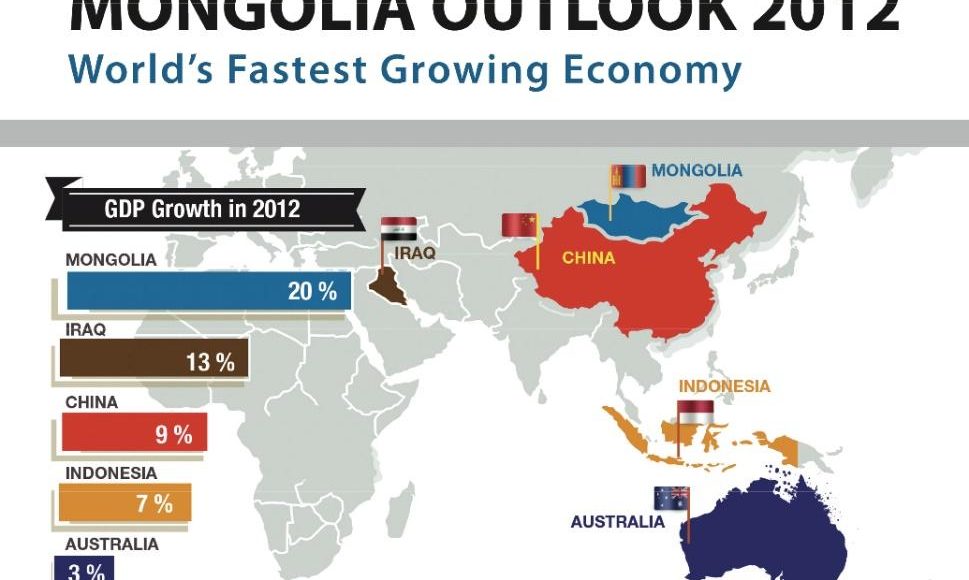
The world has changed considerably since then; and so has Mongolia. The digital revolution has rolled across the planet, the attacks of 9/11 unleashed a wave of violence and wars, and Mongolia even became the fastest-growing economy in the world a few years ago (2012). But back when this book was researched, Mongolia was just coming out of decades of isolation within the Soviet orbit under Communism, and the country experienced in the 1990s “one of the biggest peacetime economic collapses ever” (Mongolia’s Economic Reforms: Background, Content and Prospects, Richard Pomfret, University of Adelaide, 1994).
Two trends came together at the end of the 1990s and the start of the 2000s: the digital revolution and the mapping of the human genome. Both have given birth to whole new industries. Read more here: The Dawn Of The Genetics Revolution | 2001 – 2003
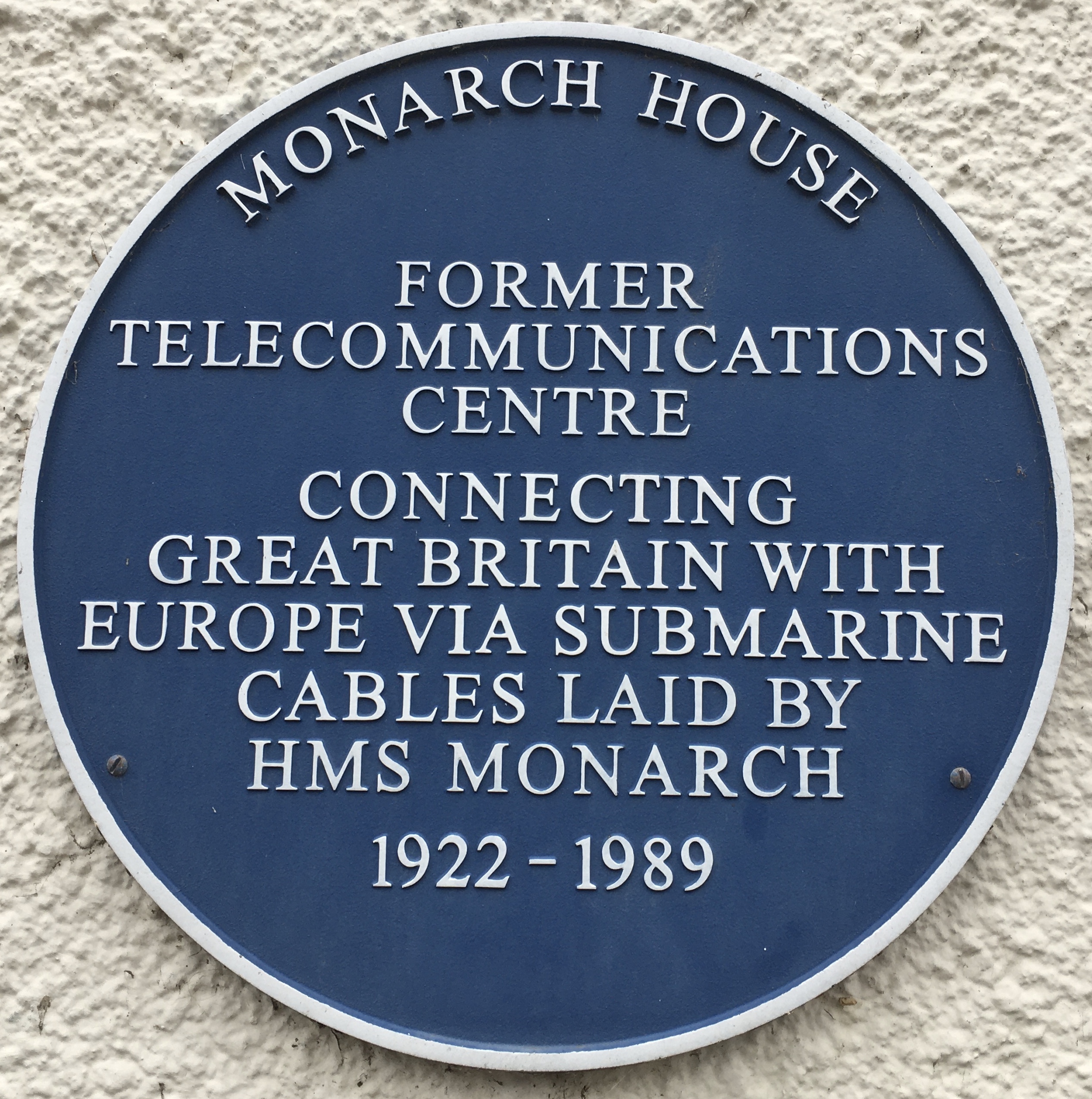
By the 1990s, cables (like above) were being joined by satellites to advance the global connectivity revolution. By the 2000s, cables (copper and fibre optic) and satellites were joined by mobile and smart phones, to deliver “kommunikation total”.
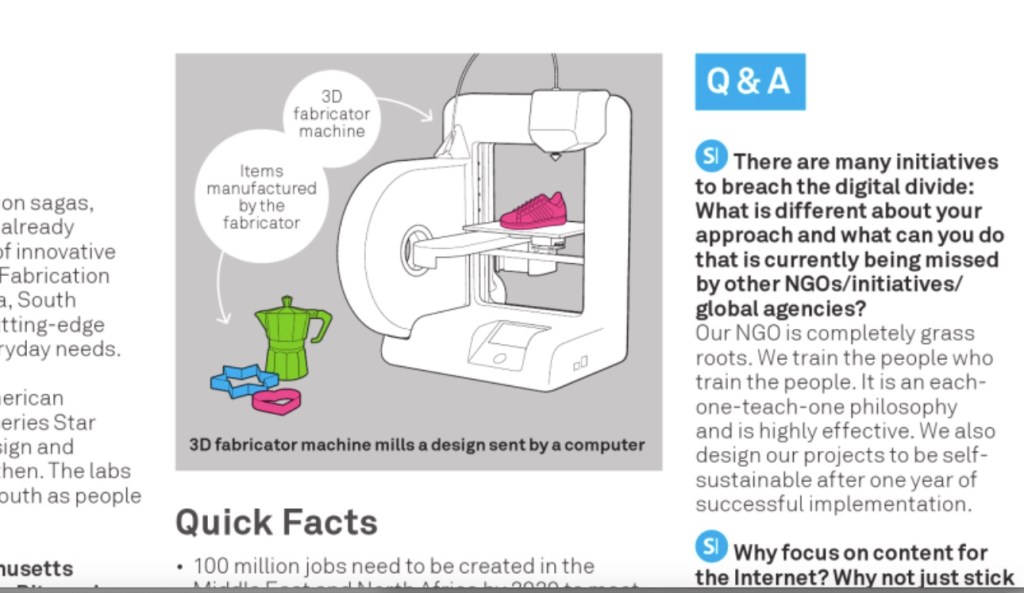
Revolutions in technology are placing more and more power into the hands of the individual, and 3D printing and fabrication machines are opening a whole new chapter.
These devices come in many forms, but they all do one thing: they can manufacture pretty well any three-dimensional object on the spot, from digital plans. These machines come in many sizes, from factory scale to smaller, home versions which are no bigger than personal computer printers, such as the well-known MakerBot Replicator 2 (makerbot.com).
3D printers introduce sophisticated precision manufacturing to the individual much in the same way the personal computer and the Internet have empowered people to make their own software, build websites and start online businesses.
A pioneering educational innovation in Chile is taking the technology even further, in a way that is truly mind-blowing. Thinker Thing (thinkerthing.com) promises to transform the way people interact with this new technology. “We have built a machine that will allow you to make real objects with your mind,” its website states.
And, it wants to do more: “We want to use our invention to light a fire of inspiration throughout the remote and often disadvantaged schools of South America and we can do this with your help.”
Thinker Thing allows the user to wear a headset and communicate through brain waves to the 3D printer. The printer then manufactures a three-dimensional model of the thoughts. These can be squiggly shapes or even, it is hoped, more sophisticated forms.
Thinker Thing’s Chilean Chief Technology Officer is George Laskowsky. Laskowsky has a games console engineering background and was a research assistant in charge of high-energy particle experiments.
The Chilean government is funding this experiment to help children to improve their creative skills. The idea is to use the technology to eliminate the technical side of creating objects and focus the effort on the creative thought process. Thinker Thing was selected from more than 1,400 applicants to participate in the prestigious global accelerator program, “Start Up Chile” (http://startupchile.org). Start-Up Chile is a program created by the Chilean government that seeks to attract early-stage high potential entrepreneurs to develop startups using Chile as a platform to go global, in line with the national goal of converting Chile into the innovation and entrepreneurship hub of Latin America.
The plan is to tour Thinker Thing all around Chile and use the science, art and engineering principles behind the invention to help very young children in remote rural regions to learn through understanding the project. Its creators also hope to take the exhibition – called the Monster Dreamer School Outreach Program and the Fantastical Mind Creatures of Chile Exhibition – on the road and show it in major global cities.
The children are being asked to imagine fantastical creatures that will then be made into 3D forms with the machine. The idea is to then sell these 3D creatures to supporters of the project to help fund the initiative. As well, these creatures will go on display in an exhibition to help educate visitors about Chile’s children and their communities.
To increase interest, exclusive photographic prints and limited edition figurines are available of the creatures the children create.
The prototype uses what is called an EmotivEPOC, basically a wireless neuroheadset collecting signals from the user’s brain. In operation, the software allows users to make 3D models with the power of thought which are then made into a plastic model using a MakerBot Industries Replicator.
This is experimental stuff and neurotechnology is in its early stages. It can detect simple emotions such as excitement or boredom and cognitive thoughts such as push and pull. Despite being in its early stages, the technology can evolve a 3D object over a number of steps by detecting the user’s emotional response to design changes.
Thinker Thing has been working alongside neuroscientists to understand the workings of the brain. Amazingly, in one experiment they were able to get a person to control the leg of a cockroach using their own thoughts. Called the Salt Shaker (http://www.thinkerthing.com/about-2/salt-shaker/), it is an experimental kit for young students and hobbyists that allows them to take control of a biological limb quickly and simply.
The 3D printing revolution is energizing for large and small-scale manufacturers alike. It means a business can now engage in precision manufacturing of products and spare parts quickly. It means it is possible to download from the Internet plans for new innovations and manufacture them within minutes. It also means communities off the mainstream supply line can make what they need and repair machinery without needing to wait weeks or months for items to be shipped from afar or spend vast sums on shipping costs.
The Fab Labs project based at the Massachusetts Institute of Technology (MIT) has been at the forefront of pioneering and prototyping this technology, including running testing labs across the global South to prove the relevance of the technology to the world’s poorest communities.
If Thinker Thing has its way, maybe people in the future will say “I think, therefore I print!”
Published: August 2013
Resources
1) Stratasys: The company manufactures 3D printers and materials that create prototypes and manufactured goods directly from 3D CAD files or other 3D content. Stratasys systems are used by manufacturers to create models and prototypes to aid in the new product design process. And they are becoming widely used for production of finished goods in low-volume manufacturing. Systems range from affordable desktop 3D printers to large production systems for direct digital manufacturing. Website: http://www.stratasys.com/
2) 3D Systems: 3D Systems is a leading provider of 3D content-to-print solutions including 3D printers, print materials and on-demand custom parts services for professionals and consumers alike. Website: http://www.3dsystems.com/
ExOne: With decades of manufacturing experience and significant investment in research and product development, ExOne has pioneered the evolution of nontraditional manufacturing. This investment has yielded a new generation of rapid production technology in the field of additive manufacturing as well as advanced micromachining processes. Website: http://www.exone.com/
FabCentral: This site supports a digital fabrication facility and global network of field fab labs managed by MIT’s Center for Bits and Atoms. Website: http://fab.cba.mit.edu
Maker Shed: 3D Printing and Fabrication: An outstanding resource for getting all you need to understand 3D printing and manufacturing, with 3D printers, supplies, Whether you want to print out physical objects or machine something from plastic, wood, or other materials, we have the tools and accessories you need. Website: http://www.makershed.com/3D_Printing_Fabrication_s/220.htm
EMachineShop: The first and leading machine shop designed from the start for the Internet, eMachineShop’s mission is to provide easy, convenient and low-cost fabrication of custom parts via the web. Website: emachineshop.com/
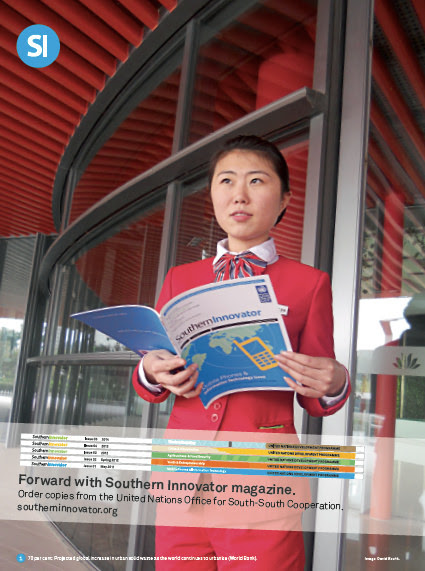
Development Challenges, South-South Solutions was launched as an e-newsletter in 2006 by UNDP’s South-South Cooperation Unit (now the United Nations Office for South-South Cooperation) based in New York, USA. It led on profiling the rise of the global South as an economic powerhouse and was one of the first regular publications to champion the global South’s innovators, entrepreneurs, and pioneers. It tracked the key trends that are now so profoundly reshaping how development is seen and done. This includes the rapid take-up of mobile phones and information technology in the global South (as profiled in the first issue of magazine Southern Innovator), the move to becoming a majority urban world, a growing global innovator culture, and the plethora of solutions being developed in the global South to tackle its problems and improve living conditions and boost human development. The success of the e-newsletter led to the launch of the magazine Southern Innovator.
The transition to a green economy has reached a crossroads: while multilateral global initiatives have been long-running and complex, the idea of a green economy still seems fragile and achieving it far from certain. In the face of the ravages of the global economic crisis that has raged since 2007/2008, countries are now trying to roll back their green pledges or slow the pace of transition.
This exposes a dilemma: a perception that a green economy is in conflict with economic growth, prosperity and the advance of human development, particularly in developing countries seeking to make rapid gains in reducing poverty and building a middle class, consumer society.
Three things need to be foremost in the minds of those who care about creating a global green economy in the 21st century: innovation in design, in market prices and in business models. I think these three factors will be the deciding elements in whether green technologies are taken up quickly and used by large numbers of people to improve their lives.
The green option needs to always be the more appealing, cheaper option that also improves living standards. Happily, many people are doing this all around the world – you just may not have heard of them yet (unless you are reading Southern Innovator magazine that is).
As editor of the magazine Southern Innovator since 2011, I have had the privilege to meet, interview and see first-hand green economy innovators across the global South and profile them in the magazine. What has stood out for me is this: the ones who have achieved sustainable success have put a great deal of effort into design – how the technology is made, what it looks like and how it is used, how efficiently it is made and distributed – while also thinking through the business case for their work and how to make it appealing to others.
We have tried to apply this thinking to the magazine as well, by using clear and modern design with bright, eye-pleasing colours, and by choosing to use 100 per cent renewable energy (much of it from geothermal sources) for the magazine’s design and layout and to have it printed on paper from sustainable forest sources.
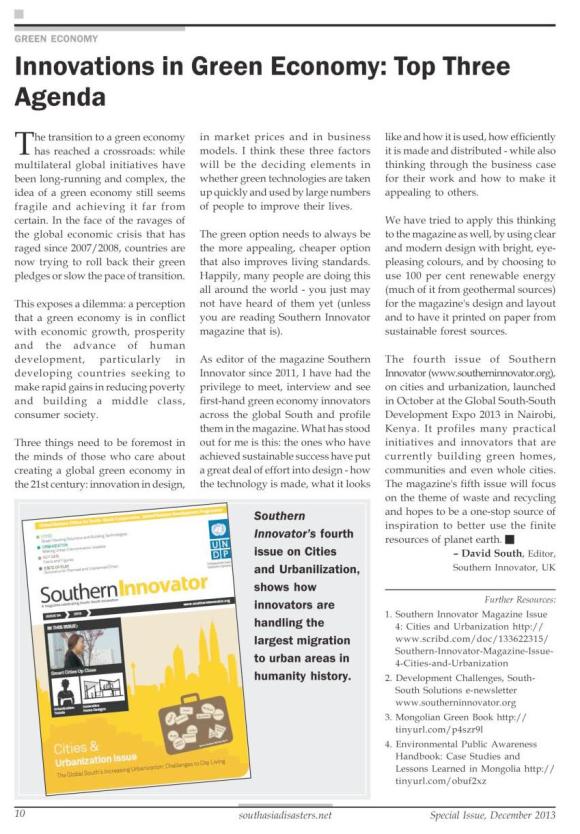
The fourth issue of Southern Innovator (www.southerninnovator.org), on cities and urbanization, launched in October at the Global South-South Development Expo 2013 in Nairobi, Kenya. It profiles many practical initiatives and innovators that are currently building green homes, communities and even whole cities. The magazine’s fifth issue will focus on the theme of waste and recycling and hopes to be a one-stop source of inspiration to better use the finite resources of planet earth.
The coming wave of technological innovations aimed at global South cities will dominate civic debates whether people wish it to or not. Already, futuristic, 21st-century cities are being built around Asia from scratch. I had the privilege of visiting a couple of them in 2012 while researching the fourth issue of our magazine, Southern Innovator ( h t t p : / / w w w . s c r i b d . c o m / SouthernInnovator). Each city had a different focus for its construction – one was seeking to be an “eco-city” and the other one called itself a “smart city,” focused on becoming a regional business and technology hub. Both aimed to use the latest information technologies to make the way Asian cities operate on a day-to-day basis smarter – and greener.
Large information technology companies – including India’s Infosys (infosys.com) – have their sights set on selling all sorts of technological solutions to common problems of urban living. This aspiring revolution is built on two foundations: One is the Internet of Things – in which everyday objects are connected to the Internet via microchips. The other is Big Data, the vast quantities of data being generated by all the mobile phones and other electronic devices people use these days.
Much of this new technology will be manufactured in Asia, and not just that – it will also be developed and designed in Asia, often to meet the challenges of urban Asia.
By their nature, cities are fluid places. People come and go for work and pleasure, and successful cities are magnets for people of all backgrounds seeking new opportunities. This fluidity puts stress on cities and leads to the constant complaints familiar to any urban dweller – inadequate transport, traffic jams, air pollution, poor housing, and a high cost of living.
If handled well and with imagination, new information technologies can ensure Asian cities do more than pay lip service to aspirations to improve human development. They can make cities resilient places – able to bounce back from disasters, whether man made or natural.
During the late 1990s, I saw first-hand the pressures placed on one Asian city, Mongolia’s capital, Ulaanbaatar. The country endured the worst peacetime economic collapse since World War II while confronting the wrenching social and economic stresses of switching from a command economy during Communism to a free-market democracy. The city’s population grew quickly as rural economies collapsed and poverty shot upwards. I can only imagine now how the response could have been different with the technologies available today.
“A lot of social initiatives based on the right to the city are coming from these ‘new cities of the South,’” Mathivet said. “The book highlights original social initiatives: protests and organizing of the urban poor, such as the pavement dwellers’ movements in Mumbai where people with nothing, living on the pavements of a very big city, organise themselves to struggle for their collective rights, just as the park dwellers did in Osaka.”
Recently, an Indian restaurant uploaded to the Internet a video of what it claimed to be the first drone delivering a pizza in an Indian city. While this may or may not be a practical solution to traffic congestion, the subsequent negative fallout – angry police and public officials – from this use of new technology highlights the promise and perils of innovating in the real world of Asian cities (http:/ /www.bbc.co.uk/news/ b l o g s – n e w s – f r o m – elsewhere-27537120).
Micro electronics are becoming cheaper and more powerful by the month. Small businesses armed with a only laptop computer, access to the Internet and/or mobile phone networks, and cloud computing services, can offer very powerful business and public services solutions. And sharing solutions across the global South via information technologies has never been easier.
The U.S. Pentagon published various reports and studies in the 2000s forecasting a dark future for cities in the global South. As author Mike Davis revealed in his seminal work, Planet of Slums (http://www.amazon.com/exec/obido/ASIN/1844670228/nationbooks08), the Pentagon saw the developing world’s cities as the “battlespace of the twenty-first century.” It imagined sprawling, crime ridden cities full of poverty and slums and needing tiny drones and robots darting back and forth, keeping an eye on everything and suppressing unrest. This threat-based view of future cities is one to be avoided. It is possible, through the right application of quick solutions to the challenges that arise as cities grow, to turn to cooperation across the cities of the global South to avoid this pessimistic fate.
Fast-growing cities and urban areas in the global South can be vulnerable because they lack the web of structures and institutions that enable more long-established cities to mitigate risks and, when a disaster does strike, to bounce back quickly. But thanks to many new technologies, and some smart new thinking, it is possible to bring resilience to even the poorest and most deprived urban communities.
The essence of resilience is to build into plans and daily activities a community’s ability to weather any disaster, small or large. All cities, rich or poor, can experience a disaster of some sort, be it weather, civil unrest, war, earthquakes, shortages, or economic, financial and health crises. New technologies make it possible for all cities, no matter how poor and overcrowded, to build in urban resilience. The ubiquity of mobile phones introduces a powerful city and urban planning tool. Mapping chaotic and unplanned areas is already underway in many cities of the global South (in Brazil and Kenya for example (http://tinyurl.com/qgba8kb).
Impressively, innovators in the South are using affordable microelectronics in the form of mobile phones and laptops to gather data and map it. This computing capability was once the sole domain of big information technology companies such as IBM. Now, a single laptop computer combined with a smartphone equipped with the right software can manage a large urban area, a task that once required rooms full of computers. The data can then be used to manage growth today and re-build after a disaster. Any excuse not to be resilient has been wiped out with this technological leap.
But how to deal with the common reality of feeling overwhelmed by the many obstacles to rational planning and building for urban growth in the South? Innovators have stepped in to take matters into their own hands with simple construction technologies as the solution. One example is the Moladi system of recycled plastic moulds (moladi.net). Anybody can master this simple building technique, as the mortar-filled moulds are designed to fit easily together to construct an earthquake-resistant, beautiful home.
This approach has the advantage of bypassing the failings of authorities to enforce building codes and standards in poor, urban communities, creating safer places to live and preventing the growth of unregulated shanty towns at risk to fire and earthquakes.
Others have found social ways to organize people, even in the most desperate of conditions, providing services and laying down the groundwork for an upgrading of an urban area to improve living conditions and long-term opportunities. The concept of ‘cities for all’ has inspired many to re-energize civic organizations and networking in poor areas to ensure they are not left out of economic growth. In Colombia, a famous example of this is the escalator in the city of Medellin, which connects a hillside slum to the centre of the city, opening up economic opportunities to all (http://tinyurl.com/nm47d3u).
Still more exciting, new technologies are in the works to simplify construction of major infrastructure and new buildings. A future city will be able to gather extensive data on an expanding urban area, make detailed development plans with architects and engineers, and then have robots and 3D fabricating machines quickly lay down infrastructure and erect buildings. Sounds far-fetched? Well, in China one company recently used a 3D machine to make 10 houses in a single day (http://www.yhbm.com/index.aspx).
An infographic from Southern Innovator’s fourth issue (http:// tinyurl.com/m9vfwur) shows 10 ways any urban area – either planned or unplanned – can build in resilience. All are proven approaches from cities in the global South.
Southern Innovator’s upcoming sixth issue will explore the interplay of science, technology and innovation in the global South and how people are making the most of 21st century advances to increase wealth and improve human development. Hopefully, all of this innovation will lead to more resilient cities in the future!












You must be logged in to post a comment.